

A lot of Brisbane business owners are in the same spot. The work is good, customers are happy, referrals still come through, but the website feels quiet and Google seems to send all the attention somewhere else. A competitor with a more organised online presence keeps showing up, even when their service isn’t better.
That’s usually where a practical strategy for seo matters most. Not the bloated version built for national brands with full marketing teams. The useful version. The one that helps a café in West End, a plumber in Chermside, or an accountant in Indooroopilly get found by people already looking for what they sell.
The good news is that small businesses don’t need to do everything. They need to do the right few things, consistently, and avoid wasting time on busywork that never turns into calls, bookings, or quote requests.
Your Practical SEO Strategy for Brisbane Business Growth
A Brisbane cafe owner can post on Instagram three times in a week, get a nice bump in likes, and still have empty tables on Tuesday morning. Then someone nearby searches “breakfast South Bank” or “coffee near me” and walks into the venue that shows up first. That is the difference between attention and demand.
BrightEdge’s research on organic search traffic found organic search drives a large share of website traffic. For a small business, that matters because search brings in people who are already looking for help, food, a quote, or a booking. A practical strategy for seo should start there, especially if time and budget are tight.
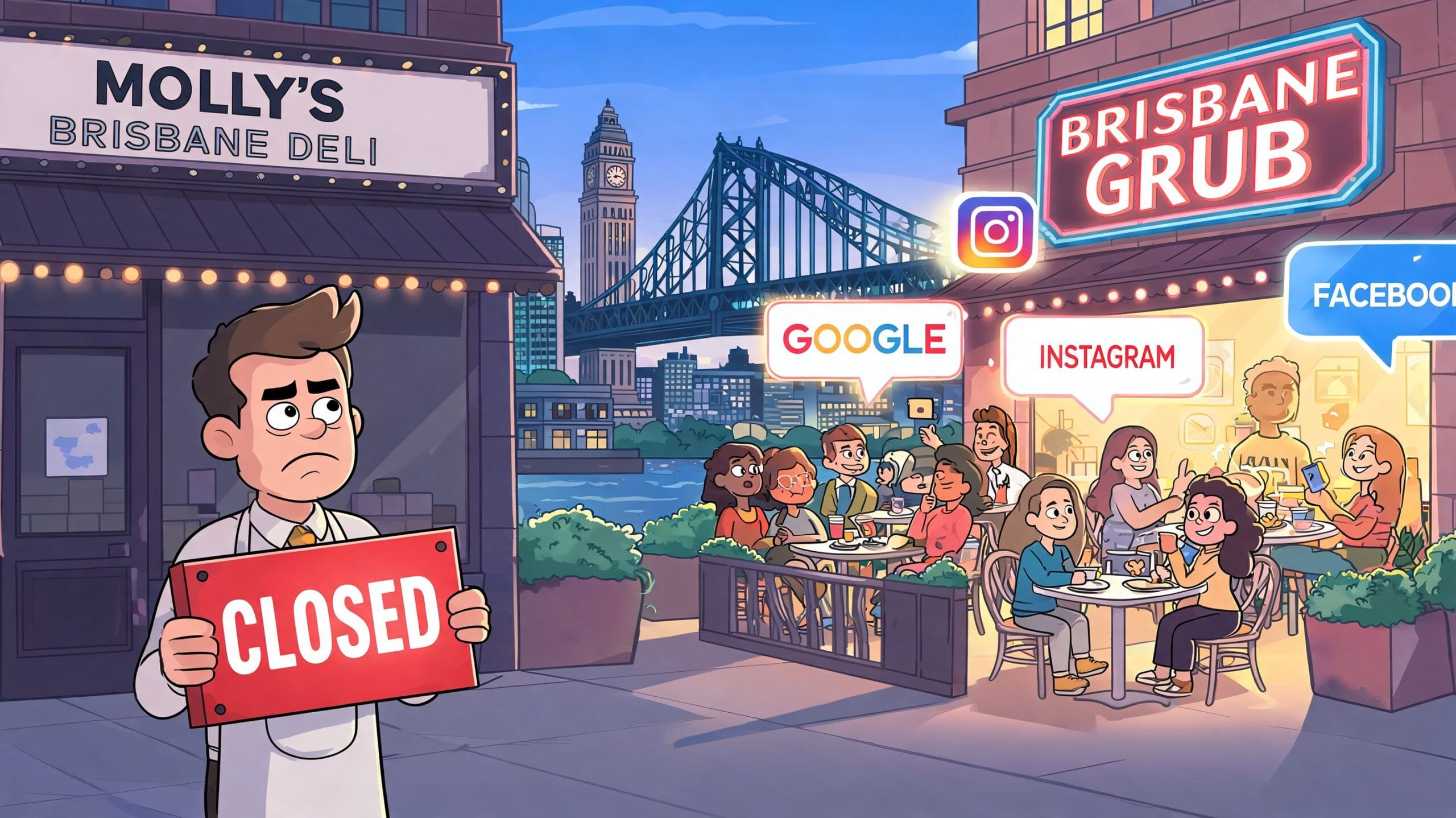
The goal is not to do everything. It is to do the few things that improve local visibility and lead to calls, bookings, and enquiries.
What a budget-first approach looks like
For Brisbane small businesses, the highest-return SEO work usually sits in four areas:
- Local visibility first. A complete Google Business Profile, clear service pages, accurate suburb or service area details, and contact information that matches everywhere.
- High-intent searches next. Focus on terms used by people ready to act, like book, quote, near me, cost, open now, or a suburb plus service.
- Simple website improvements. Better page titles, stronger headings, easier mobile use, and obvious contact options.
- Content that supports sales. Pages and articles that answer real customer questions and help someone choose the business with confidence.
That is the 20% of work that often drives the bulk of local results.
A lot of small operators get pulled into SEO jobs that look productive but do not change revenue. A cleaner approach is to ask one question before starting any task. Will this help the right customer find the business, trust the business, or contact the business? If the answer is no, it can wait.
Where small businesses waste time
The usual mistakes are predictable because a lot of SEO advice is written for bigger brands with bigger teams.
- Going after broad keywords like “lawyer”, “builder”, or “marketing” when local service terms are more realistic and more valuable
- Publishing generic blog posts that could belong to any business in any city
- Leaving out Brisbane suburbs or service areas and expecting Google to connect the dots
- Reporting on traffic alone instead of calls, form fills, bookings, direction requests, and sales
The better approach is narrower and more useful. Show up for the searches that signal buying intent. Make it easy for people to check what you do, where you work, and how to contact you. For a busy Brisbane owner, that beats chasing every SEO trend.
Start with a Smart SEO Audit and Clear Goals
Before changing copy, paying for tools, or hiring help, the business needs a baseline. A short audit can uncover the obvious issues quickly, and it doesn’t need to be technical theatre.
Check what Google can already see
Start with Google Search Console. It shows which pages appear in search, which queries trigger impressions, and whether Google has trouble indexing pages. If a service page doesn’t appear there at all, that’s a bigger problem than choosing between two headline options.
Then use PageSpeed Insights. Not because every small business needs a perfect score, but because a slow mobile site frustrates real customers. A Brisbane tradie’s website doesn’t need fancy motion effects if they make the contact page painful to use on a phone.
A simple DIY audit can look like this:
- Search the business name on Google and see what appears first.
- Open the site on a phone and try to call or submit a form.
- Check Search Console for indexed pages, search queries, and warnings.
- Run key pages through PageSpeed Insights.
- Review page titles and headings on the homepage and top service pages.
- Check contact details in the header, footer, and contact page.
- Look at Google Business Profile and compare it to the website.
For businesses that want support with this kind of review, a local search engine optimisation service in Brisbane can handle the audit and prioritisation without turning it into a long list of low-value fixes.
Set goals that mean something
“Rank number one” sounds good and means very little on its own. A better target connects search visibility to a business outcome.
Useful examples include:
- More phone calls from the website
- More quote requests from a specific service page
- More bookings from a target suburb
- Better visibility for two or three core service terms
A Brisbane physiotherapist might care about appointment bookings for “sports physio Brisbane”. A local café might care more about direction requests, menu views, and branded search visibility. An accountant may focus on enquiry forms from business owners in nearby suburbs.
SEO goals should be measurable, but they should also be commercial. Visibility without action isn’t much use.
Keep the audit lean
A small business doesn’t need a 60-page document. It needs a shortlist.
A good shortlist often includes:
- One technical fix that affects usability
- Two service pages that need stronger keyword targeting
- One local listing issue such as inconsistent business details
- One conversion issue such as a weak call to action or hard-to-find phone number
That’s enough to move from guessing to acting. It also makes the rest of the strategy for seo much easier to manage, because the business can see what needs attention first instead of trying to repair everything at once.
Find Customers with Brisbane-Focused Keyword Research
Keyword research gets overcomplicated fast. For a small business, the job is simpler. Find out what local buyers type when they need help, then build pages around those searches.
The strongest local keywords usually combine service + location + intent. That’s why “electrician Brisbane” is useful, but “24 hour electrician North Brisbane” can be even better. It’s more specific, and the customer behind it is usually closer to taking action.
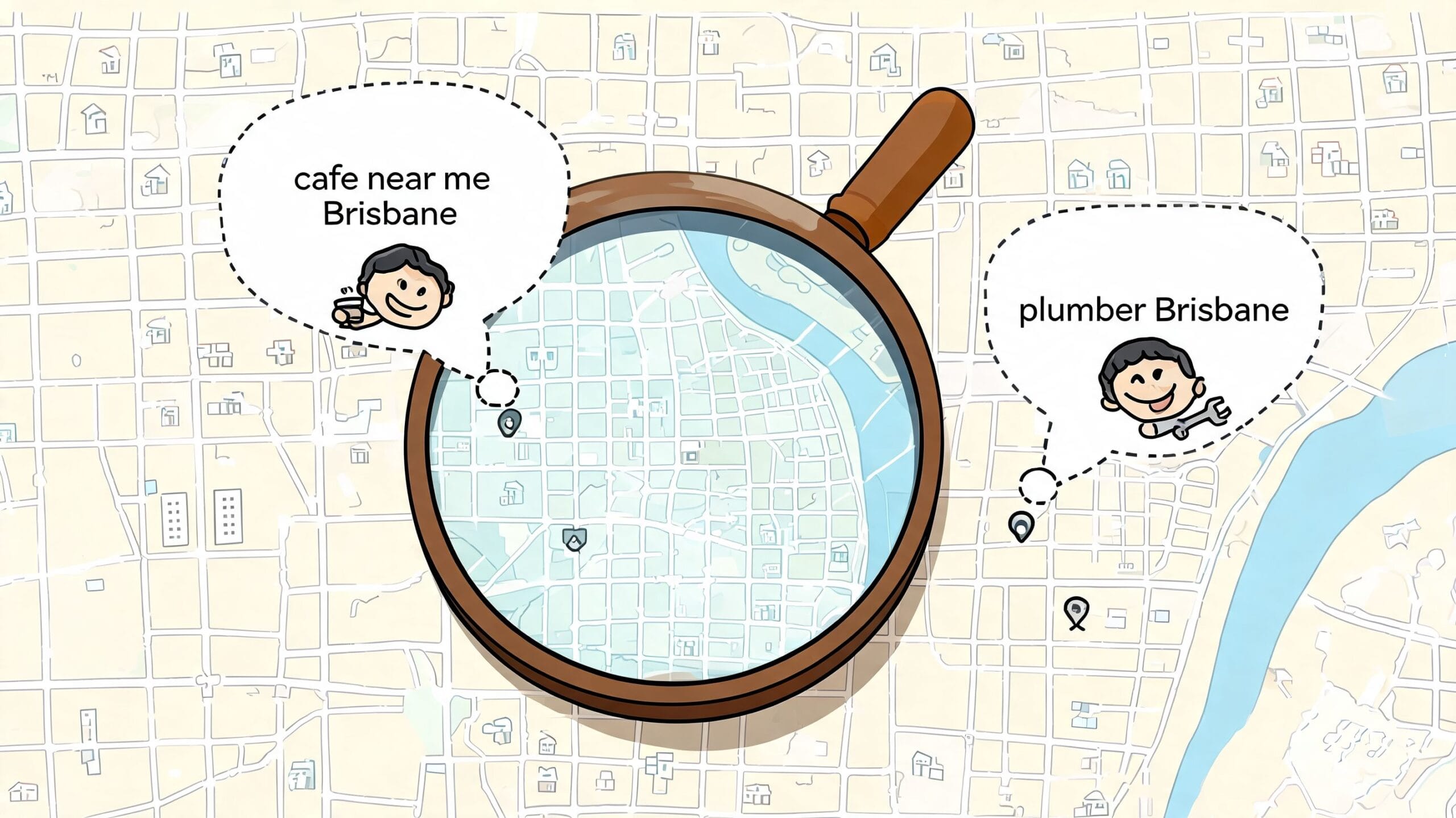
According to BrightLocal benchmark research, top Australian small businesses rank for 15% more long-tail queries. That matters because long-tail searches often reveal stronger buying intent and lower competition.
Start with how customers actually talk
A good keyword list begins offline. Look at:
- Email enquiries and the words customers use
- Phone questions staff hear every week
- Quotes and job descriptions that repeat across jobs
- Suburbs and service areas the business already targets
A plumber might build pages around:
- emergency plumber Chermside
- blocked drain Brisbane northside
- hot water system repairs Brisbane
A café might target:
- best coffee South Bank
- breakfast café West End
- Brisbane café with outdoor seating
A law firm or accountant might lean into:
- small business accountant Brisbane
- family lawyer Brisbane northside
- tax help for sole traders Brisbane
Use free tools without disappearing into them
Three tools are usually enough for a small operator:
- Google autocomplete. Type the service and watch what Google suggests.
- People also ask. Good for content ideas and FAQs.
- Google Search Console. It often reveals terms the business already appears for, even if rankings are still weak.
The aim isn’t to create a spreadsheet with hundreds of phrases. It’s to build a practical short list.
A useful structure is:
| Keyword type | Example | Best page type |
|---|---|---|
| Core service | Brisbane bookkeeper | Main service page |
| Suburb service | Bookkeeper New Farm | Local landing page |
| Urgent intent | Same day tax help Brisbane | Service page or FAQ |
| Problem query | How to fix BAS errors | Blog article |
| Comparison query | Xero bookkeeper Brisbane | Service or comparison page |
Build a list that fits the week
For a busy owner, 20 to 30 high-value keywords is plenty to start with. Split them into three buckets:
- Money terms. High-intent service phrases tied to enquiries.
- Location terms. Brisbane and suburb-based variations.
- Support terms. Questions that help content planning and FAQs.
The best local keywords don’t just describe a service. They reveal where the customer is, what they need, and how ready they are to act.
This is also where restraint helps. Don’t build separate pages for every suburb if the content will be thin or repetitive. A few strong location pages beat a pile of near-duplicate ones every time.
Optimise Your Website and Google Business Profile
Once the keyword work is done, the next step is turning that research into clearer signals on the website and stronger local visibility on Google. This approach allows many small businesses to get quick wins without rebuilding the whole site.
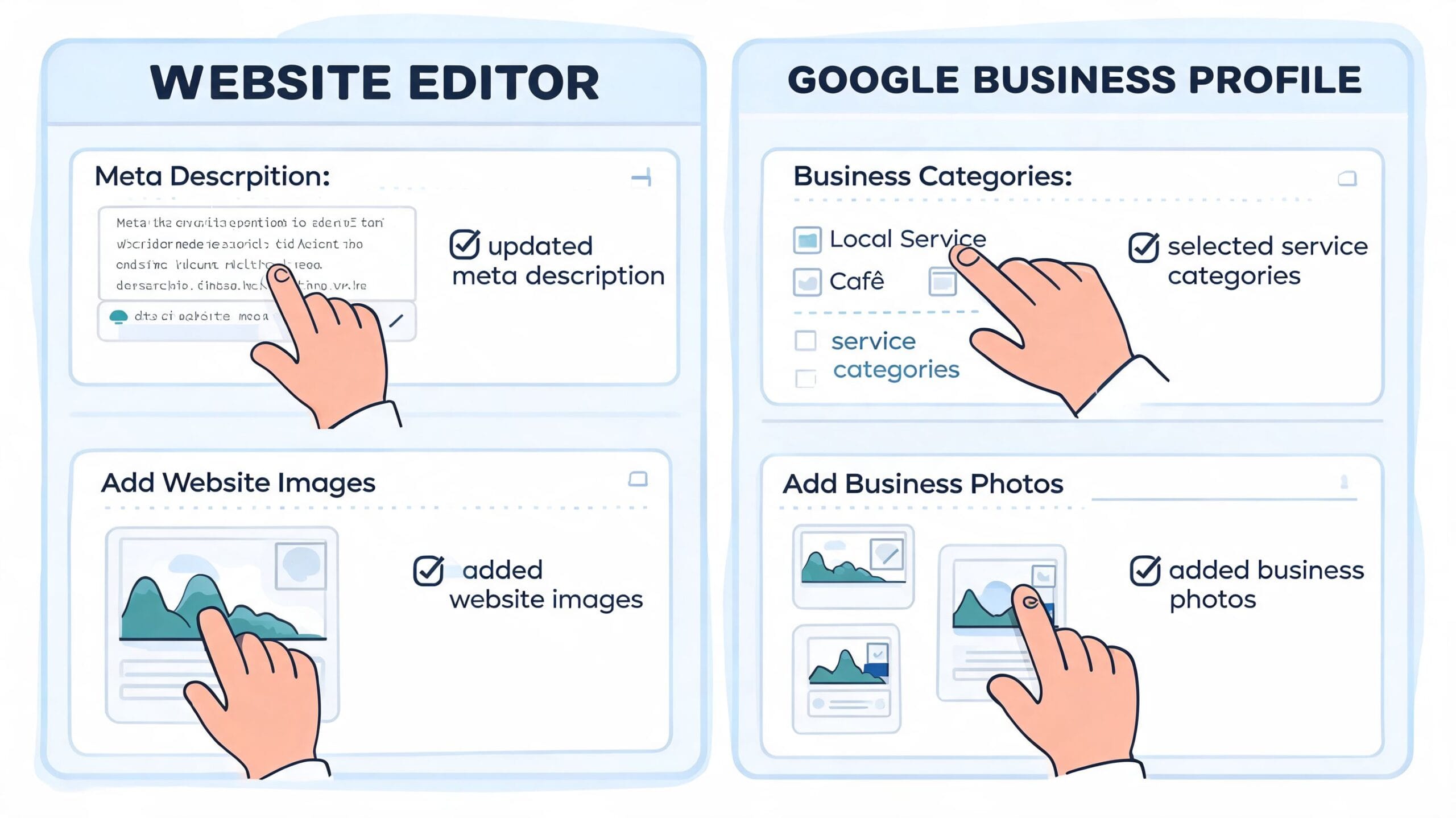
For local Brisbane businesses, Google Maps visibility matters because 42% of local queries result in clicks on Google Maps Pack results, based on Supple’s SEO statistics infographic. For many local operators, the Google Business Profile is the first thing a customer sees.
Fix the pages that already matter
Most small business websites don’t need more pages first. They need better existing pages.
Start with the homepage and top service pages. Tighten these basics:
- Page title. Include the service and Brisbane or the relevant area.
- Meta description. Make it clear, local, and action-focused.
- H1 heading. Match the page topic without stuffing keywords.
- Body copy. Explain the service plainly, mention the service area naturally, and include a clear next step.
- Calls to action. Put the phone number, booking button, or form in obvious places.
A weak page title might say:
- Home | Smith & Co
A stronger one might say:
- Family Lawyer Brisbane | Smith & Co Legal
A weak service heading might say:
- What We Do
A stronger one might say:
- Bookkeeping for Brisbane Small Businesses
This isn’t about cramming “Brisbane” into every second line. It’s about removing ambiguity so Google and customers both know what the page is for.
Treat Google Business Profile like a sales asset
A neglected Google Business Profile sends the wrong signal. An updated one helps the business appear for local searches, supports trust, and often drives calls before the website visit even happens.
The essentials matter most:
- Business category. Choose the most accurate primary category.
- Business description. Explain services in plain language.
- Phone and website details. Keep them consistent everywhere.
- Opening hours. Update public holidays and special trading periods.
- Service areas. Add the actual locations served.
- Photos. Use recent, actual photos of the team, work, shopfront, menu, or vehicles.
- Reviews. Ask satisfied customers consistently and reply professionally.
- Q&A. Add common questions before customers need to ask them.
A Brisbane café can add menu shots, interior photos, accessibility details, and common questions about parking or outdoor seating. A mobile service business can show vans, completed jobs, team members, and the areas it covers.
A complete Google Business Profile doesn’t replace the website. It makes the website easier to trust.
Keep the website and profile aligned
One common problem is mismatch. The website says one thing, the profile says another, and the customer gets mixed signals.
Check these points side by side:
| Item | Website | Google Business Profile |
|---|---|---|
| Business name | Must match brand usage | Must match |
| Phone number | Visible and clickable | Must match |
| Address or service area | Accurate | Accurate |
| Main services | Clearly listed | Clearly listed |
| Opening hours | Current | Current |
When these line up, the business looks organised. When they don’t, rankings can suffer and customers hesitate.
One practical option is to handle the updates internally and review them monthly. Another is to use one outside provider to manage the website, local SEO, and profile maintenance together. Boocoo is one Brisbane-based option that offers that mix for small businesses that want the work handled without adding another platform to learn.
Create Content and Links That Build Local Authority
A lot of small businesses hear “content marketing” and picture endless blog posts no one reads. That’s not the useful version. Helpful local content supports the service pages, answers real questions, and gives other local sites a reason to mention the business.
The same goes for links. Random directory submissions and low-grade outreach usually waste time. Relevant local mentions tied to real community activity are more believable and more useful.
Write content customers would actually search for
Good local content usually sits close to the service. It answers the questions customers ask before they book.
Examples that make sense:
- Roofers could publish a guide to storm-season roof checks for Brisbane homes.
- Accountants could explain common tax mistakes sole traders make.
- Cafés could create a page about gluten-free or vegan options for local diners.
- Conveyancers could answer common questions first-home buyers ask in Brisbane.
This kind of content does three jobs at once. It helps the site cover related search terms, it gives staff something useful to send to leads, and it builds trust before the first call.
Leads from organic search close at 14.6%, as noted in the earlier data source used for local SEO planning, which is one reason quality content and local authority work are worth the effort even when results aren’t instant.
Turn useful pages into local link opportunities
Content and links work better together than apart. If a business publishes something helpful, it becomes easier to earn local mentions without awkward cold outreach.
A practical approach looks like this:
- Partner locally. A wedding florist and local venue can reference each other.
- Support community groups. Sponsorship pages, event pages, and community acknowledgements can create relevant mentions.
- Contribute expertise. Offer a useful quote or short tip to a local publication or community blog.
- Create resource pages. Publish guides that local organisations would want to share.
A tourism operator, for example, can benefit from content tied to local attractions, visitor planning, and neighbourhood guides. That approach overlaps well with broader tourism digital marketing support because search visibility improves when useful local information sits alongside service and booking content.
Useful local content gives link building a reason to exist. Without that, most outreach feels forced.
What to avoid
Small businesses don’t need elaborate link schemes. The safer and more practical path is relevance.
Watch out for:
- Generic guest posts on unrelated sites
- Buying links from questionable providers
- Thin blog posts written only to insert keywords
- Duplicate suburb pages with barely changed copy
A solid strategy for seo uses content to make the business easier to trust, then uses local relationships to reinforce that trust. That tends to hold up much better than shortcuts.
A Realistic SEO Roadmap for Busy Brisbane Owners
A Brisbane cafe owner usually does not lose SEO because the plan is wrong. The plan usually slips because lunch service gets busy, staff call in sick, invoices pile up, and marketing drops to Friday afternoon if there is any time left. A realistic roadmap fixes that by narrowing the work to a few actions that effectively move local visibility.
SEO is a normal part of small business marketing now, but that does not mean you need a big monthly retainer or a 40-point checklist. For a busy owner, the best approach is simpler. Pick the small set of jobs that improves local trust, helps key pages rank, and turns that traffic into calls, bookings, or walk-ins.
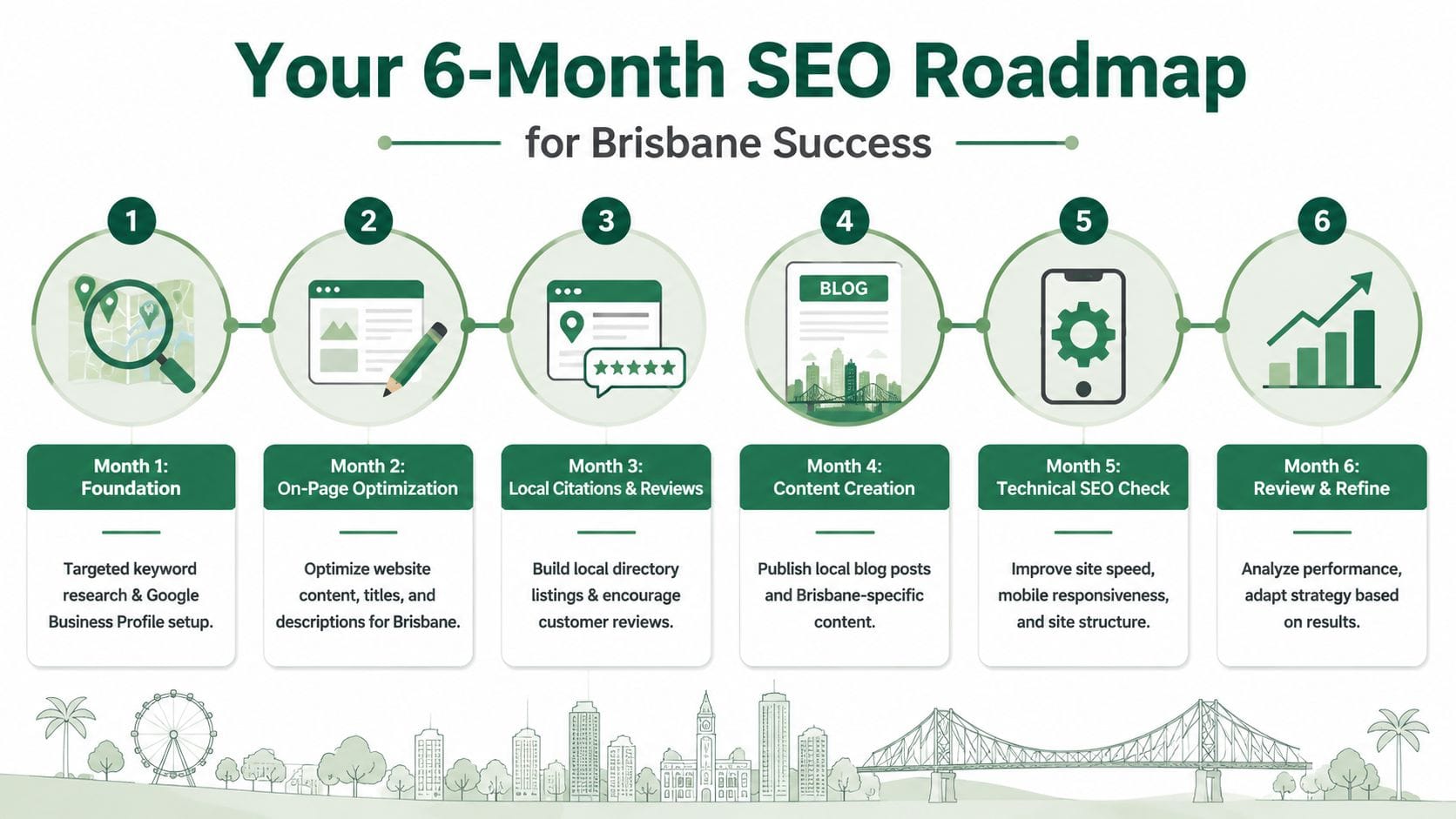
A six-month plan that fits real schedules
This is the kind of pace that works when SEO has to fit around actual business hours, not ideal ones.
| Month | Focus Area | Key Actions | KPI to Watch |
|---|---|---|---|
| 1 | Foundation | Audit the site, set goals, claim or clean up Google Business Profile, check contact details | Branded searches, profile completeness |
| 2 | On-page optimisation | Update homepage and key service pages, improve titles, headings, and calls to action | Clicks to core service pages |
| 3 | Local citations and reviews | Clean up business details across listings, ask for reviews, respond to existing reviews | Review volume and quality, calls |
| 4 | Content creation | Publish one or two useful local pieces based on customer questions | Organic impressions and engagement |
| 5 | Technical check | Review mobile usability, page speed, broken links, image sizes | Bounce points on mobile, key page performance |
| 6 | Review and refine | Compare results to goals, adjust pages, expand what’s working | Enquiries, bookings, keyword visibility |
The order matters. Month 1 and 2 usually create more impact than jumping straight into blog posts. If the homepage is vague, service pages are thin, or your phone number is inconsistent across the web, extra content will not do much. Get the basics right first.
For many Brisbane businesses, month 3 is where momentum starts to show. More reviews, cleaner listings, and better service pages often improve both visibility and conversion at the same time.
Decide what to do personally and what to hand off
Owners can usually keep a few tasks in-house without too much trouble:
- Asking happy customers for reviews
- Updating Google Business Profile posts, hours, and photos
- Writing down the questions customers ask every week
- Making simple page edits in WordPress, Wix, or Shopify
The jobs that often stall or get done poorly are different:
- Keyword mapping across multiple pages
- Finding and fixing technical problems
- Structuring content so it matches search intent
- Reading Search Console data properly
- Keeping the work consistent month after month
That is the budget trade-off. Doing it yourself costs less in cash, but more in time and attention. Hiring help costs more upfront, but it can save six months of stop-start work if no one internally owns the task.
I usually suggest a split. Keep the repeatable, low-skill jobs in-house. Hand off the setup work, technical checks, and strategy decisions if they keep getting pushed aside.
Consistency beats bursts of effort. Two useful updates each month usually does more than one rushed cleanup every quarter.
Track a few numbers, not all of them
A small business does not need a flashy reporting setup. It needs a short list of numbers that show whether SEO is helping the business, not just the graph.
The most useful KPIs are usually:
- Phone calls from the website or profile
- Form submissions or quote requests
- Bookings
- Visibility for the top service terms
- Traffic to the main service pages
Check them monthly. That is enough for most owners.
If rankings improve but enquiries stay flat, look at the page itself. The offer may be weak, the call to action may be buried, or the page may be attracting people who were never likely to buy. Good SEO brings the right visitors in. The page still has to do its job once they arrive.
Making Your SEO Strategy a Sustainable Success
SEO works best when a business treats it like regular maintenance, not a one-off burst. A smart strategy for seo doesn’t need to be complicated, but it does need to keep moving. Update the pages that matter, stay active on the Google Business Profile, publish helpful local content when there’s a genuine customer question to answer, and keep an eye on what turns into enquiries.
That steady approach is what usually separates businesses that stay visible from businesses that disappear after one good month.
For owners who want more leads from the traffic they already have, it also helps to look at the next step after the click. A page can rank well and still underperform if it’s hard to use or weak at converting. That’s where conversion rate optimisation support in Australia can fit alongside SEO.
If handling all of this in-house keeps slipping down the list, getting a local partner involved can be the simpler option. A short conversation is often enough to sort the quick wins from the distractions.