

The phone has gone quiet for two days, the website form has produced nothing but spam this week, and three quotes for help are sitting in an inbox at 9 pm. Each one promises more leads. None of them prices the same work, reports the same result, or explains what happens in the first month. A good local digital marketing company should remove that confusion, not add another monthly bill to it. The fair test is simple. Can the company connect its work to attributable local enquiries, in plain numbers, for the suburbs and services that pay?
What a Brisbane Agency Costs in 2026
An owner at the end of a long day, holding three proposals that all sound confident and none of which can be compared, needs price bands before any pitch. The figures below are typical 2026 market ranges for a Brisbane business with about 1 to 50 staff. They aren't a quote from one company, and they won't suit a national franchise or a complex online store. They're a ruler to lay beside any proposal for Brisbane digital marketing.
| Service | Usually extra | Owner time | A sensible result |
|---|---|---|---|
| Local SEO, $1,200 to $3,500 a month | Citation tools sometimes included | 1 to 2 hours a month | Profile, citations, local pages, enquiry trend |
| Google Ads management, $800 to $2,500 a month | Ad spend, often $1,500 to $5,000 a month | About 1 hour a month | Cost per qualified enquiry, not click volume |
| Social media management, $800 to $2,500 a month | Boosts and ad spend | Part of the 1 to 3 hour monthly total | Steady local posts and replies |
| Small business website, $4,000 to $12,000 one off | Photography and hosting | Review rounds | Fast mobile path to call, book, or quote |
| Bundled retainer, $2,500 to $6,000 a month | Ad spend on top | 2 to 3 hours a month | One plan across site care, SEO, and one ad channel |
What Each Band Should Buy
Local SEO at that level should cover a complete Google Business Profile, consistent citations with the same name, address and phone everywhere, service or suburb pages with real detail, and a report tied to calls or form enquiries. If the deliverable list is mostly blog posts and keyword positions, the fee is buying activity, not visibility that a nearby customer can act on.
Google Ads management sits on top of ad spend, and owners comparing quotes should separate the two lines before judging value, as this breakdown of Google Ads costs for a small business shows. Management should include tight service area targeting, ad copy that names the service and the response promise, and tracking that separates a quote request from a job seeker or a wrong number.
Social media management in this band buys a plan, finished posts, and replies on one or two channels the customers use. It doesn't buy a daily presence on every network, and it shouldn't be sold that way. Owners weighing packages can compare what's normally included at each tier in social media package insights from Gainsty, then ask which parts a local audience will ever see.
A small conversion focused website is normally a one off project plus modest hosting. The money should go to speed on mobile, clear service pages, proof such as licences and recent job photos, and a short path to call, book, or request a quote. A bundled retainer makes sense only when one plan joins site care, SEO, and one ad channel under a single enquiry target. Bundling four channels at once usually spreads a small budget until nothing gets enough to work.
Extras, Time and the Local Fit
Three costs sit outside most bands. Photography is extra, and real photos of the team, vehicles, premises and finished work are worth paying for once because they get reused everywhere. Ad spend is extra, and it should have a monthly cap agreed in writing. Owner time is the quietest cost, roughly one to three hours a month for approvals, photos, offer details and corrections. A company that promises zero owner input will guess at prices, suburbs and job types, and those guesses end up in public.
Think of the arrangement like a good bookkeeper. The owner still owns the money, the records and the final decisions. The bookkeeper keeps everything current, flags problems early and explains the numbers in plain language. A marketing partner works the same way. The owner owns the enquiries, the accounts and the customer relationships, while the company keeps the profile, pages, ads and reporting up to date.
The local market supports that model at scale. The Queensland Government Statistician's small business profile counted 524,024 businesses in Queensland at 30 June 2025, of which 508,862, or 97.1%, were small businesses, and it records Greater Brisbane holding 221,618 small businesses, representing 46% of all small businesses in Queensland, at 30 June 2023. Most of those firms can't justify an in house marketer, which is why a local specialist such as Boocoo, a Brisbane digital agency offering SEO, digital advertising and social media, fits the shape of this market.
Reading a quote against the bands is the last step. A price far below the band usually means something has been cut, often tracking, local pages, or anyone senior looking at the account. A price far above it needs a named extra outcome, such as a second location, a rebuild, or a larger service area. If neither the cut nor the extra can be explained in one sentence, the quote isn't ready to sign.
How to Shortlist and Interview Agencies
Shortlisting works when the owner decides what success looks like before looking at packages. Packages are built to be sold. A clear outcome, a budget ceiling and a short list of questions let three companies be judged on the same terms, which saves both money and evenings spent rereading proposals.
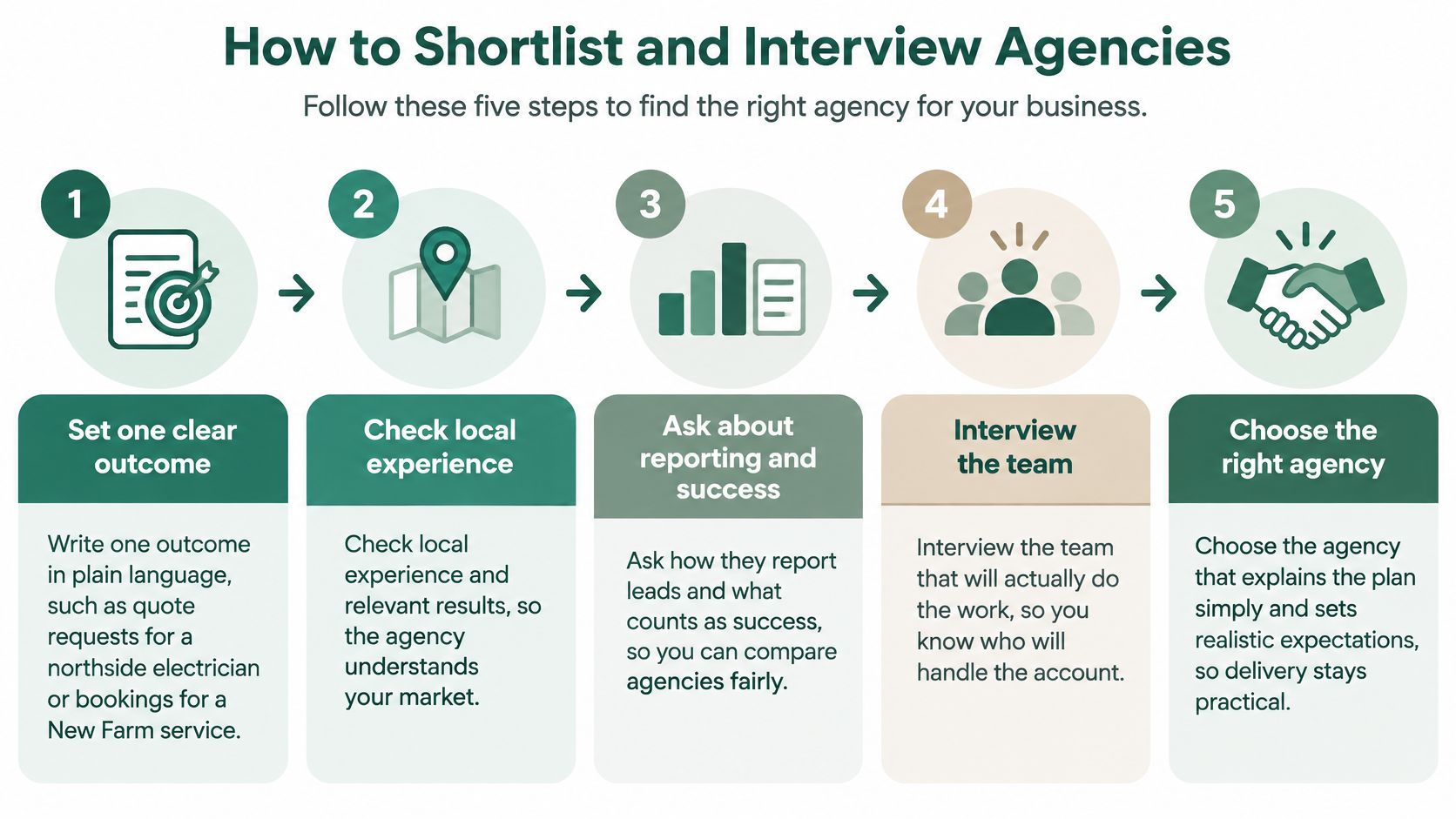
Seven Steps in Order
Write one outcome in plain language. Quote requests within 15 kilometres for a northside electrician. Bookings for a New Farm clinic. One sentence, one result, plus a monthly ceiling written down before any sales call. Without a ceiling, every add on sounds essential.
Split must haves from later work. Most owners need one or two things fixed first, not SEO, ads, social and a new website bought in one lump. A Fortitude Valley cafe with a strong Instagram following but a booking page that fails on phones needs the booking path fixed before more posts. A Logan tradie with steady word of mouth but no Google presence needs a profile, reviews and a quote page before social content.
Shortlist three companies with similar local work. Each one should show recent work for a Brisbane or Queensland business in a comparable trade, with the result stated in enquiries, bookings or sales. A generic national case study about traffic growth says little about winning quote requests in Capalaba or bookings in Paddington.
Ask who does the work. Find out whether one named strategist runs the account or the work moves between whoever is free. Confirm that ad accounts, analytics and the website login are created in the business name from day one. Access arranged later, after a dispute, rarely arrives complete.
Run the same six interview questions. A recent local client like yours. How an enquiry gets tracked from click to job. What the company will not do in the first 90 days. Contract length and exit terms. What the monthly report will show. Who answers when something breaks on a Friday afternoon. Straight answers to all six are a good sign. Evasion on tracking or exit terms is not.
Score each company from 1 to 5. Score fit with the outcome from step one, plain speaking, and whether the plan can be explained back to a staff member without notes. That last test matters more than it sounds. If the owner can't retell the plan, the team answering the phone can't support it, and enquiries get handled inconsistently.
Choose the company that names the first fix and the first number to watch. Not the largest retainer, not the longest service list. The winner usually sounds almost boring. Fix the profile and the quote form, track every call, review cost per qualified enquiry in 30 days. That kind of answer connects to real return, and owners who want the maths behind it can work through how to measure marketing ROI before signing anything.
Comparing Answers Fairly
Two traps catch owners at this stage. The first is comparing a cheap quote covering one channel with an expensive quote covering four, then treating the difference as value. The score sheet fixes that, because every company gets scored against the same single outcome. The second trap is falling for fluency. Confident talk about algorithms and funnels can hide a thin plan, and background reading on digital marketing for search visibility helps owners spot where a pitch uses jargon instead of a method.
If the plan can't be explained to the person answering the phone, it isn't a plan yet. It's a sales document.
Keep the completed score sheet after the decision. It records what was promised, what the first fix was meant to be, and which number everyone agreed to watch. That sheet becomes the reference point at the first monthly review, and it's the owner's best protection against scope creep in both directions.
Red Flags That Waste a Small Budget
The most expensive mistake in hiring a local digital marketing company is paying for a guaranteed page one ranking. No agency controls Google's results, and any company promising a position is either guessing or planning to redefine the promise later. Rankings also shift by suburb, device and search history, so the guarantee can't even be checked cleanly. Owners should treat that single promise as a reason to slow down, then run the rest of the proposal against the standards below.
| Warning sign | What it usually means | Better standard |
|---|---|---|
| Guaranteed page-one rankings | A promise nobody can keep | A 90-day plan with enquiry targets, not rank guarantees |
| Long lock-in before any results | The fee is protected, the owner is not | Month to month, or a short first term with a clear exit |
| Ad or website accounts they will not share | You cannot leave cleanly | Accounts created in the business name from day one |
| Reports of impressions and followers only | Activity is being sold as performance | Calls, forms, bookings, and cost per enquiry |
| Generic AI blogs or an AI-ranking package | Volume instead of local proof | Consistent details, reviews, expert answers, and real job evidence |
| No feel for Brisbane suburbs or trades | Copy written for anywhere | Examples from your catchment and service area |
How Each Flag Shows Up Locally
A Brisbane hospitality business that signs a twelve month lock in before a single enquiry arrives has handed over its flexibility in a seasonal trade. Wet season, school holidays and event calendars all move demand, and a contract that can't pause or end forces the owner to fund a plan that may no longer fit. A short first term with a clear exit keeps the pressure where it belongs, on the company to earn the renewal.
Account ownership is quieter but just as costly. A Toowong accountant whose agency holds the only Google Ads login can't take the campaign history, audience data or conversion tracking when leaving. The next provider rebuilds from scratch, and the owner pays twice for the same learning. This is also where bargain offers deserve scrutiny, since the pattern behind cheap search engine optimisation services often involves the client owning very little at the end.
Reporting is the third tell. An Ipswich local business receiving pages of impressions, reach, and follower counts, with no calls, forms, or booked jobs, can't determine whether the fee produced any results. Impressions mean an ad or post was displayed. They don't mean a person in the service area requested a quote. A useful report fits on a couple of pages and highlights enquiries and what each one cost.
The AI Ranking Pitch
Cheap packs of generic suburb blogs waste money in a different way. Swapping a suburb name into the same article fifty times proves nothing about work done in those streets, and customers can tell. The newer version of this pitch is the paid package promising visibility in AI generated recommendations. Caution is justified there. A 2026 Australian study reported in coverage of generative engine optimisation gaps tested 50 everyday consumer questions across ChatGPT, Perplexity, Gemini, and Google AI Mode and found that no Australian business was named in 23 queries, nearly half of the sample.
That result doesn't mean AI answers should be ignored. It means speculative packages promising placement in them deserve hard questions, because the systems often lean on authoritative third party sources rather than a business's own blog. The useful work is unglamorous. Consistent business details everywhere. Service area pages with real job evidence. Independently verifiable reviews. Expert answers to the questions customers ask before booking. Those assets help in ordinary search today and give any answer engine something solid to work with.
The final flag is local knowledge. A team with no feel for Brisbane suburbs writes for a city it doesn't know, targets areas the business can't service profitably, and misses how people describe where they live. Ask for examples from the owner's own catchment. Two red flags in one proposal means pause, even if the fee sits comfortably inside the expected band.
The First 90 Days After You Hire
Onboarding should feel like a short operating rhythm, not a strategy workshop with sticky notes. The first 90 days have one job. Get tracking, contact paths and one or two channels working well enough that the day 90 decision is based on qualified enquiries rather than hope.
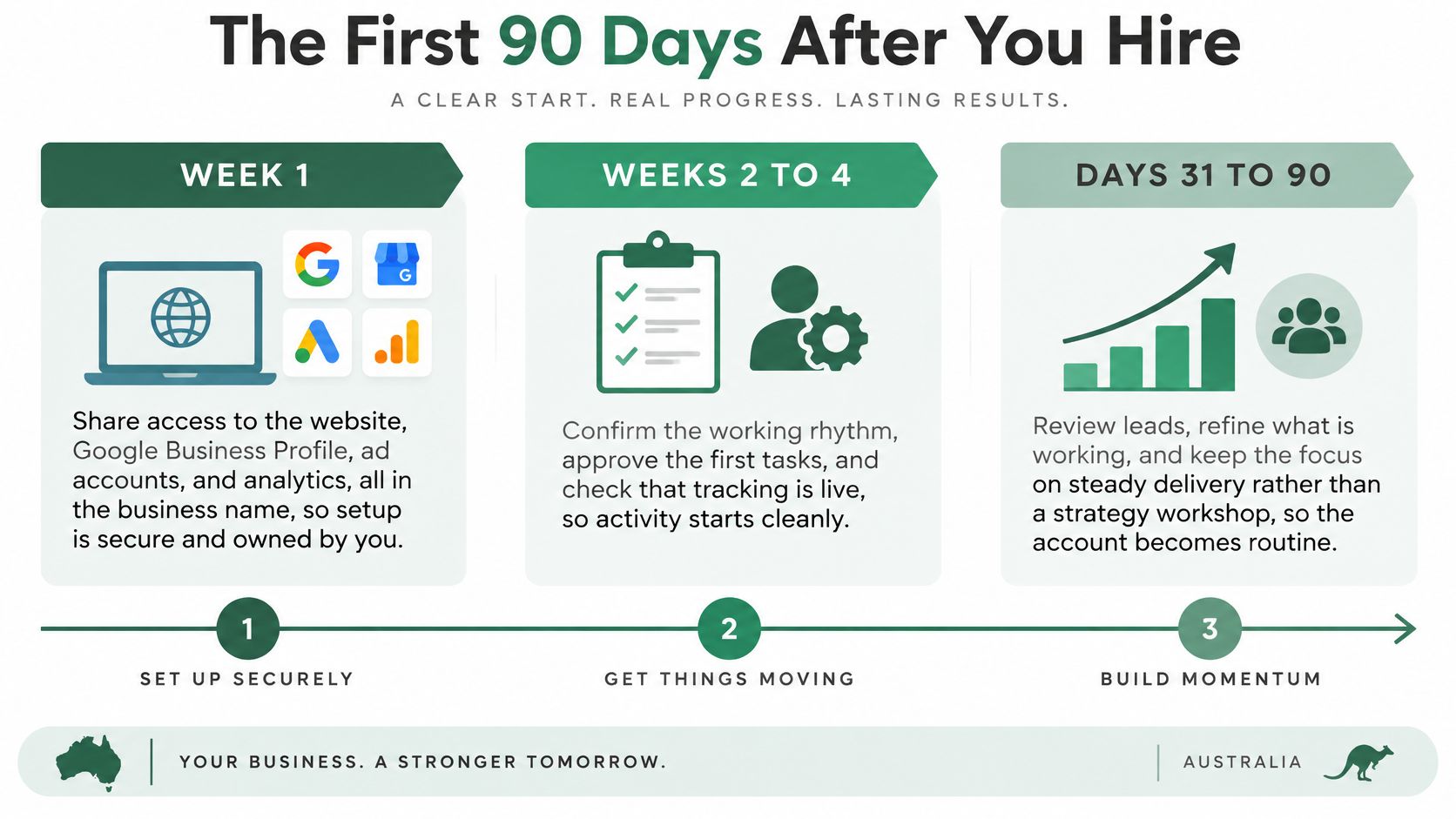
A Timeline for the Calendar
Week one, access. Share access to the website, Google Business Profile, ad accounts and analytics, all held in the business name. Chasing logins in week four is a sign the start was rushed.
Discovery call. Agree one commercial goal, the suburbs the business can serve profitably, and the monthly ceiling. The first step with Boocoo is a free discovery call where the team learns about the client's business, goals, and current marketing, which is the right shape for this conversation whoever the provider is.
By the end of week two, a written plan. Approve a 90 day plan covering one or two channels, not five. Boocoo's model has each client's strategist map out a 90-day plan specific to the client's industry, location, and budget, and owners should expect that level of specificity in writing, with tasks and dates attached.
Fix the phone path. Correct opening hours, a clear service area, click to call on every mobile page, and a quote or booking form that asks only for what's needed to respond. Sending ad traffic to a broken form is the fastest way to burn a first month.
Confirm consent before any email or SMS. The enquiry form should include a separate, unchecked marketing box, so requesting a quote does not automatically subscribe anyone to promotions. Every marketing message needs sender identification and a working unsubscribe link, tested on a phone. Retaining a simple record of when and how each person opted in protects the business and keeps the list clean.
Launch only after tracking works. The first campaign goes live when reporting can show which form or call came from which channel. A week of untracked ad spend teaches nothing and can't be recovered.
Block 30 minutes a week for approvals. Posts, ads and page changes stall in inboxes more often than they stall in production. A fixed half hour keeps the work moving without eating the week.
Day 30 and day 60 reviews. Read a plain English note covering what was done, what it cost, and which enquiries arrived. Questions at this point should be about enquiry quality. Were callers in the service area? Did they ask for profitable job types?
Day 90 decision. Keep, narrow, or stop the work based on qualified enquiries, not traffic alone. Narrowing is underrated. Cutting the weaker channel and funding the stronger one is often the best outcome of a first quarter.
Why Measurement Comes First
That sequence puts measurement ahead of activity for a reason. In the Australian Bureau of Statistics business characteristics release, only 7% of businesses measured the contribution of digital activities to overall business performance in 2024–25, even though social media use for business presence had reached 51%. Being online is common. Knowing which activity produced an enquiry is rare, and that gap is exactly what owners are paying a company to close.
Monthly reports written in plain English with no vanity metrics, which is the reporting standard Boocoo provides, make the day 30 and day 60 reviews quick. Follow up matters just as much, and a simple lead nurturing strategy ensures enquiries that aren't ready this week get a useful second contact instead of silence.
Some jobs stay with the owner throughout. Approving offers before they go public. Answering the phone during the hours the profile advertises. Correcting anything that isn't true about the business, from service areas to licences to response times. An agency can generate the ring. Only the business can turn it into a booked job.
Budget and Time Tips That Actually Stick
A small budget goes further when each task has a clear purpose and a way to judge its contribution. Choose a few practical habits, then give them enough time to produce useful evidence before adding more work.

Six Habits Worth Keeping
- Start with one organic and one paid effort. Local SEO paired with a focused ad campaign gives you two channels to assess. Adding more before you know which enquiries they produce can spread the budget thin and make results harder to attribute.
- Reuse genuine proof. A completed job, a real review or a before-and-after photo can support your website, Google Business Profile and social content. Showing actual work is often more useful than trying to invent a fresh topic every week.
- Use AI to save time, not promise rankings. Drafting and repurposing content can help, but generic local articles published at volume are a poor substitute for useful information. Check claims, prices and customer-facing details before anything goes live. In 2025, 41% of Australian small and medium-sized enterprises were adopting artificial intelligence, according to the Australian Government AI Adoption Tracker announcement.
- Fix the contact path before polishing the brand. If cash is tight, make sure your Google Business Profile is complete and your quote page is clear before paying for a rebrand, signage or a video shoot. Attractive marketing cannot make up for a broken way to get in touch.
- Keep consent records together. Record when a contact signed up, what the form said, where they came from and what they agreed to receive. Check the records and test unsubscribe links regularly to avoid sending marketing messages to people who did not consent.
- Test one change at a time. Change an offer, a landing-page headline or an audience, then check what happened before changing something else. For a deeper look at incrementality and personalization tactics, apply the same controlled-testing approach at local scale. The same principle underpins cost-effective marketing strategies: test small before committing more budget.
Two Worked Examples
A Logan plumber might set aside about $1,200 a month for local SEO and $1,000 for ads targeting emergency and blocked-drain searches within a tight radius. That's a modest first month, with ad spend kept below the typical range so the campaign can be tested before it is scaled. Social content can wait until calls are steady and the team has job photos worth sharing. The trade-off is a narrower start in exchange for clearer evidence about which searches bring enquiries.
A New Farm accountant might instead choose a $2,500 bundled retainer for site care, SEO and one ad channel, with ad spend capped in advance. Accounting is a considered service rather than an urgent one, so a useful service page may keep working over time. The first priority differs from the plumber's, but both businesses benefit from setting a spending limit and tracking attributable enquiries.
The cheapest month is the one where every dollar has a job and a person watching the enquiries.
Book a No-Pressure Brisbane Chat
By this point the decision usually falls into one of three places, and each one has a clear next move. Naming which place applies is worth five honest minutes, because hiring at the wrong moment wastes more money than hiring the wrong company.
Hire, if the score sheet has a clear winner and the fee fits the ceiling. Book a short working conversation and take three things to it. The one outcome written in plain language. The monthly ceiling, including ad spend. The login list for the website, profile, ad accounts and analytics. A company given those three things can start properly in week one instead of spending the first month asking for access and guessing at priorities.
Pause, if two red flags are still open. Ask for the missing items in writing before any payment. Exit terms, account ownership, what the report will show, what won't be done in the first 90 days. A sound company answers in a page or less. Reluctance to put basics in writing is itself an answer, and walking away at that point costs nothing.
Wait, if the business can't name its offer or its suburbs. That's homework, not a marketing problem. An agency can't target profitably on behalf of an owner who hasn't decided which jobs are worth chasing or how far the team will travel. A week spent settling those two questions makes every later dollar sharper, whether the work goes to an agency or stays in house.
A Local Option for That Conversation
Owners who want a low pressure local partner can talk with Boocoo. Boocoo is a Brisbane-based team, not a faceless offshore agency, and it has been helping small and medium Brisbane businesses grow online for over 15 years. Boocoo offers a free 30-minute call with one of its Brisbane strategists, with no lock-in and no obligation. The team can be reached on 1300 093 797 or at hello@boocoo.au, and the office sits at Level 2, Lobby 1, 76 Skyring Terrace, Newstead.
That call has a narrow, useful purpose. Work out whether SEO, ads, social, or the website should go first for a specific business, what the first fix would be, and which enquiry number would prove it worked. Owners leave with that order of priorities whether or not any work follows, which makes the half hour worthwhile on its own.
So the action for this week is one of two things. Book that conversation and bring the outcome, the ceiling and the login list. Or write down the single fix to do in house in the next 14 days, whether that's completing the Google Business Profile, repairing the quote form, or asking the last ten happy customers for reviews. Either move beats another month of three unread proposals and a quiet phone.