

A Brisbane plumber finishes a quote at 9 pm, looks at an out of date website, and moves the job to next week again. Calls have slowed, a competitor now sits above the business on Google, and there aren't enough hours to fix pages, chase reviews, and answer customers. That's the point where local digital marketing agencies can help, but only if the owner buys the channel that fixes this quarter's problem. One clear problem, one channel, and one measure of success beat a long full-service pitch every time.
Why Brisbane Owners Look for an Agency
A Brisbane electrician may have steady referrals but few new enquiries. The Google Business Profile shows old hours, the main service page loads slowly, and the owner cannot tell which calls came from Google. Quotes, staff, and customers need attention first, so marketing slips.
The hiring decision is about finding the right kind of help. Some owners need a diagnosis of what is getting in the way. Others need a website fix, better search visibility, paid advertising, or ongoing support. Paying for the wrong service can cost time as well as money.
Social media is like a sign on the street; the website and Google Business Profile are the shopfront counter where customers decide whether to call. A sign can attract attention, but the counter needs clear, accurate information to turn interest into an enquiry. The Australian Bureau of Statistics characteristics of Australian business release reported that more than 91% of businesses said their internet met most or all of their business needs, while 51% used social media as part of their online presence. Having an online presence does not guarantee that it answers customers' questions.
Start by naming this quarter's constraint. Is the problem too few qualified enquiries, or enough enquiries but too few booked jobs? Choose the channel that addresses that gap, then judge an agency by those outcomes, not by a full-service deck or an AI pitch. If the budget is tight, buy help for the single biggest bottleneck rather than spreading it across channels. For simple starting ideas, you can also boost your small business's online reach.
Brisbane Digital Marketing Costs Worth Paying
Use the table below in a first sales call. The dollar figures are planning examples for a typical 2026 Australian small-business budget, not quotes. Each row should be judged as a decision about Brisbane digital marketing priorities, not as part of a menu to buy in full.
Typical 2026 costs for Brisbane small-business marketing
| Service | Buy it when | Skip it when |
|---|---|---|
| Local SEO, about $1,200 to $3,500 a month | Suburb and service searches should bring calls | There is no website or Google Business Profile yet |
| Paid ads management, about $800 to $2,000 a month, plus media spend often $1,500 to $5,000 | Calls can be answered this week | The landing page or tracking is broken |
| Social management, about $800 to $2,500 a month | Steady local content and replies are needed | There is no clear offer or follow-up |
| Website project, about $4,000 to $12,000 | The site is slow or does not convert | A listing fix would solve the problem |
| Combined retainer, about $2,500 to $6,000 a month | Several channels must run together | Only one listing or one ad gap needs fixing |
Start where buying intent already sits
Search deserves first attention for many trades and professional services because customers use it when they're ready to compare providers. The IAB Australia Internet Advertising Revenue Report prepared by PwC Australia put Australia's internet advertising market at approximately $16.4 billion in calendar year 2024, an 11.1% increase from 2023, with search and directories at $7.2 billion, growing 10.1% year on year. Those are national figures, not Brisbane agency revenue, but they show where a large share of measurable demand already sits.
That doesn't mean every business should buy SEO and ads together. A physio with a sound website but weak suburb pages has a different problem from a builder whose enquiry form doesn't send emails. The first may need local SEO. The second needs the website and tracking fixed before any traffic is purchased.
Apply one budget rule for a tight month
Fund one highest-intent channel for 90 days. Don't buy ads until the Google Business Profile, phone number, and one obvious enquiry button work. Don't buy a combined retainer if the only gap is an incomplete listing. A smaller promise that's properly measured is safer than five channels producing activity no one can connect to bookings.
Ask every proposal to separate agency fees from ad spend. For paid campaigns, keeping management nearer 10 to 20 percent of a modest working budget helps stop fees swallowing the media. Owners comparing bundled offers can use small business digital marketing packages explained for Brisbane owners as a prompt to check what's included, what's excluded, and which line items are media rather than labour.
Direct call: If cash is tight, circle one row for this quarter and leave the rest alone. A business doesn't need every service. It needs the service that removes the current constraint.
Social management is the easiest row to overbuy. Regular posts can support trust, but they won't repair a missing service page or an unanswered phone. Put the monthly spend where a customer is closest to making contact, then add supporting channels only after that path works.
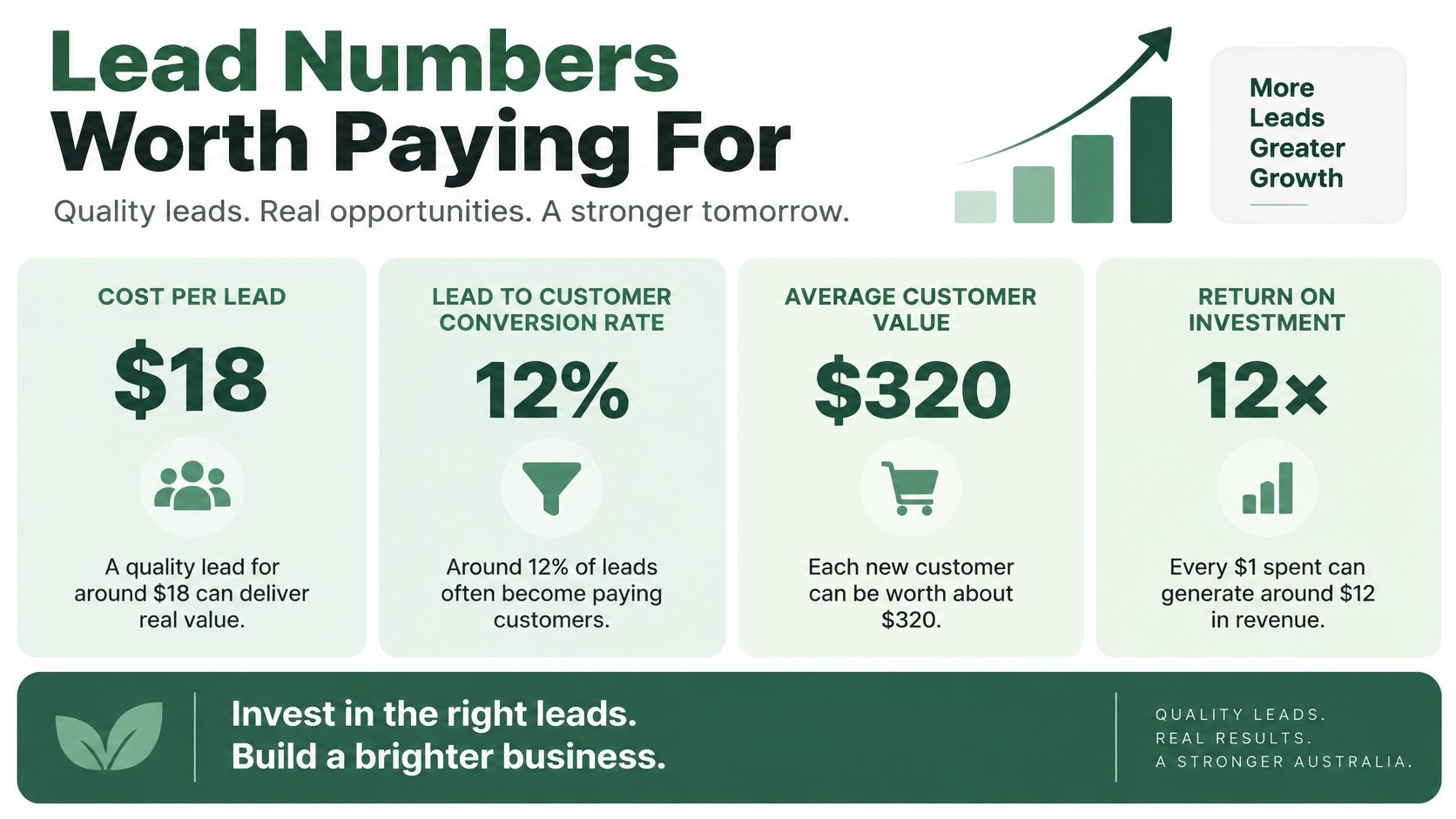
Lead Numbers Worth Paying For
A marketing report should connect activity to a profitable call, quote request, booked job, or paid invoice. Rankings and impressions can show visibility, but qualified enquiries and booked work help an owner decide whether a channel deserves more budget.
Set the baseline in week one
Start with the last three months of qualified enquiries, booked jobs, revenue, cost per lead, and lead-to-sale rate. Old invoices, a calendar, and phone records can provide a useful first picture. The numbers may be incomplete, but they give you a starting point for judging later results.
Define a qualified enquiry in one sentence. For a Brisbane solar installer, that might be a homeowner in the service area asking about a system the business installs. A student outside the service area asking for a price is still an enquiry, but not a qualified one. Record the definition so the owner and agency count leads consistently.
Connect Google Analytics 4, Google Search Console, call tracking, and form events where possible. Then add a source field to the job system or spreadsheet. Mark each lead as a Google listing call, website form, paid ad, referral, or repeat customer. Unique phone numbers for major channels can help; a consistent booking field is a useful starting point. For a plain-language guide, read how to measure marketing ROI without vanity metrics.
Review three numbers once a month
A short monthly review can focus on qualified enquiries, cost per qualified enquiry, and booked revenue. Agree on one change to test, such as clarifying a suburb page, changing an ad schedule, or following up quote requests faster. Testing one change at a time makes it easier to see what may have affected results.
Tools alone do not create good reporting habits. The 2025 Australian small-business survey from QuickBooks reported that 64% of small businesses used AI regularly, while 31% had not adopted it. Any AI pitch should be judged against the business's goals and measurable results, not accepted because the software sounds new. Consider weighing AI tools against business goals before paying for a tool. A call log linking marketing spend to jobs can be more useful than an automated report full of clicks.
Keep delayed jobs, repeat customers, and referrals visible in the records. A renovation enquiry may turn into work later, so marking it lost too soon can make a channel look weaker than it is. When the customer books, record the original source, even if they first called after visiting a suburb page and later confirmed by email.
If the report cannot name a lead source, it is not ready to scale.
How to Shortlist Agencies in One Week
A busy owner doesn't need a month of research. A focused week is enough to find three credible local digital marketing agencies and compare them on the same terms.
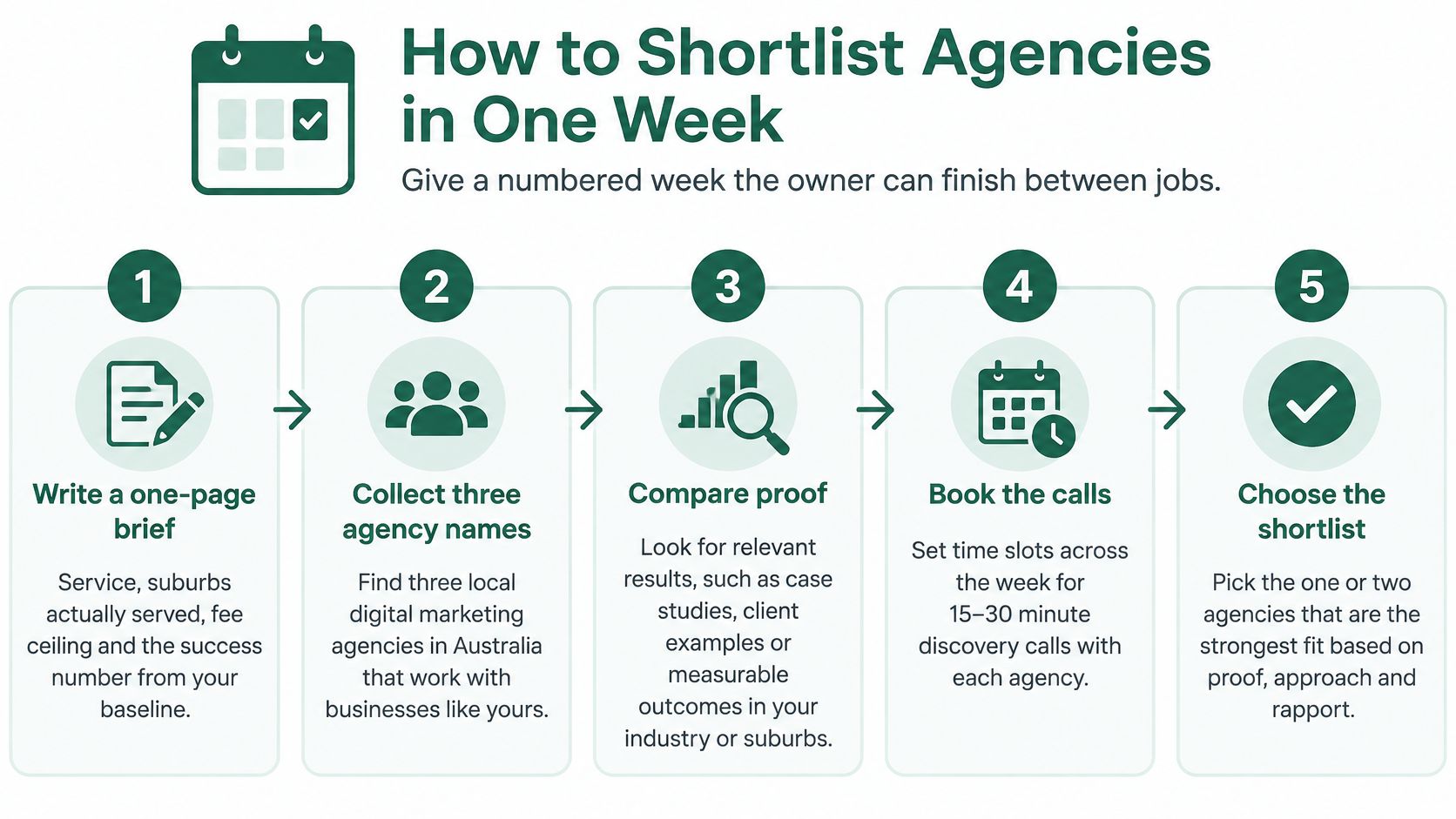
Run the same five steps
- Write a one-page brief: Include the core service, suburbs served, fee ceiling, and success number from the baseline, such as qualified enquiries per month. One page saves time because weak-fit agencies can decline early.
- Search locally and inspect the proof: Search for a digital marketing agency in Brisbane plus the trade or service type. Open each Google Business Profile, website, and two recent local examples, then note whether the examples resemble the business doing the hiring.
- Ask trusted contacts for names: One supplier and one accountant or peer can widen the list. Drop any shop that can't work locally or shows only overseas case studies, since suburb knowledge and local competition matter.
- Keep three realistic options: Favour agencies that will estimate a range before a long pitch and already work with a similar Brisbane business. A helpful comparison point is what a Brisbane marketing consultant should clarify before work starts.
- Book three 30-minute calls in the same week: Send each agency the identical brief so answers can be compared side by side. Memory fades quickly when calls are spread over three weeks.
Keep the service area honest
The Australian Government ASBAS Digital Solutions Round 3 grant opportunity guidelines state that Queensland, the Northern Territory and Western Australia contain an estimated 758,400 small businesses, representing 29.3% of Australia's small-business population. That regional scale is exactly why broad targeting burns a small budget.
An electrician should start with one core service and a few real service areas, not dozens of thin suburb pages. It's like putting clear signs on the streets where the business works rather than printing flyers for the entire state. The same rule applies to ads. Restrict the service area and schedule, so clicks arrive when someone can answer.
Finish the week with a shortlist of three, not a folder of twelve. More names don't create a better decision. They usually create more follow-up calls and less clarity.
Interview Questions That Reveal Fit
Use the same short script on all three calls. Spoken plainly, the questions reveal who will do the work, what proof exists, and whether the agency can stay focused.
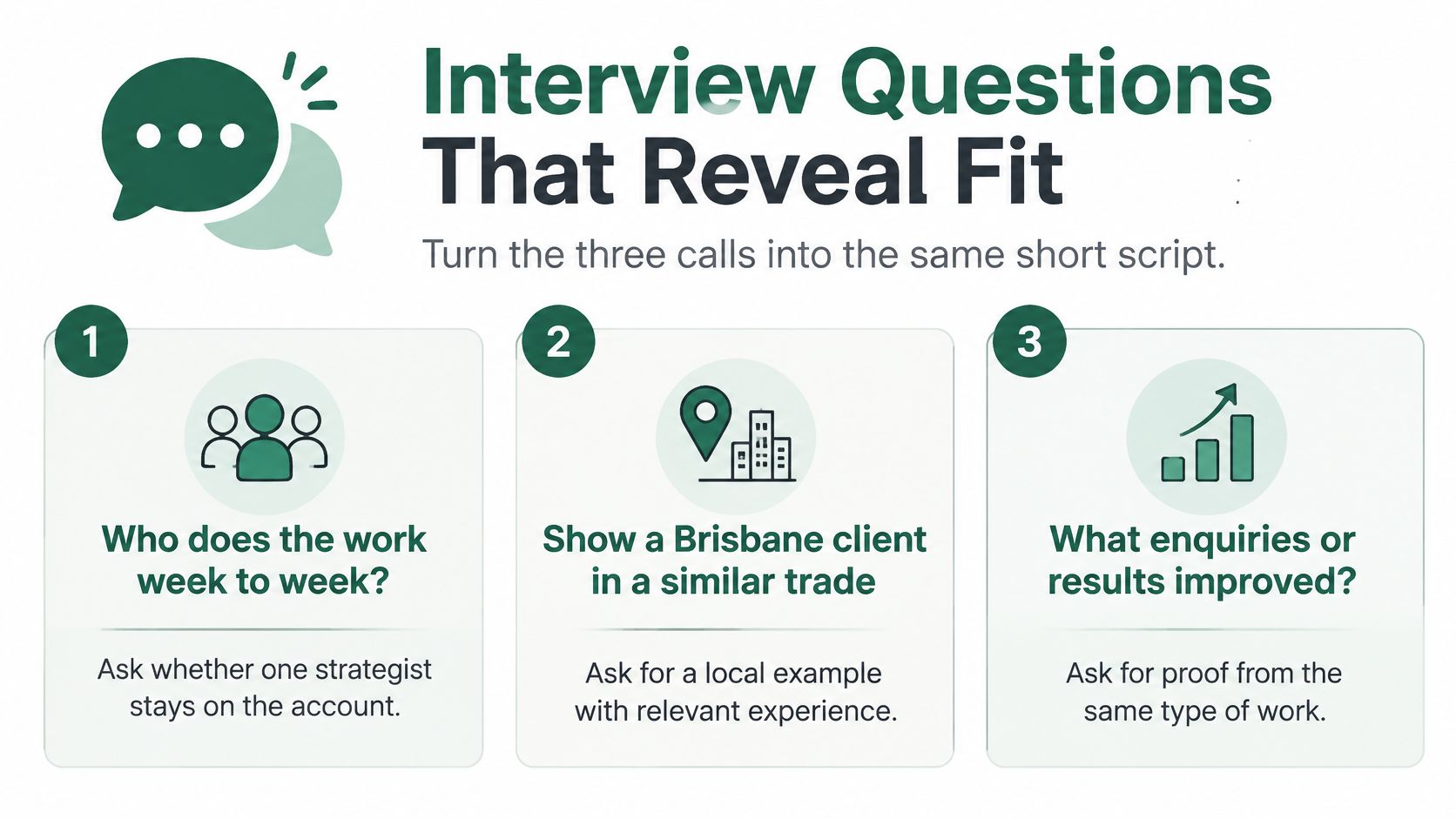
Ask these questions word for word
- Who does the work week to week: Ask whether one named strategist stays on the account or the work moves between whoever is available.
- Can a Brisbane example in a similar trade be shown: Ask what happened to enquiries or booked jobs. A ranking screenshot without lead numbers isn't enough.
- What won't be done in month one: This exposes agencies that pitch every channel at once. A focused answer should name one first channel and explain why it comes first.
- What changes after 90 days if qualified leads don't move: Look for a specific review against the baseline, not a promise to just keep posting or keep spending.
- How are pay-per-click accounts and customer data handled: Owners comparing paid media support can use questions for pay-per-click advertising companies to prepare, then ask who owns the account and who approves changes.
Reviews need a separate compliance question. Ask exactly how reviews are requested. The safe process is a neutral follow-up to genuine customers, no reward offered only for praise, and no reviews written by staff pretending to be customers. The Australian Competition and Consumer Commission guidance on online reviews and testimonials covers an internet sweep conducted from 4 to 14 October 2022, where 137 businesses across 10 sectors were examined and 37% were found to have potentially misleading or concerning review practices.
Say a plumber asks every customer for an honest review after the invoice is paid. That's clean because the request doesn't pressure anyone toward a favourable rating. An agency that suggests filtering out unhappy customers before sending the review link is creating trust and regulatory risk.
AI deserves the same direct treatment. Ask how customer data and brand voice are protected if AI helps with drafts, ad variations, or enquiry sorting. Insist that a person approves anything public, checks prices and service claims, and can step in when the output sounds wrong. Automation should save drafting time. It shouldn't publish unchecked claims under the business name.
Score each call before the next one
Give one point each for a named strategist, a relevant local example, a single first channel, a clean review process, and a clear 90-day review. A score of four or five is a useful pass. Keep notes in the same order for every call, so the smoothest pitch doesn't beat the strongest evidence.
Contract Terms That Protect a Small Budget
Read the proposal like a job sheet, not a brochure. The clauses below show the fair version first and the walk-away version second.
Contract clauses to accept or refuse
| Clause | Fair for a small business | Walk away if |
|---|---|---|
| Term | Month to month or a 3-month trial | 12-month lock-in with no exit |
| Notice | 30 days | Auto-renewal needing 90 days' notice |
| Reporting | Work done, leads and cost per enquiry | Only impressions or followers |
| Ownership | You own the site, content and ad accounts | The agency owns the ad account |
| Ad spend | Billed separately with invoices you can see | Spend hidden inside one vague fee |
| Guarantees | Results described as targets | Guaranteed number-one rankings |
| Day-90 check | Review against the lead baseline | No review point in the proposal |
Check ownership before price
Ownership is the clause owners most often skim. The business should own the domain, website content, Google Analytics property, Google Ads account, and social accounts. Agency access can be granted for management, but the underlying assets shouldn't sit inside an account the owner can't enter after the relationship ends.
Confirm that content, reports, and logins can be exported if the business leaves. Ask where passwords are stored, who has administrator access, and how access is removed at the end. These questions sound administrative on day one and become expensive only when they're left unasked.
Ad spend needs the same clarity. Media should be invoiced separately from management labour, with platform invoices available for checking. One vague monthly fee makes it impossible to tell whether a weak month came from low media spend, high fees, or poor targeting.
Put the success number in the scope
Copy the success number from the one-page brief into the proposal scope. That number might be qualified enquiries from named suburbs or booked jobs from one core service. Extra channels should then require a written change, with the added cost and reason stated before work begins. This stops scope creep from gradually swallowing the budget.
Reporting should name work completed, leads received, source of those leads, and cost per qualified enquiry. Impressions and follower growth can sit in the background, but they can't be the report. A month-to-month term or three-month trial gives the owner a fair exit while still allowing enough time for a focused test.
A fair contract should be easy to leave if the work is not producing enquiries.
Before signing, mark every lock-in, auto-renewal, ownership, and guarantee clause. If a clause isn't clear, ask for it in plain English in writing. No owner should need a dictionary to understand how to end a small marketing agreement.
Choose Hire DIY or a Local Partner
Choose by situation, not by whoever gave the most impressive pitch. The right model for this quarter may be wrong next quarter, and that's fine.
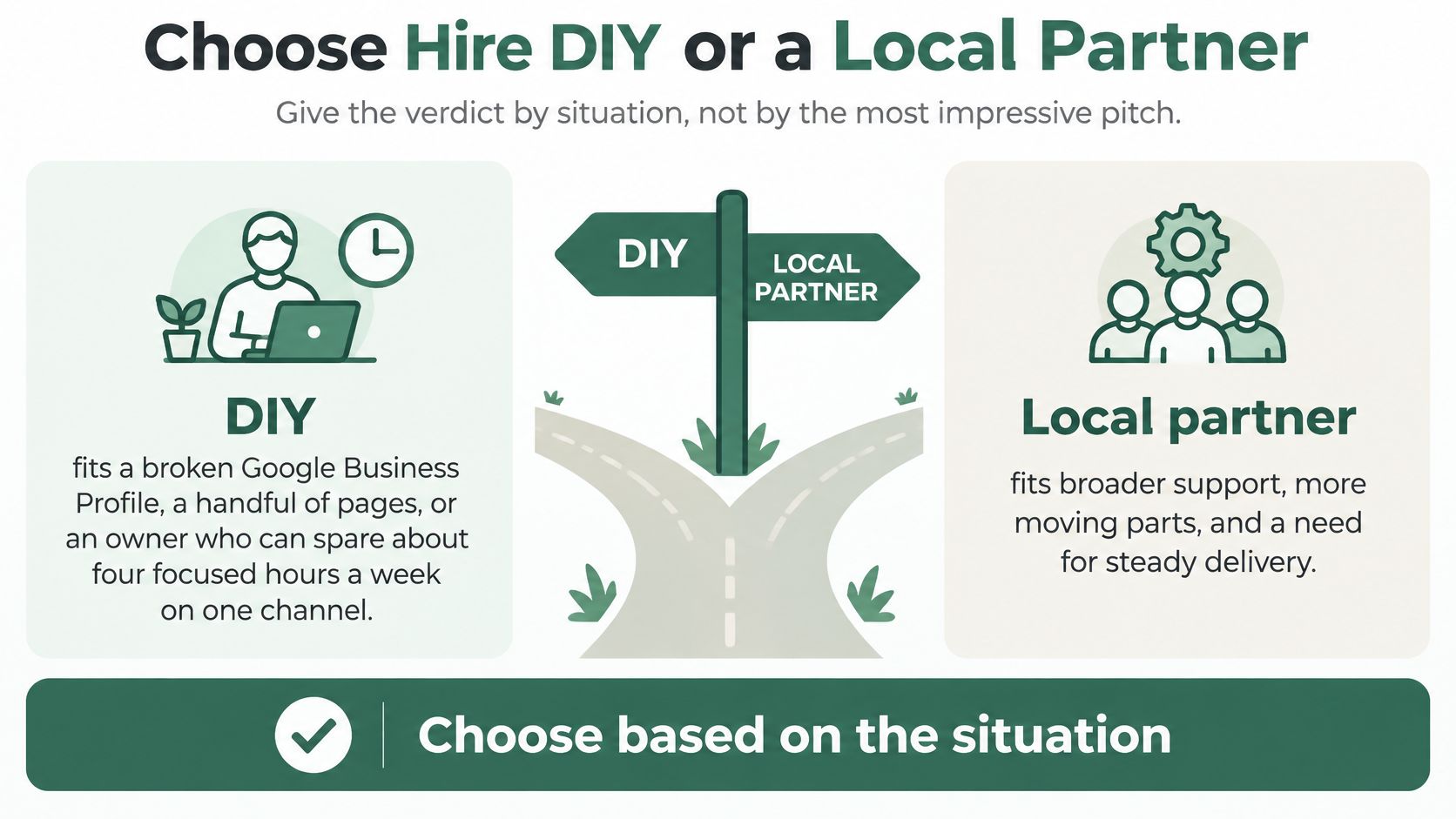
DIY, freelancer or local agency
| Situation | DIY | Freelancer | Local agency |
|---|---|---|---|
| One broken Google profile or listing | Best use of this month | Optional | Unnecessary |
| One channel and a clear brief | Works with about 4 hours a week | Often the best fit | Only if they will limit the scope |
| Several channels and no spare hours | Likely to stall | Hard to coordinate | Fits a retainer |
| Need a plan plus delivery | Risk of random tactics | Depends on one person | One strategist and a 90-day plan |
Match the model to the constraint
DIY fits a broken Google Business Profile, a handful of service pages, or an owner who can protect about four focused hours a week. It fails when those hours are fictional. If marketing only happens after quotes at night, it won't happen consistently.
A freelancer fits one clear job, such as a website rebuild or an ad account setup, when coordination is light. Owners weighing that route against broader support can compare it with when it makes sense to outsource SEO services. The risk is dependence on one person for strategy, delivery, and reporting.
A local agency fits when several channels must run together and nobody inside the business has the hours. The useful version includes one strategist, a written 90-day plan, and reporting tied to qualified enquiries. A stronger digital presence can support growth, but no agency can guarantee revenue. Buying paid traffic before tracking works remains a common waste, whatever model is chosen.
If a local partner is the answer, Boocoo is one Brisbane option to put on the shortlist. Boocoo has been helping small and medium Brisbane businesses grow online for over 15 years. Each client's strategist maps out a 90-day plan suited to the client's industry, location, and budget, and Boocoo offers a free 30-minute call with one of its Brisbane strategists, with no lock-in and no obligation.