
Running a small business in Brisbane often means marketing gets pushed to the end of the day. Quotes need sending, staff need managing, customers need answers, and the website or Google profile becomes that job that keeps rolling into next week. The problem isn't usually motivation. It's that every option seems to come with a different promise, a different price tag, and a different layer of jargon.
That's where many owners start looking for a Brisbane marketing consultant. Not because they want a fancy strategy deck, but because they want clarity. They want to know what to fix first, what can wait, and whether they need a consultant at all.
That decision matters. A consultant can be the right move for one business and the wrong move for the one next door. Some businesses need diagnosis and direction. Others need someone to write ads, fix technical SEO, rebuild a website, or manage everything month after month. Hiring the wrong model costs time first, then money.
This guide is built for that exact fork in the road. It helps Brisbane business owners sort out what they need, compare the consultant option against freelancers, agencies, and DIY, and hire with a lot more confidence.
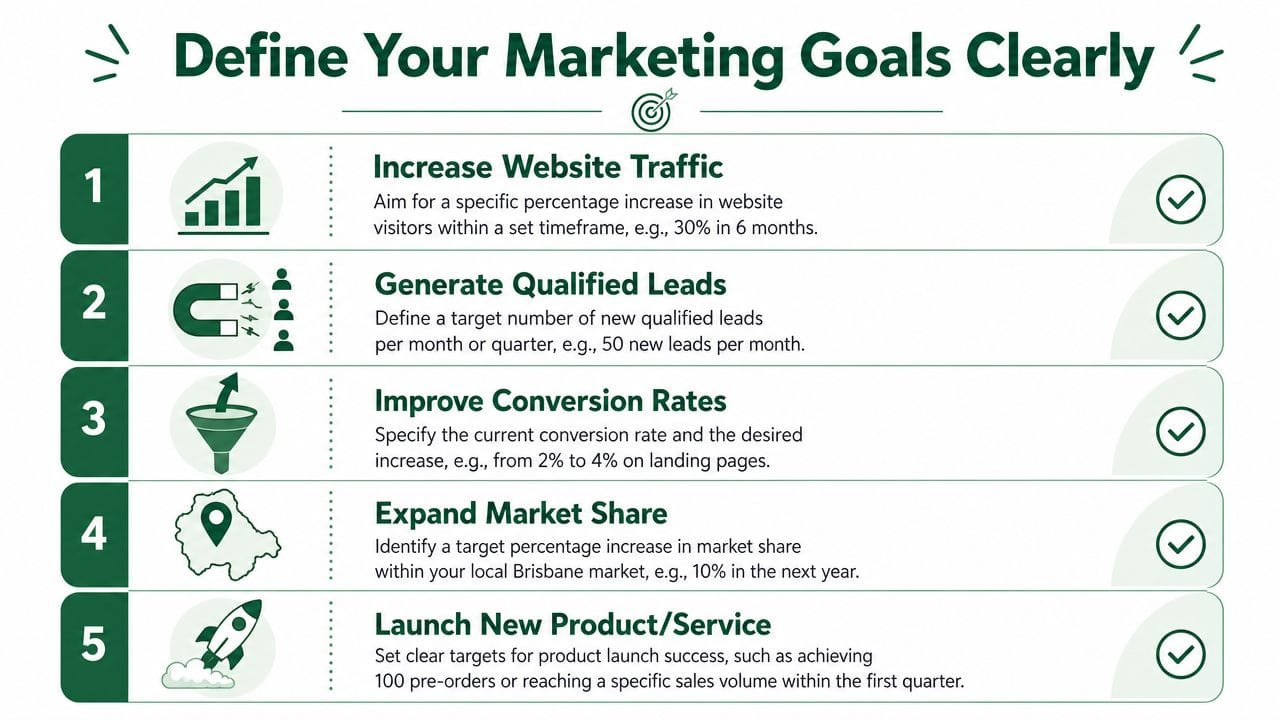
First Things First Define Your Marketing Goals
Most marketing problems aren't actually marketing problems. They're decision problems.
A Brisbane business owner says they need “more leads”, but that can mean five different things. The phone might ring with poor-fit jobs. The website might get traffic but no enquiries. The suburb targeting might be too broad. The service mix might be wrong. Or the business might already have enough demand and only need better-quality jobs.
That's why the first job isn't finding a Brisbane marketing consultant. It's defining what success looks like in plain language.
Start with the business problem
A useful filter is to ignore channels for a moment. Don't start with SEO, Google Ads, social media, or email. Start with the commercial issue.
For example:
- Service business problem: A plumber doesn't need “more visibility”. They need more profitable call-outs in selected suburbs, at the right job size, without relying only on repeat clients.
- Professional service problem: An accountant may need fewer tyre-kickers and more enquiries from businesses that suit a specific advisory offer.
- E-commerce problem: An online store may have traffic but weak conversion, low repeat purchase behaviour, or unclear product messaging.
Practical rule: If the goal can't be explained to a staff member in one sentence, it's still too vague to hand to a consultant.
Some owners also confuse brand activity with lead generation. Both matter, but they aren't the same. If the business needs enquiries this quarter, the brief should reflect that. A consultant can help shape the plan, but they can't fix a fuzzy target.
Build a one-page brief
A one-page brief saves hours later. It also makes interviews sharper because each consultant responds to the same business reality.
Include these points:
What the business sells
List the main services or products that matter most. Not everything. Just the revenue drivers.Who the ideal customer is
Describe the type of buyer. Include location, urgency, budget fit, and common reasons they buy.What a good lead looks like
Many small businesses quickly gain clarity on this point. A good lead might be a booked consultation, a quote request, a phone call from a local suburb, or an online sale of a specific product line.What isn't working now
Keep it blunt. Website looks dated. Google Business Profile is neglected. No clear reporting. Social posting is inconsistent. Paid ads have no follow-up.Internal limits
Note what the business can support. If nobody can approve content quickly, the plan must account for that. If the owner has one hour a week, that matters.
A simple table can help.
| Brief item | What to write |
|---|---|
| Main offer | The core service or product to prioritise |
| Best customer | The type of buyer the business wants more of |
| Target area | Brisbane suburbs or wider service area |
| Lead action | Call, form enquiry, booked consult, sale |
| Current bottleneck | Visibility, conversion, follow-up, messaging |
| Time available | Realistic owner or team involvement |
For businesses that sell into visitor-heavy sectors, it also helps to review examples from related industries. Boocoo's article on tourism digital marketing is a useful example of how channel choices change when buyer behaviour is tied to timing, intent, and local discovery.
A good brief doesn't need polished language. It needs enough truth to make the next conversation useful.
Finding and Shortlisting Local Brisbane Talent
Brisbane isn't short on marketing providers. That's the good news and the annoying part.
There are consultants, solo freelancers, small agencies, and larger full-service teams all competing for the same search terms. The local market is also well established. Brisbane agency listings show providers operating since 2010 and some consultancies position themselves with over 25 years of expertise, which points to a mature service market rather than a brand-new niche (Brisbane marketing agency market examples).
That maturity helps small business owners because there's no need to settle for the first person who sounds confident on a Zoom call.
Where to look without wasting a week
A fast shortlist usually comes from three places, not one.
- Local referrals: Ask non-competing business owners who they've used, what they hired them for, and whether communication stayed clear after the sale.
- LinkedIn search: Search by Brisbane location and service specialty. This is especially useful when the business needs a specialist rather than broad marketing support.
- Google search with intent: Search for the actual problem, not just “marketing consultant”. Terms like local SEO, Google Ads management, or website conversion help narrow the field.
A business that mainly needs search visibility should lean toward providers who clearly show capability in that channel. A good starting point is to understand the work involved in search engine optimisation before comparing providers, because it makes promises easier to judge.
How to shortlist fast
The shortlist should usually be small. Three to five names is enough. More than that and most owners end up comparing personalities instead of capability.
Use a quick screen:
- Check their own presence: If they sell SEO, can the business find their service pages and local positioning easily? If they sell paid ads, do their offers sound commercial and specific?
- Look for relevance: A consultant who understands service businesses may be a better fit than someone with only large-brand experience.
- Read the language they use: Clear writing is a good sign. Jargon-heavy copy often carries into reporting and strategy meetings too.
- Review service shape: Some providers diagnose and advise. Others mostly execute. Neither is better by default. The right one depends on what the business needs.
A shortlist should be built around fit, not fame. The best-known option in Brisbane can still be the wrong operating model for a small business.
One more practical filter helps. Ask whether the business needs thinking, doing, or both.
If the owner already knows the problems and just needs tasks done, a freelancer may suit. If the business needs cross-channel execution across SEO, ads, web, and content at once, an agency may be stronger. If the issue is confusion, prioritisation, or oversight, a Brisbane marketing consultant often makes the most sense.
The Interview What to Ask Your Shortlist
Most owners treat the interview like a sales call they need to sit through politely. That's the wrong frame.
The best interview feels more like a short working session. The consultant should ask smart questions, challenge assumptions, and make sensible trade-offs visible. Even if the business doesn't hire them, the owner should leave clearer than they arrived.
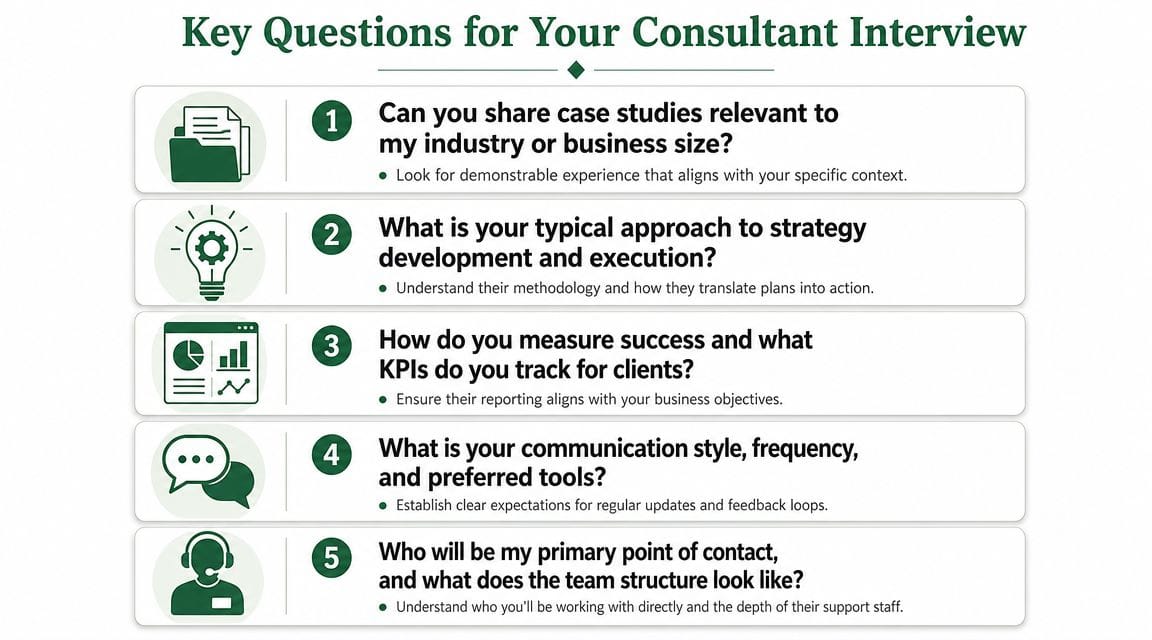
Turn the meeting into a working session
Send the one-page brief before the call. Then ask the shortlist to react to it.
That changes the tone immediately. Instead of hearing generic capability statements, the business hears how each person thinks. One may push for a website fix before ad spend. Another may say the business has a positioning issue, not a traffic issue. Another may recommend doing less across more focused channels.
That difference matters because strategy is mostly prioritisation.
Here's a practical way to compare answers:
| Question area | Strong sign | Weak sign |
|---|---|---|
| First priority | Names a specific business issue and why it comes first | Talks in broad channel language |
| Early wins | Suggests actions that match the brief | Promises everything at once |
| Measurement | Defines success in business terms | Leans on vanity metrics |
| Communication | Explains cadence and decision points clearly | Keeps it vague |
| Scope limits | Says what they won't handle or what needs another specialist | Pretends to do everything |
Questions that expose fluff
These questions tend to get more useful answers than “tell us about your experience”.
Based on this brief, what would you tackle first and why?
This reveals prioritisation skill.What would you leave alone for now?
Good consultants know what not to do yet.What do you need from the business each month for this to work?
This exposes whether the engagement is realistic for a time-poor owner.If budget is tight, what's the lean version of the plan?
Useful answers here usually signal commercial maturity.When would a freelancer or agency be a better fit than you?
Honest providers answer this cleanly.
Some of the best answers in an interview start with “not yet” or “that depends”.
There's also value in asking how they report. A good report helps the owner decide what to do next. A bad report is a screenshot pile with no decisions attached.
Ask for an example of how they would explain a poor month. Anyone can present wins. The better test is how they handle friction, delays, underperforming channels, or a bad-fit offer.
If they answer every question by talking about content, social, SEO, and paid ads all at once, be careful. That often means they haven't diagnosed the business. They've just unloaded a menu.
Decoding Pricing Contracts and Red Flags
This is usually where Brisbane business owners get stuck. Not because pricing is impossible to understand, but because many proposals mix scope, jargon, and delivery terms in a way that makes comparison harder than it should be.
The cleanest way to look at pricing is to ask one question first. Is the business buying advice, execution, or capacity?
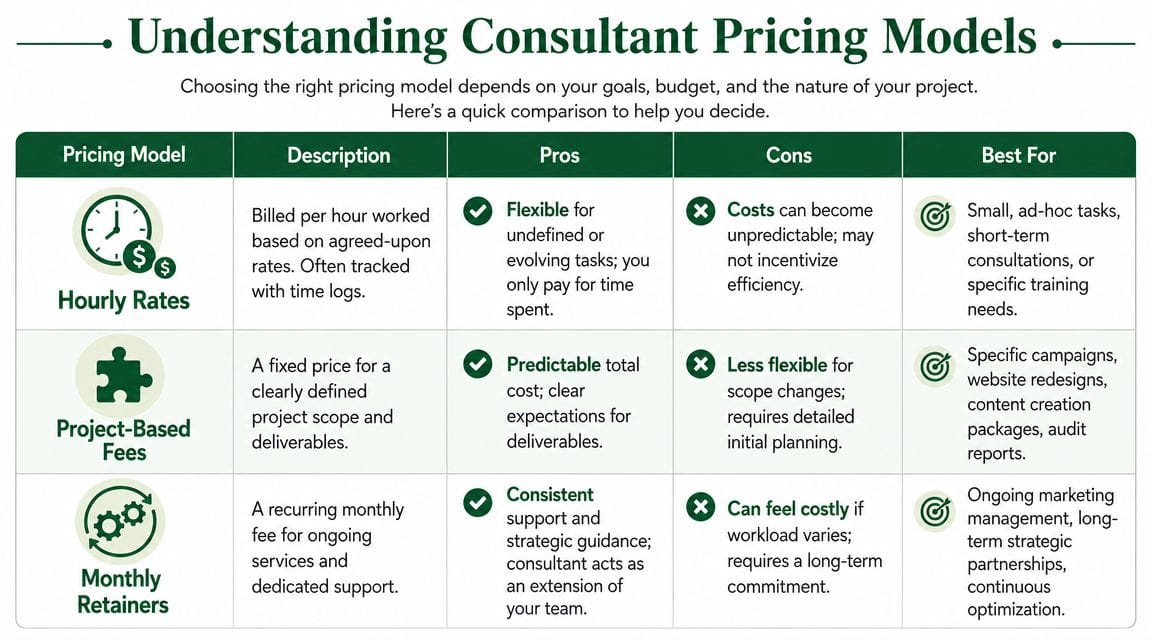
What the common pricing models actually mean
A consultant's fee structure should match the job.
For Australian benchmarks, a rate guide reported an average consultant day rate of $798 across 21 marketing roles. In that same dataset, Digital Marketing Manager consultants averaged $711 per day, Marketing Manager consultants averaged $820 per day, SEO Specialist consultants averaged $853 per day, and 68% of rates fell between $650 and $5,150 per day (Australian marketing consultant day rate guide). Another Australian pricing reference notes marketing consultant pricing at about AU$45.58 per hour on average, with a commonly cited range of AU$25.33 to AU$100.19 per hour, and reports AU$50.45 per hour for marketing consultants as a practical baseline for consulting engagements (Australian marketing consultant pricing overview).
Those numbers don't tell a business what it should buy. They help it judge whether a proposal is being pitched as senior strategic input, hands-on delivery, or something in between.
Contract terms worth checking before signing
Hourly pricing is like calling a tradie for small repair jobs. It suits narrow tasks, audits, training, and problem-solving where the scope may shift. The downside is that owners can lose track of total cost if nobody controls the work list.
Project pricing suits defined outcomes. Think website rebuild, SEO audit, messaging framework, or a campaign launch. This model works when the deliverables are written clearly and both sides know what “done” means.
Retainers buy ongoing access and consistency. They're often the right fit when marketing needs regular review, implementation, and refinement over time. They're a poor fit when the business still hasn't decided what problem it wants solved.
Before signing, check these points:
- Scope boundaries: What is included, and just as important, what is not.
- Approval process: Who signs off content, ads, landing pages, or changes.
- Reporting cadence: When updates happen and what decisions those updates should support.
- Asset ownership: Confirm who owns ad accounts, creative files, website copy, and tracking setup.
- Exit terms: Notice periods, handover obligations, and what happens to unfinished work.
A plain-English explainer like this practical guide to service contracts helps owners read agreement terms without getting lost in legal wording.
Red flags that usually cost more later
Some red flags show up before the proposal. Others only appear in the document.
Watch for these:
- Guaranteed rankings or guaranteed lead volumes: No serious operator controls search engines or buyer behaviour that tightly.
- Vague deliverables: “Ongoing optimisation” means very little without examples, channels, and meeting rhythm.
- No handover language: If the relationship ends, the business should be able to keep functioning.
- Excessive lock-in: Long terms can make sense for complex work, but they shouldn't trap a small business that isn't getting traction.
- Too many moving parts too early: If a proposal includes every channel under the sun from month one, it may be a sales document, not a plan.
The best contract doesn't sound clever. It sounds clear.
One final point matters for small businesses on tight budgets. A consultant can be excellent at diagnosis and prioritisation but still be the wrong fit if the business needs heavy execution across multiple channels immediately. That's not failure. It's a mismatch between strategic help and production capacity.
Your First 90 Days A Sample Engagement Plan
A good hire can still drift if the first three months are vague. Small businesses do better when the early plan is visible, staged, and tied to decisions.
The first quarter shouldn't be judged by noise. It should be judged by whether the consultant found the core bottlenecks, set the basics up properly, and created momentum the business can sustain.
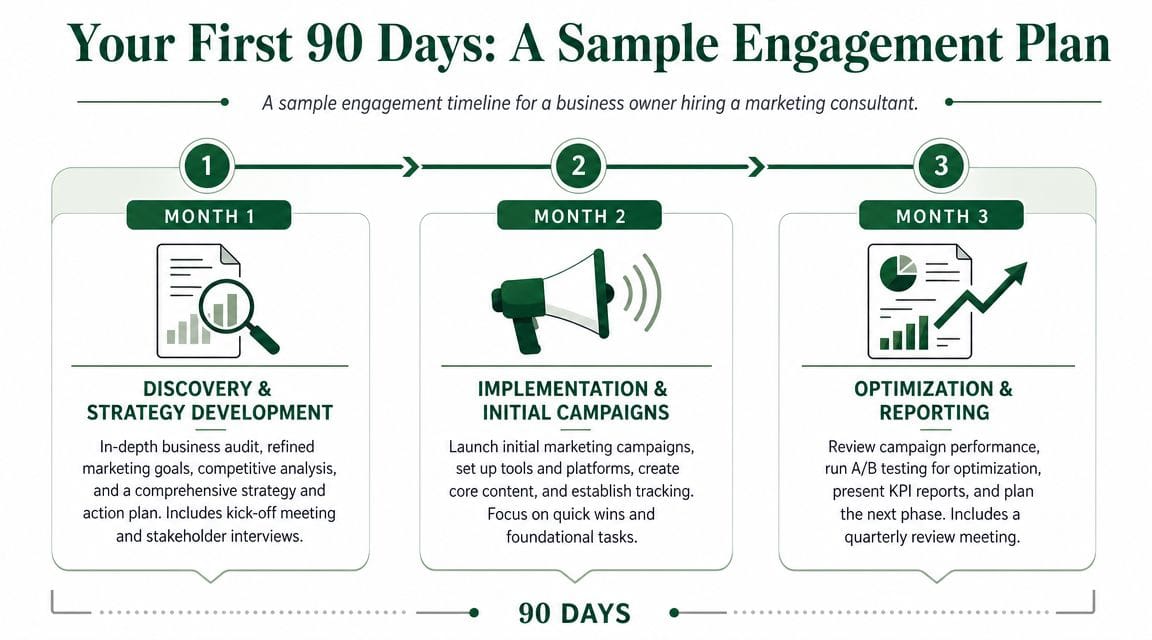
Month 1 discovery and direction
The first month should focus on facts, not activity for the sake of it.
That usually includes a review of the website, search visibility, conversion paths, offers, suburb targeting, competitor positioning, and existing tracking. If there are paid campaigns already running, those need checking before more money goes out the door.
A useful month-one output is a short action plan divided into:
- Fix now
- Build next
- Ignore for now
That last category matters. Brisbane owners often waste budget trying to keep every channel alive when only one or two are commercially ready.
Month 2 implementation and early wins
The second month should move from diagnosis to action.
That may mean tightening key service pages, improving enquiry paths, cleaning up Google Business Profile details, launching a focused ad campaign, fixing technical website issues, or refining landing pages. If conversion is a concern, owners should understand the basics of conversion rate optimisation in Australia because better enquiry flow often saves more money than buying more traffic.
This is also the point where responsibilities should be obvious.
| Task type | Consultant | Business owner or team |
|---|---|---|
| Strategy priorities | Yes | Approves direction |
| Platform setup or fixes | Often yes | Provides access |
| Content approvals | Drafts or guides | Reviews and signs off |
| Lead handling | Advises process | Responds to enquiries |
| Sales follow-up | Supports messaging | Owns execution |
Month 3 review refinement and next decisions
By the third month, the business should have enough signal to make smarter choices.
Not perfect data. Just enough reality to answer practical questions. Are the right leads coming through? Is the message resonating? Are people dropping off on key pages? Is the suburb focus right? Does the business need more implementation help than originally expected?
A good review at this stage includes:
- What changed: Work completed and what impact it appears to be having
- What blocked progress: Delays, missing inputs, weak offers, internal bottlenecks
- What to double down on: Channels or actions showing clear promise
- What to stop: Busywork that isn't helping
Momentum in the first 90 days usually comes from sharper focus, not more marketing activity.
This is also where the operating model gets tested. Some businesses realise a consultant remains the right fit. Others realise they now need a specialist freelancer, or an agency for broader execution. In Brisbane, providers like Boocoo offer services across SEO, web design, social media management, paid advertising, and digital marketing consulting, which can suit businesses that need both direction and implementation under one roof.
Conclusion Your Partner for Growth
Hiring a Brisbane marketing consultant shouldn't feel like gambling on a slick pitch. It's a business decision, and the strongest decisions usually follow a simple sequence. Define the goal. Find a shortlist that matches the problem. Use the interview to test thinking, not charm. Then make sure pricing, scope, and early milestones are clear enough to manage.
For many small businesses, the biggest win isn't flashy marketing. It's getting a practical partner who helps cut wasted effort and focus budget where it can move the business forward.
Owners who also want broader commercial context around growth decisions may find this guide to strategic business advice useful alongside marketing planning.
The right support should save time, reduce stress, and make the next decision easier, not harder.