
A lot of Brisbane business owners are in the same spot right now. The business itself is solid, customers are happy, and referrals still come through, but the website sits there like a brochure and the marketing keeps slipping to the bottom of the list.
That's usually when content marketing agencies start to make sense. Not because a business suddenly needs “more content”, but because it needs a practical system that helps the right people find the business, trust it, and make contact without the owner having to post every second night or rewrite website copy on a Sunday.
For small businesses, the win isn't volume. It's useful content, published consistently, tied to real commercial intent, and measured against calls, enquiries, bookings, and sales.
Why Your Brisbane Business Needs More Than Just a Website
A website on its own rarely brings steady leads. It can confirm that a business exists, show a phone number, and display a few photos, but that's not the same as giving potential customers a reason to find it through search or trust it before making contact.
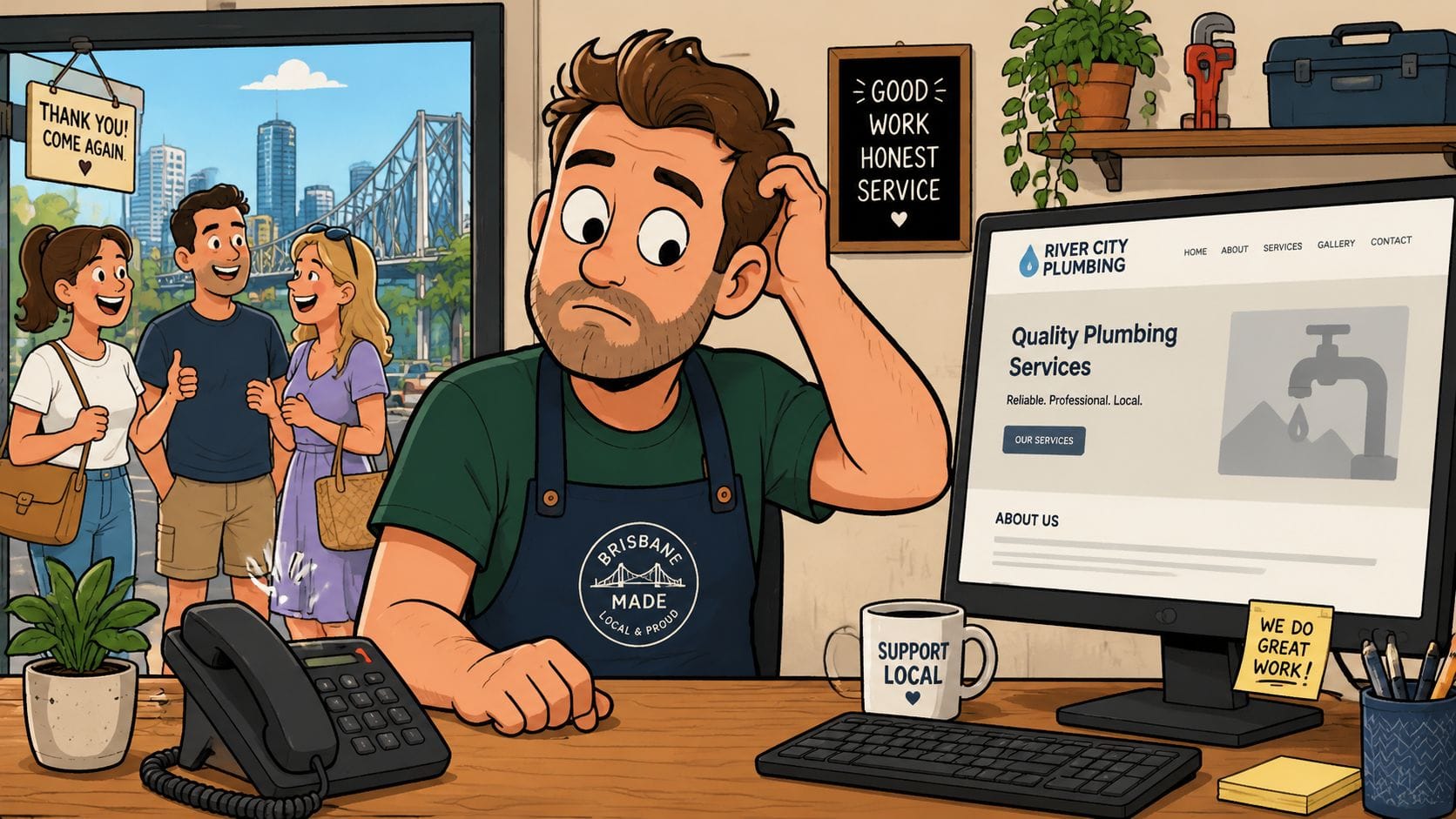
A website without content stays passive
For a Brisbane plumber, accountant, physio, electrician, or builder, the usual problem isn't that the business has nothing to offer. It's that the website doesn't answer the questions people are already searching. A customer types in something specific, lands on a competitor's helpful page, and makes the call there instead.
That's where content marketing starts to matter. It means creating useful material that matches customer intent. That might be a service page for “emergency hot water repairs Brisbane”, a blog answering pricing questions, a suburb page, an email follow-up, or short-form social content that keeps the business visible.
The scale of the opportunity is hard to ignore. Globally, 90% of organisations now have a content marketing strategy, and Australia had about 20.8 million social media user identities at the start of 2025, which shows how much buyer attention now sits across digital channels rather than just word of mouth or walk-ins (Reboot content marketing statistics summary).
Practical rule: If a website only talks about the business, it behaves like a brochure. If it answers buyer questions, it starts behaving like a salesperson.
What content marketing looks like for a local business
For small businesses, content marketing doesn't need to mean publishing endless thought leadership pieces. It works best when it solves obvious buyer questions and supports local search intent.
A few examples:
- For a trade business: a page explaining common causes of blocked drains in older Brisbane homes.
- For a legal or financial service: an article that explains a process in plain English, then points the reader toward a consultation.
- For a clinic: FAQ content around symptoms, treatment options, and when to book.
- For a retail or e-commerce business: buying guides, comparison pages, and product education.
The smartest version of this also overlaps with local SEO. A business that wants more suburb-level visibility should understand how content, location signals, and service pages work together. A practical local SEO guide, such as Brisbane local SEO advice for small business owners, can help frame the next steps.
Most owners don't need more marketing noise. They need a website that earns attention after hours, supports Google visibility, and helps turn interest into enquiries while the team is busy doing the actual work.
The Services Menu What Content Marketing Agencies Actually Do
Agency service pages can be confusing because they describe activities, not outcomes. A small business owner usually doesn't care about “editorial planning” in the abstract. They care about whether the phone rings more often, whether the right suburb pages rank, and whether enquiries improve.
The core jobs behind the service list
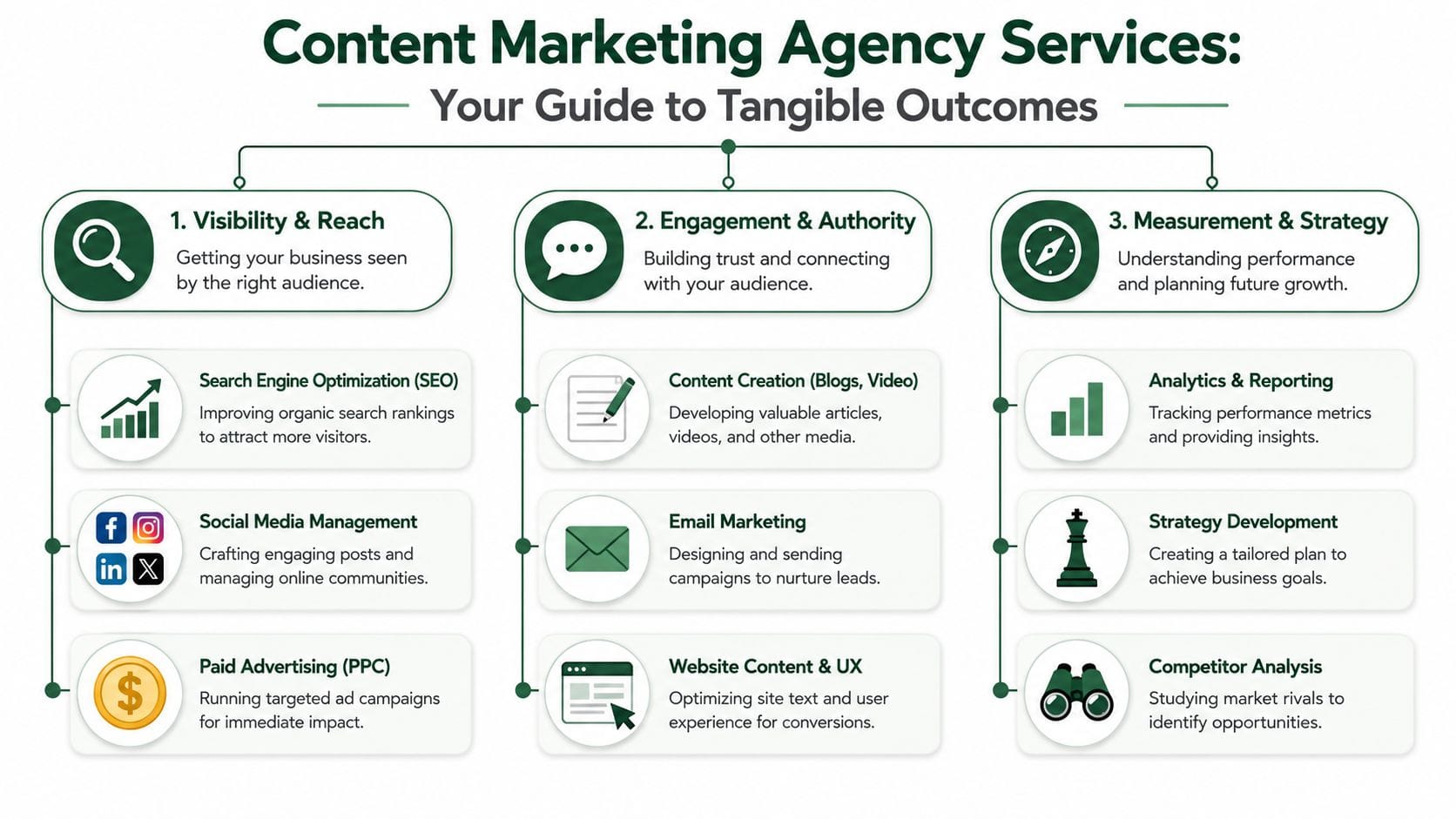
Most content marketing agencies are really handling three jobs at once.
First, they improve visibility. That includes SEO, service page copy, blog content, local landing pages, and sometimes paid support around high-intent pages. If someone searches for a specific problem in Brisbane, the goal is to make sure the business has a relevant page worth showing.
Second, they build trust and engagement. That's where social media content, email newsletters, case-study style content, FAQs, videos, and website copy come in. These assets help a prospect decide that this business looks organised, active, and credible.
Third, they handle measurement and iteration. That means checking which pages attract useful traffic, which topics lead to contact form submissions, and where people drop off before enquiring.
A local example makes this clearer:
- SEO content: a roofing company publishes pages around roof leak repairs, storm damage, and gutter replacement.
- Social media management: the same business posts project photos, maintenance tips, and before-and-after work to stay visible between buying cycles.
- Email marketing: past customers get seasonal reminders about inspections before storm season.
- Lead magnet or guide: a downloadable checklist helps property owners understand what to ask before approving repair work.
For agencies juggling multiple clients, operational systems matter too. Teams looking at ways to scale agency social media services often build repeatable approval, scheduling, and reporting processes so content doesn't become a bottleneck.
What this means for a time poor owner
Value is less about “content creation” and more about taking repeatable marketing jobs off the owner's plate.
A useful agency should be able to explain its work in plain language:
- Search content gets found by people already looking.
- Website copy helps those people understand the offer fast.
- Social content keeps the brand familiar.
- Email follows up with people who weren't ready on day one.
- Reporting shows whether any of it is leading to real enquiries.
Meaningful results from content marketing take time. Agencies expect to see initial traffic growth in 3 to 4 months, but consistent lead generation often takes 6 to 9 months, and stopping too early is one of the biggest mistakes small businesses make (Ten Speed on content marketing agency benchmarks).
That timeline matters because it changes expectations. A tradie or clinic owner shouldn't hire a content agency expecting next-week miracles. The better expectation is steady improvement through the right pages, useful content, proper distribution, and consistent follow-up.
A practical starting point for owners who know social media is part of the mix is this guide to social media for small business in Brisbane. It helps separate busywork from the kind of posting that supports enquiries.
Your Guide to Finding and Shortlisting an Agency in Brisbane
The fastest way to waste money is to hire an agency because its website looks polished, then discover later that no one can explain the strategy, the reporting, or what success is supposed to look like.
A better approach is to shortlist slowly and compare how each agency thinks.
Where to look beyond a basic search
Google is a start, but it shouldn't be the only filter. Some strong local agencies get most of their work through referrals, partner networks, and repeat business rather than chasing every broad search term.
Useful places to look include:
- Local business groups: chambers, networking groups, and industry meetups often reveal who other owners use.
- Referrals from adjacent suppliers: web developers, photographers, copywriters, and ad specialists usually know which agencies are organised and which ones create chaos.
- Agency content itself: an agency that publishes useful advice tends to show its thinking before the first call.
- LinkedIn and local social presence: not for vanity. For signs of consistency, clarity, and whether the team understands Brisbane businesses.
A business owner who wants a clearer picture of the local advisory side can also compare agencies with the help of a Brisbane marketing consultant guide, especially when deciding between one-off advice and ongoing execution.
What to check before making contact
Before sending any enquiry, spend ten minutes on the agency's own assets. That usually tells the story.
Look for these signs:
Their website explains process clearly
If the agency jumps straight to deliverables and skips discovery, strategy, and measurement, that's a warning.Their examples feel commercially relevant
The work should show an understanding of lead generation, not just design polish or clever wording.Their own content is current enough to trust
Perfection isn't required, but abandoned blogs and silent socials can signal delivery issues.They talk about outcomes in business terms
Good agencies discuss enquiries, conversion paths, and lead quality. Weak ones stay vague.They make room for different budgets and stages
Small businesses don't all need the same scope. A credible team should know that.
A professional agency workflow reduces risk when it starts with discovery and auditing existing assets, then maps content to buyer stages and sets clear KPIs. Agencies that can't explain how they measure conversions and pipeline impact usually fall back on vanity reporting (Wellows on agency workflow and measurement).
Red flags that save time and money
Some warning signs are obvious. Others look impressive at first.
The biggest ones:
- Guaranteed rankings promises: no serious agency can guarantee a specific Google position.
- No questions about the business model: if they don't ask about margins, services, booking value, or lead handling, they're probably selling output.
- Too much focus on volume: more blogs, more posts, more activity. None of that matters if the topics are weak.
- Unclear ownership: if no one can say who writes, edits, approves, publishes, and reports, delays usually follow.
- Reporting that stops at reach: traffic can matter, but Brisbane small businesses usually need calls, quote requests, booked consults, or sales.
A shortlist doesn't need to be long. Three solid options are usually enough. Past that point, extra comparison tends to create more confusion than clarity.
How to Interview an Agency and Ask the Right Questions
The interview call shouldn't feel like a sales demo. It should feel like due diligence.
A lot of content marketing agencies sound similar until the questions get specific. That's where the difference shows up between a team that has a working process and one that mostly sells confidence.

Questions that reveal how they really work
A good interview doesn't need marketing jargon. It needs practical questions that expose fit, clarity, and accountability.
These tend to work well:
How do you decide what content gets created first?
This shows whether they prioritise commercial intent or just fill a calendar.What will you need from the business each month?
Owners need to know whether they'll be approving every post, joining interviews, or supplying photos and job details.Can you show a sample monthly report?
This helps reveal whether reporting is useful or padded with vanity metrics.How do you measure success for a small business with a limited budget?
Strong agencies usually simplify the scoreboard. They don't drown owners in dashboards.How do you handle communication if the owner is hard to reach during the day?
This matters for tradies, clinicians, and service operators who aren't sitting at a desk.What happens in the first month?
The answer should include discovery, audit work, prioritisation, and setup. Not instant publishing.
The strongest agency answers usually sound calm and specific. They explain trade-offs, talk through sequencing, and admit that some channels matter more than others for certain businesses.
What a strong answer sounds like
The details matter more than the pitch style.
A capable agency will usually explain that content works best when the foundations are sorted first. That might mean tightening service pages before writing blogs, fixing calls to action before increasing traffic, or improving lead tracking before publishing more content. That answer isn't flashy, but it's often the right one.
By contrast, vague answers often sound polished while saying very little. If every question gets answered with “it depends” and no follow-up detail, the business owner still doesn't know what the next month will look like.
A strong answer also respects budget limits. It might sound something like this in practice:
- Start with the pages closest to purchase.
- Build a small content plan around common buyer questions.
- Use social to support visibility, not to replace the website.
- Report on enquiries and conversion actions, not just impressions.
- Review after a few months and adjust based on what's occurring.
That kind of conversation usually tells a small business owner more than any proposal deck.
Budgeting for Success Brisbane Pricing and a Sample Brief
Pricing is where many small businesses either overcommit too early or go too cheap and end up paying twice.
The key is to think in terms of scope, not just sticker price. A lower monthly fee may only cover a couple of posts and light admin. A higher retainer may include strategy, writing, on-page updates, reporting, publishing, and regular optimisation. Those are very different services.
What Brisbane businesses are usually paying for
Content should be judged on business impact, not activity alone. One industry compilation cited an average ROI of $7.65 for every $1 spent, and Australia's digital advertising market reached A$17.1 billion in 2024, which shows how much pressure now sits on marketing to justify spend with traffic, enquiries, and revenue rather than just output (ProperExpression content marketing statistics).
That doesn't mean every campaign will perform the same way. It means owners should ask what the spend is buying in practical terms.
Here's a simple way to think about retainers in Brisbane.
| Package Tier | Typical Monthly Budget (AUD) | Common Inclusions |
|---|---|---|
| Starter | Lower monthly retainer | One core priority each month, such as a service page refresh, a small SEO content plan, basic publishing, and simple reporting |
| Growth | Mid-range monthly retainer | Ongoing strategy, multiple content assets, social support, website updates, conversion-focused reporting, and regular optimisation |
| Broader support | Higher monthly retainer | Multi-channel content, deeper SEO work, more frequent production, campaign coordination, and tighter integration with ads or email |
Without a fixed scope, “cheap” can become expensive fast.
A simple brief that gets better quotes
A short written brief saves time and makes agency quotes easier to compare. It doesn't need to be fancy.
A strong small-business brief includes:
- Business type: what the business does and where it operates
- Main services or products: which offers matter most
- Ideal customer: suburb, industry, job type, or problem type
- Current marketing situation: what's already in place
- Main goal: more calls, quote requests, online sales, bookings, or repeat business
- Internal limits: time available, approval speed, available assets
- Budget comfort zone: a realistic monthly range
- Success signal: what result would make the spend worthwhile
If an owner can summarise the goal in one sentence, agencies usually produce better proposals. “More Brisbane traffic” is weak. “More quote requests for high-margin electrical work in the northside” is much better.
A Local Brisbane Partner Who Gets It Meet Boocoo
Plenty of agency problems come down to mismatch. The business needs clear help, simple communication, and sensible priorities. The agency delivers layers of process, vague reporting, and too many moving parts.
That's why local fit matters.
Why a local operator can make the process easier
For Brisbane businesses, there's practical value in working with a team that understands local service areas, suburb-based search behaviour, and the way small operators make decisions. That usually leads to better prioritisation and less wasted motion.
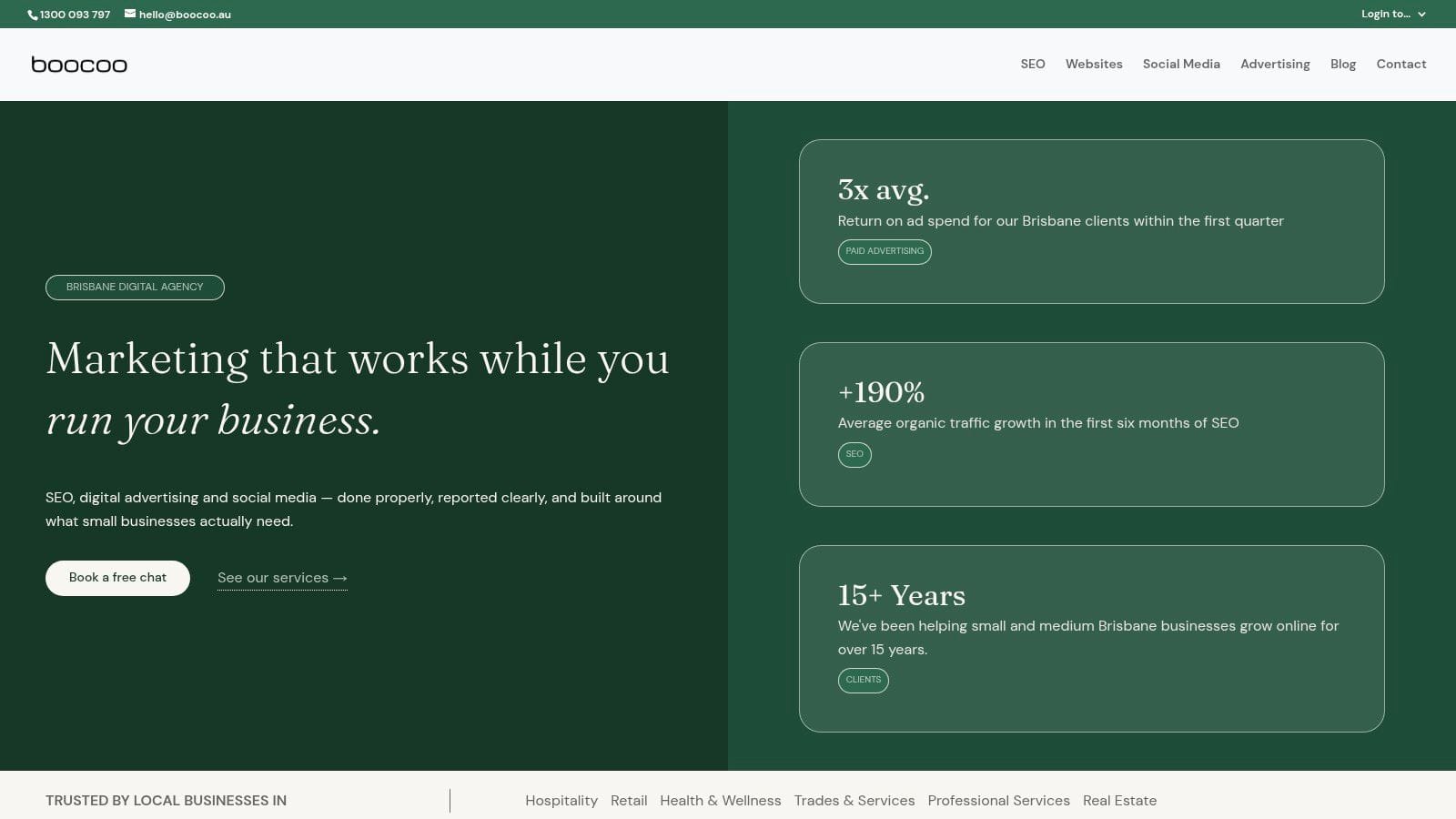
Boocoo is one example of that kind of partner. It's a Brisbane-based small business digital agency that supports local operators with SEO, web design, social media management, and paid advertising, with a focus on taking marketing admin off the owner's plate and keeping communication straightforward.
That matters because most small businesses don't need a massive content machine. They need someone to help sort the basics, keep the important channels active, and build momentum without creating another part-time job for the owner.
A practical partner should be able to help answer questions like these:
- Which pages should be fixed first
- Whether social content is supporting the website properly
- What can be paused without hurting results
- What should be measured every month
- How to keep the workload manageable
A low pressure next step
The businesses that get the most from content marketing agencies are usually the ones that stay focused. They don't chase every channel at once. They pick the pages, topics, and buyer questions closest to revenue, then build from there.
For a Brisbane owner who wants that kind of support, a low-pressure conversation is often the best next step. Boocoo can be reached on 1300 093 797 or at hello@boocoo.au to talk through goals, timing, and whether outsourced support makes sense for the business.
That sort of first conversation should feel simple. Clear goals, clear scope, clear next steps.