
Some Brisbane tourism businesses are flat out on Saturday and quiet on Tuesday. One week the phone rings with last-minute bookings, the next week there’s too much silence. That pattern feels normal in tourism, but it becomes expensive when the business depends on walk-bys, referrals, and whatever social post happened to land well that month.
Tourism digital marketing matters most when bookings feel uneven. A small operator doesn’t need a big team or a glossy campaign to fix that. It needs a simple system that helps the right people find the business, trust it quickly, and book without friction.
For Brisbane operators, that system should match local reality. Visitors compare options on mobile. Families look for easy activities during school holidays. Interstate travellers search with weather and season in mind. Local customers want fast answers, clear prices, and confidence that the tour will be worth their time.
Why Your Brisbane Tour Needs Digital Marketing Now
A Brisbane tour operator can still get bookings from word of mouth. That hasn’t disappeared. What’s changed is how people narrow options before they ever call, message, or turn up.
A visitor might land in Brisbane for a few days, search on Google while waiting for coffee in South Bank, compare reviews, tap through two or three websites, then book the option that feels easiest. Another traveller in Melbourne might start planning a winter break weeks earlier and save a Reel before ever visiting a website. Both decisions happen digitally, even if the experience itself is local and personal.
The broader shift is already clear. In Australia, 85% of Destination Marketing Organisations maintained or increased their digital advertising budgets in 2024 to 2025, while digital channels accounted for over 70% of international visitor inquiries to Queensland in 2024, according to Australian tourism marketing statistics. That tells small operators something useful. The market has already moved. Waiting doesn’t create an advantage.
What relying on old habits looks like
Some operators still lean on a familiar mix:
- Print and brochures: Helpful as support material, but weak as a primary lead source.
- Irregular posting: A burst of social activity before peak periods, then silence.
- No clear booking path: Customers have to call, email, or hunt for details.
- Generic messaging: “Great local experience” says very little when every competitor says the same thing.
Those habits don’t always fail all at once. They just leak opportunities every week.
Practical rule: If a traveller can’t understand the tour, trust the operator, and see how to book within a minute on mobile, the marketing is doing extra work to make up for it.
Tourism digital marketing isn’t about doing everything. For a small Brisbane business, it’s about creating steady visibility and making booking easier when interest appears. That’s the difference between hoping demand shows up and building something more predictable.
Building Your Digital Foundation on a Budget
The cheapest marketing fix is usually not another platform. It’s improving the assets already in place. For most small tourism businesses, that means the website and local search presence.
Your website has one job
A tourism website doesn’t need clever language. It needs to answer practical questions fast.
When someone lands on the homepage or a tour page, they usually want six things straight away: what the experience is, who it suits, where it starts, how long it takes, what it costs, and how to book. If any of that is buried, the site starts losing people.
A lean site setup usually works better than a bloated one. One strong homepage, one page per tour, one clear FAQ section, one contact page, and a simple booking flow often outperform sites loaded with extra menus and filler pages.
A budget-friendly website checklist looks like this:
- Mobile-first layout: Most visitors will see the site on a phone first. Buttons need to be obvious, text needs breathing room, and booking steps need to feel easy.
- Real photos: Use genuine images from actual tours where possible. Staged stock photography creates distance.
- Clear calls to action: “Book now”, “Check availability”, and “Call to confirm today’s departure” work better than vague prompts.
- Practical FAQs: Include weather, accessibility, age suitability, meeting point, and cancellation details.
- Fast trust signals: Reviews, safety notes, and operator credentials should appear before the visitor has to search for them.
For operators improving visibility without overspending, a focused approach to search engine optimisation in Brisbane often does more than spreading effort across too many channels too early.
Local SEO starts with the basics
Local SEO sounds technical, but the first wins are simple. A tour business wants to appear when someone searches terms such as Brisbane river cruise, Brisbane walking tour, or things to do near South Bank.
For Brisbane-based operators, effective local SEO optimisation can yield a 25 to 40% increase in organic traffic, while incomplete Google My Business profiles can reduce visibility in the local pack by up to 70%, according to tourism local SEO guidance.
That doesn’t mean chasing every technical trend. It means getting the basics right before anything else.
The low-cost work that actually helps
- Complete the Google Business Profile properly: Add accurate categories, opening hours, service details, booking links, and recent photos.
- Match business details everywhere: The same name, address, and phone details should appear across the website, directories, and listings.
- Create location pages only when they’re real: If tours leave from different meeting points, explain each clearly. Don’t spin up thin suburb pages with recycled copy.
- Ask for reviews while the experience is fresh: The best time is usually the same day the customer finishes the tour.
- Write pages for actual searches: “Private Brisbane brewery tour” beats generic copy about unforgettable experiences.
A good local presence isn’t built by tricks. It’s built by accuracy, clarity, and enough proof that Google and customers can both trust what they’re seeing.
Small operators often waste money trying to look bigger than they are. The smarter move is looking reliable, local, and easy to book.
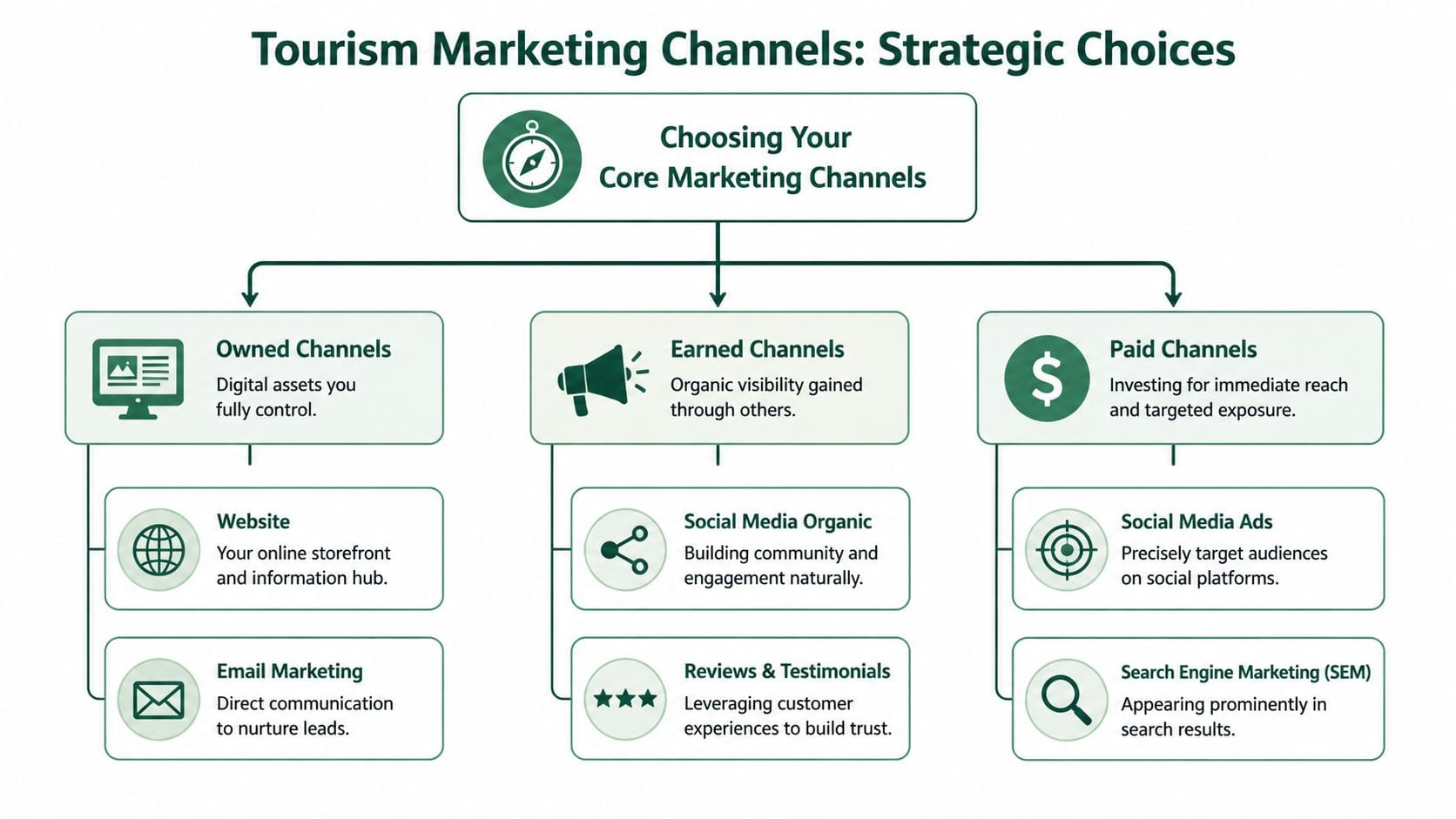
Choosing Your Core Marketing Channels
Every channel has a different job. Problems start when a tourism business expects Instagram to close every sale, Google Ads to build brand loyalty, or email to fix weak offers. Channel choice gets easier when each one has a clear purpose.
Social media for demand creation
Social media works best near the top and middle of the decision process. It helps people discover the experience, imagine themselves in it, and remember the brand later.
That matters in tourism because travel choices are visual. Video content has proven especially influential with Millennial and Gen Z travellers, and 75% of travellers report their destination choices were inspired by social media, according to research on social media and tourist behaviour.
For a small Brisbane operator, social doesn’t need polished production. It needs useful, believable content. Short clips of the boat leaving the dock, the guide greeting guests, the view at a key stop, or families enjoying a simple moment usually beat over-produced montage videos.
Social media tends to work when the content does one of these jobs:
- Show the experience clearly: What happens on the tour, not just pretty scenery.
- Reduce uncertainty: What to bring, where to park, whether kids will enjoy it.
- Borrow trust: Repost guest photos and short testimonials with permission.
- Create timeliness: Limited departures, weekend availability, event tie-ins.
What doesn’t work as well is constant self-promotion with no variety. A feed full of sales copy gets ignored quickly.
Paid ads for active intent
Paid ads are useful when timing matters. A new product launch, a quiet month, a school holiday window, or a weather-driven travel spike are all good reasons to use them.
Search ads and Meta ads do different jobs. Google Ads captures people already looking. Meta creates awareness and can support retargeting for people who visited the site but didn’t book.
For Queensland tourism campaigns, geo-targeted PPC on Google Ads and Meta can deliver up to a 3.2x return on ad spend by targeting interstate markets, according to Queensland tourism PPC guidance. For a Brisbane operator, that makes practical sense during cooler months down south, when interstate travellers are more open to a short escape.
A simple way to think about it:
| Channel | Best use | Good example |
|---|---|---|
| Google Ads | Capture ready-to-book intent | “Brisbane whale watching”, “best Brisbane day tour” |
| Meta Ads | Build awareness and retarget interest | Short Reel showing the tour experience to people planning trips |
| Retargeting | Recover warm traffic | Follow up with people who viewed a tour page but didn’t finish booking |
Email for follow-up and repeat bookings
Email usually gets overlooked because it feels less exciting than ads. For small businesses, that’s a mistake. It’s one of the few channels the business fully controls.
A tourism operator doesn’t need a complex automation setup to make email useful. Even a basic structure helps:
- Pre-visit emails: Confirmation details, what to bring, where to meet.
- Post-visit emails: Review request, photo reminder, referral offer.
- Seasonal emails: School holiday offers, gift ideas, weekend availability.
- Past guest campaigns: Invite previous customers back for a different experience.
The cheapest booking is often the one that comes from someone who already knows the business.
Email also sharpens the rest of the marketing. It shows which offers people care about, which subject lines get ignored, and which parts of the experience are worth turning into social content or ad creative. Used properly, it stops marketing from becoming a one-shot effort.
Local and Seasonal Tactics for Brisbane Operators
Brisbane rewards operators who pay attention to the local calendar. A campaign that feels ordinary in March can feel timely and relevant during Riverfire, school holidays, a long weekend, or a stretch of cool weather in Sydney and Melbourne.
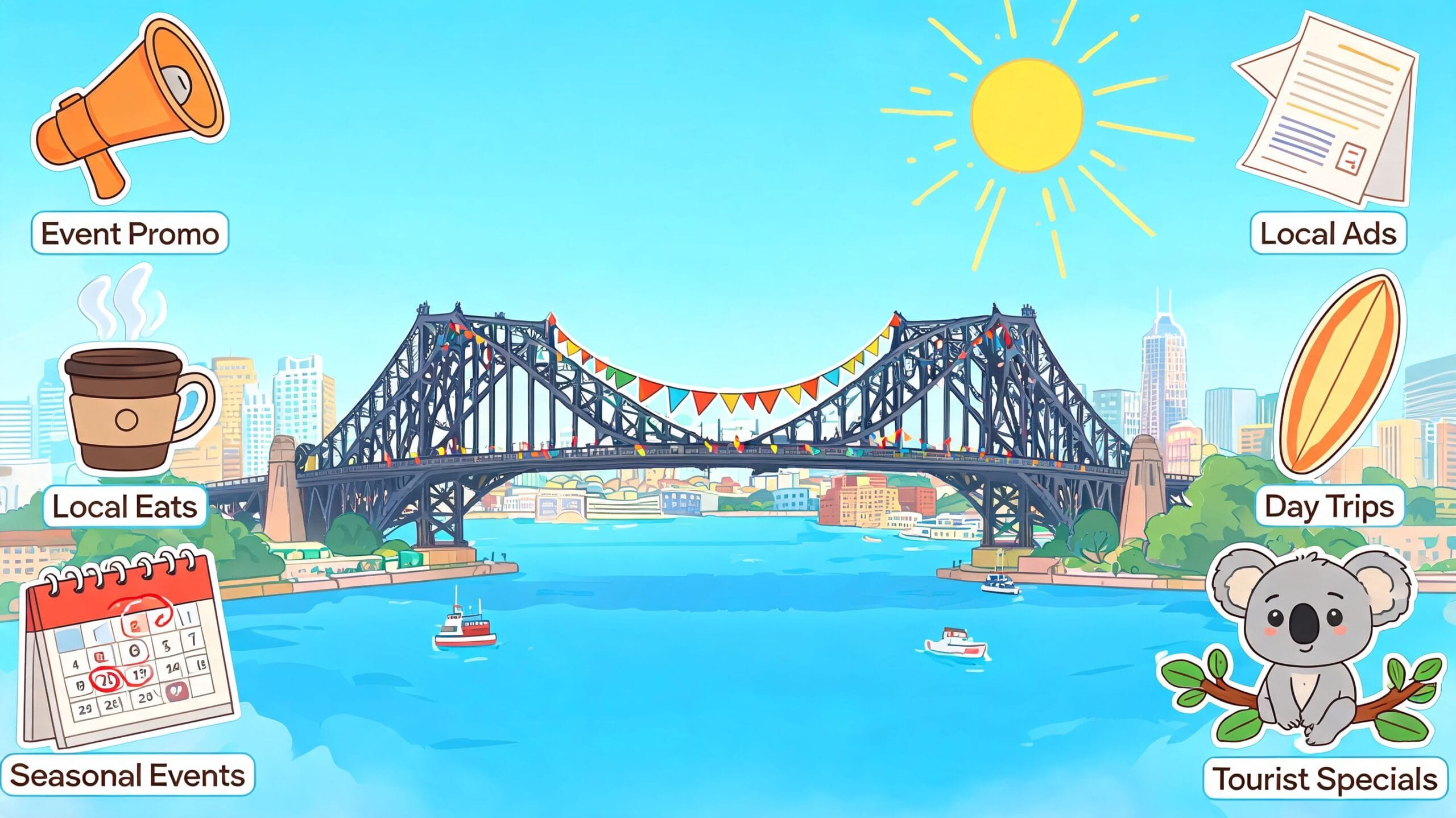
Build campaigns around Brisbane moments
Take a hypothetical river-based operator in the lead-up to Riverfire. A generic ad saying “Book our Brisbane cruise” blends into the background. A tighter campaign angle works harder: pre-event departures, skyline views, easy city access, and a simple explanation of who the experience suits.
The same thinking applies across the year. During school holidays, families need convenience. During summer storm periods, people need reassurance and clear weather policies. In winter, interstate visitors are often chasing warmth, not just activities.
A practical seasonal content plan might include:
- School holidays: Family-friendly itineraries, group booking prompts, simple packing tips.
- Winter: “Weekend in Brisbane” angles for southern states, tied to sunshine and easy outdoor experiences.
- Event periods: Departure timing, access details, and event-specific packages.
- Quieter weeks: Staycation offers for locals who want something different without leaving town.
Posting timing matters too. For operators relying on Facebook and Instagram, it helps to understand the best time to post to Facebook for Australian audiences so seasonal offers don’t disappear into dead hours.
Use partnerships to stretch your budget
The cheapest reach often comes from businesses that already serve the same customer. Hotels, cafes, local accommodation providers, visitor centres, wedding venues, and event organisers can all help put the offer in front of the right people.
The key is choosing partners that complement the tour instead of competing with it. A brewery tour can work with a nearby hotel. A family attraction can work with a café that already sees parents and kids all day. A scenic day tour can work with an inner-city accommodation provider that wants better guest recommendations.
This approach works best when the offer is easy to explain.
A partner can’t sell a confusing tour. Give them one sentence, one image, and one booking link they can share without effort.
The Brisbane businesses that stay visible year-round usually don’t rely on one big campaign. They keep adapting the same core offer to local moments, local audiences, and local partnerships.
Sample Campaign Frameworks for Small Budgets
A small budget works when the campaign is narrow. It fails when the business tries to target everyone, on every channel, with one vague message. Two simple frameworks can go a long way.
Framework one for a new tour launch
This framework suits a business launching a new walking tour, food tour, river activity, or private experience.
Start with one clear promise. Keep it specific. “Small-group twilight Brisbane city walk” is stronger than “amazing local adventure”. Build one landing page, one short booking form, a handful of social assets, and one email to existing contacts.
Suggested setup:
| Campaign Goal | Target Audience | Channels | Sample Budget | Success Metric |
|---|---|---|---|---|
| New tour launch | Local Brisbane residents, past customers, nearby weekend visitors | Organic Instagram and Facebook, a small Meta ad campaign, one email send | $500 | Booking enquiries and completed bookings from the new tour page |
How the budget can be used in practice:
- Creative first: Use short vertical video, one guest-facing image, and a straightforward offer.
- Warm audiences before cold ones: Start with past customers, website visitors, and people already engaging with social content.
- Keep the landing page focused: One tour, one message, one booking action.
- Use social proof quickly: As soon as the first customers come through, request photos and reviews.
This campaign works because it limits variables. The operator can clearly see what resonated instead of guessing across too many moving parts.
Framework two for a shoulder season push
A shoulder season campaign is about filling unused capacity without discounting the brand into the ground. That usually means sharper targeting, stronger timing, and better landing pages.
For Queensland tourism campaigns, geo-targeted PPC on Google Ads and Meta can deliver up to a 3.2x ROAS when targeting interstate users, which makes this a practical model for a Brisbane operator trying to attract travellers from southern cities during quieter periods. That performance benchmark was noted earlier in the article.
A simple version looks like this:
| Campaign Goal | Target Audience | Channels | Sample Budget | Success Metric |
|---|---|---|---|---|
| Shoulder season push | Interstate travellers planning short Brisbane breaks | Google Ads for intent, Meta retargeting, email to past guests | Ongoing modest weekly spend | Qualified leads, booking volume during quieter weeks |
A few trade-offs matter here.
If the operator has very limited time, Google Ads usually deserves attention before more organic social posting because search traffic carries clearer intent. If the operator already has warm audiences and strong visuals, Meta retargeting can support that effort well. If the website is clunky, neither channel will save the campaign for long.
The most useful discipline is simple. Run one offer, to one audience, with one main conversion action. Then adjust based on bookings, not on how busy the dashboard looks.
Measuring What Matters to Avoid Wasting Money
A lot of tourism marketing feels productive without being profitable. A post gets likes. An ad gets clicks. Website traffic rises. None of that guarantees more bookings.
That gap is common in tourism. Experts highlight a significant disconnect where organisations prioritise easy-to-measure KPIs like clicks, while actual goals are outcomes like bookings, and clicks and impressions do not reliably reflect campaign success, according to analysis of KPI gaps in tourism marketing.
What to ignore first
Vanity metrics aren’t useless. They just need to stay in their place. A Reel with strong reach may help awareness, but it doesn’t automatically justify more budget. A spike in clicks may mean the ad was curious, not convincing.
Small operators usually get clearer answers by downgrading the importance of:
- Follower count: Plenty of followers never become customers.
- Impressions alone: Seen doesn’t mean considered.
- Click volume without context: Traffic can be low quality.
- Post engagement by itself: Likes are easy. Bookings are hard.
At this stage, many campaigns go off track. The business rewards the channel that looks busiest instead of the one that produces customers.
What to track instead
A lean measurement setup is enough for most tourism businesses. Google Analytics 4, booking platform reports, enquiry forms, and call tracking can usually provide enough signal to make better decisions.
The more useful questions are practical:
- Which channel brought the booking or enquiry
- Which tour page converts best
- Which campaign produces higher-quality leads
- Where people drop off before booking
- Which audience segment keeps returning
Operators that want more bookings from the same traffic should also pay attention to conversion friction. Improving headlines, mobile page layout, trust signals, and form length can make more difference than chasing extra traffic. A solid conversion rate optimisation approach for Australian businesses usually starts there.
If the campaign sends good people to a weak page, the page is the problem. Not the platform.
A practical dashboard for a small tourism business can stay very simple: enquiries, completed bookings, top traffic source, best-performing page, and abandoned booking steps. That’s enough to cut waste and make better decisions month after month.
Your Quick-Start Action Checklists
Good tourism digital marketing doesn’t need a giant reset. It needs repeated small actions that keep the business visible and bookable.
Weekly
- Reply to every new review: Thank the customer, answer concerns calmly, and show future customers that the business is active.
- Check booking friction: Test the website on a phone and complete the booking path as if it were a real customer.
- Review ad basics: Pause weak creative, confirm links work, and make sure campaigns still match current availability.
- Post one useful update: Share something practical, such as departure conditions, local weather context, or a guest photo.
Monthly
- Refresh key pages: Update tour descriptions, FAQs, seasonal details, and images so the site reflects what’s being sold.
- Plan content around the calendar: Tie posts and offers to school holidays, long weekends, local events, and quieter periods.
- Send one email: Promote availability, remind past guests about other experiences, or ask for referrals.
- Review search visibility: Check whether the business appears properly for core branded and local searches.
Quarterly
- Audit the channel mix: Keep the channels that produce bookings. Reduce effort on the ones that only produce noise.
- Review top-performing offers: Look at which tours sell most easily and which need better positioning or packaging.
- Tighten local partnerships: Contact hotels, venues, or nearby businesses that could refer aligned customers.
- Set one improvement project: Pick a single priority such as the booking page, Google Business Profile, review process, or campaign landing page.
A small Brisbane operator doesn’t need perfect marketing. It needs consistent marketing that matches how people search, compare, and book.