
A lot of Brisbane business owners hear the phrase what is da backlink after a call with an SEO provider, then privately wonder whether they've missed a lesson everyone else already got. The website looks fine, the service is solid, enquiries should be coming in, yet the jargon keeps piling up. DA, DR, authority, link equity. It can sound like a private language.
The useful part is much simpler. A backlink is just one website linking to another, and search engines often treat that like a vote of confidence. That matters because 94% of web pages have zero backlinks, which means earning even a small number of quality links can set a business apart in search results, according to Reboot's SEO statistics. For a small Brisbane operator, that's good news. It means the goal isn't to build a giant pile of random links. It's to earn a few that are relevant.
Demystifying DA Backlinks and Why They Matter
A DA backlink sounds more technical than it really is. Most of the time, people are, in essence, talking about a backlink from a website that has a strong Domain Authority score in Moz. That's the shorthand. The confusion starts when that shorthand gets treated like the whole strategy.
For a Brisbane small business, backlinks matter because they help search engines work out who is credible in a local market. If a local accountant gets mentioned by a respected business association, or a café is listed by a trusted Brisbane guide, those links help build trust signals around the site. They can also send real visitors.
A good backlink does two jobs at once. It helps search engines understand trust, and it gives real people a path to the business.
That second part is where many small businesses save time and money. Chasing dozens of low-grade links usually creates admin with very little upside. A smaller number of relevant links from Australian sites, suppliers, associations, partners, or local publications is usually the smarter play.
There's also a practical reason not to overcomplicate this. Most competitors aren't doing it well. Many are either ignoring link building entirely or buying links that look good in a report but do nothing for leads. A grounded backlink strategy gives a business owner a way to filter the noise.
A Brisbane plumber doesn't need a backlink from a random overseas lifestyle blog. A link from a local chamber page, a builder partner, or an Australian trade body is far easier to justify. It fits the business, it fits the audience, and it fits the budget.
What Is Domain Authority and How It Relates to Backlinks
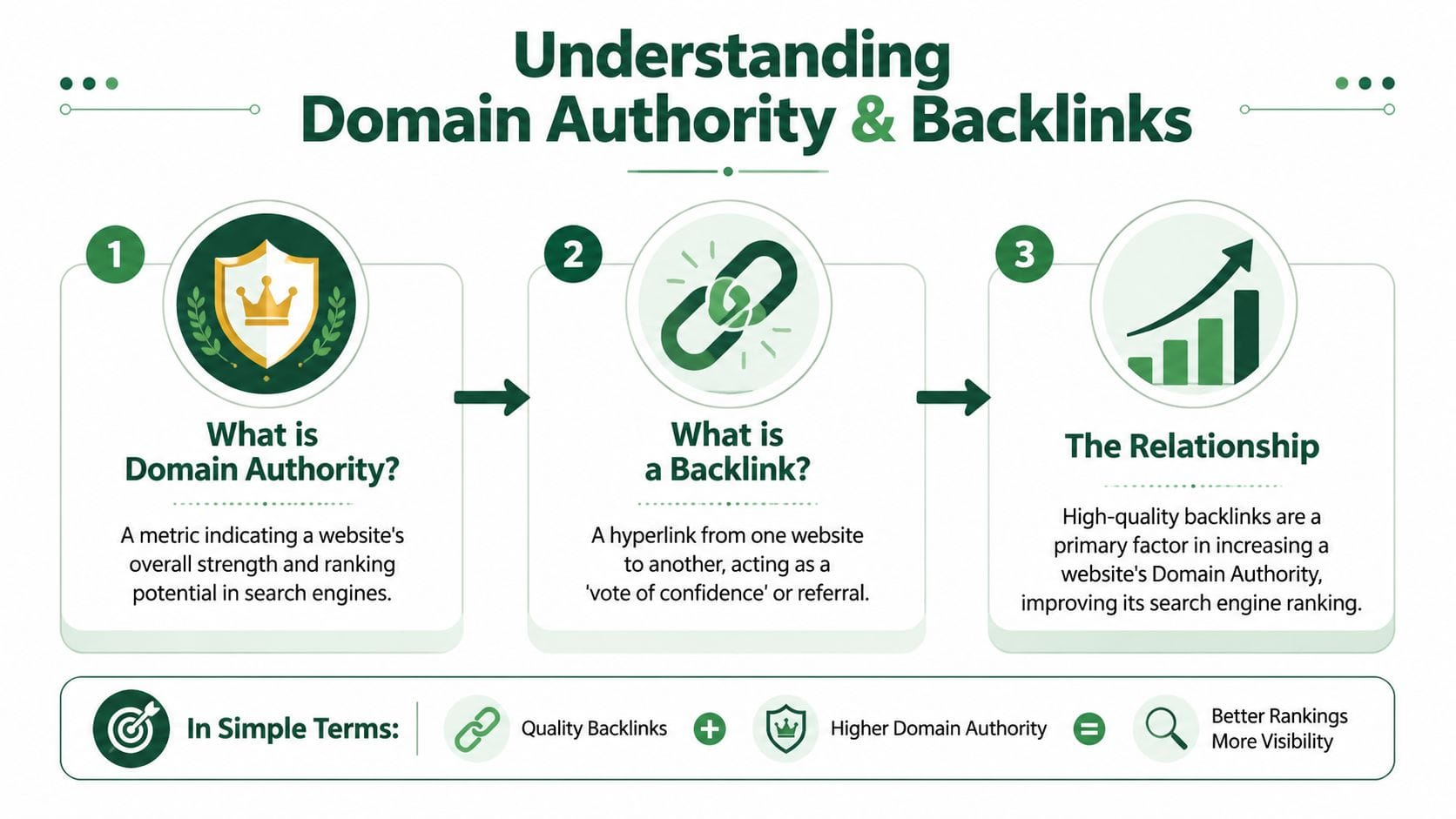
A backlink is the easy part to understand. It's a hyperlink from one website to another, and search engines treat those links as trust signals. A link from a relevant, authoritative site generally passes more value than a weak or unrelated one, as explained in Moz's backlink guide.
Backlinks first, DA second
The easiest analogy is a business referral. If a trusted Brisbane architect recommends a builder, that referral carries weight because of who made it and how relevant the connection is. A backlink works in much the same way online.
Domain Authority, or DA, is a metric created by Moz. It estimates how strong a website's ranking ability may be compared with other sites. For readers wanting a plain-English explainer of the score itself, this guide to domain authority for SEO is a handy companion resource.
DA can be useful for quick comparisons. It helps answer questions like these:
- Is this site generally established
- Does it appear to have a stronger backlink profile than another site
- Is this opportunity likely to come from a trusted publication or a weak one
That said, businesses still need broader SEO basics in place. Strong links won't rescue a poorly organised site, which is why foundational work like search engine optimisation services still matters.
What people mean by a DA backlink
When someone asks what is da backlink, they usually mean a backlink from a site with a higher DA score.
That's all.
It does not automatically mean the link is excellent. It does not mean Google uses that score directly. It also doesn't mean a high-DA link will bring a single enquiry.
Practical rule: treat DA like a quick reputation clue, not a final verdict.
A strong site can still host a weak page. A modest site can still send an excellent link if the page is relevant, indexed, and seen by the right audience. That distinction matters a lot once the conversation moves from SEO theory to actual lead generation.
Why High DA Is Not the Whole Story
The biggest mistake in backlink planning is assuming the highest DA always wins. It doesn't. Moz, which created Domain Authority, states that DA is a comparative metric designed to predict ranking ability, not a direct Google ranking factor, in its Domain Authority explainer.
DA is a comparison tool, not the finish line
That changes how a small business should look at link opportunities. The useful question isn't only “What's the DA?” It's also “Who reads this page, and would they ever become a customer?”
A Brisbane café is a good example. A mention on a generic overseas business site might carry a bigger DA number, but it may never send a local customer through the door. A feature on a Brisbane food blog, neighbourhood guide, or event page may have a lower DA score but be far more valuable commercially.
This is why many marketers now care more about audience fit and conversion potential than raw authority metrics alone. For a broader perspective on how people try to improve authority scores, Feather's guide to domain authority is worth reading, especially when viewed with a healthy dose of scepticism.
A Brisbane example that makes this clearer
Say a café in West End gets two possible link offers.
| Link Attribute | Option A: High DA, Low Relevance | Option B: Lower DA, High Relevance |
|---|---|---|
| Website type | Large international marketing blog | Brisbane food and events blog |
| Audience fit | Broad, unrelated readers | Locals looking for places to eat |
| Local signal | Weak | Strong |
| Chance of referral traffic | Low | Higher |
| Lead value | Mostly vanity | More likely to bring actual visits |
The table is simple, but it reflects a common trade-off. A flashy metric can look impressive in a report. A relevant local mention can do more for bookings, walk-ins, and branded searches.
There's another layer here. If the site gets traffic but the landing page doesn't convert, the link still underperforms. That's where businesses need to think beyond rankings and into conversion. A page that attracts visitors should also make it easy for them to call, book, enquire, or order. That's the same logic behind conversion rate optimisation for Australian businesses.
The best backlink is rarely the one that looks best in a spreadsheet. It's the one that fits the business.
For Brisbane operators with tight budgets, that mindset stops a lot of wasted spend. It shifts attention from vanity metrics to actual outcomes.
How to Evaluate the Quality of a Backlink
A backlink opportunity doesn't need a complicated audit. Most small business owners can do a quick quality check in a few minutes if they know what to look for.

Modern SEO places more weight on the specific page a link appears on, not only the site-wide DA score. An indexed, contextually relevant page that can send referral traffic is often more useful than a link from a high-DA site with no audience fit, as outlined in Loganix's explanation of DA links.
A simple four-part check
Start with relevance.
- Topical relevance: Does the site talk about the same industry, problem, or customer need? A Brisbane mortgage broker should care more about finance, property, and local business sites than random general blogs.
- Local relevance: Is the site tied to Brisbane, Queensland, or Australia? Local directories, suburb guides, chambers, schools, clubs, and neighbourhood media often carry stronger local context.
- Audience fit: Would the readers buy? A partner business, supplier page, or community site may have a small audience, but it can still be the right one.
- Legitimacy: Does the website look real and maintained? Thin content, strange categories, stuffed keywords, or obvious paid-link pages are warning signs.
Questions to ask before saying yes
A quick checklist helps:
- Would this link make sense even if Google didn't exist
- Is the page about something connected to the business
- Can a real customer plausibly click it
- Does the site look trusted, updated, and human
- Would the business be comfortable showing this link to a customer
If the answer is mostly no, it's probably not worth chasing.
A useful filter: if the only selling point is the DA number, the opportunity is usually weaker than it sounds.
Small operators can also spot stronger opportunities by looking at page context. A link inside a useful article, sponsor page, partner page, or local resource section tends to make more sense than a link dropped onto a random page full of unrelated businesses.
That keeps the process lean. No fancy tool stack required. A browser, common sense, and a few careful questions are often enough to avoid the worst link pitches.
Practical Link Building Ideas for Brisbane Businesses
Backlink advice often gets abstract fast. Small businesses need options that are affordable, local, and realistic to execute without a full-time marketing team.
Google has confirmed backlinks are one of its top three ranking factors, and for a Brisbane business, links from Australian and Brisbane-based websites send a strong local credibility signal, as noted in SE Ranking's SEO statistics roundup.
Low-cost ideas that suit local operators
Some of the best link opportunities come from ordinary business activity.
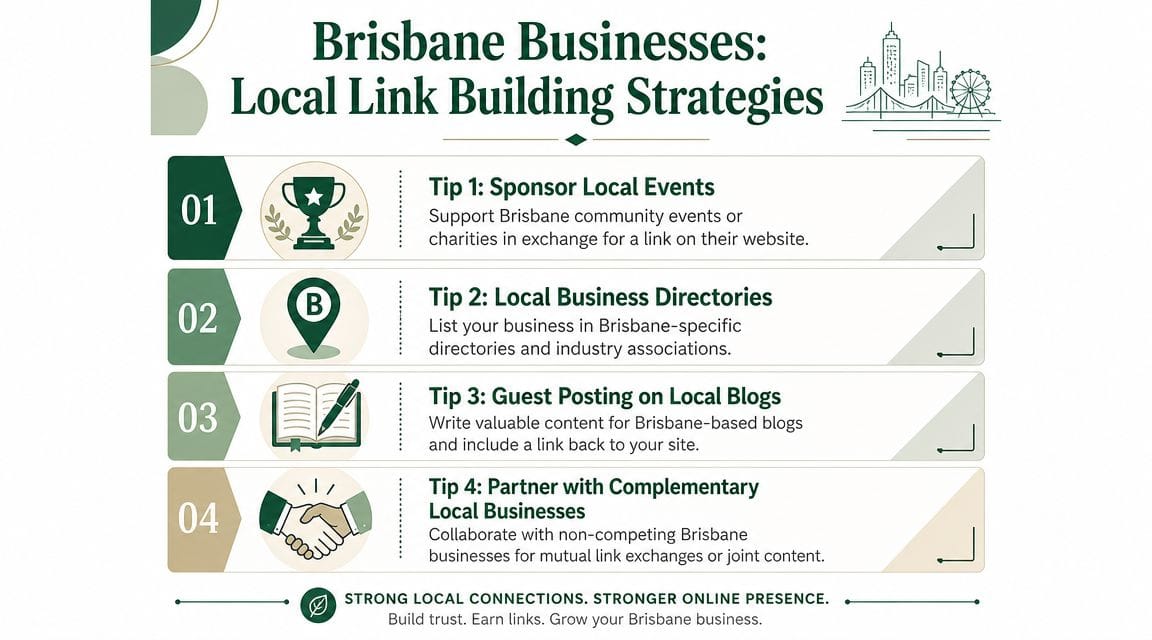
- Sponsor something local: A junior sports club, school fundraiser, charity event, or suburb festival often thanks sponsors on its website.
- Build partner pages: A plumber can swap useful partner mentions with an electrician, builder, or real estate agency where the relationship is genuine and relevant.
- Join industry bodies: Membership listings from associations and local business groups can strengthen trust and local visibility.
- Contribute useful local content: A Brisbane accountant could write tax tips for a local business blog. A gardener could contribute seasonal yard advice to a suburb publication.
For businesses that want more ideas around local authority building, this resource on how to boost local SEO for agencies can spark a few practical angles, even for non-agency operators.
What tends to work better than cold backlink pitches
Cold emails promising “premium placements” usually aren't the most efficient path for a small business. Relationship-based links are often better value because they come from people already connected to the business.
A few examples that fit Brisbane well:
- A café in Paddington partners with a nearby florist on a Mother's Day promotion and both businesses link to the campaign page.
- A tradie in The Gap sponsors a local team and earns a sponsor page mention.
- A tourism operator gets featured in a Brisbane itinerary article or event roundup, then links that mention to a booking page built for local intent.
Tourism and hospitality businesses in particular benefit from local mentions, attractions pages, and event tie-ins. That's one reason specialised work like tourism digital marketing support often overlaps with local link strategy.
Local links work best when they come from real participation in the community, not manufactured placements.
That approach also saves time. Instead of hunting strangers for backlinks, the business looks at existing suppliers, clients, memberships, sponsorships, and networks. Most already have more link opportunities around them than they realise.
Focus on Quality and Avoid Common Link Schemes
A bad backlink usually looks attractive on paper before it does any real damage. The spreadsheet shows high DA, the seller promises fast wins, and the report looks busy. Then nothing useful happens. Rankings stay flat, enquiries do not improve, and the site picks up links from pages no Brisbane customer would ever read.
Cheap link packs cause that problem all the time. So do private blog networks, irrelevant guest posts, and directory blasts built for volume. They can inflate backlink counts, but they do not build local authority, trust, or qualified traffic. For a small business, that is the part that matters.
A simple filter works well.
If a link would still be worth having without any SEO value, it is usually a decent prospect.
That includes a supplier page, a chamber of commerce listing, a local sponsorship mention, a trade association profile, or a genuine article covering the business. Those links make sense to a real person. They also tend to age better because they are tied to an actual relationship, location, or service.
The risky links tend to share a few patterns. The site has no clear audience. The article is stuffed with exact-match anchor text. The page exists only to link out. Or the topic has nothing to do with the business, Brisbane, or the customers being targeted.
DA can still be a useful clue, but it should stay in the passenger seat. Relevance, context, and traffic potential should be driving the decision. One solid mention from a trusted local or industry page often does more for a business than a stack of random high-DA links bought in bulk.
For Brisbane businesses, the long-term win is straightforward. Build the kind of link profile that matches how a good local reputation grows in real life. Steady, relevant mentions from credible places beat flashy metrics every time.