
Domain Authority is a third-party predictive score from 1 to 100, not a Google ranking factor, that estimates how likely a domain is to rank. For Brisbane businesses, it's most useful as a benchmark against local competitors, not a target to chase in isolation.
A free SEO audit can turn a normal coffee break into a small business emergency. A Brisbane tradie enters a website address, sees a score in the teens, and assumes the site is broken, invisible, or wasting every dollar spent on marketing.
That reaction is understandable, but the number needs context. Domain Authority, usually shortened to DA, is a comparative SEO metric, so its value comes from showing how one domain compares with similar domains. It isn't a pass-or-fail grade for a business website.
Why Domain Authority Confuses Brisbane Business Owners
A local business with a modest DA can still appear in search results, attract enquiries, and win customers from nearby suburbs. A newer website may have fewer referring domains than a national publisher, but it can still compete effectively when its pages answer a specific local need better.
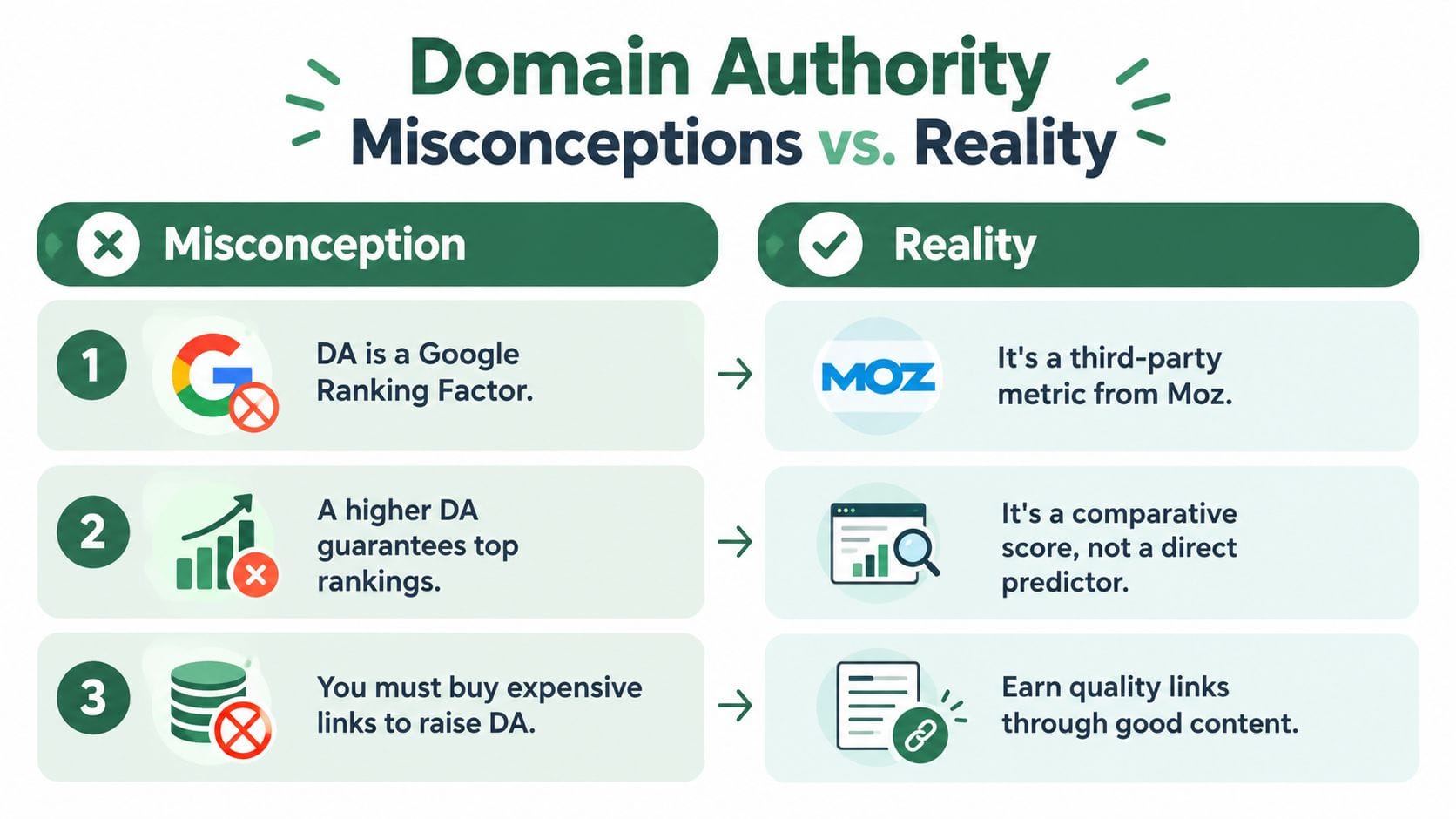
Moz created Domain Authority to predict how likely a root domain is to rank, using a 1-to-100 scale. Moz also makes clear that DA isn't a direct Google ranking factor. It's a third-party measurement that helps marketers interpret link strength and compare competing websites (Moz's Domain Authority explanation).
Practical rule: A DA score is useful only when the comparison is fair. Compare a Brisbane accountant with other Brisbane accountants, not with a national bank.
The local comparison matters
Suppose a residential electrician in Brisbane sees a DA score below a large Australian home-services directory. That comparison tells the owner very little. The directory has a different business model, content footprint, link profile, and national reach.
A better review would compare the electrician's domain with nearby competitors targeting similar searches. The owner could record each competitor's DA, referring domains, service-page coverage, suburb relevance, Google Business Profile strength, and review presence. That creates a working benchmark rather than a vanity contest.
Australian SEO guidance commonly frames above 30 as meaningful, 40 to 50 as average, 50 to 60 as good, and above 60 as excellent, but those ranges still need market context (Australian guidance on tracking and improving Domain Authority). A score that looks modest nationally may be competitive within a narrow Brisbane niche.
For owners still clarifying the wider role of search marketing, Boocoo's explanation of what SEO means for a business provides useful background. The central point remains simple: a low DA doesn't prove that a website is failing. It signals that the domain has limited measurable link strength compared with the sites in the tool's index.
How Domain Authority Is Actually Calculated
Think of DA like a rough credit profile for a website. A lender doesn't judge a borrower from one transaction alone. It considers the broader record, including the quality and reliability of previous relationships. DA similarly looks primarily at the domain's backlink profile, then turns that information into a comparative score.
Moz calculates Domain Authority at the root-domain level, rather than treating every subdomain as a separate main website (Moz's guidance on link-count metrics). For a business, that means the main domain's overall link profile influences its authority measurement, even though individual pages can have very different levels of strength.
The inputs that matter
The score is influenced by the sites linking to the domain, including the authority and relevance of those referring domains. A link from a credible Australian industry body or publication can be more useful than a collection of links from unrelated, low-quality directories.
Moz describes link equity as the value that can pass from one page to another through a link. That value depends on factors including the linking page's authority, topical relevance, and HTTP status (Moz's link-equity guidance).
A Brisbane building consultant, for example, would benefit more from a relevant link on an Australian construction association website than from a random overseas blog about an unrelated subject. The first link gives search tools a clearer relationship between the businesses, topic, and region.
The score can also change when a tool updates its index or recalculates its model. A business owner might not have edited the website, yet the score may move because a linking site disappeared, a newly discovered link changed the competitive picture, or the provider refreshed its data.
What the number cannot tell a business owner
DA doesn't measure every factor involved in local search. It doesn't replace a review of page relevance, search intent, technical accessibility, business information, or conversion quality.
New domains also need credible references and mentions as they establish their place online. IndieTool's guide to external signals for new domains offers useful context for businesses building an initial link profile without treating the score as an overnight project. For a practical Australian explanation of the metric itself, the guide to what a DA backlink is connects the score with the links that influence it.
Common Domain Authority Misconceptions That Waste Budget
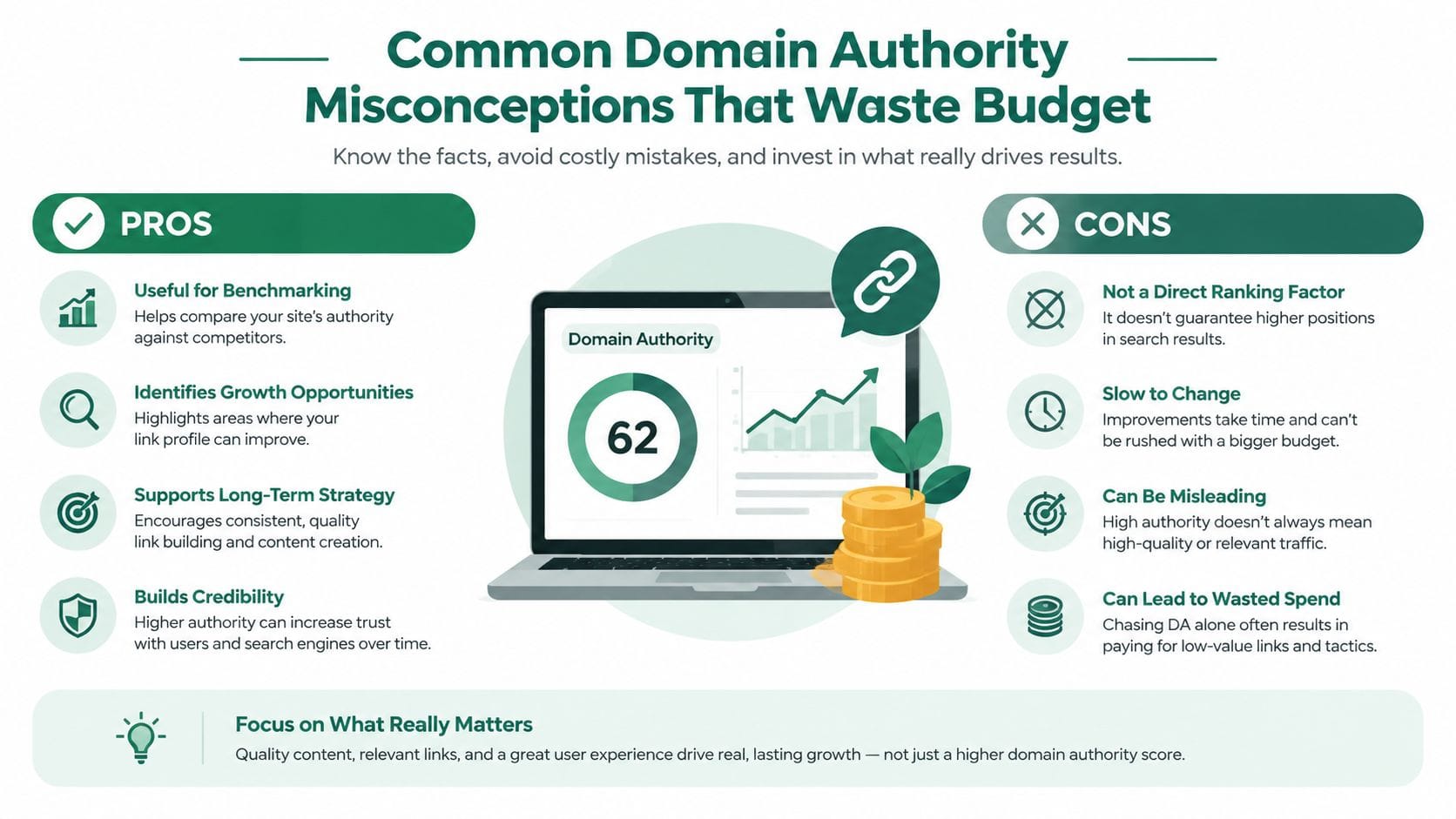
The most expensive DA mistake isn't having a low score. It's paying for activity that raises a dashboard number without improving visibility for the searches that matter.
Misconception one, DA is a Google ranking factor
Google doesn't use Moz's Domain Authority score in its ranking system. DA is a third-party prediction of ranking potential, not a switch inside Google Search.
That doesn't make it useless. The metric can help a marketer compare link profiles and identify a gap against direct competitors. It becomes wasteful when an agency presents a DA increase as proof that rankings or leads must improve.
Misconception two, the highest score always wins
Local search often rewards closer relevance. A Brisbane plumbing business with a lower DA may be more useful for a searcher than a national directory with a higher score, particularly when the business has a dedicated service page, clear location information, strong reviews, and content that matches the customer's problem.
A local agency's Australian guidance recommends benchmarking against nearby competitors and watching referring domains, rather than focusing only on the headline score (local Domain Authority benchmarking guidance). That approach helps owners ask a more commercial question: which website is earning the enquiries?
Misconception three, expensive global links are the fastest answer
A high-profile overseas link can look impressive in a report, but geographic and topical fit still matter. Australian SEO guidance highlights local directories, industry organisations, Australian publications, and regionally relevant websites as useful parts of an authority profile. Australia's managed domain environment, including the .au namespace overseen by auDA, reinforces the importance of a distinct local web ecosystem (Australian government domain management policy).
Businesses should be cautious with offers promising large quantities of cheap links. A link from an irrelevant site may do little for Brisbane visibility, and a pattern of manipulative link acquisition can create broader SEO risk.
Before approving an SEO package, owners can use the advice in this guide to cheap search engine optimisation services as a prompt to inspect deliverables. The useful questions are practical: Which pages will be improved? Which Australian websites are relevant? How will enquiries be tracked? What happens if the links are unrelated?
Domain Authority Versus Other SEO Metrics
SEO software uses different names for related ideas, and the same website can receive different scores across platforms. That's normal. Each provider uses its own database and calculation method, so business owners should avoid combining scores as if they were interchangeable.
| Metric | Source | What It Measures | When to Track It |
|---|---|---|---|
| Domain Authority | Moz | Predicted ranking strength for a root domain | When comparing link strength with direct competitors |
| Page Authority | Moz | Predicted ranking strength of an individual page | When assessing a key service or product page |
| Domain Rating | Ahrefs | A separate view of a domain's backlink strength | When reviewing Ahrefs-based competitor or link research |
| Topical authority | Search strategy concept | Depth and connected coverage around a subject | When planning content that should answer related customer questions |
DA is domain-level. Page Authority is page-level. A business may have a reasonably strong domain while a newly published service page has little direct link support. Internal linking and relevant content can help that page become easier for users and crawlers to discover, but the two measurements still answer different questions.
Domain Rating from Ahrefs shouldn't be treated as a second version of DA. It's another provider's metric, useful inside an Ahrefs workflow but not directly comparable with a Moz score.
Topical authority is different again. It concerns whether a website demonstrates useful, connected coverage of a subject. A Brisbane pest-control company could build topical depth with clear pages about termite inspections, prevention, treatment options, property types, and local considerations. That content may support visibility even before the domain has accumulated a large link profile.
Business owners reviewing reports should also separate authority metrics from operational measures. Search impressions, qualified organic visits, calls, form submissions, and booked jobs are closer to commercial outcomes. A plain-language quality score definition can help explain why a metric only matters when tied to a specific marketing objective.
For most local businesses, DA is best tracked as a monthly comparison signal, while rankings for priority services and genuine enquiries receive the greater attention.
How to Check Your Domain Authority Score
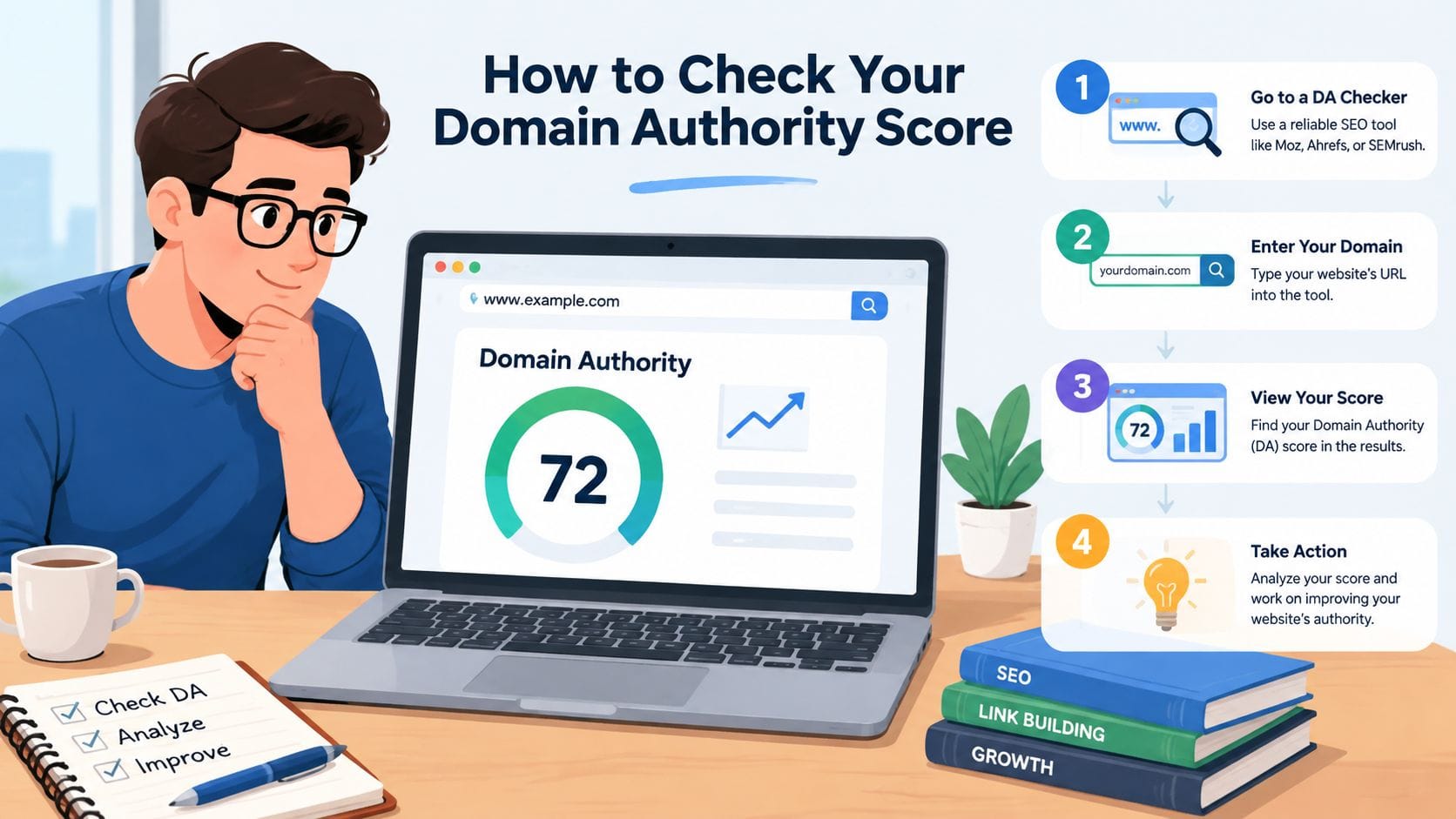
A small business owner doesn't need an expensive software stack to establish a useful baseline. Moz's domain analysis tools can provide a DA reading, and browser extensions or broader SEO platforms can support competitor research when more detail is needed.
A simple checking process
- Enter the exact domain: Use the main website domain, not a single service-page URL, when checking DA.
- Record the score: Note the DA reading and the date in a spreadsheet.
- Review referring domains: Record the number of unique websites linking to the domain, not only the total link count.
- Inspect important backlinks: Look for relevant Australian publications, directories, associations, partners, and community organisations.
- Check direct competitors: Review businesses serving similar customers in Brisbane and surrounding areas.
- Compare trends: Look for movement over time rather than reacting to one reading.
A monthly check should take only a short amount of time once the spreadsheet is set up. Useful columns include the domain, DA, referring domains, notable new links, lost links, priority rankings, and organic enquiries.
The process works best when the owner checks the same competitors and uses the same tool each month. Switching platforms constantly creates noise because providers calculate their authority metrics differently.
A score is a prompt for investigation, not an instruction to rebuild the website. If the number falls, check whether important referring domains disappeared and whether the competitors changed. For broader search visibility actions, the guide to improving Google search rankings provides a more useful strategic frame than treating DA as the entire SEO programme.
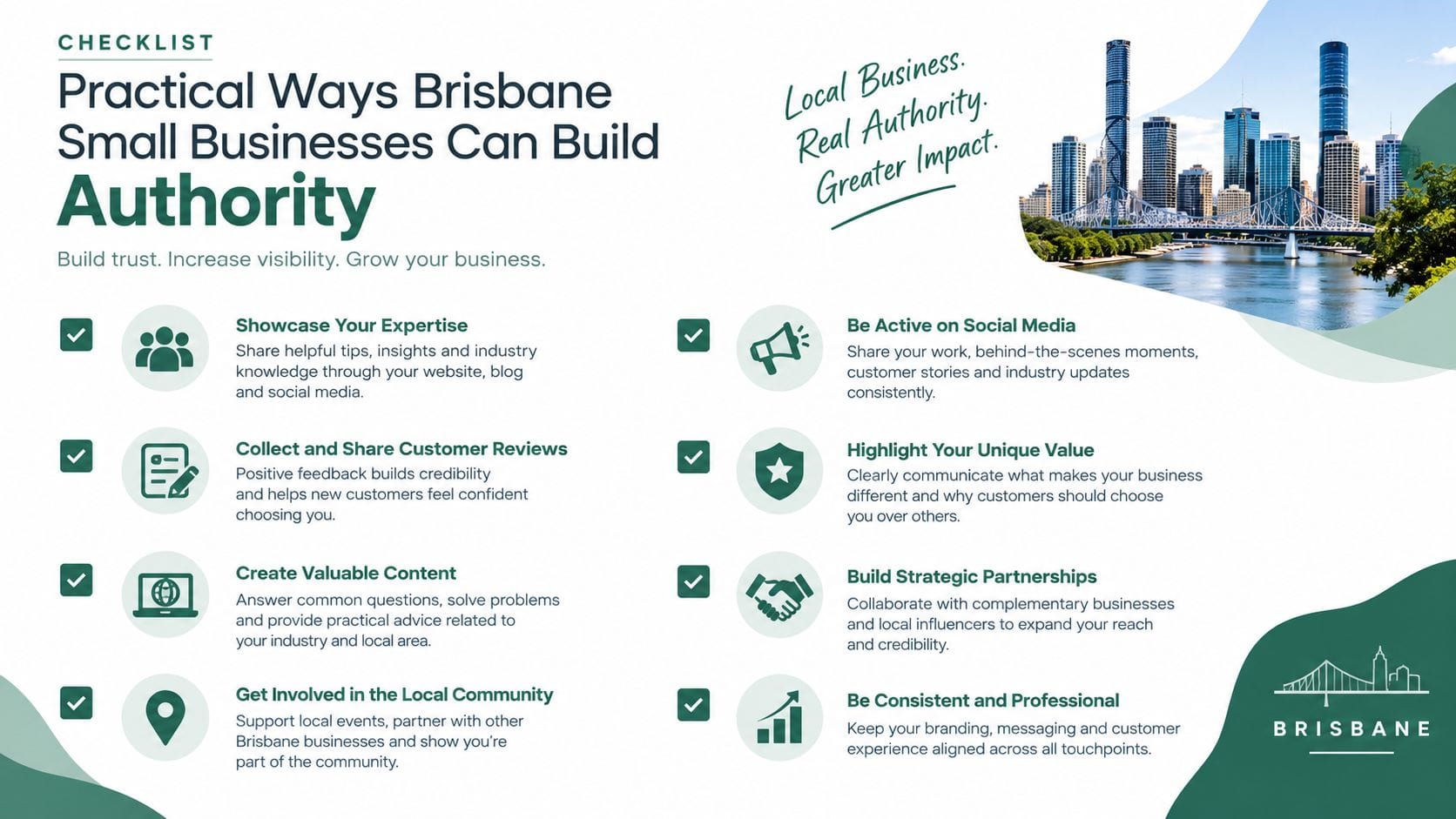
Practical Ways Brisbane Small Businesses Can Build Authority
Authority grows when other relevant organisations have a reason to reference a business. That usually starts with useful information, genuine partnerships, and a website that makes the business easy to understand.
Start with local Australian signals
Brisbane businesses can review whether their details are accurate across relevant Australian directories such as Yellow Pages and TrueLocal. These listings won't replace a proper SEO strategy, but consistent business information and a relevant profile can support local discovery.
Other opportunities depend on the sector:
- Trades: Build relationships with suppliers, builders, property managers, and local community groups that may mention completed work or useful resources.
- Professional services: Contribute practical commentary to industry associations, local business networks, and Australian publications.
- E-commerce: Create product guides, care instructions, comparison resources, and collaborations that give publishers a reason to cite a page.
A link from a relevant .com.au, .edu.au, industry, or local publication domain can make more strategic sense than a generic global link. Australian SEO guidance specifically encourages businesses to pursue locally relevant sources, including directories, industry bodies, educational websites, and major publications (Australian link-building guidance).
Build topical depth before chasing every link
Recent 2026 Australian commentary presents topical authority as a potentially faster path for some businesses and recommends building 25 to 30 tightly interlinked articles in a focused cluster before heavy link acquisition (Australian national SEO strategy commentary for 2026). That isn't a universal formula, but the underlying principle is valuable: a website should demonstrate depth around the services it wants to sell.
For a Brisbane air-conditioning company, one strong cluster could cover installation, servicing, maintenance, energy considerations, commercial systems, and common faults. Each page should link naturally to the others and to the relevant service page.
A lean 90-day priority list
- First phase: Fix inaccurate listings, improve core service pages, and identify direct Brisbane competitors.
- Second phase: Publish focused answers to real customer questions and add sensible internal links.
- Third phase: Contact relevant partners, associations, local publications, and suppliers with useful resources.
Small business owners who want a broader, practical overview can review this guide to small business SEO from Sibley Digital. The priority isn't producing content for its own sake. Each page should support a service, answer a real question, or create a credible reason for another Australian website to reference the business.
Should You Focus on Domain Authority or Local Relevance
For most Brisbane service businesses, local relevance and topical coverage deserve attention before raw DA growth. A business serving a defined area usually benefits more from clear service pages, suburb context, useful answers, accurate business details, and relevant local references than from chasing a score that looks impressive in a national report.
DA improvement becomes more important when a business is competing for broad national topics, expanding beyond Brisbane, or facing established brands with substantial link profiles. Even then, link quality and relevance matter more than collecting domains.
A practical decision framework is straightforward:
- Choose local relevance first when customers search by service and suburb, the business has limited time, or the website lacks useful coverage of its main services.
- Prioritise topical authority when the business has expertise but thin content, and customers ask several related questions before making contact.
- Invest more in authority building when core pages are strong, local competitors have similar relevance, and credible Australian links are the remaining gap.
Queensland Government guidance encourages businesses to improve how search engines see and rank their websites, and it points owners towards digital marketing learning support, including SEO workshops (Queensland Government digital marketing guidance).
The answer to what is domain authority is therefore practical, not just technical. It's a comparative indicator of link strength. Brisbane owners should use it to understand the competitive scene, then spend limited budget on the pages, partnerships, and local signals most likely to generate enquiries. A business can contact Boocoo on 1300 093 797 or at hello@boocoo.au to discuss a custom Brisbane digital marketing plan, or begin with a competitor comparison and one focused service page this week.