
A Fortitude Valley café owner can spend the morning pulling espresso shots, checking rosters and answering a phone full of unread enquiries, then still wonder whether email marketing deserves a place on the list. Social media feels faster, paid ads feel easier to switch on, and every spare hour seems to disappear before a newsletter is written.
For Brisbane small businesses, email works best when it isn't treated as another content chore. It is a permission-based customer channel that can support repeat visits, bookings, enquiries and seasonal offers, provided the database is clean, the sending setup is sound and every message has a useful reason to arrive.
Why Email Still Works for Brisbane Small Businesses
The café owner in Fortitude Valley doesn't need another marketing channel that demands daily attention. She needs a dependable way to remind regulars about a new menu item, fill quieter periods and keep past customers connected without paying to reach them again.
Email is already part of normal small business practice in Australia. The ACMA research summary on SME marketing messages found that 42% of Australian SMEs had conducted e-marketing, and 84% of SME e-marketers used email, making it the most common direct digital channel. Email was also the most likely method to be sent at least weekly, with 34% of SME e-marketers doing so, while 83% had used direct marketing email in the previous two years.
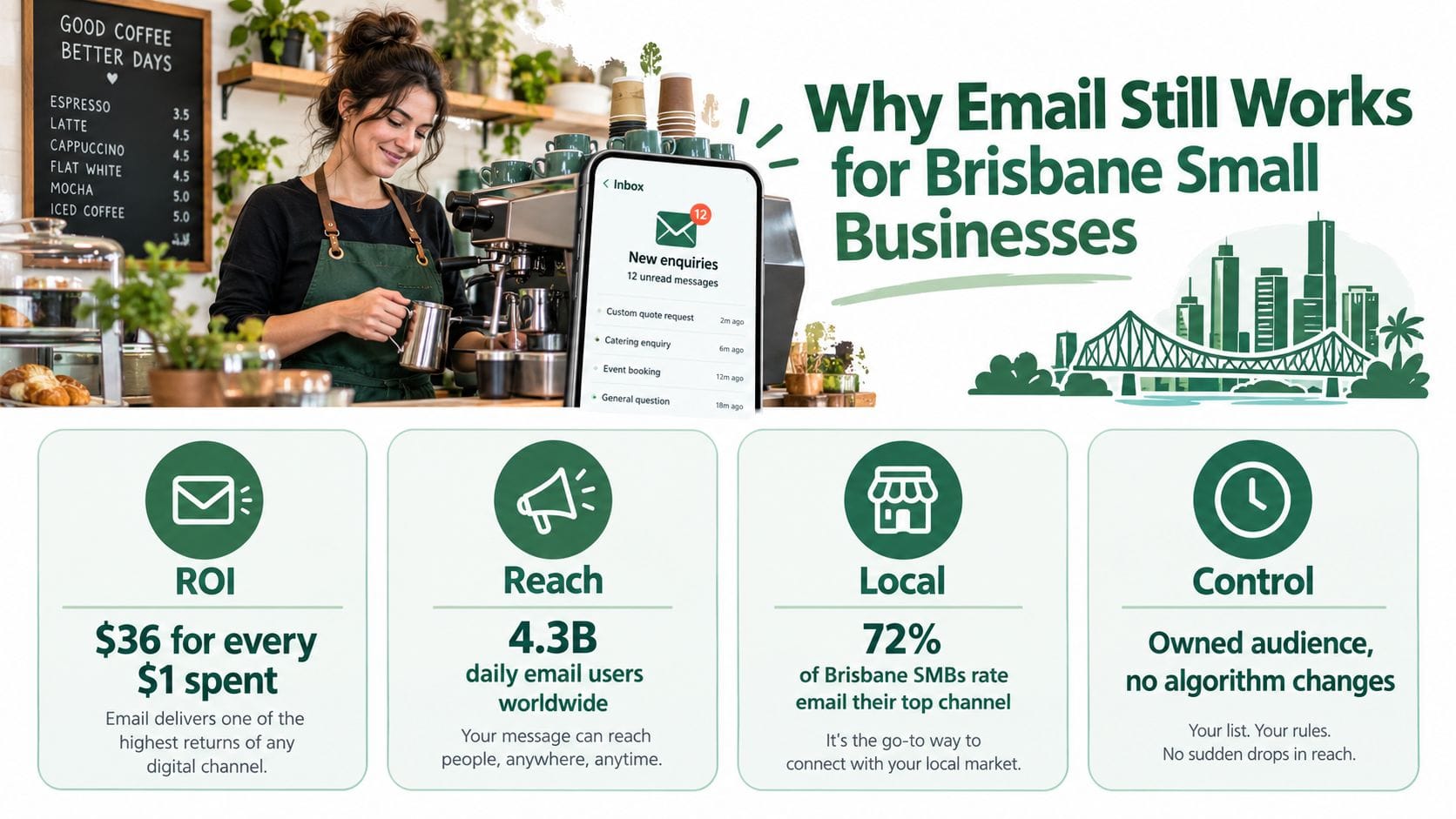
That matters because a subscriber list is an audience the business has built with permission. A social following remains dependent on a platform's distribution choices. A Kelvin Grove tradie may have hundreds of followers, but a platform outage, algorithm change or account problem can make that audience difficult to reach. An opted-in email list gives the business a direct route to people who have already shown interest.
The local advantage
Brisbane businesses can make email feel local without creating a separate campaign for every suburb. A café can promote a rainy-day offer to nearby customers, a tradie can speak differently to inner-city landlords and outer-suburban homeowners, and a professional service can tailor reminders around local events or seasonal demand.
The channel also suits ordinary routines. Customers check messages during a morning commute on the M1, on a train into Central or between appointments. A concise email with one clear action can reach them without relying on a social feed being generous at the right moment.
Australia-focused benchmarks reinforce the need for a measured, mobile-first approach. One 2025 benchmark set reports a 21.5% average open rate, a 2.8% click-through rate and a 0.24% unsubscribe rate per send, while another Australian summary reports a 26.8% open rate, a 3.0% click-through rate and a 0.41% bounce rate. The figures come from Australian email marketing benchmarks for 2025, and they should be treated as reference points rather than promises.
Practical rule: A useful email list is more valuable than a large audience that the business can't contact reliably.
A strong subject line still needs a useful message behind it. Guidance on writing a newsletter readers trust is helpful for businesses that want to sound informative rather than desperate for a click. The next step is measuring whether those clicks lead to a booking, enquiry or sale, using a clear conversion definition such as the one explained in what conversion rate means.
The Compliance and Deliverability Foundation
The most expensive email mistake often happens before the copy is written. A Brisbane business imports old contacts, sends from a poorly configured domain and then wonders why a carefully designed campaign lands in junk folders or attracts complaints.
Commercial email in Australia needs consent, clear sender identification and a functional unsubscribe option. Business Queensland guidance also states that unsubscribe requests must be honoured within 5 working days. The Queensland guidance on online legal obligations gives local operators a practical starting point for checking those responsibilities.
What a compliant send includes
A sole trader in Morningside or Fortitude Valley should make the sender obvious. The footer should identify the business, include a genuine contact method and provide a valid physical business address, such as the operator's registered street address. An ABN can support identification, but it doesn't replace the need for a clear sender identity and a working unsubscribe process.
The consent record matters just as much. A contact collected through a booking form for appointment reminders hasn't automatically agreed to receive every promotion, newsletter or partner offer. Someone met at a networking event hasn't necessarily consented to ongoing commercial email either.
A useful pre-send check includes:
- Permission: Record how and when each contact agreed to receive marketing.
- Identity: Use a recognisable business name and reply address.
- Unsubscribe: Test the link and make the process simple.
- Address: Include a valid business address in the footer.
- Purpose: Send content that matches the expectation created at sign-up.
Protecting the inbox
Sender authentication helps mailbox providers recognise legitimate mail. SPF, DKIM and DMARC should be configured on the business domain before regular campaigns begin. Authentication isn't a substitute for consent, but weak technical setup can undermine a compliant list.
Australian and New Zealand mailbox-provider data reported 90.6% inbox placement, 1.1% spam and 8.3% missing mail in the cited deliverability benchmark. The same guidance treats 98% or higher delivery as strong, under 0.5% bounce as healthy and under 0.08% spam complaints as ideal, while inbox placement below 75% is a warning sign. These figures appear in the Validity email deliverability benchmark.
List hygiene means suppressing hard bounces, removing addresses that repeatedly fail and reviewing inactive subscribers before sending at scale. Role addresses such as info@ and accounts@ often need separate handling because they may be shared rather than tied to one person. Gmail and Outlook tabs also mean that a message can be delivered without appearing in the primary inbox.
Businesses that want a deeper technical explanation can use this guide to improve your email deliverability. A well-organised customer database, supported by a suitable CRM system, makes consent and engagement records easier to manage.
Growing a Quality Brisbane List Without Buying One
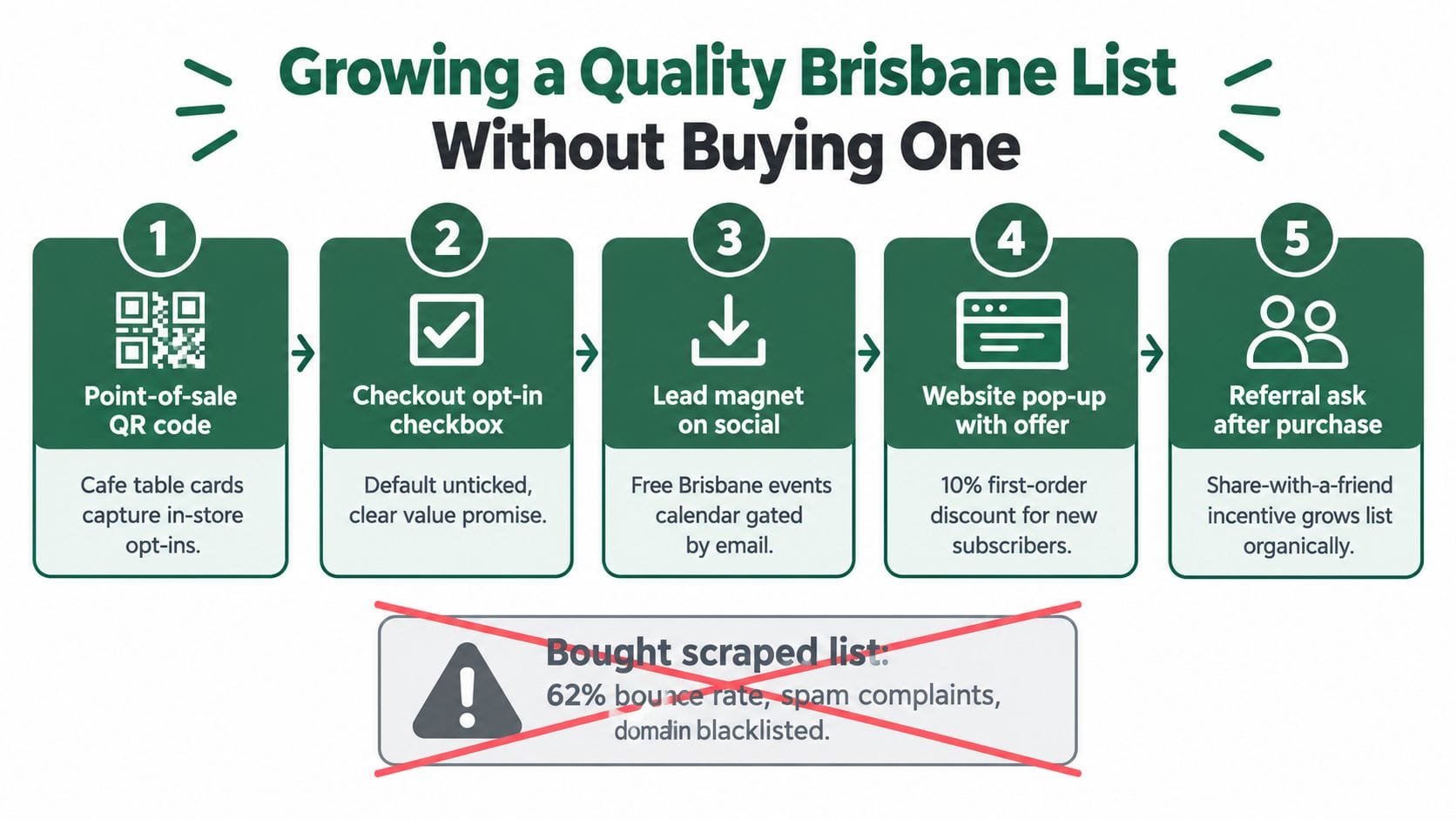
Buying a scraped list looks like a shortcut, but it gives a small business names without context, permission or reliable intent. A local operator is usually better served by capturing contacts at moments when customers already have a reason to hear from the business.
A Woolloongabba physiotherapy clinic can ask whether a patient wants general treatment updates during a booking process. A West End homewares shop can offer an optional marketing sign-up after an online receipt. A suburban IGA can invite repeat customers to join for local specials, provided the wording makes the marketing purpose clear.
Start with existing customer contact points
The best collection points are often already in use:
- Booking confirmations: Add a separate, unticked marketing choice to the confirmation process.
- Receipts and order emails: Make the benefit clear, such as seasonal product news or useful care advice.
- Customer accounts: Give account holders a visible preference option rather than enrolling them without asking.
- In-store prompts: Use a QR code at a Spring Hill yoga studio reception desk to deliver a truly useful sign-up benefit.
- Quote requests: A North Lakes tradie can offer a practical quote preparation guide in return for a properly explained opt-in.
The value promise should match the business. A free class pass may suit the yoga studio, while a home maintenance checklist may suit the tradie. A New Farm restaurant can run a Brisbane-specific competition around Ekka or Riverfire, but the entry form still needs clear marketing consent rather than burying it in the terms.
Referrals beat empty giveaways
A giveaway can attract people who want the prize and nothing else. A referral request after a genuine purchase or appointment tends to create a stronger connection because the existing customer understands the service.
A Newstead beauty salon could provide each customer with a shareable friend link after a booking. The message might invite a friend to join for a relevant offer, while the original customer receives a modest benefit only if the referral is valid and properly consented. The local network does much of the work, without forcing the business to chase strangers.
The most useful growth target is not a large database. It is a steady flow of consented, relevant contacts whose expectations are clear. A small Brisbane operator with fewer subscribers can often send more confidently than a business with a larger list full of old addresses and uncertain permission.
For operators building organic visibility alongside email, blogging and SEO can create additional entry points for useful guides, suburb pages and sign-up offers.
Segmentation That Actually Changes the Message
Segmentation only earns its place when it changes the email. If a tag affects nothing beyond inserting a first name, it adds admin without improving relevance.
A small Brisbane business can begin with three practical dimensions: location, customer stage and service or purchase type. A tradie may need different messages for Brisbane CBD, Logan, Ipswich and Redcliffe. A café may separate office workers from weekend locals. A professional practice can distinguish a new subscriber from an active customer or a person who has stopped engaging.
A Newstead clinic example
A Newstead physiotherapy clinic could separate contacts into workers compensation, private rebate and sports injury groups. Each audience needs different explanations, booking prompts and supporting content. A sports injury subscriber may respond to recovery advice and an assessment link, while a workers compensation contact may need information about referrals and claim-related appointments.
The platform doesn't need to be complicated. Mailchimp, Klaviyo and ActiveCampaign can all apply rules based on form selections, purchases, appointment types or engagement. A list of 400 contacts could produce several useful groups, but only if each group receives a meaningfully different message.
| Segment | Trigger or Rule | What Changes in the Email | Result You Want |
|---|---|---|---|
| Brisbane CBD customers | Address or service area | Shorter, convenience-focused offer | More nearby visits or bookings |
| Outer-suburban customers | Logan, Ipswich or Redcliffe location | Travel, timing or service-area information | Better-qualified enquiries |
| New subscribers | Recent sign-up | Introduction and next step | First booking or purchase |
| Active customers | Recent purchase or appointment | Relevant follow-up or complementary offer | Repeat business |
| Lapsed customers | No recent activity | Helpful reactivation message | Renewed interest or clean suppression |
Keep the rules usable
A segment should answer a real marketing question. Does the subject line change? Does the offer change? Does the send time change? If the answer is no, merging the segment back into the main audience may be the more disciplined choice.
The same principle applies to audience research. A clear user persona should describe a meaningful difference in needs, not just a collection of decorative labels. Segmentation is useful when it helps the operator decide what to say next.
Automation Flows a Time-Poor Operator Can Maintain
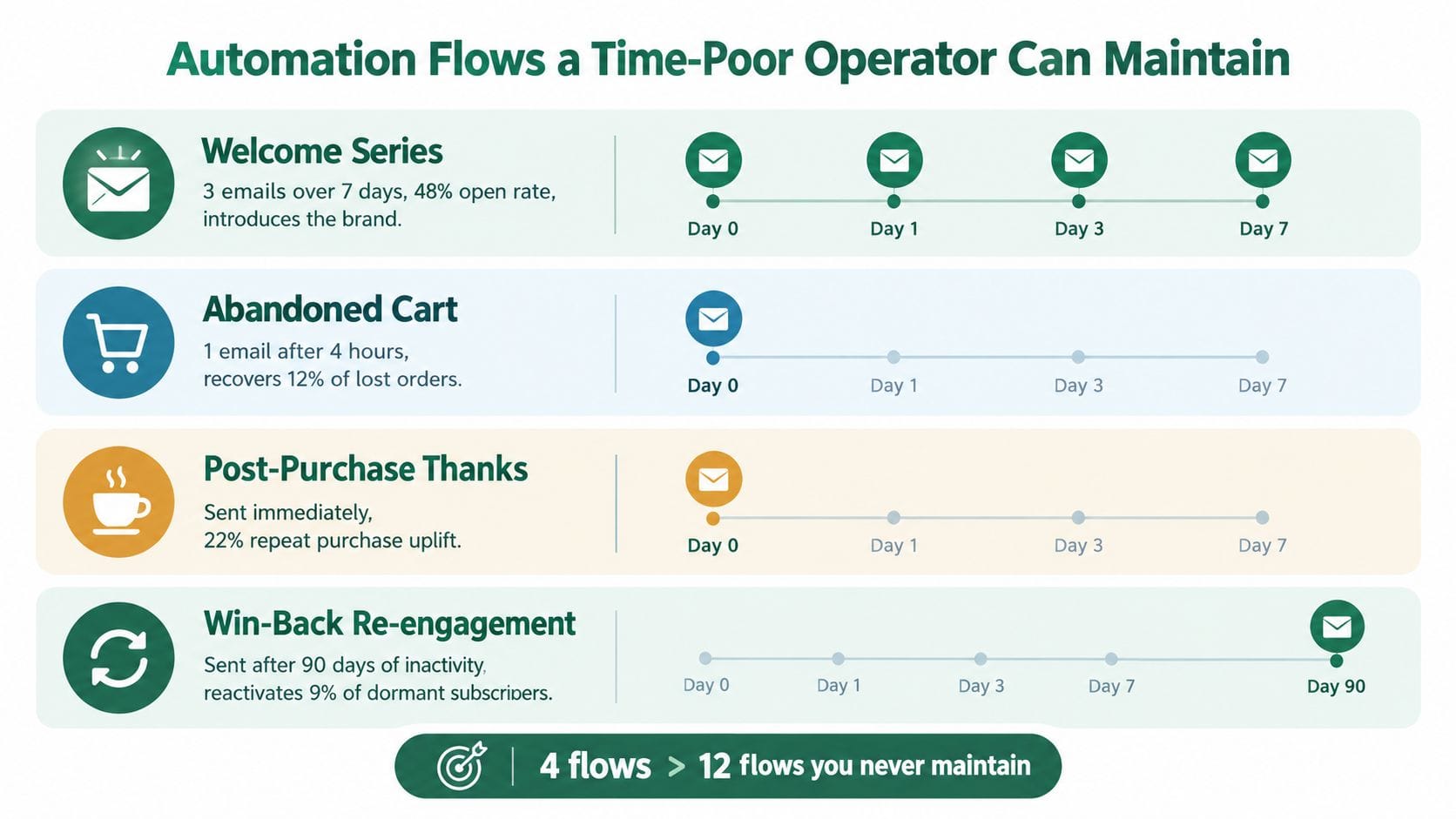
A café owner or sole trader doesn't need a maze of automations. Four dependable flows are more useful than a dozen half-finished sequences that no one reviews.
Start with the customer moments
A welcome series can introduce the business, deliver the promised resource and finish with a low-friction action such as ordering, booking or requesting a quote. The messages should arrive over a short, deliberate period, with each email doing one job rather than repeating the same sales pitch.
A post-purchase or post-appointment flow should thank the customer, provide useful follow-up information and invite a review at an appropriate point. A later referral request can work when the customer has had enough time to experience the product or service. The wording should ask for an honest review, not pressure the customer into a positive one.
A win-back flow can begin after a meaningful period of inactivity. The first message can offer a relevant reason to return, while a final preference or removal message protects list quality if the subscriber no longer wants contact.
The fourth option suits Brisbane's event and weather patterns. A Fortitude Valley retailer can promote a trade night, while a café can send a rain-day offer when indoor demand is likely to matter. The trigger needs to be genuinely relevant, not an excuse to send another promotion.
Build for maintenance
| Flow | Useful trigger | Core message | Maintenance task |
|---|---|---|---|
| Welcome | New confirmed subscriber | Set expectations and deliver value | Check links and offer relevance |
| Post-purchase | Completed order or appointment | Thank, support and invite feedback | Review timing and exclusions |
| Win-back | Sustained inactivity | Give a clear reason to return or leave | Suppress contacts that remain inactive |
| Local moment | Event or weather condition | Make a timely, location-relevant offer | Turn the trigger off when the moment ends |
Mailchimp can suit a straightforward subscriber journey, Klaviyo is useful when purchase behaviour drives the flow, and ActiveCampaign can help connect email with broader contact records. The platform matters less than naming each trigger, checking its exclusions and reviewing the live messages.
A useful automation is one the business can explain in a sentence and inspect without calling a developer.
DIY, Freelancer or Brisbane Agency
The right delivery model depends on the operator's time, confidence and tolerance for technical work. DIY can suit a small list when the owner enjoys writing and can consistently review consent, design and reporting. Mailchimp, Klaviyo and Brevo all offer accessible starting points, but the software doesn't remove the need for strategy.
A freelancer becomes useful when the business has offers and customer knowledge but needs help with copy, templates, segmentation or flow setup. A Brisbane agency makes more sense when email needs to connect with SEO, website conversion, paid campaigns or a broader lead-generation plan. Boocoo, for example, offers email setup alongside other digital marketing services, including business email and domain-related setup.
| Option | Typical Monthly Cost (AUD) | Best For | Time Commitment | Main Risk |
|---|---|---|---|---|
| DIY | Platform-dependent | Owners who can write and review campaigns | Regular owner time | Inconsistent sending or missed technical checks |
| Freelancer | Scope-dependent | Businesses needing specialist execution | Approval and feedback time | Reliance on one external person |
| Brisbane agency | Scope-dependent | Businesses needing integrated marketing support | Strategic decisions and approvals | Paying for services that aren't tied to business outcomes |
A provider should explain how consent is recorded, how bounces and complaints are monitored and who owns the account. List rentals are a poor fit for a local business because a purchased audience rarely has the context needed for relevant communication. Vague answers about the Spam Act, authentication or reporting should end the conversation.
For businesses comparing broader automation support, a practical overview of a marketing automation agency can help clarify the difference between software access and managed implementation. The digital marketing agency options for small businesses are also worth comparing against the actual workload the owner wants removed.
A quick decision guide is simple:
- Choose DIY when the list is modest, the offer is clear and the owner can protect regular working time.
- Choose a freelancer when the business needs specialist campaign production without a broad retainer.
- Choose an agency when email must support several acquisition channels and compliance or deliverability needs ongoing oversight.
Your 90-Day Email Marketing Brisbane Starter Plan
A practical rollout gives the operator enough time to fix the foundation before judging creative performance. The first month should focus on the sender setup, existing database and consent records, not on sending more frequently.
Days 1 to 30
Audit the sending domain and confirm that SPF, DKIM and DMARC are in place. Remove invalid addresses, suppress clear bounces and identify contacts whose permission cannot be explained. Choose one main platform, such as MailerLite, Klaviyo or ActiveCampaign, rather than spreading a small list across several systems.
The first month should also produce one simple campaign brief. It might promote bookings, repeat orders, a seasonal service or a useful local guide. The brief needs one audience, one promise and one primary action.
Days 31 to 60
Create two list-growth assets that match the business. A café might use an in-store QR sign and a local offer, while a professional service could publish a practical Brisbane guide with an optional email sign-up. Build three segments based on a real difference in location, lifecycle or service need.
Switch on the welcome, post-purchase and win-back flows only after the links, exclusions and consent wording have been tested. A small team should be able to describe what each flow does and identify the person responsible for checking it.
Days 61 to 90
Set a regular campaign cadence that the business can maintain. Test subject lines one variable at a time, then review the metrics that connect activity with commercial intent:
- Opt-in rate: Shows whether the sign-up offer and placement work.
- Open rate: Indicates whether the sender and subject line earn attention.
- Click-to-open rate: Shows whether the email content motivates action.
- Revenue per email: Connects a campaign with tracked commercial value.
- Unsubscribe rate: Signals whether expectations, frequency or relevance need attention.
The Australian benchmark figures cited earlier provide context, but local performance should be judged against the business's own audience, offer and season. Mobile design deserves particular attention because 58.6% of opens were reported as occurring on mobile in the cited 2025 benchmark set, available through the Australian email benchmark source.
A calendar reminder for a monthly review keeps reporting manageable. A quarterly compliance check should confirm consent wording, sender details, unsubscribe operation and list suppression practices.
For local learning, a Fortitude Valley retail check-in can reveal how nearby businesses present offers, while a Brisbane Small Business Expo visit can provide practical conversations with software and service providers. The ACMA Spam Act information and resources offer a sound compliance reference before the next campaign is scheduled.
Brisbane operators ready to stop guessing can begin with a consent audit, one useful sign-up offer and a review of the next campaign's single conversion goal. Businesses needing help can contact Boocoo on 1300 093 797 or hello@boocoo.au to discuss a practical email and digital marketing plan suited to their workload and budget.