
A lot of Brisbane owners are in the same spot. The phone rings from referrals, the work is solid, customers are happy, but online visibility feels patchy. A plumber in Chermside might do excellent work and still lose jobs to a competitor with a sharper Google Business Profile. A café in West End might have better coffee but barely show up when locals search nearby.
That's usually where local SEO stops feeling like a marketing buzzword and starts looking like a practical fix. It isn't about chasing broad internet fame. It's about helping nearby customers find the business at the exact moment they need it.
For owners who want a plain-English starting point, this guide to expert local SEO for businesses gives a useful overview of what a local campaign should focus on. The important part is simple. If the business serves Brisbane suburbs, local search visibility needs to match the actual service area.
Are You Invisible to Your Brisbane Neighbours?
A common pattern shows up across Brisbane small business marketing. The business has a decent website. The owner knows the local area. Customers leave happy. But when someone searches “electrician near me”, “family lawyer New Farm”, or “best café South Brisbane”, another business gets the click.
That gap is frustrating because the issue often isn't quality. It's visibility.
Local SEO fixes that by lining up the business with how people search. A mobile customer doesn't care that a company has existed for years if Google Maps shows three other options first. A homeowner in Aspley looking for a fast quote will usually contact whoever looks local, active, and easy to trust.
A strong local presence saves time before it makes money. Better visibility means fewer wasted conversations with the wrong audience and more enquiries from people already looking for that exact service.
For a time-poor owner, that matters. The goal isn't to become a full-time marketer. The goal is to stop missing the straightforward opportunities sitting in nearby suburbs.
What usually makes a Brisbane business feel invisible online?
- An unfinished Google Business Profile with weak categories, missing services, or old opening hours.
- Scattered contact details across the web, where the business name, address, or phone number doesn't match.
- Thin website pages that mention services but never connect them to Brisbane locations people search for.
- No review routine, which leaves the listing looking stale beside competitors with fresh customer feedback.
These aren't glamorous fixes. They are practical ones. For most small businesses, local SEO works best when it removes friction. Better listings, clearer location signals, stronger suburb relevance, and a website that helps people call or enquire fast.
What Local SEO Really Means for Your Business
Local SEO is best understood as a digital shopfront on Brisbane's busiest streets. The difference is that the street is Google Search and Google Maps. If the shopfront looks complete, trusted, and relevant to the searcher's location, more people walk in. If it looks neglected or confusing, they keep scrolling.
In Australia, local intent is huge. Safari Digital reports that 46% of all Google searches include local intent, and Marketix Digital cites Google data showing 46% of searches are for local information such as business addresses, store hours, and directions in its summary published at Safari Digital's local SEO statistics resource. For a Brisbane small business, that means local visibility isn't a side issue. It's a core part of being found at all.
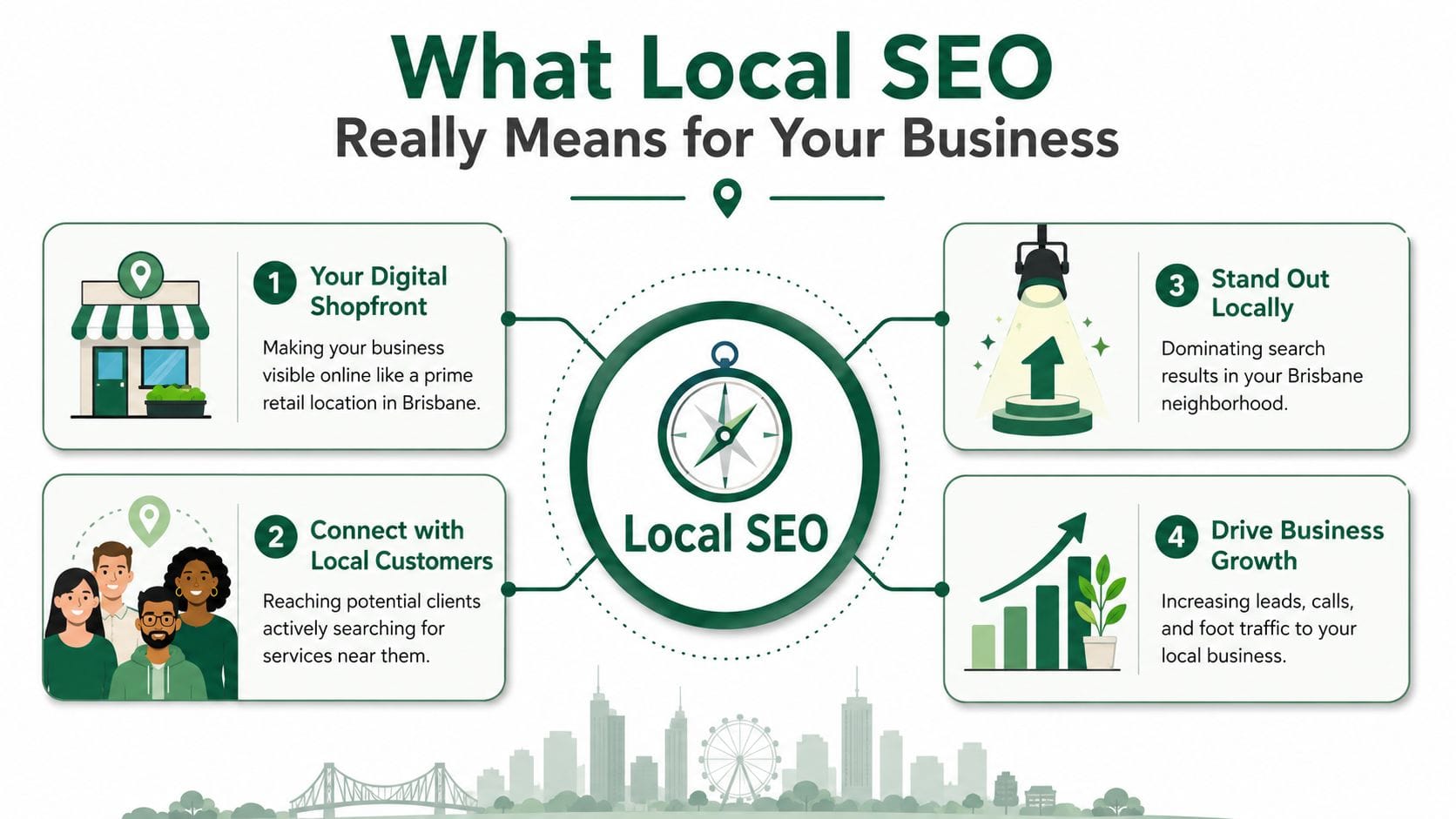
Your digital shopfront matters first
The single most important local asset for many businesses is the Google Business Profile. That listing often shows before the website does. It carries the business name, service category, hours, reviews, photos, directions, and the quick actions people use when they want to call now instead of reading a long sales page.
If that listing is sloppy, everything else has to work harder.
A good local setup makes it easy for a customer to answer three questions within seconds:
- Is this business nearby?
- Does it offer the exact service needed?
- Does it look trustworthy enough to contact?
The three pieces that do the heavy lifting
The first piece is Google Business Profile. This is the fast path to local visibility. The category choice, service list, business description, photos, and accurate contact details all shape whether a listing looks relevant.
The second is local keywords. A broad phrase like “accountant” is vague. A phrase like “tax accountant Brisbane northside” or “emergency plumber inner north Brisbane” shows local intent. Good local SEO uses the language customers already use.
The third is reviews. Reviews do two jobs at once. They help conversion because people trust recent feedback, and they help reinforce local relevance when customers mention suburbs, job types, and service quality naturally.
Practical rule: If a customer can't quickly confirm where the business operates, what it does, and whether others trust it, local SEO isn't doing its job.
A good starting point is a structured check of the basics. This local SEO audit guide is useful because it breaks the process into visible items rather than abstract SEO theory.
For businesses in tourism, hospitality, and visitor-driven services, local discovery often overlaps with broader destination marketing. That's where a more integrated approach like tourism digital marketing support can help connect search visibility with bookings, seasonal offers, and local intent.
Our Simple SEO Process for Brisbane Businesses
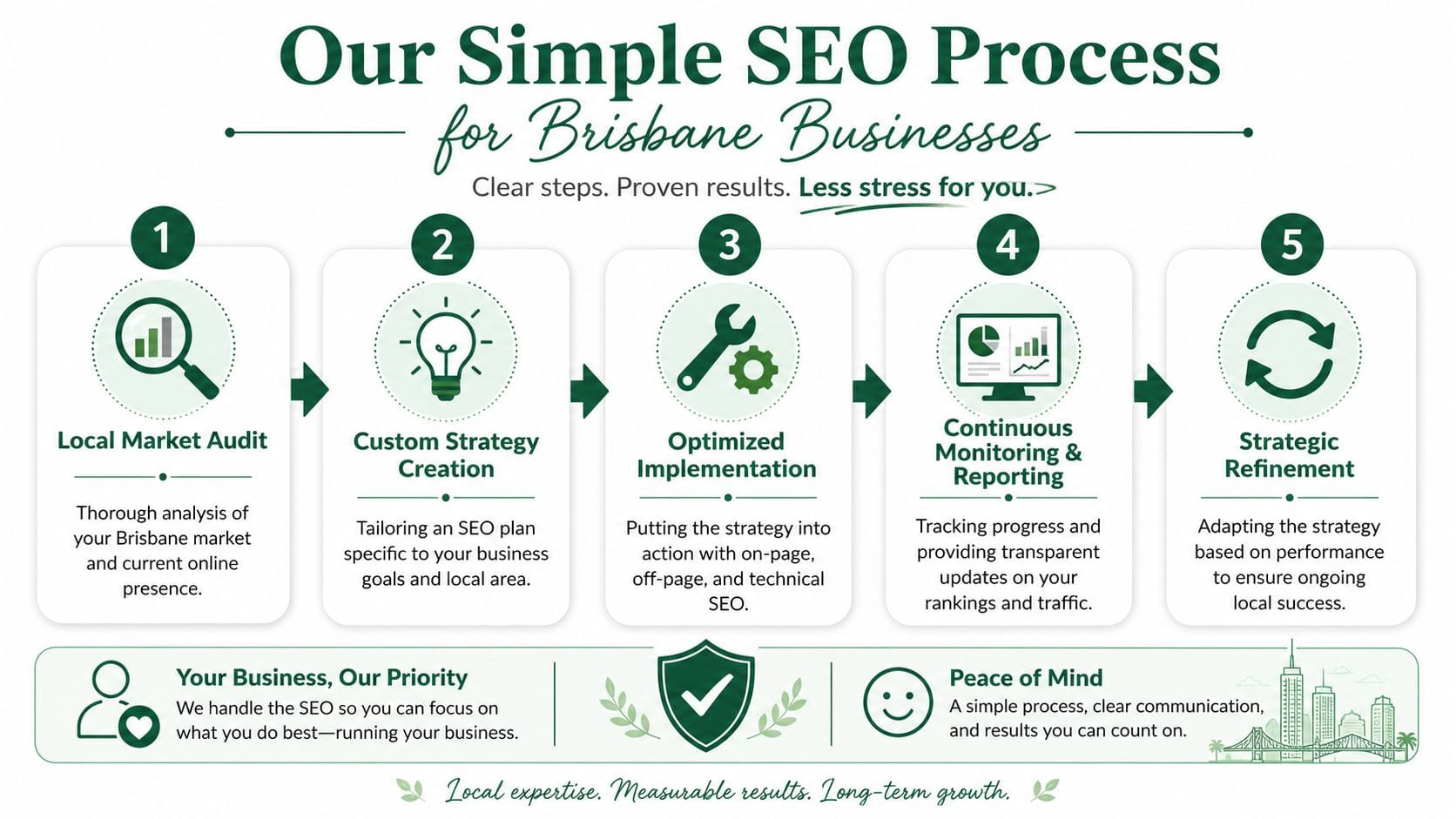
The most useful local SEO process is the one a busy owner can live with. It should reduce admin, not create more of it. That means fewer vanity tasks, cleaner priorities, and a clear sequence.
Google Business Profile accuracy sits at the centre of this. Google's own guidance, summarised in this Brisbane-focused breakdown of local SEO strategies and Google Business Profile consistency, stresses that businesses need to keep profile details accurate and up to date because incomplete or inconsistent information can weaken trust signals.
Stage one and two getting the basics right
The first stage is discovery and strategy. During this stage, the business clarifies which suburbs matter, which services bring the best leads, and which competitors keep appearing in maps and local organic results. There's no point building pages for every suburb in South East Queensland if the main work mostly comes from a tighter service radius.
The second stage is foundational optimisation. This tends to produce the quickest visible clean-up work:
- Google Business Profile fixes such as categories, services, photos, service areas, hours, and business description.
- NAP consistency work so the name, address, and phone details match across the website and major listings.
- Website local signals including service pages, contact pages, suburb mentions, and location-aware metadata.
- Technical clean-up so mobile users can load the site, tap to call, and send an enquiry without hassle.
A practical template helps here. This local SEO audit template is handy for spotting missing basics before more advanced work starts.
Stage three and four building authority and tracking leads
The third stage is local content and authority. Many campaigns either gain traction or drift into busywork during this stage. What works is content that proves the business really operates in the areas it targets. That might include service pages with suburb relevance, project examples, FAQs based on local customer questions, and mentions on Brisbane-based directories or community sites.
What doesn't work is pumping out near-identical suburb pages with only the place name swapped.
The fourth stage is reporting tied to commercial outcomes. Rankings have their place, but a small business usually cares more about whether the campaign is increasing calls, form submissions, booking requests, and map interactions.
| Service Component | What It Means For You |
|---|---|
| Local market review | Clear focus on the suburbs, services, and competitors that actually affect lead flow |
| Google Business Profile optimisation | Better map visibility and fewer missed clicks from incomplete listing details |
| Citation and NAP clean-up | Less confusion across directories and stronger consistency signals |
| Local content creation | Pages that match how Brisbane customers search by service and area |
| Technical tidy-up | Faster mobile experience and fewer friction points before enquiry |
| Lead-focused reporting | Visibility into calls, enquiries, and actions that matter to the business |
For owners who want done-for-you support rather than piecing this together internally, Brisbane SEO services are one option alongside in-house work or freelance support. The key is finding a process that stays focused on local enquiries, not endless SEO jargon.
Real SEO Results for Brisbane Businesses
Results from local SEO are easiest to understand when they're translated into ordinary business situations. A ranking chart isn't very useful on its own. A steady lift in calls from nearby customers is.

Google has reported in Australia that 76% of people who search for something nearby on their smartphone visit a related business within a day, and 28% of those searches result in a purchase, as cited in this Brisbane search overview from Digital Nomads HQ. That's why local visibility often changes lead quality as much as lead volume.
What this looks like in real life
A North Brisbane electrician might start appearing more consistently for urgent service searches in surrounding suburbs. The practical result isn't “more impressions”. It's more people tapping the call button from the listing because the business looks local, available, and credible.
A café in an inner-city suburb might not need long website articles at all. It may get better value from stronger map visibility, better photos, updated trading hours, menu-related search relevance, and a healthier review profile. In that case, local SEO is doing the quiet work of bringing foot traffic from people already nearby.
A professional service firm, such as a mortgage broker or family lawyer, usually needs a different setup. Those businesses often benefit from sharper suburb and service pages, stronger trust signals, and enquiry forms that make the first contact easy.
The best local SEO campaigns feel boring in the right way. The listing is accurate, the pages are clear, reviews keep coming in, and leads arrive without the owner having to babysit the process every week.
What results matter most
For a small business, the most useful outcomes are usually:
- More map pack actions such as calls, website visits, and direction requests.
- Better suburb relevance so enquiries come from areas the business prefers to serve.
- Improved conversion paths where the website turns visibility into quote requests or bookings.
- Stronger trust signals through recent reviews, updated photos, and clearer service information.
Once visitors land on the site, conversion work matters just as much as rankings. Local traffic that doesn't turn into enquiries is wasted opportunity, which is why conversion rate optimisation for Australian businesses often sits right beside SEO in a practical lead-generation setup.
Choosing the Right Brisbane SEO Agency for You
A good local SEO agency should make the work clearer, not murkier. If every answer sounds vague, overloaded with jargon, or obsessed with rankings alone, that usually means the owner will spend more money and still feel unsure what's happening.
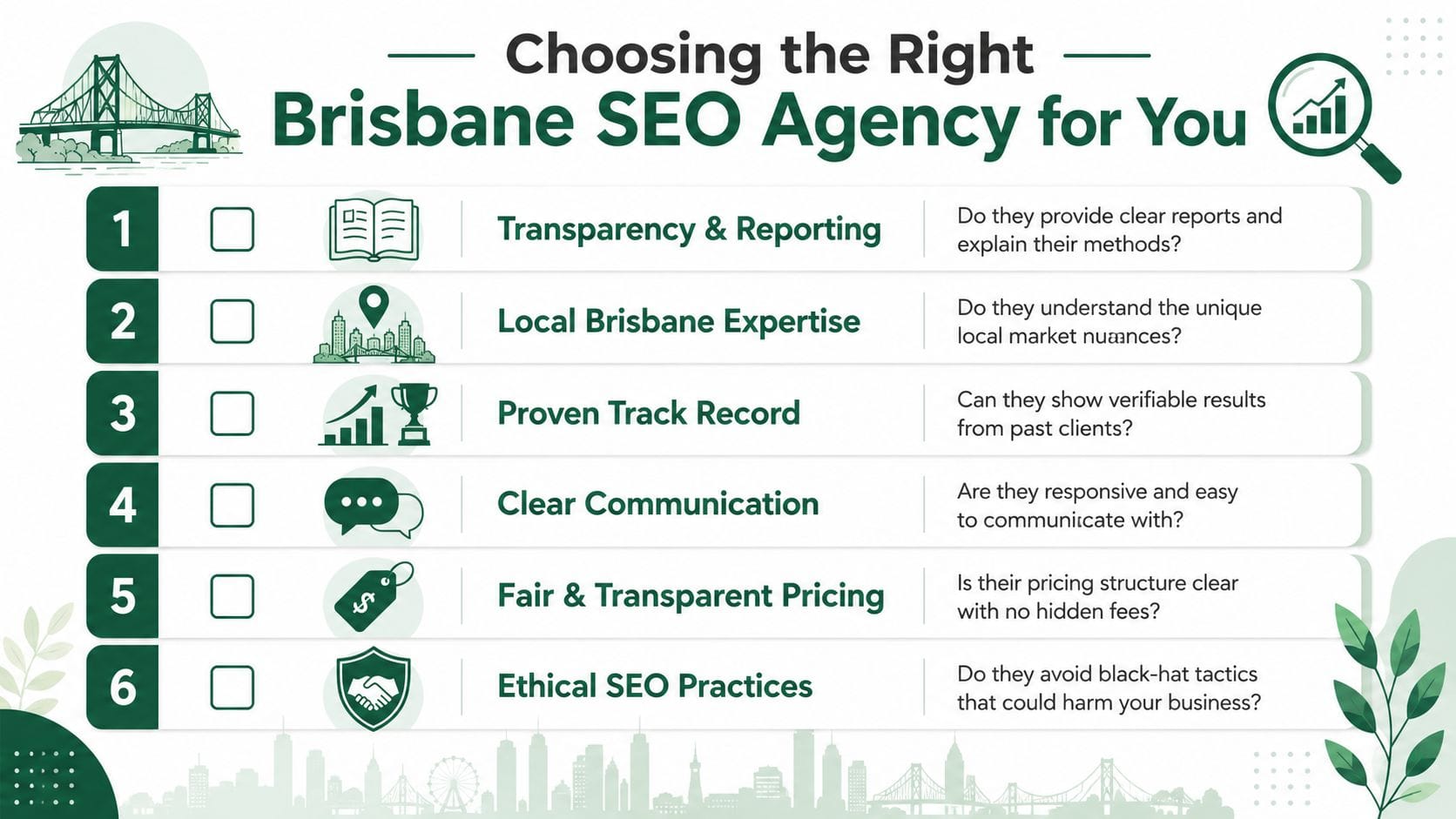
Brisbane businesses don't need a grand promise. They need a realistic partner who understands suburb targeting, service-area trade-offs, and the fact that most small operators don't have a spare marketing department.
Questions worth asking before signing anything
Ask direct questions and pay attention to how plainly the agency answers.
- What do you do each month? A serious agency should explain the recurring work in normal language.
- How do you handle Google Business Profile optimisation? This should include profile completeness, category decisions, services, photos, and consistency with the website.
- What will reporting focus on? Good answers mention enquiries, calls, direction requests, or leads, not just keyword movement.
- How do you approach suburb pages? The right answer usually involves quality thresholds, not bulk page production.
- Who does the work? Owners deserve to know whether they're dealing with a local team, a contractor, or a white-label backend.
Red flags that usually waste time and budget
Some warning signs come up again and again.
- Guaranteed number one rankings. No agency controls Google.
- One-off SEO packages sold as permanent fixes. Local SEO needs upkeep.
- No discussion of business goals. If the agency doesn't ask about service areas, margins, and lead types, the strategy will be generic.
- Reports full of activity but light on outcomes. Plenty of tasks can be completed without improving lead flow.
- Cheap bulk content for every suburb under the sun. Thin location pages often create more clutter than value.
A reliable local SEO agency in Brisbane should be able to say what it will do, why it matters, and how the business will know whether it's working.
If the answers feel evasive in the sales conversation, they usually won't get clearer after the contract is signed.
Your Brisbane Local SEO Questions Answered
What does local SEO usually cost in Brisbane
For a Brisbane small business, cost usually comes down to how much fixing is needed and how competitive the service area is.
A single-location café with a decent site and an underused Google Business Profile usually needs less work than a plumber, electrician, or mobile service business trying to win searches across multiple suburbs. One business might need profile optimisation, review work, and a few website improvements. Another might need service pages, technical fixes, citation cleanup, and ongoing content support.
There are still some useful market benchmarks. Digital8 notes that Brisbane SEO retainers often sit between $1,250 and $3,500+ GST per month, with lower entry points and higher-end campaigns depending on scope, on its SEO Brisbane service page. The more useful point for owners is what that monthly spend is buying.
Usually, it buys time.
It saves the owner from chasing directory issues, rewriting weak service pages, updating business details across platforms, responding to review gaps, and trying to work out why competitors keep showing up in Maps first. For a lean team, local SEO works best when it removes wasted hours and brings in more of the right enquiries.
Should a business target Brisbane or specific suburbs
This depends on how customers search for the service.
Some businesses should target Brisbane broadly. Others get better results by focusing on a smaller group of suburbs where they already work, can respond quickly, and have proof they serve the area well. Trying to rank everywhere usually spreads the budget too thin.
A simple way to decide is:
- Target Brisbane as a whole if the service has city-wide relevance and the website can support that claim clearly.
- Build suburb pages selectively if those suburbs matter commercially and the business has genuine coverage there.
- Show local proof on those pages, such as job photos, testimonials, service details, or examples tied to the area.
This matters even more for trades and service-area businesses. Google Business Profile guidance allows service-area businesses to hide a street address and define service areas, which changes how location signals should be handled on the website. That is one reason bulk suburb-page strategies often waste money. A more selective approach is discussed in this Brisbane-focused local SEO note at Brisbane Local SEO.
Is local SEO still worth it compared with Google Ads
Yes, if the business judges it by leads and visibility in the right places.
Some Brisbane owners get frustrated because SEO is sold like a ranking report, while the actual goal is more calls, quote requests, bookings, and map actions from nearby customers. If local SEO is helping the business appear in Maps, branded search, and high-intent local searches, it is doing its job.
Google Ads and local SEO solve different problems.
- Use Google Ads when leads are needed quickly and the business can afford the cost per click.
- Use local SEO when the goal is to build steady visibility that does not disappear the moment ad spend stops.
- Use both together if cash flow allows and the business wants short-term enquiries while organic visibility improves.
There is a trade-off here. Ads are faster, but every lead has a direct ongoing cost. Local SEO is slower, but it can reduce reliance on paid traffic over time. For many small Brisbane businesses, that matters more than chasing every possible click.
Earlier sources in this article note that SEO progress tends to build over months, not days. That is why the smartest setup is usually the simplest one. Tight service-area targeting, a complete Google Business Profile, clear service pages, and reporting that tracks real enquiries. That is how local SEO becomes a practical investment instead of another marketing expense to manage.
If a Brisbane business wants a low-pressure conversation about local search visibility, lead quality, and what's realistic for the available budget, Boocoo can be reached at hello@boocoo.au or 1300 093 797.