
A lot of Brisbane owners are in the same spot right now. The business itself is solid, the phone should be ringing more often, and customers are still coming through word of mouth, but Google isn't doing much heavy lifting. Someone nearby searches for the exact service, and a competitor shows up in the map pack instead.
That gap is where local SEO services in Brisbane matter most. Not as a vague “visibility” project, but as a practical way to show up when people in Ashgrove, Chermside, South Brisbane, or the CBD are actively looking for help. For a small business with limited time and a careful budget, the question isn't whether local SEO matters. It's where to start so the fastest wins come first.
Why Your Brisbane Business is Invisible and How to Fix It
A common Brisbane scenario looks like this. A café in Paddington makes good coffee, treats regulars well, and has loyal locals. But when someone a few streets away searches for a nearby café, another venue gets the click, the visit, and the sale.
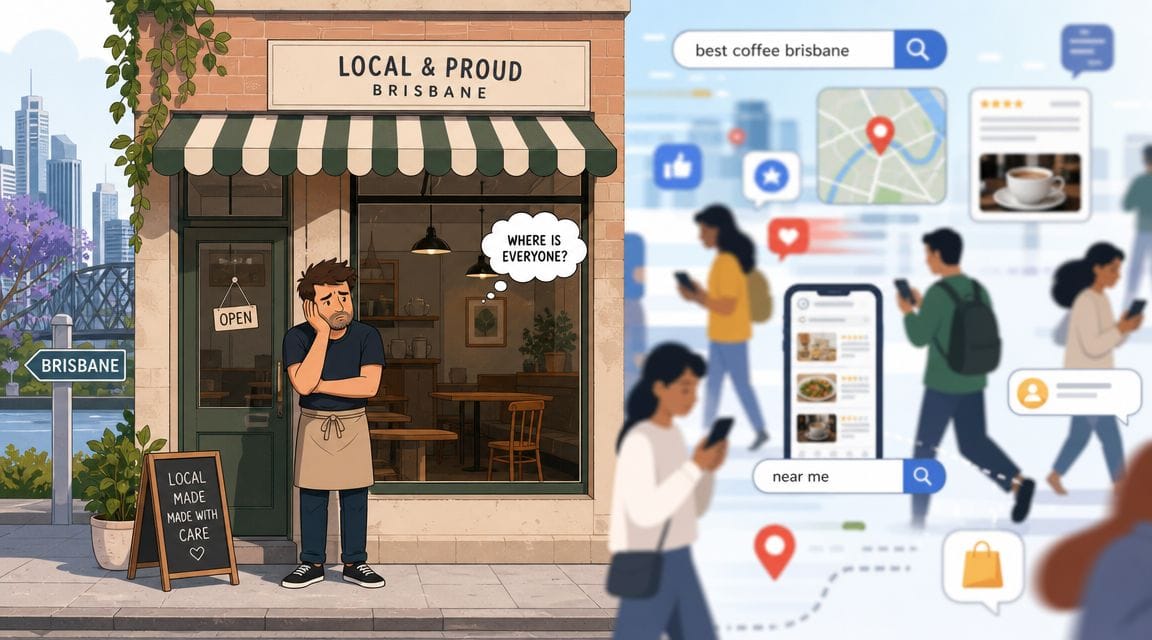
That same pattern shows up for tradies, physios, dentists, lawyers, and cleaners. The issue usually isn't service quality. It's that Google can't clearly match the business to the local search happening right now.
Google reports that 76% of people who search for something nearby on their smartphone visit a related business within 24 hours, and 28% of those searches result in a purchase, as noted in Safari Digital's Brisbane SEO guidance. For a small business, that's not abstract marketing. That's missed calls, missed bookings, and missed foot traffic.
Local SEO works best when it solves a timing problem. The customer is already ready. The business just has to be visible at the right moment.
In Brisbane, that matters because search intent is often suburb-driven. People don't just look for “plumber” or “dentist”. They search for the closest option they trust, often with a suburb, a precinct, or “near me” attached. A business that serves North Lakes but only talks about “Brisbane” in broad terms can end up invisible in the exact area it wants to win.
A simple fix usually starts with the basics:
- Tighten the location signal by matching services to real suburbs or service areas.
- Clean up the Google listing so hours, categories, photos, and contact details are current.
- Make the website useful for local intent with service pages that reflect where the business works.
For clinic owners, a similar logic applies to patient acquisition. This 2026 playbook for dentists is useful because it connects visibility with practical lead flow, not just traffic charts.
What Is Local SEO Really? The Three Simple Pillars
Most local SEO jargon makes a simple system sound harder than it is. A better way to think about it is like running a stall at a busy weekend market. The stall needs to be in the right spot, clearly labelled, and known as trustworthy.
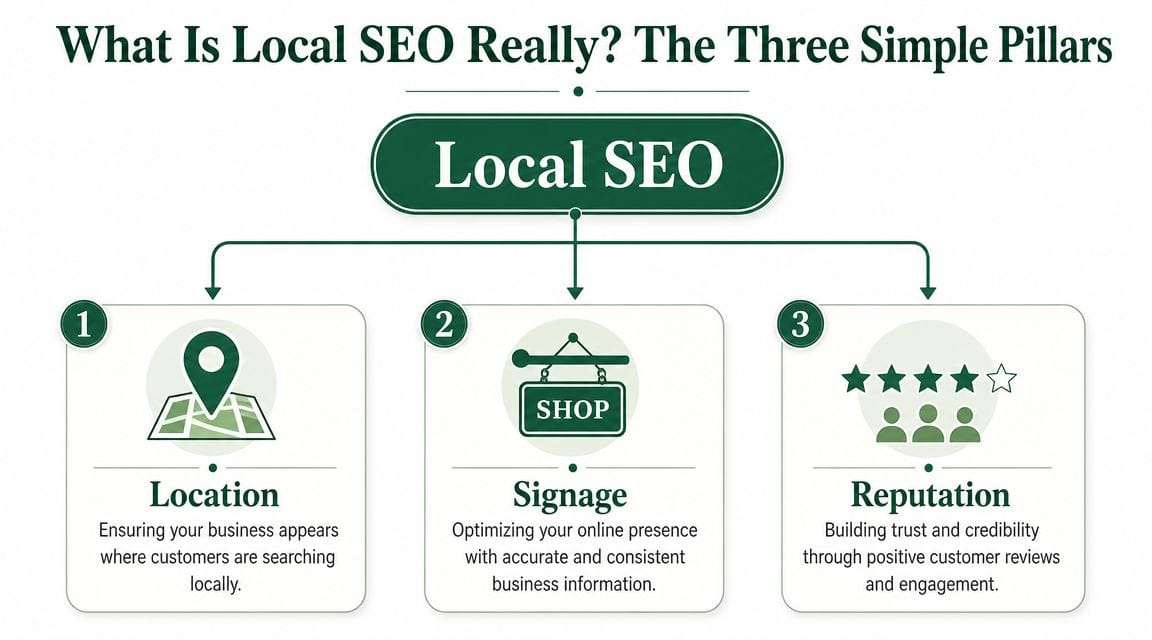
Google's local system revolves around three ideas. They're not complicated, but each one affects whether a Brisbane business appears in maps and local results.
Relevance
Relevance is about fit. If someone searches for “emergency electrician Chermside”, Google wants to show businesses that clearly offer emergency electrical work and clearly serve that area.
That means vague website copy doesn't help much. “Quality services across South East Queensland” sounds broad and safe, but it doesn't answer the search. Pages, categories, services, and descriptions need to line up with what the customer is typing.
Distance
Distance is the practical one. Google tries to show options that are close to the searcher or closely connected to the named area.
A business can't fake being closer than it is. But it can help Google understand where it operates. That's where properly set service areas, suburb pages, and accurate business details come in. If the business serves Toowong, Indooroopilly, and Milton, those areas need to be reflected clearly.
Prominence
Prominence is trust and recognition. It's the digital version of being the stall people recommend.
This comes from signals like reviews, mentions across directories, and an active, complete profile. It also comes from whether Google sees the business as a well-established local entity rather than a half-finished listing with patchy details.
Practical rule: If a business has the right service, in the right area, with a stronger reputation signal than nearby competitors, local visibility gets much easier.
For a time-poor owner, this framework is useful because it cuts through fluff. Nearly every worthwhile local SEO task in Brisbane improves one of those three pillars. If a proposed task doesn't strengthen relevance, distance, or prominence, it probably isn't the first thing to spend money on.
The Core Components of Local SEO Services
When a business pays for local SEO services in Brisbane, it should be paying for a clear set of jobs, not mystery work hidden behind reports. Good local SEO has a short list of core components, and each one should connect back to enquiries, calls, or bookings.
Your Google Business Profile is the storefront
For most small businesses, the Google Business Profile is the first priority. It's the digital storefront that powers map visibility, phone clicks, direction requests, and a big slice of local trust.
A proper local SEO service should cover:
- Category selection so the primary and secondary categories match its service.
- Service setup with clear descriptions that reflect what the business provides.
- Photo management because outdated or low-quality images make a listing feel neglected.
- Review process so happy customers are asked consistently, not randomly.
- Posting and updates to keep the profile active and aligned with current offers or service areas.
There's also a technical side that gets ignored far too often. Local rankings are driven by relevance, distance, and prominence, so an NAP mismatch between the Google Business Profile, website schema, and Australian directories can weaken prominence signals and suppress visibility in the map pack, as explained in Ape-X's local SEO guidance.
If a business is listed as “Suite 2, Level 1” on the website, “Lvl 1 Ste 2” in a directory, and uses a different phone number on the profile, that's not harmless admin drift. It creates confusion.
GBP first or website first
For a time-poor operator, this is the big trade-off. Should the budget go into the Google listing first, or the website first?
In many Brisbane service businesses, GBP comes first. The map pack is strongly influenced by profile completeness, reviews, proximity, and setup quality. If the profile is thin, the wrong category is selected, and service areas are messy, broad website SEO usually won't fix the main problem quickly.
A good rule of thumb:
- Start with GBP first if the business relies on local calls, quote requests, or same-area jobs.
- Start with the website first if the site is broken, painfully slow on mobile, or missing core service pages entirely.
- Do both together when the business is in a crowded market and wants steady lead flow, not just a short-term visibility lift.
That's why many providers combine GBP work with broader search engine optimisation support rather than treating them as separate projects.
The support work that makes local SEO stick
Google profile work on its own usually isn't enough. It needs support from the website and the wider web.
A practical local SEO service should also include:
- Local keyword research focused on service plus suburb intent, not generic national phrases.
- Suburb and service landing pages with unique copy for real areas the business serves.
- Internal linking so those pages support each other instead of sitting isolated.
- Citation cleanup across Australian directories to reinforce the same business details.
- LocalBusiness schema to help search engines understand the entity clearly.
A strong Brisbane benchmark is to treat local SEO as a conversion system, matching location intent with suburb-level landing pages and review workflows, as outlined in Cloud SEO Marketing's Brisbane local SEO article. In practice, that means a page like “Electrician in North Lakes” should feel built for North Lakes, not copied from a generic master template.
Measuring Real Success From Your Local SEO
The worst local SEO reporting focuses on rankings the owner never sees and traffic that never turns into work. A Brisbane business doesn't need more charts. It needs a simple answer to one question. Is this bringing in leads?

That matters even more now because search behaviour is shifting. For Australian businesses, a key gap in advice is the right KPI mix, and it's now likely to include Google Business Profile calls, direction requests, and website form conversions, not just rank trackers, especially as AI Overviews change user behaviour, according to Shout Digital's Brisbane SEO article.
What to track instead of vanity rankings
For most local businesses, the practical KPI list is short:
- GBP calls because these often reflect immediate buying intent.
- Direction requests for clinics, cafés, retailers, and offices.
- Website form submissions from service pages and contact pages.
- Booked jobs or consultations where the enquiry source can be traced.
- Branded search growth as the business becomes more recognised locally.
A ranking report can still be useful, but only as supporting context. If a business moves up for a suburb term and nothing changes in calls or quote requests, the job isn't done.
Rankings are a signal. Leads are the outcome.
What a useful monthly report looks like
A useful report should be easy to scan in a few minutes. It should show what changed, what the numbers mean, and what the agency is doing next.
A simple format works well:
| Report Area | What to look for | Why it matters |
|---|---|---|
| Google Business Profile | Calls, direction requests, website clicks | Measures direct local intent actions |
| Website conversions | Forms submitted, contact clicks | Shows whether traffic turns into enquiries |
| Service pages | Which suburb pages attract engagement | Helps identify where demand is strongest |
| Reviews | New reviews and response activity | Supports trust and local prominence |
| Next actions | Clear priorities for the next month | Keeps the work accountable |
For businesses that want stronger results from existing traffic, pairing local SEO with conversion rate optimisation in Australia often makes sense. More visitors won't help much if the mobile contact form is clunky or the phone button is hard to find.
Typical Local SEO Pricing and Packages in Brisbane
Local SEO pricing in Brisbane varies a lot, and that's one reason owners get frustrated. One provider offers a cheap setup. Another pushes a monthly retainer. A third bundles in content, technical fixes, reviews, and reporting. Without a framework, it's hard to compare apples with apples.
The safest way to assess pricing is to look at the type of work included, how competitive the market is, and whether the business needs a one-off fix or ongoing management.
Typical Brisbane Local SEO Packages
| Package Tier | Best For | Typical Inclusions | Estimated Monthly Cost (AUD) |
|---|---|---|---|
| Foundation | New businesses, sole traders, businesses with an unoptimised profile | Google Business Profile setup or cleanup, NAP audit, basic citation corrections, core service page recommendations, review request setup | Varies by provider and scope |
| Growth | Established small businesses wanting consistent local leads | Ongoing GBP management, suburb/service page optimisation, citation work, review workflow support, monthly reporting, on-page improvements | Varies by provider and scope |
| Competitive | Multi-suburb service businesses and crowded niches | Everything in Growth plus deeper location page development, stronger content support, technical SEO, broader local authority work, closer conversion tracking | Varies by provider and scope |
No precise Brisbane-wide pricing benchmark is cited here because verified package price data hasn't been provided. That's a good reminder in itself. If an agency publishes neat package labels but stays vague about deliverables, caution is sensible.
What changes the price
Three factors usually drive cost more than anything else:
- Service area spread. A business targeting one suburb is simpler than one targeting many parts of Brisbane.
- Competition level. A quiet niche usually needs less ongoing work than legal, dental, or trades in dense metro areas.
- Starting point. A clean profile and decent site need refinement. A messy profile, broken pages, and inconsistent citations need repair first.
A useful buying question is whether the work is setup-heavy or maintenance-heavy. Some businesses mainly need a proper foundation. Others need recurring work because competitors are active, reviews need managing, and service pages need expansion.
A cheap package isn't cheap if it only produces reports. A more focused package can save money if it fixes the main local bottleneck first.
How to Choose the Right Brisbane SEO Agency
A Brisbane owner usually starts shopping for SEO after the same frustrating pattern. The phone is quiet, competitors keep showing up in Google Maps, and every agency pitch sounds polished but oddly generic. The key question is simpler. Who can tell you what to fix first so you get enquiries sooner without paying for work you do not need yet?
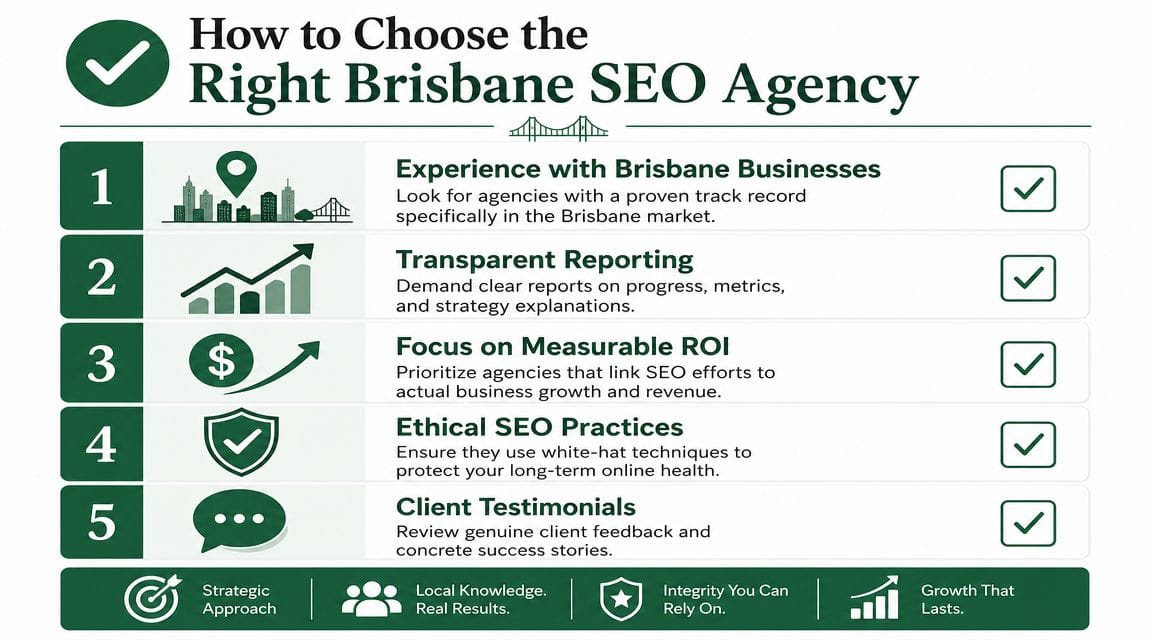
Choosing the right Brisbane SEO agency means finding one that can diagnose the bottleneck, not just sell a package. For many small businesses, the fastest win is not a full website rebuild or a long content plan. It is getting the Google Business Profile, reviews, service areas, and local trust signals sorted first. For others, the profile is fine and the website is what stops traffic from turning into calls.
That distinction matters because it affects both budget and speed. If an agency cannot explain whether your business should prioritise Google Business Profile work or website SEO first, it is guessing with your money.
Green flags to look for
Good agencies sound specific. They should be able to explain what they would do in month one for your business, why that work comes first, and what can wait.
Ask questions like:
- What would you fix first for this business, and why?
- Would you prioritise Google Business Profile work or website SEO first?
- How do you measure leads, calls, and form enquiries, not just rankings?
- What local work is included each month?
- Who does the work and how often will we speak?
Useful answers usually mention trade-offs. A solid agency might say a mobile service business across several suburbs should clean up its profile, categories, reviews, and service-area signals before investing heavily in new pages. A clinic with a decent profile but weak service pages may need stronger location content and a better conversion path on the site first.
Look for plain English too. If the explanation is full of jargon but light on priorities, the strategy often is too.
One practical option in the local market is Boocoo, which supports Brisbane small businesses with GBP work, suburb-focused SEO, and small business website improvements when the site is part of the conversion problem. That joined-up approach helps when visibility and enquiries are tied to each other.
Red flags to avoid
Some warning signs show up early:
- Guaranteed rankings
- Long lock-in contracts before an audit
- Reports full of ranking graphs but no call or enquiry tracking
- A copy-paste strategy that could apply to Sydney, Perth, or anywhere else
- Heavy focus on backlinks while local profile work, reviews, and suburb intent barely get mentioned
Another red flag is poor questioning. A good agency should ask about your service area, busiest jobs, strongest suburbs, margins, and whether you need more calls now or better lead quality over time. Without that context, the campaign can drift into busywork.
It also helps to choose a team that sees local SEO as part of the wider marketing picture. SleekPost helps understand 2026 marketing if you want a broader view of how local search fits alongside the rest of your digital spend.
The best fit is rarely the agency with the biggest pitch. It is the one that can show you where the quickest local gain is, what it will cost to fix, and what should wait until later.
Your Next Step to Getting Found in Brisbane
Local SEO isn't reserved for big brands with bigger budgets. For a Brisbane small business, it's often the most practical route to steady, high-intent enquiries from people already looking for help nearby.
The key is to start in the right place. For some businesses, that means fixing the Google Business Profile before pouring money into broad website SEO. For others, it means tightening the site so local traffic has somewhere useful to land. Either way, the win comes from solving the bottleneck first.
A sensible next-step checklist looks like this:
- Audit the Google Business Profile for categories, services, photos, and accuracy.
- Check NAP consistency across the website and directories.
- Review suburb targeting to see whether service pages match actual demand areas.
- Look at conversions on mobile so local visitors can call or enquire easily.
- Decide whether the website supports trust or gets in the way.
Owners who are also trying to keep up with broader industry shifts may find this SleekPost guide to understanding 2026 marketing useful. It helps frame local SEO inside the wider digital picture without turning everything into trend-chasing.
If the current site is part of the problem, a stronger small business website setup can make local SEO work much harder by improving mobile usability, service-page clarity, and contact pathways.
Local SEO services in Brisbane work best when they reduce overwhelm, not add to it. A small business owner shouldn't need to become an SEO technician. The practical move is to get a clear diagnosis, prioritise the fastest-impact fixes, and let the work support the business instead of distracting from it.