
A lot of Brisbane business owners are in the same spot right now. They're good at what they do, the phone should be ringing more than it is, and they know customers are looking for them on Google, but the whole digital marketing side feels murky, expensive, and full of buzzwords.
One agency talks about backlinks. Another talks about technical fixes. Someone else promises page-one rankings. Meanwhile, there's still a business to run, staff to manage, quotes to send, and customers to look after. That's why search engine optimisation SEO services can feel harder to judge than they should.
This guide keeps the focus where it belongs. On what SEO means for a small business in Brisbane, what usually works, what tends to waste money, and how to choose help without getting boxed into a bad deal. For businesses trying to make sense of Brisbane Digital Marketing, the goal isn't more jargon. The goal is more clarity.
Why Finding More Customers Online Feels So Hard
A Brisbane electrician in Carindale, a dentist in Chermside, or a bookkeeper in Ipswich can all run into the same problem. They know customers are looking online, but they can't tell why a competitor appears first while their own business barely shows up.
Part of the frustration is that online visibility doesn't break in obvious ways. A shopfront with no sign is clearly a problem. A website that looks fine but doesn't bring in enquiries is harder to diagnose. It might be the page titles, weak suburb pages, poor internal links, missing Google Business Profile work, or content that never quite matches what local customers are searching for.
That confusion gets worse when every marketing term sounds technical. Traffic, authority, indexing, metadata, citations. For a small business owner already stretched for time, it's easy to switch off and assume SEO is something vague, slow, and impossible to measure.
A simpler way to look at it is this. SEO helps a business get found when someone is already looking for a service. Not casually browsing. Looking. That's why understanding where visits come from matters in the first place. For anyone trying to make sense of channels before paying for more marketing, this practical resource on understanding website traffic for DTC gives a useful breakdown of how different traffic sources behave.
Why small businesses often feel stuck
The usual pattern looks like this:
- The website exists: It was built a while ago, looks decent enough, and gets occasional enquiries.
- The owner hears mixed advice: One person says to blog more. Another says to buy ads. Another says the site needs a rebuild.
- Nothing feels certain: Without clear reporting, it's hard to know which action would lead to more calls or quote requests.
Practical rule: If a business can't explain which pages bring enquiries, which suburbs matter most, and what customers are actually typing into Google, SEO work will feel random.
For Brisbane small businesses, that's where good SEO earns its keep. It turns “why aren't people finding us?” into a practical checklist. Which services matter most. Which suburbs are worth targeting first. Which pages need to be fixed, expanded, or combined.
Some owners decide to sort that out in-house. Others compare local providers and decide whether outside help is worth the cost. This guide on whether SEO is worth it for small business is useful for making that call before signing anything.
What SEO Services Actually Do for Your Business
SEO sounds technical because people often explain it backwards. The clearer way is to compare it to a physical shop.
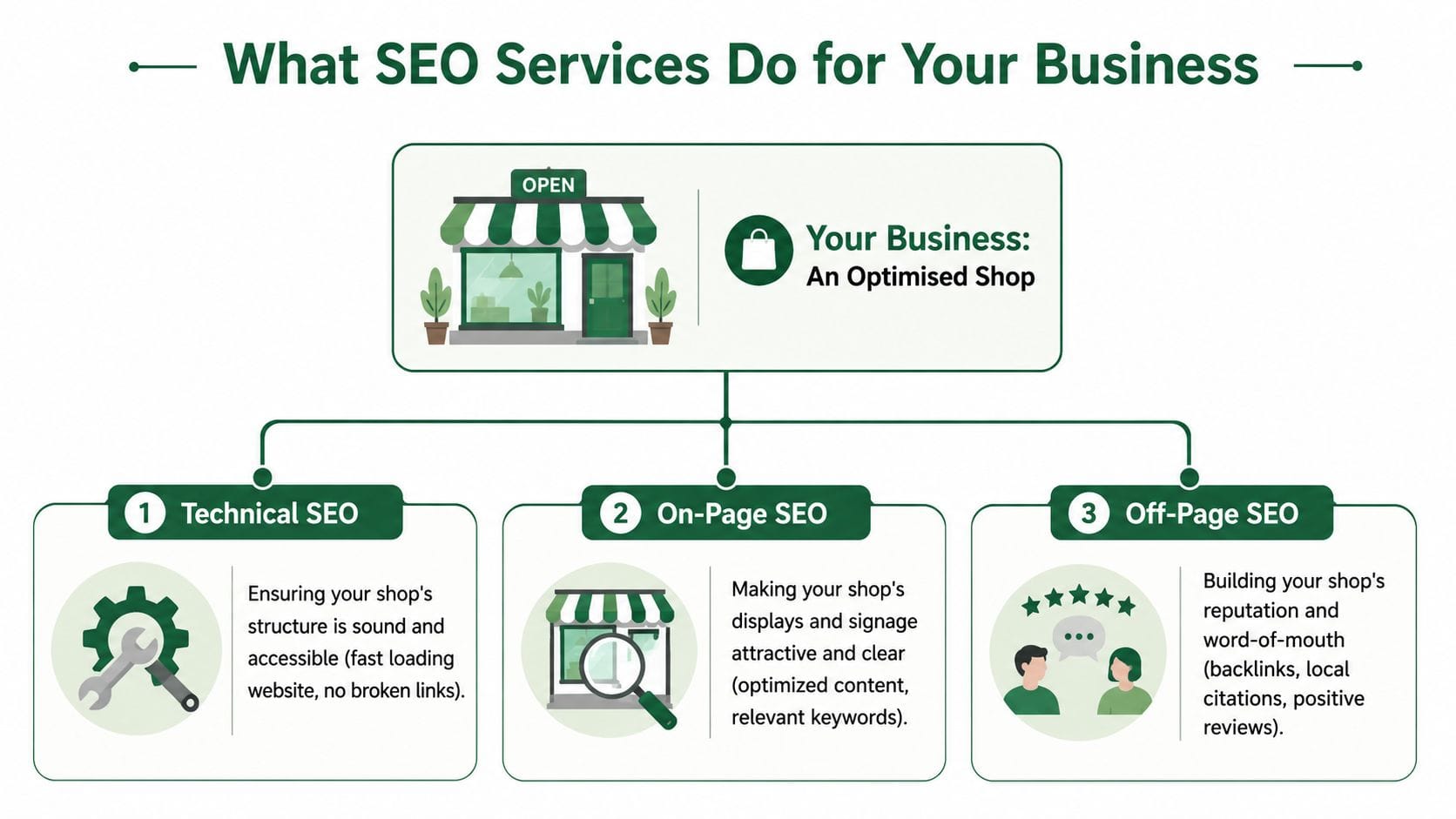
Think of SEO like setting up a physical shop
If a business had a shop on a busy Brisbane street, three things would matter.
First, the building needs to work. The door opens, the lights are on, and people can get in without hassle. Online, that's technical SEO. It covers things like site speed, broken links, crawl issues, mobile usability, and whether search engines can properly read the site.
Second, the inside of the shop needs to make sense. Clear signs, organised shelves, and a layout that helps people find what they came for. Online, that's on-page SEO. It includes page titles, headings, service copy, internal links, location pages, and content that matches search intent.
Third, the business needs a good reputation around town. People mention it, recommend it, and leave strong reviews. Online, that's off-page SEO. It includes backlinks, local citations, review management, and brand mentions that help Google trust the business.
This is also why random one-off fixes rarely do much on their own. A faster website helps, but not if the pages are thin. A good service page helps, but not if the business has no local authority signals. SEO works when the parts support each other.
What an agency should actually be doing each month
A proper SEO service isn't just “doing some keywords”. It usually includes a mix of work such as:
- Technical upkeep: Checking indexing issues, page errors, redirects, mobile performance, and page speed.
- Page improvement: Rewriting service pages, tightening titles and headings, improving internal links, and clarifying calls to action.
- Content work: Publishing new pages or refreshing old ones so the site answers real customer questions.
- Authority building: Earning relevant backlinks, improving citations, and helping the business gather and respond to reviews.
- Reporting: Showing what changed, what improved, and what should happen next.
The authority side matters more than many owners realise. Data shows that local SEO performance hinges on key factors like backlinks, consistent content, and reviews. Top-ranking local businesses typically have 35x more backlinks and 8x more customer reviews than lower-ranked competitors, while 65% of consumers use search engines to find local businesses every week according to Australian local SEO statistics.
That's why “set and forget” SEO packages usually disappoint. Search behaviour changes, competitors publish new pages, and listings drift out of date. Good SEO is organised monthly maintenance mixed with deliberate growth work.
For business owners who want a plain-English primer before hiring anyone, this guide on website optimization for marketers is a handy companion. And for businesses reviewing how content fits into the bigger picture, these SEO content writing services show what should be happening beyond basic blog posts.
The Real Benefits for a Brisbane Small Business
The upside of SEO isn't “more traffic” in the abstract. It's better visibility in the places where local buyers make decisions.

Better leads, not just more visits
A plumber based in The Gap doesn't need attention from people across Australia. That business needs local intent. Someone searching for emergency plumbing in Ashgrove, Bardon, Red Hill, or Enoggera. A family lawyer in the Brisbane CBD needs visibility for nearby searches with strong intent, not random national traffic that never turns into a call.
That's where local SEO becomes practical. It helps a business appear for service-plus-location searches, supports visibility in the map results, and makes it easier for a buyer to trust what they see. A solid Google Business Profile, suburb-relevant service pages, and clear reviews do more than lift rankings. They reduce hesitation.
The best local SEO work doesn't chase everyone. It helps the right customer find the right page at the right moment.
That matters in a market where competition is rising. The Australian SEO services market was projected to reach approximately $1.5 billion in 2025, with small businesses investing an average of $1,500 to $2,500 monthly. The same research notes that businesses using multi-location targeting generate 557% more traffic on average than single-location competitors, according to state of SEO and marketing in Australia research.
SEO becomes an asset the business keeps
Paid ads stop when the budget stops. SEO is different. A better service page, stronger review profile, cleaner site structure, and useful suburb content keep working after they're published.
That doesn't mean SEO is instant or effortless. It means the work builds on itself. One improved service page supports another. One useful location page strengthens the local footprint. Better internal links help people and Google move through the site more easily.
For small businesses managing tight budgets, that's often the strongest argument for SEO within a broader Brisbane Digital Marketing plan. It creates something durable. Not overnight visibility, but a stronger base that doesn't disappear the moment spend is paused.
A trade business, allied health clinic, accountant, or local e-commerce store may all use the channel differently. The common thread is that SEO helps them get found by people already looking, without relying only on rented attention.
What to Expect in Your First 90 Days
The first three months of SEO should feel structured. Not magical, not mysterious, and not padded with fluff.
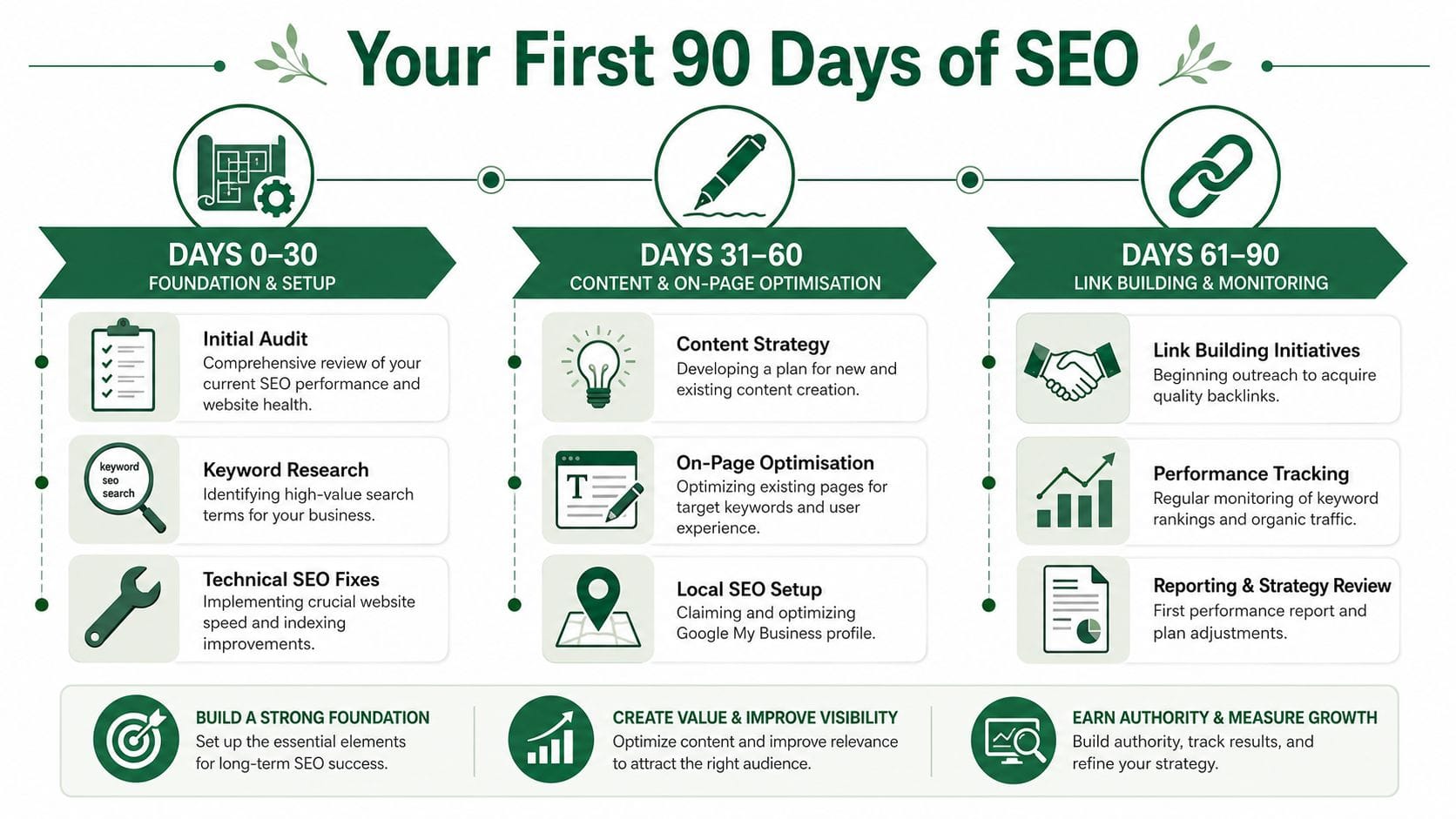
For Brisbane service businesses, a good early campaign usually starts with the basics, then moves into implementation, then into measurement and refinement. While timelines vary, 62% of Brisbane small businesses in high-intent sectors like trades and healthcare see their first qualified leads within 90 days when using a strategy focused on Google Business Profile optimisation and local citations, based on local SEO service findings for AU markets.
Days 0 to 30
This first block is about finding problems before spending money in the wrong place.
An SEO provider should review the website structure, existing pages, rankings, technical health, Google Business Profile setup, competitors, and local keyword opportunities. This is also when the provider should identify which services make the most commercial sense to target first.
Typical deliverables in this phase include:
- Technical audit: A list of issues affecting visibility or usability, explained in plain language.
- Keyword research: The terms customers use when looking for each service and suburb.
- Priority roadmap: A realistic sequence of what gets fixed first, what gets created later, and why.
If a provider skips straight to “more blog posts” without doing this groundwork, that's usually a warning sign.
Days 31 to 60
The visible changes usually begin at this point.
Priority pages get rewritten or expanded. Page titles and headings are improved. Thin pages are combined or strengthened. Google Business Profile details are tightened up. Local citations are checked for consistency. Internal links are added so the website has a clearer structure.
A small trade business might use this phase to improve its core service pages first. An accountant might clean up service pages and add suburb targeting. A clinic might refine practitioner pages, treatment pages, and local listing signals.
Working benchmark: If nothing meaningful has changed on the website by the second month, the campaign is probably too slow.
Days 61 to 90
By this point, the business should start seeing early signals. That might include more impressions for target searches, stronger map visibility, better engagement on key pages, or the first qualified enquiries linked to SEO work.
This phase often includes:
- Content expansion: New suburb or service pages where the opportunity is clear.
- Link and authority work: Relevant outreach, local mentions, and review activity.
- Reporting and refinement: A monthly report that explains what improved, what didn't, and what gets adjusted next.
The important thing is expectation setting. Month three isn't the finish line. It's where a business starts to see whether the strategy is connecting with the market.
Understanding SEO Pricing and What You Get
SEO pricing gets messy because many quotes look similar on the surface. “Monthly optimisation”, “content support”, “technical enhancements”. Those phrases don't tell a business owner how much actual work is being done.
Why cheap SEO often becomes expensive
Low-cost SEO can look attractive when budgets are tight. The problem is that a cheap package often means very little gets done, or the work is outsourced so heavily that it misses local context.
Data from Clutch shows that 68% of Australian SMBs prefer agencies that guarantee in-house work by Australian teams, and many service pages still lack pricing or team-location clarity according to Clutch's SEO firms listing in Australia. For a Brisbane business, that matters. Service area language, suburb targeting, local intent, and page quality are hard to fake with generic offshore production.
There's another practical issue. If a package is too cheap, it usually can't support the time needed for proper page work, local SEO, technical fixes, and reporting. A business ends up paying twice. Once for the weak campaign, then again to clean it up.
Businesses comparing local options often look at affordable SEO in Brisbane because price by itself doesn't say much. The better question is what level of work the budget buys.
Typical Monthly SEO Service Tiers
| Tier | Typical Monthly Price (AUD) | Best For | Common Inclusions |
|---|---|---|---|
| Foundational | Lower end of the common small business range | Newer businesses needing core fixes | Basic technical cleanup, Google Business Profile work, priority page optimisation, light reporting |
| Growth | Mid-range within the common small business range | Established local businesses wanting stronger lead flow | Ongoing content work, local page expansion, review support, technical upkeep, reporting, moderate authority work |
| Comprehensive | Upper end and beyond the common small business range | Competitive service sectors or multi-location businesses | Broader content production, more frequent optimisation, deeper authority building, advanced local targeting, strategy reviews |
The market context helps frame this. Australian small businesses are investing an average of $1,500 to $2,500 monthly in SEO, as covered earlier in the article. That doesn't mean every business should spend at the top of the range. It means serious SEO usually sits closer to an ongoing marketing investment than a one-off cheap fix.
A simple way to judge value is to ask: how many important pages are being worked on, how often, by whom, and with what reporting? If the proposal can't answer that clearly, the price is secondary.
How to Choose the Right Brisbane SEO Agency
Hiring an SEO agency shouldn't feel like buying a mystery box. A good provider explains the work, the trade-offs, and the likely timeline without hiding behind jargon.
Questions worth asking before signing anything
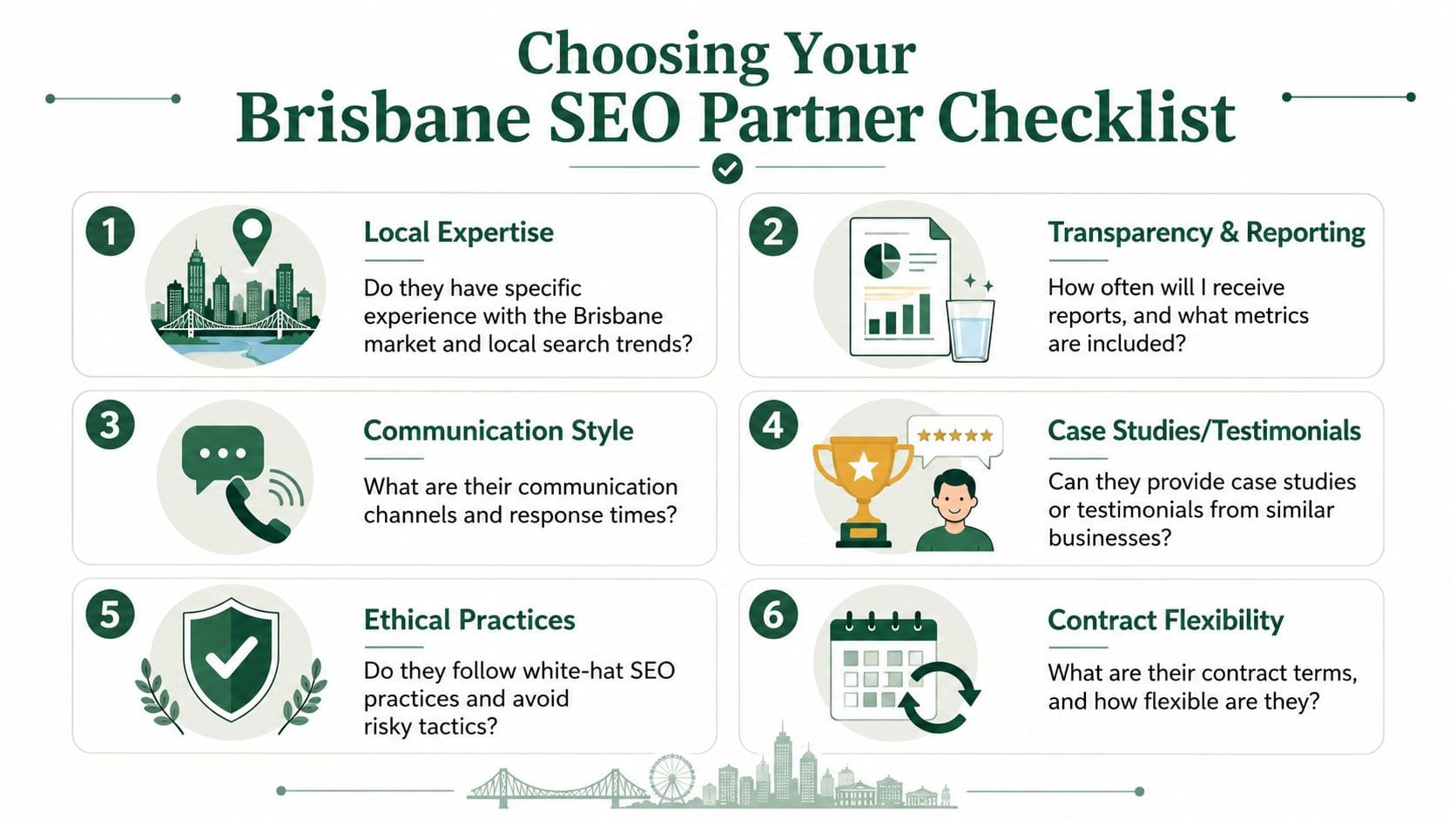
A Brisbane business owner doesn't need to become an SEO expert. They do need a short list of sensible questions.
- Ask about local understanding: Which Brisbane suburbs, service areas, or local search patterns do they understand?
- Ask what gets done each month: Not broad promises. Actual tasks, page work, reporting, and review cycles.
- Ask who does the work: In-house staff, contractors, or offshore fulfilment.
- Ask how they report: The report should connect SEO activity to business outcomes, not just vanity metrics.
- Ask for relevant examples: Not secret client data. Just enough to show they've handled similar service businesses before.
Transparency matters because many business owners have already had one poor agency experience. That's part of why 68% of Australian SMBs prefer agencies that guarantee in-house work by Australian teams, as noted in the Clutch data already referenced earlier.
Some owners also like to ask what tools an agency uses. Tools don't guarantee results, but they do reveal how organised the provider is. This roundup of top marketing tools for agencies gives a decent sense of the kinds of platforms serious teams use for reporting, workflow, and communication.
Red flags that usually signal trouble
A few warning signs come up again and again.
If an agency guarantees “#1 rankings”, skips questions about business goals, or won't explain where the work is done, caution is warranted.
Other red flags include:
- No clear scope: The proposal sounds polished but never says what happens in month one, two, or three.
- No reporting sample: If they can't show what reporting looks like, they may not report well at all.
- Only rankings talk: Rankings matter, but enquiries, calls, and lead quality matter more.
- Very long contracts with vague deliverables: Lock-in without clarity benefits the agency more than the client.
- Generic strategy: A law firm, plumber, and online store shouldn't all get the same plan.
For businesses that want a local shortlist to compare against, SEO companies for small business is a practical starting point. One local option in Brisbane is Boocoo, which offers SEO support alongside web design, social media, and paid advertising for small businesses that want marketing handled in a coordinated way. That kind of setup suits owners who don't want separate providers pulling in different directions.
The best fit still comes down to clarity, communication style, and whether the agency understands the business model, not just the keyword list.
Your Next Step to Getting Found on Google
Good SEO is rarely about one clever trick. It's usually the result of steady work on the right pages, in the right order, with clear local intent and honest reporting.
For a Brisbane small business, the next step doesn't need to be complicated. It helps to check three things first:
- Visibility check: Are the main services appearing in search results in the suburbs that matter most?
- Website check: Do the core service pages clearly explain what the business does, where it works, and how to enquire?
- Trust check: Does the business have strong reviews, consistent local details, and a Google Business Profile that's actively maintained?
Even small changes can move the needle. One study found that updating existing website content can improve organic traffic by 437%, according to Safari Digital's digital marketing statistics. That's a useful reminder that many businesses don't need to start from scratch. They need to improve what's already there.
For owners who want a clearer plan before talking to any provider, this guide to building a strategy for SEO is a sensible next read.