

A good Brisbane physio clinic can be full of skilled clinicians, strong referrals, and happy patients, yet still feel stuck when the phone doesn't ring often enough. That usually isn't a treatment problem. It's a visibility problem, and in a city like Brisbane, SEO for physiotherapists is often the most practical way to close that gap without burning cash on ads that stop the moment the budget pauses.
When someone in Newstead, Woolloongabba, or Indooroopilly feels a niggle in their back, they're not browsing leisurely. They're searching for a clinic that looks close, credible, and ready to book. In Australia, that behaviour is hard to ignore, because 78% of Melburnians search Google before booking a physio appointment and 68% of physio searches include a suburb or “near me” modifier (local search behaviour for physiotherapy clinics in Australia). Brisbane follows the same pattern. If a clinic isn't visible in map results, suburb searches, and service-plus-location queries, it's missing people at the exact moment they're ready to act.
Why Local SEO Is the Biggest Growth Lever for Brisbane Physio Clinics
A Brisbane physio clinic can be good on the table and still be hard to find in Google Maps. That gap costs bookings. The clinic may have the skills, the rooms, and the trust, but the person who just tweaked a hamstring in Newstead will go to the clinic that shows up first in search.
Visibility beats brochure-style marketing
Local SEO fixes that gap by lining up the clinic with real search intent. Someone typing “physiotherapist near me” or “back pain physio Brisbane” is not browsing for interest, they want a clinic they can contact now. That is why local search matters so much for physiotherapists in Australia, and why suburb-based optimisation, map visibility, and service-location pages matter more than a polished homepage alone (Australian physio local search guidance).
The click pattern is blunt. For physical therapy searches, the #1 organic result typically earns 19–28% of clicks, while position #3 drops to around 8–13%, and results beyond page 1 receive less than 1% of clicks (physical therapy SEO click distribution). In local results, the top map listing captures roughly 17–24% of clicks. That is a sharp funnel, and Brisbane clinics feel it quickly when they fall behind the top results.
Practical rule: if a Brisbane clinic is not close to the top of the map pack or the first page, it is likely losing high-intent bookings to practices that are easier to find, not necessarily better at treatment.
What this means for small clinics
For a small practice, local SEO is usually a smarter use of budget than spreading money across broad marketing that does not map to bookings. It supports the searches that already show intent, and it keeps working after the first round of setup. The first gains usually come from Google Business Profile optimisation, suburb-focused landing pages, and service-plus-location keywords such as sports physiotherapy Brisbane or physiotherapist [suburb].
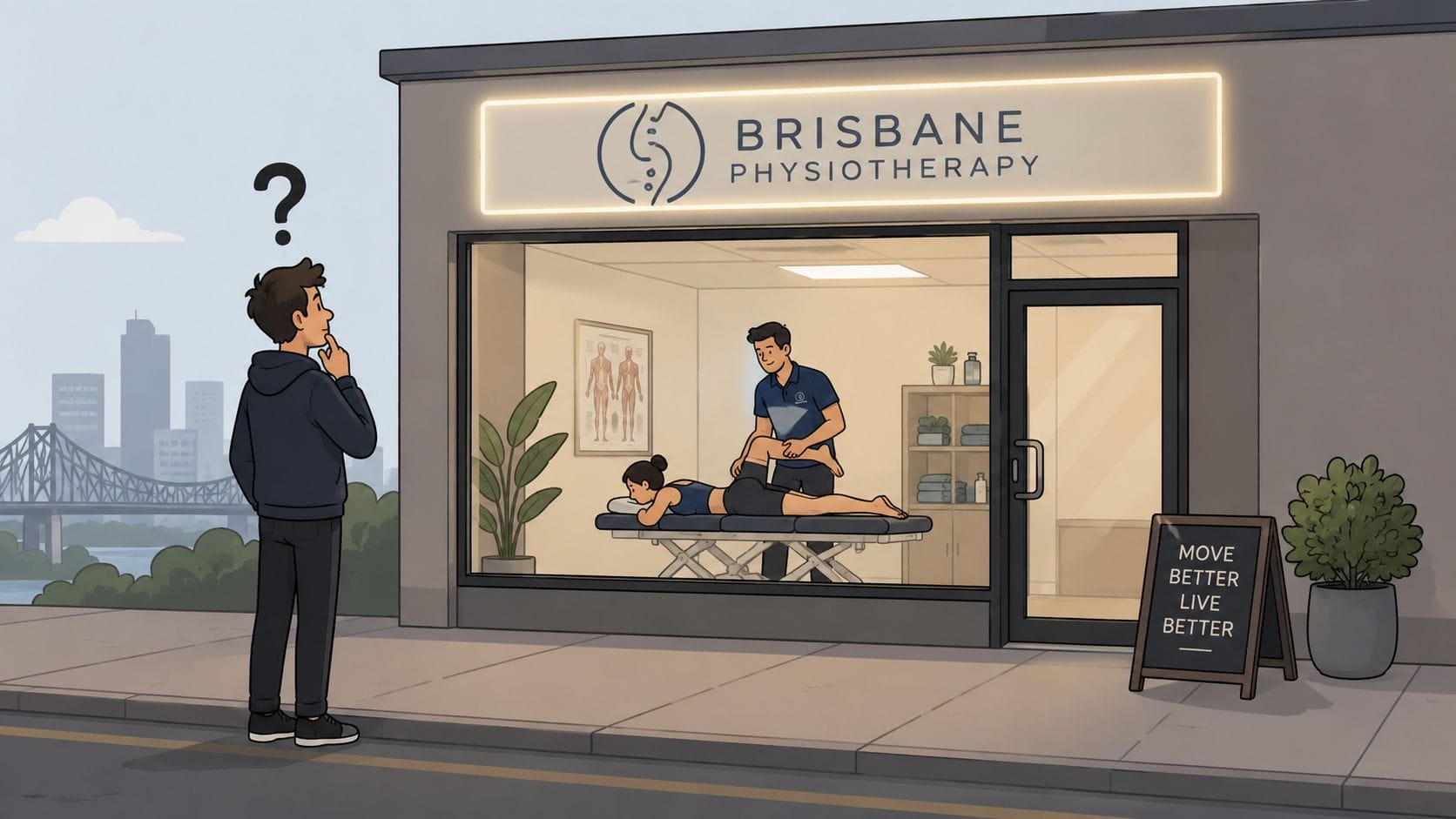
For Brisbane clinics, the job is to treat SEO less like branding and more like a booking channel. That means using suburb targeting properly, keeping Google Business Profile details tight, and building citations that match the clinic's real location and service area. A plain-English guide to what local SEO marketing is helps frame that approach without the fluff.
Finding the Right Keywords for Brisbane Physio Searches
Keyword work for physios is about matching patient intent, not chasing the biggest number in a planner. A generic term like “physiotherapy” is broad and often wasteful. A phrase like “sciatica treatment Woolloongabba” or “back pain physiotherapist Fortitude Valley” is closer to someone who's already narrowed the choice to a clinic, a suburb, and a condition.
Build around condition plus location
The fastest way to build a useful keyword list is to pair what the patient needs with where they need it. For Brisbane clinics, that usually means combining treatment terms, suburb names, and booking modifiers. The phrases don't have to be perfect English. They just need to reflect what real patients type into Google.
A simple starting list might include:
- Sports physiotherapy Brisbane
- Post-surgery rehab Brisbane
- Back pain physiotherapist Fortitude Valley
- Sciatica treatment Woolloongabba
- Physio near me
- Same day physio Brisbane
- Private health rebates physio
Use Google autocomplete, People Also Ask, and Keyword Planner to expand each seed phrase into suburb variations. Then sort them by intent in a spreadsheet with columns for keyword, search intent, priority, and existing page target. That makes it obvious which terms deserve a dedicated page and which ones can live inside FAQs or blog content.
Avoid page cannibalisation
The biggest mistake is letting several pages chase the same search. If one page targets sports physiotherapy Brisbane and another page also targets it, Google gets mixed signals and neither page performs as well as it should. Each page needs one clear job.
Rule of thumb: one main query, one main page, one clear booking path.
For a budget-aware clinic, this approach saves time as well as money. Instead of writing ten thin pages that all say roughly the same thing, the clinic builds a small number of useful pages that line up with searches people use when they're ready to book. A practical keyword planning workflow is also covered in Boocoo's guide on how to improve Google search ranking.
Optimising Your Google Business Profile for Physio Clinics
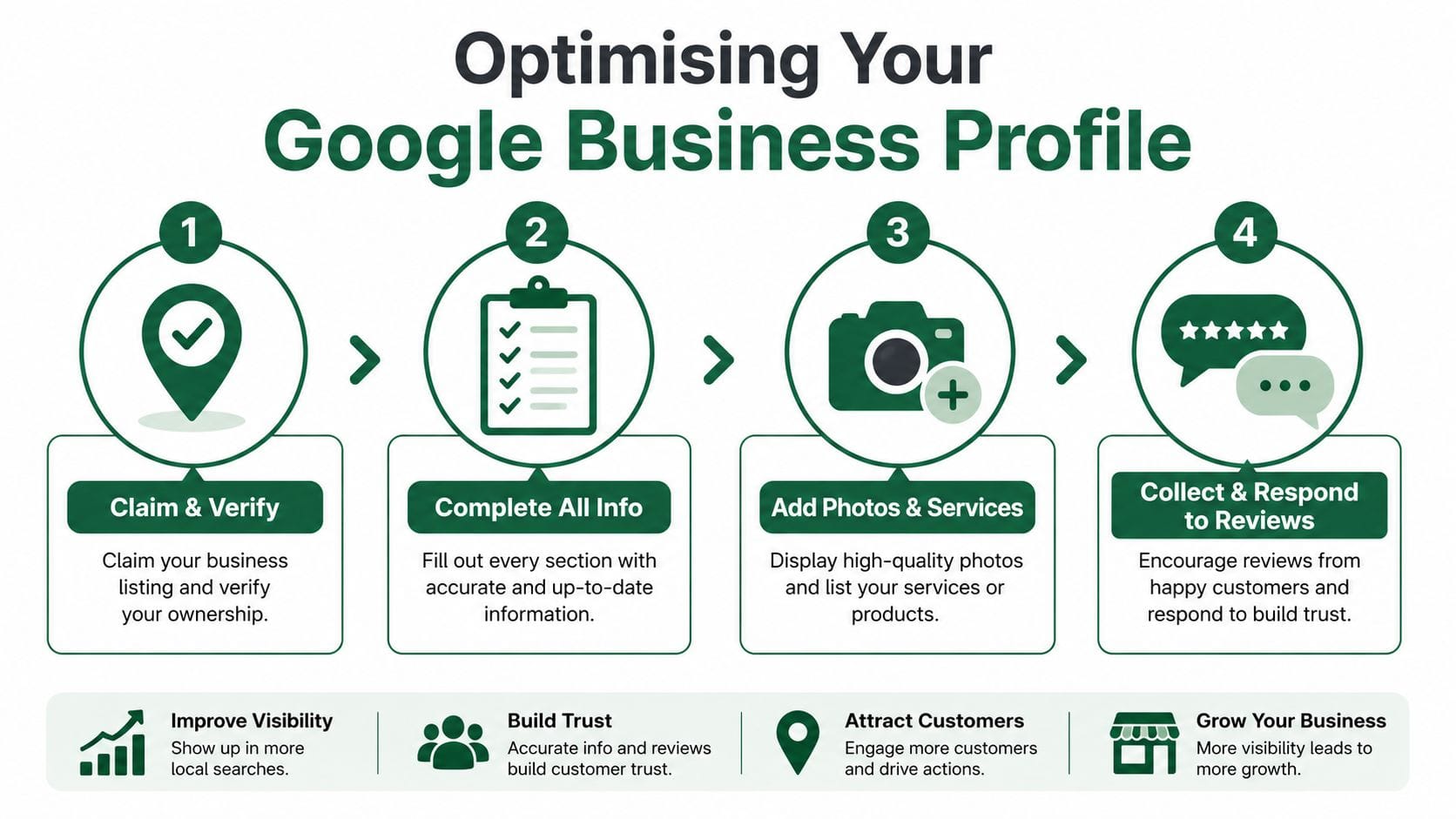
For most physio clinics, the Google Business Profile is the front door. It controls map visibility, local pack placement, and the first impression a patient gets before they even touch the website. If the profile is incomplete, outdated, or written in generic language, it holds the clinic back.
Set the profile up the Australian way
Start with the primary category. In Australia, that should be Physiotherapist, not the US term Physical Therapist. That sounds minor, but it matters because the profile needs to line up with Australian search language and local relevance. The same principle applies to service names. Each service should be added separately, with a short 2 to 3 sentence description that uses patient language such as sports injury rehab, WorkCover physiotherapy Brisbane, or Pilates rehab classes (Australian physio GBP guidance).
The profile also needs all the basics filled in properly. That includes opening hours, appointment URL, attributes like wheelchair access, and a clinic description that tells people exactly what the practice does. Real photos matter too, clinic exterior, interior, treatment rooms, and team members. Stock images don't build trust, and they don't help the patient decide to book.
Treat the profile like an active sales asset
Weekly posts keep the profile alive. They don't need to be long. A short update about seasonal injuries, booking availability, or a patient education topic is usually enough to show the clinic is active. The point is consistency, not volume.
Google tends to reward profiles that stay complete, accurate, and relevant to the searcher's location and wording.
For Brisbane clinics, that means the profile should feel like a live snapshot of the practice, not an abandoned directory listing. A clear setup checklist is also available in Boocoo's guide on how to add your business to Google. That's useful when a clinic is setting up a new location or fixing an old listing that's missing key details.
Building Citations and a Review Strategy That Delivers Results
Citations and reviews do different jobs, but they need to support each other. Citations tell Google the clinic exists in the same place, with the same contact details, across trusted directories. Reviews tell patients the clinic is real, active, and worth contacting. If the two don't line up, the trust signal gets weaker.
Keep the clinic details identical everywhere
For a Brisbane physio clinic, the name, address, and phone number need to stay exactly consistent across the website, Google Business Profile, and directory listings. That includes major directories like TrueLocal, Yellow Pages, Healthengine, HotDoc, and the relevant state health directories (NAP consistency guidance). Even small mismatches can create confusion. A suite number written one way on the website and another way in a directory is enough to blur the local signal.
Start with the most trusted listings first, then fill in the niche ones. The job is not to be everywhere. It is to be accurate wherever the clinic appears.
Build a repeatable review habit
Many clinics ask for reviews ad hoc, usually when a staff member remembers to do so. That rhythm is hard to sustain and it shows up in the profile. A better approach is a simple weekly process. After a good treatment session, send a personalised SMS or email with a direct link to the Google review page. Keep the ask light and specific. Asking the patient to mention the treatment, the body area, or how quickly they felt improvement makes the review more useful for future searchers.
Reviews that naturally mention services or conditions help local relevance because they echo the same language patients use in search. That does not mean scripting the review. It means making it easy for patients to write something specific if they want to.
Practical workflow: one admin task, one review link, one personal message, every week.
For clinics that want a useful reference on review management, the Square merchant review guide from ViralRef is a solid operational example of how to organise the process without turning it into a burden. A realistic target is a small, steady stream of fresh reviews rather than bursts of activity followed by silence. That suits a busy clinic and keeps the profile looking active without needing extra staff.
A clinic website also needs the same kind of discipline. A clear structure makes it easier for patients to find the right page, and it gives Google cleaner signals about which locations and services matter. If the site is being rebuilt or cleaned up, this guide to building a small business website is a practical starting point for getting the basics right before adding more marketing layers.
Structuring Your Website for Physiotherapy Patients
Most physio websites are built like service brochures. That's tidy, but it's not how patients search. People don't usually type “services”. They search for the thing that hurts, the treatment they think they need, or the location they want. A site built around those real queries gives Google clearer signals and gives patients a faster route to the right page.
Use condition pages, not just service pages
A strong structure starts with condition-specific pages. Each important page should have its own title tag and H1, then cover four things clearly: the condition itself, how treatment works, what patients can expect, and how to book. That structure helps both readers and search engines understand the page quickly.
For example, a page on sciatica should explain the condition in plain language, describe the clinic's treatment approach, outline the first appointment, and end with a clear call to action. The same logic applies to back pain, post-surgery rehab, shoulder pain, and other common physio searches. Each page should be written as substantive clinical content, not padded marketing copy, and it should be reviewed by a named registered clinician (evidence-based physio page structure).
Link pages together logically
Internal linking matters because it shows Google how the site is organised. A page on sciatica should link to lower back pain or piriformis syndrome where it makes sense. A post-surgery rehab page should point to related recovery or exercise pages. No page should sit in isolation.
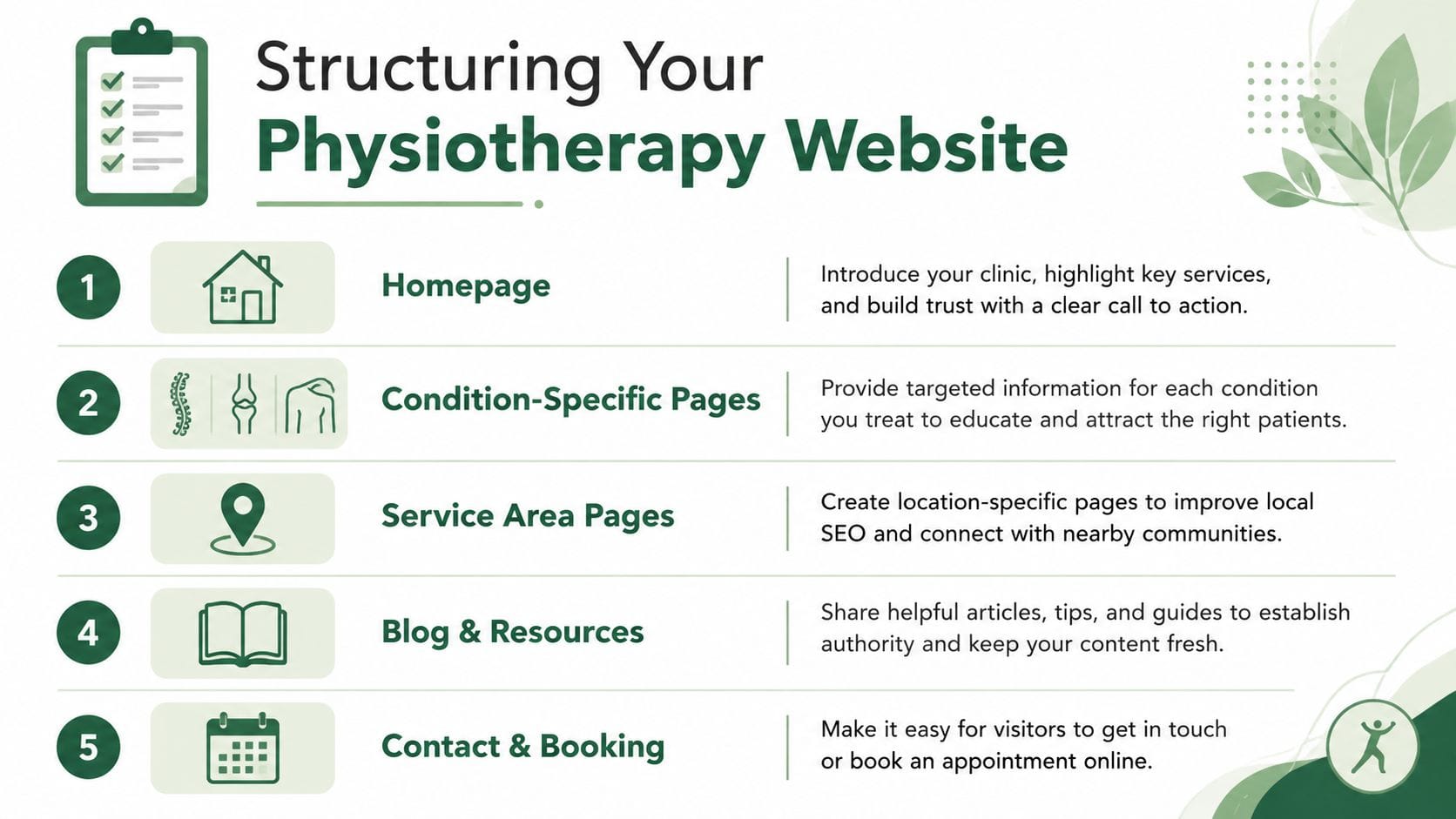
- Homepage: introduce the clinic, core services, and booking options.
- Condition pages: explain specific problems patients search for.
- Service area pages: support legitimate suburb targeting where the clinic serves patients.
- Blog and resources: answer questions that lead into the main pages.
- Contact and booking: remove friction at the moment of intent.
The aim is simple. Every important page should be reachable from the homepage or a high-traffic service page, and every page should pull weight in the booking journey. A practical guide to simple site structure for small businesses is available in Boocoo's article on how to build a small business website.
Content and Blog Topics That Attract Brisbane Patients
A physio content plan works best when it answers the questions patients already have, connects the clinic to Brisbane life, and follows the pattern of injuries that come through the door. Random blogging rarely earns much return. A planned content system gives the website more entry points, more local relevance, and more material to support Google Business Profile posts.
Build around three content pillars
The first pillar is condition education. These are the searches people make when they want clarity before booking, things like how long rehab might take, when to see a physio after a fall, or what treatment often looks like for back pain. The second pillar is local relevance, which ties content to Brisbane communities, local sports, office work, and neighbourhood-specific problems. The third is seasonal injury trends, which gives the clinic a reason to publish timely content through the year.
For Brisbane, that seasonal angle matters. Winter content often fits falls and recovery after reduced activity. Summer content can cover sports, beach movement, and heat-related strain. Spring and autumn are useful windows for gym and training-related injuries. The content does not need to be dramatic. It needs to be useful, local, and easy to connect to booking intent.
A simple 90-day topic rhythm can look like this:
| Week | Topic type | Example topic |
|---|---|---|
| 1 | Condition education | What to expect from back pain physiotherapy |
| 2 | Local relevance | Workplace ergonomics for Brisbane office workers |
| 3 | Seasonal injury | Common gym injuries during training season |
| 4 | Condition education | When to see a physio after a fall |
| 5 | Local relevance | Pre-season injury prevention for Queensland rugby league |
| 6 | Seasonal injury | Beach running injuries in Brisbane suburbs |
| 7 | Condition education | Sciatica symptoms and treatment options |
| 8 | Local relevance | Desk setup tips for Fortitude Valley and CBD workers |
| 9 | Seasonal injury | Summer sports recovery habits |
| 10 | Condition education | Post-surgery rehab and early movement |
| 11 | Local relevance | Return-to-sport advice for local clubs |
| 12 | Seasonal injury | Autumn injuries from heavier gym workloads |
Use each post to support a bigger page
Each article should target one primary keyword and end with a soft call to action, such as booking a consultation or downloading a checklist. That keeps the blog from competing with the service pages, and it feeds them instead. Over time, a steady publishing rhythm creates a library that helps the clinic show up for more searches and gives the GBP fresh material to post from.
For clinics that want a practical reference point on back pain content, the MEDISTIK physiotherapy back pain guide shows how condition information can be organised in a way that is easy for patients to scan before they book. The goal is not to copy another site's wording. It is to write clearly enough that a stressed patient can read, understand, and act.
A blog calendar also helps the clinic avoid filler topics. If every post has a job to do, the website stays focused on the searches that matter, and the content becomes easier to link from service pages, suburb pages, and Google Business Profile updates. A useful guide to the relationship between blogging and search is Boocoo's article on blogging and SEO, which is worth using when you are planning what to publish next.
Build local authority off the website too
Link building for physio clinics works best when it stays local. Brisbane sports clubs, corporate wellness programs, equipment suppliers, community newsletters, school websites, and local news outlets can all be relevant. Short expert quotes, injury prevention tips, and collaboration with non-competing practitioners such as chiropractors, osteopaths, and exercise physiologists usually fit better than generic national guest posts.
A simple spreadsheet keeps outreach manageable, with columns for target site, contact person, outreach date, response status, and link outcome. That is enough to keep the work organised without turning it into a second job.

Technical SEO Fixes and Measuring Your Results
Technical SEO for a physio website doesn't need to be complicated. Most of the win comes from making the site fast, easy to use on mobile, and simple for Google to read. If the site feels clunky on a phone, the patient often leaves before they see the booking button.
Start with speed and mobile usability
The first check is page speed. Run the homepage and a few inner pages through Google PageSpeed Insights, then fix the obvious issues first, usually oversized images, scripts that slow loading, or lazy loading that hasn't been set up properly. The site should load quickly on mobile, because many patients are searching on their phones while they're at work, in pain, or between appointments.
The second check is the actual user experience on a phone. The contact number should be clickable. The booking button should be visible without a lot of scrolling. Opening hours should be correct on every page that matters. These details sound small, but they affect whether a visitor becomes an enquiry.
Track the basics and review monthly
Set up Google Search Console and Google Analytics if they aren't already in place. Then track three things: organic sessions, keyword rankings for the top 20 terms, and conversion actions like contact forms and phone calls. That gives the clinic enough signal to make decisions without drowning in data.
- Organic sessions: shows whether search visibility is growing.
- Top keyword rankings: shows which treatment and location pages are moving.
- Conversions: shows whether the traffic is turning into bookings and enquiries.
If a page doesn't gain traction after around 90 days, it usually needs a content refresh, stronger internal links, or a technical fix. That's normal. SEO for physiotherapists is a slow burn, but the work compounds once the foundations are in place.
A practical monthly review is enough for most small clinics. Check what moved, fix what didn't, and keep the process simple enough that staff can maintain it.
For clinics that want help improving the experience after the click, a broader customer care framework can be useful too. Heyline's guide to local customer care is a good reminder that search visibility and patient experience need to support each other. Better service keeps reviews flowing, and better reviews help the next patient choose the clinic.