

A lot of Brisbane owners are in the same spot right now. The phone isn't dead, but it isn't consistently busy either. Referrals still matter, paid ads feel expensive, social media takes time, and the website mostly sits there like a brochure.
That's usually when small business SEO services start coming up. Not because SEO is trendy, but because people are already searching for a plumber in The Gap, an accountant in the CBD, a physio in Carindale, or a café in New Farm. The core question isn't whether SEO matters. It's whether it's the right next move for the business, and what kind of work will turn into enquiries instead of vague “visibility”.
For a Brisbane small business on a tight budget, the answer needs to be practical. Less jargon. More clarity on what to fix first, what to ignore, what to measure, and how to avoid wasting months on work that looks busy but doesn't help the business.
What SEO Actually Is for a Brisbane Business
SEO is simple when stripped of the jargon. It's the process of putting a business where local customers can find it when they're looking for help.
A good way to think about it is a shopfront. A business wants the online version of a prime spot on a busy street, not a back lane no one walks down. For a Brisbane business, that “street” is overwhelmingly Google. The ACCC's Digital Platform Services Inquiry found Google has around 95% share of general search in Australia, and that Google Search and Maps work closely together in how people find local businesses in Australia, as summarised by Page Optimizer's coverage of the ACCC findings.
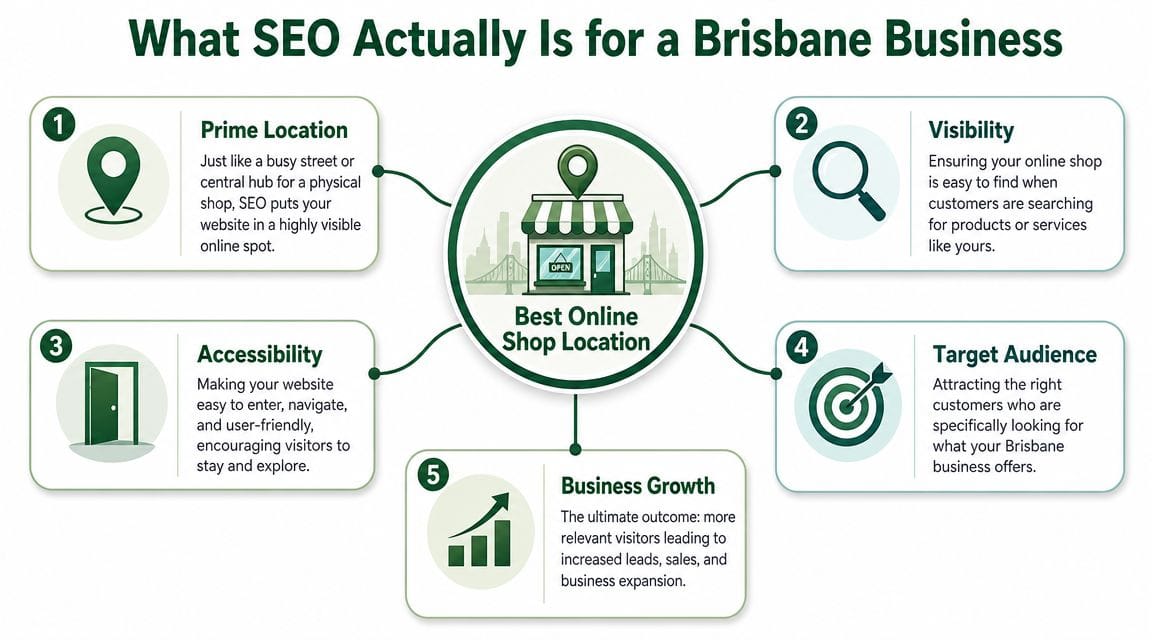
Google is the main street
That changes how a small business should think about SEO. It's not about “being everywhere online”. It's about showing up properly in the places that lead to action:
- Google search results for services and problems the business solves
- Google Maps and the local pack for nearby intent
- Mobile searches from people ready to call, visit, or compare options quickly
For most local operators, that's the core focus. Not vanity traffic. Not random blog topics. Not chasing every platform at once.
Practical rule: If a Brisbane business depends on local enquiries, SEO should start with Google Business Profile, service pages, and local relevance before anything more elaborate.
The three parts that matter
Most small business SEO services fall into three buckets.
Technical SEO is the foundation. If Google can't crawl pages properly, understand them, or load them well on mobile, rankings become harder than they need to be.
On-page SEO is the signage. It's the wording, page structure, headings, titles, service descriptions, and internal links that tell Google and customers what the business does.
Local SEO is the map presence. That includes Google Business Profile, suburb and service-area pages, consistent business details, and review signals.
There's another shift happening too. Google now shows more AI-generated summaries in search, which means some searchers get enough information without clicking. That doesn't make SEO less useful. It means small businesses need pages that answer real questions clearly, reinforce the brand, and create obvious next steps like calling, booking, or requesting a quote.
SEO isn't magic. It's organised visibility for people already looking.
What Is Inside a Small Business SEO Package
Most owners don't need a fancy package name. They need to know what work is being done each month and why it matters.
A useful small business SEO service should cover the parts that affect discoverability, local trust, and conversion potential. If the package is vague, padded out with jargon, or obsessed with rankings alone, it's usually a bad sign.
The work that should be in scope
A proper package usually includes a mix of these activities:
Local search setup and maintenance
This means Google Business Profile optimisation, service-area targeting, review support, and keeping business details consistent across the web.On-page improvements
This includes rewriting weak service pages, improving headings, tightening title tags, adding internal links, and making pages line up with what people search.Technical fixes
This is the hidden work many owners never see, but it matters. Google's guidance links visibility to whether pages can be discovered and understood. Practical fixes include XML sitemap submission, schema markup, and Core Web Vitals work, as outlined in Hungry Ram's technical SEO guide.Content work
Not endless blog spam. Useful content. That might mean suburb pages, FAQs, service explainers, or articles that answer the questions buyers ask before they call.Authority building
For small businesses, this often starts with local mentions, credible directory consistency, and earning trust rather than chasing low-quality backlinks.
Some businesses also need website fixes before serious SEO work starts. If the site is confusing, outdated, or hard to use on mobile, it can make sense to sort that first. For businesses weighing a redesign or structural tidy-up, website support options can be part of the groundwork before a broader SEO push.
Typical Small Business SEO Service Tiers
Not every business needs the same level of service. A sole trader with one core service and one suburb focus needs a different setup from a multi-service operator targeting Brisbane-wide demand.
| Service Tier | Typical Inclusions | Best For | Indicative Monthly Cost (AUD) |
|---|---|---|---|
| Foundational | Google Business Profile work, basic on-page edits, local page cleanup, reporting setup | Sole traders, new businesses, businesses with a simple site | Varies by provider and scope |
| Growth-focused | Foundational work plus technical fixes, ongoing service page improvements, local content, review process support | Established local service businesses that want steady enquiry growth | Varies by provider and scope |
| Broader campaign | Ongoing technical SEO, multiple service or suburb pages, deeper content, multi-location support, stronger reporting | Larger small businesses, competitive niches, multi-location operators | Varies by provider and scope |
That “varies by provider and scope” answer may sound annoying, but it's the honest one. SEO work isn't a fixed commodity. A five-page local service site and a messy thirty-page site with duplicate content aren't the same job.
Good packages are specific about deliverables. Bad packages hide behind generic promises like “monthly optimisation” with no detail at all.
The right package should answer three things clearly. What gets fixed first. What gets worked on each month. What business outcome that work is meant to support.
How Much SEO Costs and What Return to Expect
A lot of business owners get frustrated with SEO pricing. It is all over the place, and a fair bit of it makes no sense.
Some providers underquote and deliver almost nothing. Others bundle in every marketing buzzword they can think of. A small business doesn't need either extreme. It needs a sensible scope, clean reporting, and a realistic view of what success looks like.
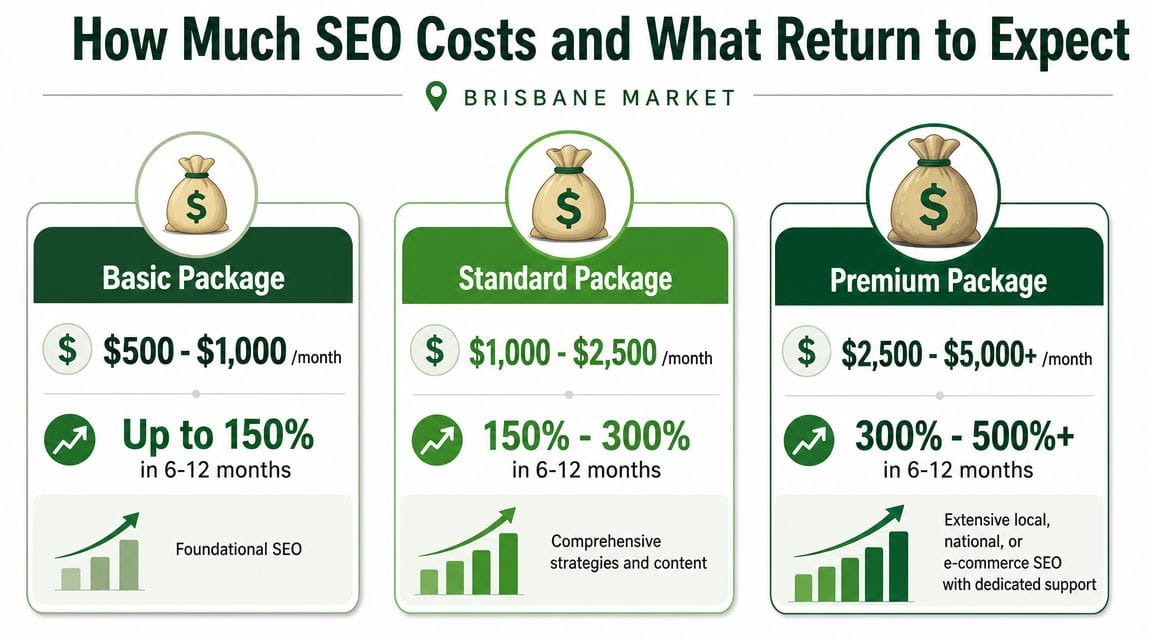
Cost matters, but tracking matters more
The biggest mistake is asking only, “How much per month?” The better question is, “What exactly will be tracked, and how will anyone know if this is producing leads?”
For small businesses, free tools are usually enough to measure the essentials. A mature setup should use Google Analytics 4 and Google Search Console, with local performance also shaped by consistent NAP details and Google Business Profile signals like review volume and quality, as noted in this small business SEO measurement guidance.
That means reports should include things such as:
- Organic enquiries through forms
- Phone calls where practical
- Landing pages that attract search traffic
- Search queries driving impressions and clicks
- Google Business Profile actions like calls, direction requests, and website visits
Rankings still matter, but they're not the final score.
For owners who already get traffic but not enough leads, SEO alone may not solve the problem. Sometimes the smarter move is to improve the site's ability to turn visitors into enquiries. That's where conversion rate optimisation support becomes relevant. More traffic to a weak page just creates a more expensive problem.
What a sensible return looks like
A good return from SEO usually starts small and compounds. Early wins often come from fixing obvious issues, tightening local pages, and improving Google Business Profile visibility. Broader gains tend to take longer because trust and relevance build over time.
The hard truth is this. SEO isn't always the fastest lead channel.
If a business has no tracking, a slow website, weak service pages, or a neglected Google Business Profile, spending heavily on ongoing SEO from day one can be premature. The business may need a cleaner website, stronger offers, or a small paid search campaign to create immediate lead flow first.
SEO works best when the foundations are in place. Otherwise, the campaign ends up paying to expose problems that were already hurting conversions.
A sensible owner should expect honesty on timelines and trade-offs. Good SEO can become a durable lead source. Bad SEO becomes a monthly bill attached to a dashboard.
How to Choose the Right SEO Provider in Brisbane
A Brisbane business doesn't need a provider that talks the most. It needs one that tells the truth, explains the work clearly, and focuses on leads rather than theatre.
That rules out a surprising number of agencies straight away.
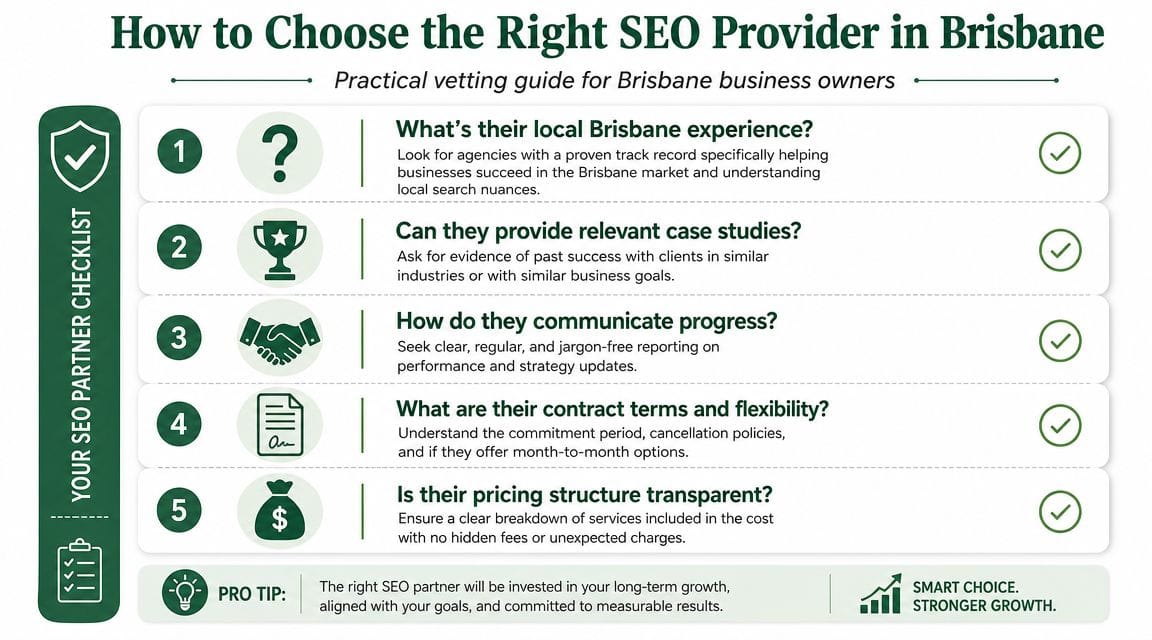
Questions worth asking before signing anything
Most discovery calls are too soft. A business owner should ask direct questions and expect direct answers.
What would they fix first for this business?
If the answer is a generic package pitch, that's not strategy.How do they approach Brisbane local search?
They should talk about suburbs, service intent, Google Business Profile, local pages, and what nearby customers search.What will monthly reporting include?
A decent provider should be able to show an example and explain it in normal English.Who is doing the work?
Owners deserve to know whether the work is done locally, outsourced, or split across contractors.Is SEO even the best first move?
This is a big one. Some businesses should start elsewhere.
That last question matters because many agencies don't address it. Yet for owners under cost pressure, website fixes or a small paid search campaign may be a better first move than SEO if faster leads are needed, as discussed in DesignRush's analysis of affordable SEO services for small business.
Red flags that should end the conversation
Some warning signs are obvious. Others are subtle.
| Red flag | Why it matters |
|---|---|
| Guaranteed #1 rankings | No one can control Google like that |
| Secret methods | Usually means poor transparency or risky tactics |
| Reports full of impressions but no lead discussion | Vanity metrics don't pay wages |
| Long lock-in contracts before trust is built | The provider may be selling commitment, not outcomes |
| No interest in offers, margins, or profitable services | SEO without business context gets shallow fast |
A good provider should be willing to say, “SEO isn't the first thing to fix here.”
That's often the most trustworthy answer on the call.
A local partner should also communicate like a normal person. Small business owners don't need lectures about algorithms. They need clear next steps, sensible priorities, and someone who respects their time.
Your Simple SEO Implementation Checklist
SEO goes better when the owner and provider both know their role. The agency handles the technical and strategic work. The owner provides the business insight that no outsider can fake.
That split matters because many Australian businesses are still early in their digital setup. The Australian Bureau of Statistics reported that 61% of businesses had a website in 2023-24, which means plenty of businesses still have room to gain from foundational improvements, as summarised by AIOSEO's Australian SEO statistics page.
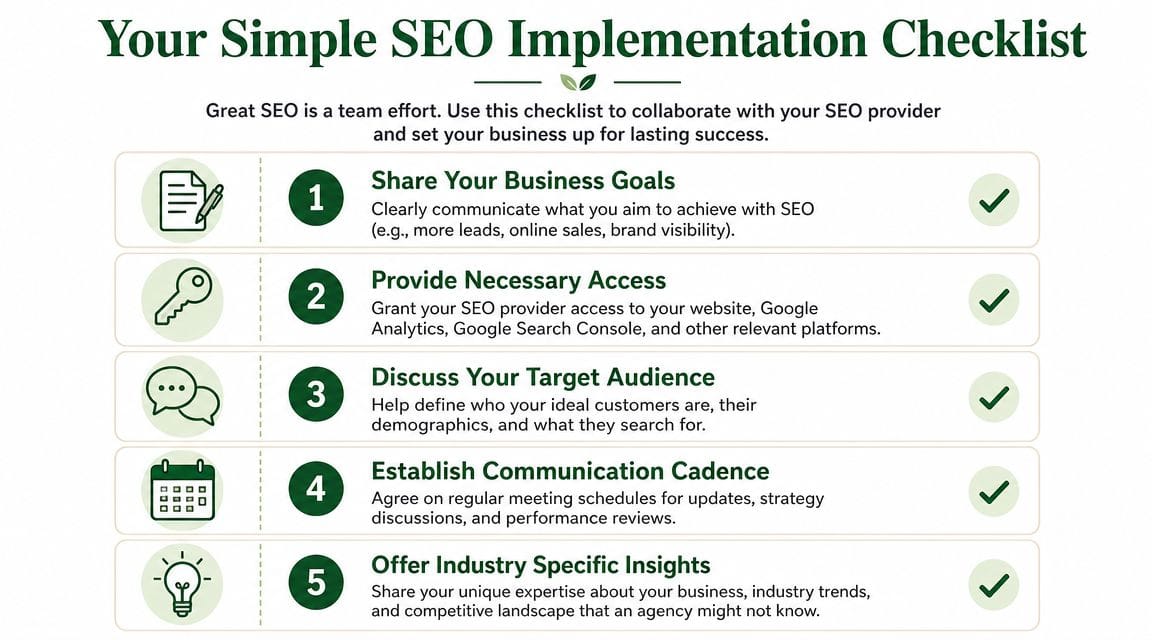
What the business owner needs to provide
A smooth SEO rollout usually starts with a short list of inputs.
Business goals
More calls, better quality leads, more bookings, stronger visibility for a key service. Pick the main goal, not ten of them.Access to the right platforms
Website access, Google Analytics 4, Search Console, and Google Business Profile where relevant.Top services and priorities
Not every service deserves equal attention. The provider should know what's most profitable, easiest to sell, and most important to grow.Real-world proof
Photos of jobs, team, premises, vehicles, products, or projects. Local businesses often sit on useful trust assets and never publish them.Review process
Someone in the business needs to own how reviews are requested and followed up.
What to expect from the working relationship
The owner doesn't need to become an SEO technician. But some collaboration is essential.
A solid setup usually includes:
A realistic priority list
The first month should focus on the highest-impact fixes, not a scattergun list.Fast feedback on content
Service pages and local pages are stronger when the owner reviews them for accuracy.Simple reporting rhythm
Monthly is usually enough for most small businesses.Room to test AI-assisted workflows carefully
Used properly, AI can help draft outlines, surface search questions, and speed up repetitive work. For owners curious about that side of execution, SynaBot's AI SEO solution is one example of how AI tools are being applied to support SEO workflows rather than replace judgment.
The key is not to overcomplicate it. Most Brisbane businesses don't need a giant SEO machine. They need a reliable process that keeps moving.
Local SEO in Action Short Brisbane Examples
SEO makes more sense when it's tied to real business situations. Not case studies with inflated claims. Just normal Brisbane-style examples that show what the work looks like.
A trade business
A plumber in The Gap wants more emergency and same-day jobs. The website exists, but the service pages are thin, the Google Business Profile hasn't been updated properly, and suburb relevance is weak.
The useful move isn't publishing random blogs. It's tightening the emergency plumbing page, building suburb-specific relevance where appropriate, improving the Google Business Profile, and making sure reviews mention real jobs and locations naturally. For owners wanting a deeper read on location-driven optimisation, this overview of geo SEO strategies is useful because it connects local relevance with how search engines interpret place and service intent.
The likely outcome is better visibility for nearby urgent searches and map-based discovery. That's the kind of SEO a trade business can effectively use.
A professional service
An accountant in the CBD wants more business clients, not random consumer traffic. Generic “accounting services” copy won't do much on its own.
A stronger approach is targeted service pages plus useful content tied to actual client concerns, such as tax changes, bookkeeping issues, or business structure questions. That builds topical relevance and helps the firm appear more credible before a prospect ever enquires.
This same principle applies in sectors where location and planning matter heavily, including visitor-facing businesses. There's a useful parallel in tourism digital marketing, where search intent, local information, and timely content shape whether someone takes the next step.
A café or local retailer
A café in New Farm may not need a huge SEO campaign. It may need cleaner basics done properly.
That can include updated opening hours, better photos, active review management, menu and category clarity, and a website that matches what people see on Google. If someone searches for brunch, coffee, or a nearby meeting spot, the business needs enough relevance and trust to earn the click or map action.
Local SEO is often less about clever tricks and more about removing friction between a search and a visit.
That's why the best small business SEO services aren't always the flashiest. They solve the obvious things first, then build from there.
Start Getting Found by More Brisbane Customers
Small business SEO services are worth it when they're tied to reality. That means local search intent, sensible priorities, clear tracking, and honest advice about whether SEO should happen now or later.
For Brisbane businesses, the smart move usually isn't doing everything. It's doing the right few things first. Tighten Google Business Profile. Fix weak service pages. Sort the technical basics. Track calls and enquiries properly. Then build from there.
The long-term value of SEO is simple. A business creates an asset that keeps helping the right customers find it without paying for every click. But that only works when the campaign is built around leads and conversions, not pretty reports.
Owners who are still comparing providers may find it helpful to review broader criteria on how to find your local SEO partner, then use those questions to vet Brisbane agencies properly.