

A Brisbane agent can have a packed open home on Saturday, three buyer calls by Sunday night, and a vendor asking for an appraisal before lunch on Monday, then lose the whole week's momentum by Wednesday because everything sits in the inbox. That's the core problem with digital marketing for realtors. It's not a lack of effort, it's a lack of system, and the system has to catch enquiries at the exact moment people are ready to move.
In Australia, 63% of consumers use search engines to research products and services, and Facebook and Instagram still matter as discovery channels for local businesses, so the first trust signal is often digital, not physical, for Brisbane agencies. The property game has moved from print and portal-first thinking to search-led behaviour, which means the agent who shows up cleanly in search, social, and suburb pages usually gets the first serious conversation. The rest of this playbook is about building that visibility without turning every week into a content scramble.
Where Brisbane Realtors Actually Lose Leads
A typical Brisbane week starts strong and ends messy. An open home brings in a stack of names, a handful of buyers click through from a listing, one seller asks for a valuation, and then the inbox gets buried under contract notes, appraisal prep, and the next inspection. The leads did come in. They just didn't get handled with the speed or structure needed to turn interest into a conversation.
The real leak is after the first enquiry
Most agents think they need more posts. They usually need faster follow-up and better routing. If someone checks a suburb page on Tuesday, sends an enquiry from a phone on Wednesday, and gets a reply on Friday, the lead has already cooled off. That's why digital marketing for realtors has to be treated like an operating system, not a posting schedule.
Practical rule: if an enquiry cannot be answered, tagged, and assigned within the same day, the marketing system is too loose.
That's also where workflows matter. A useful resource on lead-gen workflows for agents shows how automation can reduce the number of enquiries that vanish between platforms and inboxes. The point isn't automation for its own sake, it's making sure the right person sees the right lead before the lead forgets the agent's name.
What the rest of the system has to fix
The fix comes in layers. Positioning tells people what kind of agent they're dealing with. Website and local search make sure that agent shows up when intent is high. Content and paid ads create repeat exposure, and CRM follow-up turns that attention into appraisal conversations.
A helpful way to think about it is like a kitchen pass in a busy restaurant. The orders matter, but what matters more is whether the tickets move in the right sequence. If one ticket gets stuck, the whole table waits. Brisbane agents lose leads in exactly that way, not because demand is weak, but because response systems are not tight enough.
Set Goals and a Channel Mix That Matches Your Week
Before a dollar goes into ads or a weekend disappears into a website refresh, the agent needs to define what success looks like. For most solo operators, that means choosing two or three outcomes, not ten. Listing appraisals, qualified buyer leads, and vendor leads are the ones that matter most because they connect directly to revenue.
Pick the goal before the channel
A seller-focused agent in the inner-south ring needs a different mix from a buyer-heavy agent working across multiple suburbs. The seller-focused agent should lean harder into suburb authority, Google Business Profile visibility, and appraisal content. The buyer-focused agent should put more weight on listings, walkthrough videos, and remarketing. One channel mix does not fit both.
A practical split for a solo Brisbane agent looks like this:
- 40% of effort on local SEO and Google Business Profile, because that's where high-intent local discovery happens.
- 30% on content and video, because trust is built through repeated visibility.
- 20% on paid ads, because paid traffic should accelerate the best offers, not replace them.
- 10% on list-building, because email and SMS are the cheap follow-up layer that makes the rest worth doing.
That mix shifts depending on whether the pipeline needs sellers, buyers, or both. A seller-heavy month should pull more effort into suburb pages and review building. A buyer-heavy month should move more attention into listing campaigns and short-form video.
Budget has to match the operating reality
For a small agency, the monthly spend has to stay sane. A realistic starting point is to keep paid channels controlled, the website simple, and the content process repeatable. The ABS reported that 96% of Australian businesses with 0 to 4 employees had access to the internet in 2023-24, and 93% used cloud computing services, so even tiny teams can run CRM, web, and campaign tools without heavy infrastructure. That matters because the constraint is usually time, not technology.
If budget pressure is real, a useful comparison for automated property promotion is browse automated property ads. It's not a substitute for strategy, but it does show how much repetitive work can be removed when the campaign structure is clean.
Simple test: if the channel mix cannot be explained in one sentence, it's too complicated for a solo agent to maintain.
Build a Website and Google Business Profile That Convert on Mobile
The website and Google Business Profile are the spine of the whole setup. In Australia, Google dominates search, with 94.8% of the search engine market according to DataReportal's Australia Digital 2025 report, so local visibility lives or dies in that ecosystem. If the site and profile don't work together, the agent is paying for attention that never turns into contact.
Build for suburb intent, not site vanity
The biggest mistake is stuffing every listing into one crowded homepage and hoping search traffic sorts itself out. It doesn't. A better structure is a separate suburb or pocket page for each area the agent wants to own, with clear service-area language, local examples, and a simple enquiry path. That keeps the site aligned with how buyers and sellers search, which is suburb-first and mobile-first.
The technical basics are not glamorous, but they matter. Add schema markup, embedded maps, compressed hero images, and a form that asks for no more than three fields. A name, email, and one short message is enough to start the conversation. Anything longer makes the mobile experience clunky and costs enquiries.
A practical implementation guide for a small business site is covered in how to build a small business website. The same logic applies here, the site has to be easy to load, easy to scan, and easy to contact from a phone.
Treat Google Business Profile like a live storefront
Google says businesses can create and verify a profile to appear on Search and Maps, with opening hours, location, contact details, photos, and reviews displayed in one place. That makes the profile a low-cost trust layer for real estate agents who need local proof fast. Verification should happen early, not after the website feels “finished”.
Use the profile like a living shopfront. Keep categories accurate, add geo-relevant photos, post weekly updates, and make sure review requests are part of the client handover. Buyers and sellers are checking for evidence that the agent is active, local, and responsive.
A one-day setup checklist is enough to get momentum:
- Claim and verify the profile, then clean up the contact and location details.
- Publish suburb pages, each with a unique URL and a clear call to action.
- Add map embeds and schema, so search engines and users get a cleaner signal.
- Set the lead form to a short format, then test it on mobile.
- Connect the profile to the website, so reviews, photos, and enquiry paths support each other.
Create Content and Video That Travels on Social
Most Brisbane agents overthink content and under-deliver it. They chase polished branding when they really need a repeatable library of simple assets. A phone, a lapel mic, and a free editor are enough to create the weekly content that keeps buyers and sellers aware of the agent's name.
Build a content library that a solo agent can maintain
The easiest format is a small set of building blocks used every week. A 30-second listing walkthrough works for buyer intent. A suburb tip supports local trust. A vendor FAQ answers seller concerns. A sold-story carousel proves momentum. A market update gives the agent a reason to stay visible without pretending to be a full media company.
A Morningside property can go from shoot to ad creative in under two hours if the process is tight. Film the walkthrough on a phone, cut the clips into short vertical segments, export one square carousel for Facebook, then turn the strongest stills into a listing post for Instagram and LinkedIn. That is enough to keep the campaign moving without turning the agent into a part-time producer.
The reason video matters is plain. Industry data compiled in 2025 says listings with video receive 403% more inquiries, 73% of homeowners are more likely to list with an agent who uses video, and 90% of realtors use Facebook while 52% use Instagram for marketing. Those figures are global, but the strategic point is still clear, social feeds reward content that can be watched fast and shared quickly.
Make each format work for a different intent
Short vertical video is best for buyer attention because it feels immediate and native on mobile. Longer carousels are better for vendor intent because they can show process, proof, and a bit more reasoning. That split matters because one post rarely does both jobs well.
A useful SEO companion for this content layer is search engine optimization for realtors. It reinforces the same principle, good content should match a searcher's actual question, not just fill a calendar.
For Brisbane agents who need a practical production reference, business video production Brisbane is worth scanning for the basics of keeping shoots fast and usable. The point is not cinematic perfection. The point is that the video has to be useful enough to become ad creative, a website asset, and a social post without extra work.
Run Paid Search and Paid Social Without Burning the Budget
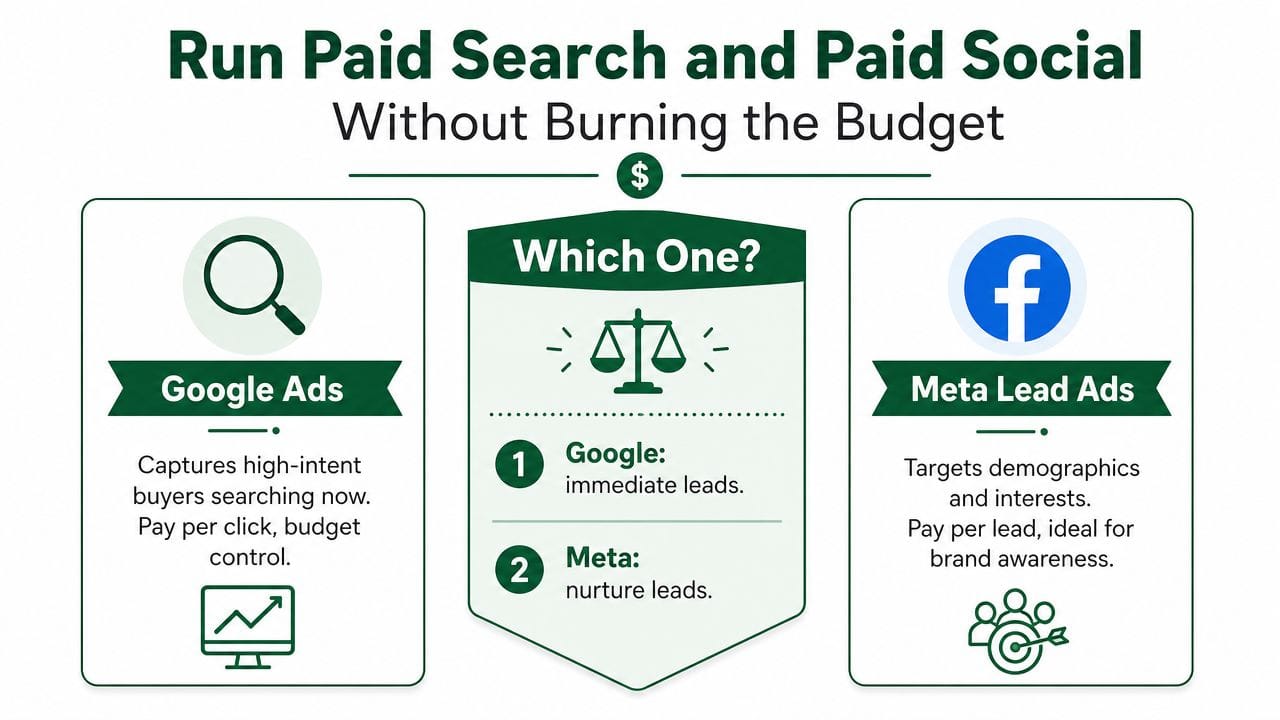
Paid ads cause confusion because agents often expect every platform to do the same job. They won't. Google Ads and Meta lead ads solve different problems, and treating them as interchangeable is how budgets get wasted.
Use Google Ads for intent that is already hot
Google Ads are for people searching now. Queries like “sell my house Brisbane” or “three-bedroom auction Camp Hill” signal active intent, which means the ad should go to a fast landing page with one clear action. This is not the place for broad brand storytelling. It's the place for a clean offer, a simple form, and a tracked conversion.
A starter budget for a solo agent can sit around $500 to $1,500 a month per channel if the campaign is kept tight and the landing page is sensible. That's enough to test without pretending the account can buy the whole market. A simple negative-keyword list should be part of every campaign, because real estate traffic can get polluted quickly by irrelevant searches.
Use Meta lead ads for lower-friction capture
Meta lead ads are better for buyers who are still browsing and for seller audiences who need a softer entry point. The best setup uses a property carousel or single-image creative and keeps the form to three fields or fewer. That lower friction matters because the user is not yet ready for a long form or a slow home page.
The main failure point is sending paid traffic to a sluggish homepage and hoping the user will hunt for the right page. They won't. The first conversion step has to be native or near-native, then the follow-up sequence does the rest.
For a practical read on ad costs, Facebook advertising costs is a sensible companion. It helps frame Meta as a controlled testing channel, not a blank cheque. The campaign only works when it is measured by cost per qualified lead, not likes or impressions.
Nurture Leads With a CRM and a Two-Week Email Sequence
Most Brisbane agents do not lose listings at the point of enquiry, they lose them in the days after. Someone fills in a form, gets one polite reply, then the thread goes quiet while the agent gets pulled into showings and paperwork. That gap is where competitors win.
Keep the system light and visible
A lightweight CRM is enough. Even a shared inbox with tags is better than scattered phone notes and forgotten follow-ups. The key is to separate buyer intent from seller intent as soon as the lead comes in, because each group needs a different next message.
A simple lead score helps too. Someone asking for an appraisal is hotter than someone downloading a suburb guide. Someone replying twice in a week deserves a call sooner than someone who just clicked a listing link. The system should make that obvious at a glance.
The hottest lead is not the one who clicked most, it's the one who can be called while the question is still fresh.
Use a 14-day sequence that does the follow-up work
A sensible two-week sequence does not need fancy copy. It needs timing and relevance. The first email can be a short thank-you. The second can share a recent suburb sale. The third can send a vendor checklist. The final touch can ask for a short call or appraisal conversation.
Subject lines need to work on mobile, so keep them plain. “Thanks for your enquiry” is better than clever wording that gets skipped. SMS can be used sparingly for the most engaged leads, especially when an appraisal request or inspection follow-up is involved.
The CRM layer also supports segmentation. Buyer leads should get listings, inspection reminders, and neighbourhood content. Seller leads should get proof, process, and local market signals. If those lists are mixed, the messages feel generic and the response rate drops.
For the workflow side of the system, what is a CRM system is a useful primer. It makes the case for treating lead management as a repeatable process rather than a memory test.
Measure What Matters and Roll Out a 90-Day Plan
Too many agents track the wrong numbers and then wonder why the marketing feels busy but weak. Likes do not pay commissions. Enquiry counts alone do not tell the full story either. A useful dashboard should stay narrow and tied to outcomes.
Track the four metrics that tell the truth
The core measures are cost per qualified lead, lead-to-appraisal rate, appraisal-to-listing conversion, and time-to-first-response. Those four numbers connect directly to the goals set earlier, because they show whether traffic, follow-up, and conversion are all doing their job. If one of them is weak, the whole system needs a fix.
The dashboard should be simple enough to review weekly. If the first response is slow, the CRM and handoff process need work. If qualified leads are cheap but appraisals are thin, the landing page or offer is off. If appraisals are happening but listings are not, the pitch and proof need tightening.
The same logic applies to content and ads. If buyer leads are flowing but seller leads are quiet, the balance of suburb authority, review requests, and appraisal messaging needs to shift. Measurement is not a reporting ritual. It's the steering wheel.
Roll out in ninety days, not nine months
A clean rollout avoids overwhelm:
- Weeks one to two, fix the website, suburb pages, and Google Business Profile.
- Weeks three to six, build the content workflow and the email nurture sequence.
- Weeks seven to ten, test paid search and paid social with small, controlled budgets.
- Weeks eleven to twelve, review the numbers and cut whatever is not producing qualified enquiry.
A useful companion on conversion discipline is conversion rate optimisation in Australia. The principle is the same here, remove friction before adding more traffic.
The true win is not doing more marketing. It's doing fewer things, with more precision, and getting out of the way of the leads once they arrive. A Brisbane agent who gets that right spends less time chasing scraps and more time talking to people who are already ready to move.