
A Brisbane business can do everything right on paper and still end up with a messy inbox. A plumber gets three spam forms, one price shopper who vanishes after the quote, and one genuine homeowner who wants help this week. A lawyer, accountant, or designer sees the same pattern, a stream of contacts that look busy but don't move the pipeline.
That's the core problem behind many digital marketing lead campaigns. The issue isn't always volume, it's whether the enquiry has intent, fit, and timing. In Australia, that matters even more because people are online almost constantly, with the ABS reporting 94% of households had internet access and 92% used the internet every day or almost every day in 2021–22, while 83% of households with internet access used a mobile phone to get online, according to the ABS figures cited in the lead-generation benchmark summary ABS household internet access and mobile use figures.
What a Digital Marketing Lead Looks Like
A real lead looks less like “someone filled out a form” and more like “someone who is ready for the next conversation.” In practice, that means the person has a clear problem, a realistic budget, and timing that fits the service on offer. If those three things do not line up, the enquiry may still be useful later, but it is not pipeline-ready today. For a broader perspective on agency roles, the Ecommerce Boost expert marketing guide offers additional context.

A Brisbane tradie often feels this distinction the hard way. The inbox fills up with “just checking prices” messages, vague requests from outside the service area, and spam that arrived through a generic web form. Then, buried in the mess, there is one message from a homeowner in the right suburb, with a broken hot water system and a clear need to book.
Contact Versus customer-in-waiting
That difference is why lead-source integrity matters. Google held the dominant search share in Australia during the ACCC's Digital Platform Services Inquiry, and the ACMA reported that a large share of Australians aged 16+ used the internet to buy goods or services in 2022 to 23, according to the benchmark summaries Google's dominant search share in Australia and Australian online buying behaviour. That means many enquiries begin with digital intent, but not all of them deserve immediate sales time.
A practical way to think about it is like sorting mail at a business front desk. Some envelopes are bills, some are junk, and a few are invoices that need action today. A digital marketing lead is the envelope that opens into revenue, not just another item to file.
For businesses that want a wider view of how audience fit works, the user-persona framework in this user persona guide helps anchor the difference between a casual click and a likely buyer. That mindset keeps lead generation tied to real people, not just traffic numbers.
Practical rule: if the enquiry does not match service, budget, and timing, it is not a sales lead yet. It is a contact, and it should be handled differently.
The best marketers do not celebrate every form fill equally. They separate curiosity from commitment, then build systems that move the right people forward while keeping the wrong ones out of the sales queue.
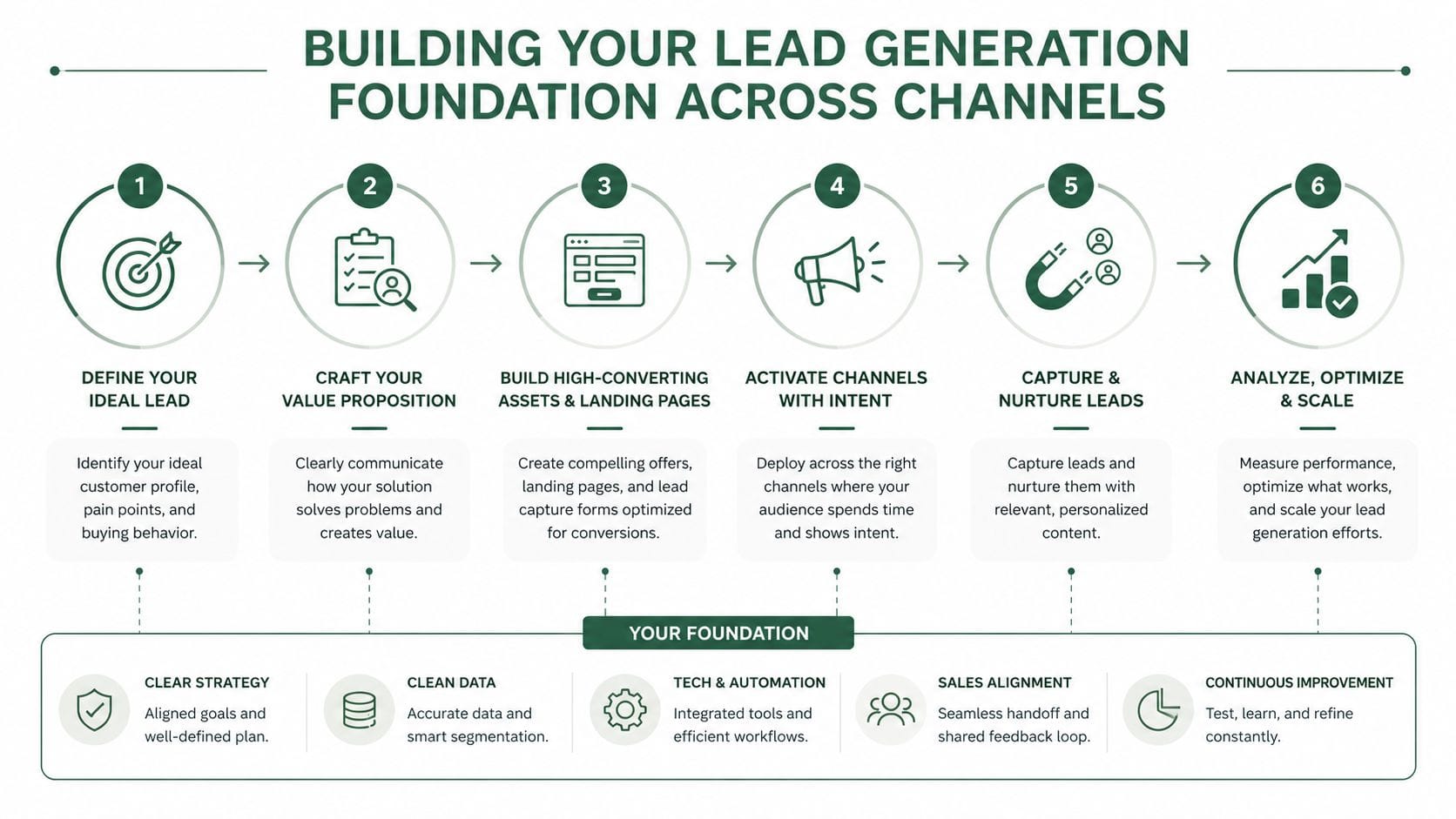
Building Your Lead Generation Foundation Across Channels
A small business doesn't need every channel at once. It needs the channel mix that matches its time, budget, and how quickly enquiries must arrive. SEO, paid search, social media, and email each play a different role, and the wrong sequence can waste months.
Start with the channel that matches urgency
SEO works like planting a garden. It takes time, but once the groundwork is in place, the harvest keeps coming without paying for every click. Paid search is more like turning on a tap, because it can send traffic quickly, but the tap stops the moment budget stops.
For a business under pressure to generate enquiries fast, paid search usually handles immediate demand while SEO builds the longer-term base. That's why local keyword targeting matters, especially for service businesses that need customers searching with location in mind. Brisbane operators should focus on phrases their buyers type, then build pages that answer those queries clearly.
For social, the job isn't to chase every platform trend. The job is to publish useful, locally relevant content that proves the business understands the buyer's problem. A childcare service, for example, might share a simple guide to choosing a provider, while a builder could post before-and-after project walkthroughs that speak to trust and process.
Use email to convert the leads already earned
Email is where many small businesses save the most time. A welcome sequence can explain what happens next after an enquiry, filter out poor fits, and prompt serious prospects to reply with the missing details. The benchmark source on email performance notes roughly 43% open rates and about 2% click rates as common reference points, but significant value comes after the click, when the business qualifies the response and follows up efficiently email benchmark data.
A useful external reference on social lead capture is the Trendy AI customer acquisition guide, which is worth reviewing for businesses that want social content to do more than generate likes. For a small operation, the lesson is simple. Every channel should feed the same funnel, not create extra admin.
The smartest budget is usually not the biggest one. It's the one that puts the right message in front of the right person, then removes friction before the enquiry reaches sales.
For tight budgets under $2,000 a month, the practical split is usually to prioritise one demand channel, one trust channel, and one follow-up layer. That might mean search, a few high-intent local pages, and automated email, rather than trying to run a dozen scattered campaigns. Businesses using this approach can also compare their setup against the digital strategy overview to make sure each channel has a clear role.
The channel stack should compound, not compete. SEO captures ongoing intent, paid search fills near-term gaps, social builds familiarity, and email turns all of that effort into more efficient follow-up.
Qualifying Leads Before They Drain Your Time
Most small businesses don't just need more leads. They need fewer bad ones. A lead that never converts still costs time, attention, and follow-up energy, and that hidden cost can be worse than a quiet week.
Measure the handoffs, not just the headline volume
A practical benchmark for lead management is to treat visitor→lead as the first gate, then measure lead→MQL and MQL→SQL separately. Cross-industry B2B data commonly cited in lead-quality research shows average 2.3% visitor-to-lead conversion, 31% lead-to-MQL, and 13% MQL-to-SQL, with more than 90% of leads lost before opportunity stage in many organisations lead-quality benchmark data. The exact numbers won't map perfectly to every Brisbane business, but the pattern usually will, because most loss happens after the first form fill, not before it.
That's why a spreadsheet can be enough at first. One column for source, one for service fit, one for urgency, one for budget signals, and one for next action gives a sole trader a better grip on lead quality than a messy inbox ever will. A CRM can do the same work, but the principle is identical.
Filter early with simple rules
A low-friction scoring model often catches the worst enquiries before they take up time. Form fields can ask for suburb, service need, and preferred timeframe. Chatbots can ask one or two qualifying questions. Automated email can request missing information before a call is booked.
The clearest red flags are usually obvious. A postcode outside the service area, a message with no details, a request that doesn't match the business offer, or a contact that dodges every follow-up question all point to low intent. A score doesn't need to be fancy. It just needs to separate “reply now” from “park it.”
For teams that want a voice layer on top of that process, the AI receptionist caller scoring overview shows how phone enquiries can be screened before staff spend time on unsuitable calls. That kind of structure matters because the ACCC reported that Australian small businesses lost about AUD 15.1 billion to scams in 2023, which is a sharp reminder that low-quality inbound contact can be more than just annoying small business scam losses in Australia.
Short version: if the lead won't answer basic fit questions, it usually won't become a good customer either.
A simple lead-scoring template can be built in under an hour by assigning points for fit, urgency, and budget, then flagging every enquiry below the threshold for nurture rather than sales. Businesses using a CRM can align that with the internal lead-handling process in this CRM explanation. The goal isn't to reject people too quickly. It's to stop good staff from burning time on enquiries that were never going anywhere.
Local Optimisation Tactics for Brisbane Lead Quality
Brisbane lead quality improves when the website, local listings, and ad copy all tell the same story. Generic pages attract generic enquiries. Local pages attract people who want the service in the right place, at the right time.
Make local signals impossible to miss
Google Business Profile is often the first impression, so it needs to stay current. Hours, services, photos, and posts should all reflect what the business is offering, because a stale profile sends mixed signals before a visitor even clicks through. Brisbane businesses also need consistent NAP details, meaning name, address, and phone number, across every citation and directory.
Local reviews matter for more than reputation. They help prospective customers decide whether to contact the business at all. A clear review pattern with real service detail gives a better signal than a handful of generic five-star comments.
Brisbane-specific landing pages work best when they match how people search. A page for “plumber Brisbane inner north” should speak directly to the suburbs serviced, common jobs handled, and the process for booking. The Brisbane local SEO guide is a useful reference point for businesses tightening that structure.
Keep the page useful, not stuffed with suburb names
Suburb pages should read like a service page first and a location page second. That means clear service descriptions, proof of local coverage, fast mobile load times, and a direct call path for people ready to enquire. If the page only repeats suburb names, it may rank poorly for trust as well as readability.
Local ad copy should do the same job. A service business can speak more directly to Brisbane buyers by mentioning response time, nearby suburbs, or service-area specifics, rather than relying on broad claims. That often improves lead quality because the ad pre-qualifies the buyer before the click.
Practical examples help here. A landscaping business servicing the western suburbs can build pages around common project types in those suburbs, while a private clinic can create location pages that explain parking, access, and appointment flow. Those details reduce friction and attract people who are more likely to book.
Local SEO isn't about tricking Google. It's about making it easy for nearby customers to recognise a fit.
A good local setup does three things at once. It helps search engines understand service area, it reassures the buyer, and it keeps unqualified leads from arriving in the first place. That combination saves time, which is exactly what small businesses need.
Comparing Channels by Cost and Lead Quality
A Brisbane small business does not need the cheapest channel on paper. It needs the channel that brings in enquiries the team can work with, without filling the inbox with spam, tyre-kickers, and poor-fit requests. Cost, speed, lead quality, and weekly effort all matter, because a low-cost lead that never converts still wastes time and momentum.
| Channel | Avg Cost Per Lead | Time to First Results | Lead Quality | Weekly Effort |
|---|---|---|---|---|
| SEO | $31 per lead SEO benchmark | Slower, but compounds over time | Strong when intent is local and pages are focused | Moderate, ongoing content and technical work |
| Google Ads | Higher than SEO in many cases, exact cost varies by market | Fast | Often strong for high-intent searches if ads and landing pages match | Moderate to high, needs constant tuning |
| Facebook and Instagram Ads | Cost depends on audience and creative | Fast | Mixed, because many clicks are early-stage rather than ready to buy | Moderate, creative refresh and audience testing |
| Email marketing | Efficient, with strong returns reported in benchmark data email ROI benchmark | Immediate for existing lists | Strong when the list is clean and segmented | Low to moderate, automation does the heavy lifting |
| Content marketing | Often more efficient over time, especially when consistent | Slower at first | Strong when content answers buyer questions clearly | Moderate to high, needs consistent publishing |
The spread between channels matters, but so does what sits behind each enquiry. Analysts in the lead generation benchmark cited above found that average B2B cost per lead is much higher than SEO lead cost, which is one reason search can suit budget-conscious businesses that are willing to wait for results to build. That does not make SEO the answer for every business. It means the channel has to match the buying cycle, the service area, and the team's ability to follow up properly.
Paid traffic is the easiest place to waste money on low-quality leads. A campaign can generate form fills quickly while still attracting people who are not ready to buy, who are comparing prices only, or who are outside the service area. If the ad, offer, and landing page do not filter for fit, the business pays faster for the same weak enquiries.
That is why lead qualification has to be built into the channel choice, not patched on later. A plumber chasing emergency jobs, a clinic booking appointments, and a B2B service selling retainers all need different filters, different follow-up speed, and different expectations for lead quality. Good channel selection is less about chasing volume and more about protecting time for work that can turn into revenue.
For businesses comparing paid channels, the paid advertising examples guide is useful because it shows how different campaign structures affect lead flow. The real question is whether the channel helps the business attract better-fit enquiries early, or whether it fills the pipeline with people who were never likely to convert.
Measuring What Matters and Keeping It Sustainable
A lead generation system breaks down when the owner tracks too many numbers and not enough outcomes. Page views, followers, and likes can look healthy while the sales inbox stays quiet. The better scorecard is the one that ties marketing activity back to revenue.
Keep the dashboard small and useful
The core KPIs are simple. Cost per lead, lead-to-customer conversion rate, customer acquisition cost, and lead source attribution tell a clearer story than vanity metrics ever will. A business can also track enquiry quality by tagging leads as good fit, borderline fit, or poor fit, then reviewing patterns weekly.
A one-page dashboard works best when it is easy to update. One row per channel, one row for total leads, and one row for closed jobs gives enough visibility without creating admin overload. That's especially important for sole traders and small teams already juggling quoting, delivery, and support.
Review weekly, adjust monthly
A 30-minute weekly check-in is usually enough to catch problems early. Lead volume can be reviewed alongside lead quality score and pipeline movement, then any broken handoff can be fixed before the next week's spend goes out. If enquiries are increasing but conversions are not, the issue is usually not traffic, it's qualification or follow-up.
Monthly review is where the business looks at what is pulling its weight. That can mean tightening ad copy, improving landing pages, refining lead forms, or trimming channels that create busywork rather than revenue. The conversion-rate optimisation services overview is a useful reference if the issue is not lead flow but what happens after the click.
Keep the rule simple: if a channel creates enquiries but no real customers, it's not performing, no matter how nice the dashboard looks.
Professional help makes sense when the business has the leads but not the time or skill to sort, follow up, and convert them efficiently. In-house management still works when the owner can keep the system small, consistent, and honest. The strongest setups don't feel dramatic. They feel calm, repeatable, and easy to maintain.