
A Brisbane business owner can spend the morning quoting jobs, the afternoon chasing suppliers, and the evening wondering why the website isn't bringing in enough enquiries. Then come the familiar questions: Should the business post more often, improve its Google ranking, run Google Ads, rebuild the website, or ask customers for reviews?
That confusion isn't caused by a lack of effort. It comes from treating services internet marketing as a list of disconnected tasks. A better approach is to build a local demand system that helps the right customers find the business, trust it, and take the next step, without making the owner manage every channel personally.
For Brisbane small businesses, Brisbane Digital Marketing should be practical. The system needs to reflect suburb-level demand, limited time, tight budgets, and the actions that create revenue, such as calls, form submissions, shop visits, and booked jobs.
Why Internet Marketing Feels Overwhelming
A Brisbane electrician might update a Facebook page between appointments, a consultant might rewrite a service page after dinner, and a café owner might check Google reviews while waiting for a delivery. Each task feels reasonable in isolation, but none provides a clear answer to the bigger question: which activity will generate the next qualified customer?
The problem usually isn't motivation. It's prioritisation. Business owners are trying to run operations, manage staff, answer enquiries, issue invoices, and maintain standards while also keeping up with search rankings, social content, online reviews, and advertising platforms.
Digital marketing becomes manageable when the pieces have a job. A website should turn attention into enquiries. SEO should help people with relevant needs discover the business. Paid advertising should capture demand that exists now. Social media should reinforce familiarity and trust rather than become an endless demand for fresh content.
Practical rule: Every marketing activity should connect to a customer action or a useful business decision.
Replace the task list with a local demand system
A demand system works like a well-run reception desk. It tells potential customers what the business does, whether it serves their area, why they should trust it, and how to make contact. It also records what happened after the customer arrived.
That means a small business doesn't need to win every search or publish constantly. It needs to be visible for commercially relevant searches, provide clear information, respond quickly, and measure whether attention becomes a genuine opportunity.
For example, a Brisbane roof plumber may gain more from a strong service page for a specific local area, a clear click-to-call button, and tracked phone enquiries than from producing general roofing articles with no booking path. A professional adviser may need a credible website, useful answers to common questions, and a simple consultation form rather than a large social media following.
The right internet marketing services reduce the number of decisions the owner has to make. They create a repeatable process that keeps working while the team concentrates on customers and delivery.
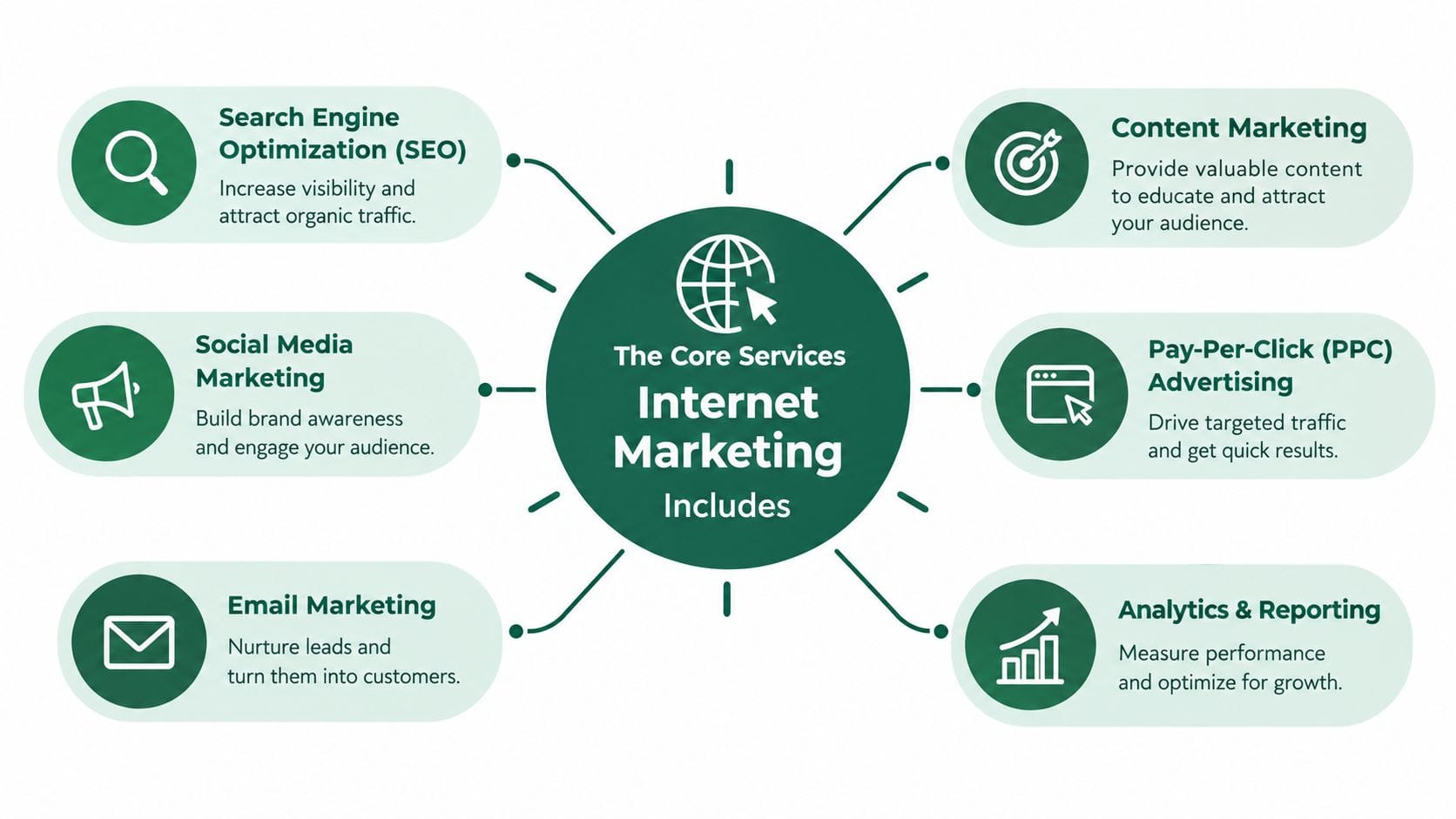
The Core Services Internet Marketing Includes
A useful way to understand digital marketing is to treat the business as a local shopfront. SEO is the signage and location, the website is the layout and service counter, paid advertising is a targeted letterbox drop, social media is the community noticeboard, and analytics is the till that shows what happened after people walked in.
SEO gives customers a way to find the business
Search engine optimisation starts with the services and locations that matter commercially. Work can include a technical website review, clearer service pages, suburb-focused landing pages, improved page titles, internal links, Google Business Profile optimisation, and consistent business details across relevant directories.
The purpose isn't to chase rankings for their own sake. It's to make sure a person searching for a service in Brisbane can quickly understand whether the business can help, where it operates, and how to contact it.
Web design removes friction
A polished website still fails if visitors can't find the phone number, understand the offer, or use the page comfortably on a mobile. Conversion-focused web work should clarify the headline, explain the service in plain language, display trust evidence, show service areas, and provide a direct next step.
For a local builder, that could mean project photos, licence information, service suburbs, and a quote request form. For a clinic, it might mean treatment details, opening hours, practitioner information, and a clear booking button.
Paid search captures immediate demand
Google Ads can put a relevant offer in front of people who are already searching. The work includes keyword selection, tightly grouped campaigns, ad copy, landing pages, location settings, negative keywords, conversion tracking, and regular optimisation.
A campaign for “emergency electrician Brisbane” shouldn't send every visitor to a generic homepage. The landing page should address emergency availability, service coverage, response expectations, and the easiest way to call.
Social media and content build familiarity
Social media works best when it shows how the business operates. Useful content can answer recurring customer questions, explain preparation requirements, demonstrate completed work, introduce staff, and clarify service limitations. Businesses needing a practical starting point can use these actionable social media strategies to organise content around customer needs rather than random posting.
In the 2024–25 financial year, 51% of Australian businesses used social media as part of their online presence, while the share measuring the contribution of digital activities to overall performance doubled to 7%, according to the Australian Bureau of Statistics business technology data. That gap matters. Posting is common, but measurement remains less consistent.
Email can support repeat business where the customer has lawfully opted in. Analytics should connect website visits to calls, forms, bookings, and sales wherever practical.
A business considering packaged support can review small business digital marketing packages before deciding which combination fits its immediate bottleneck.
Real Business Outcomes and Local Search Intent
Visibility matters only when it helps a real customer choose what to do next. A Brisbane service business doesn't need broad national attention if the profitable opportunity comes from nearby suburbs, specific services, and urgent customer needs.
Australian data indicates that 46% of Google searches have local intent, and 70% of Australians have visited a physical store after finding information online, according to this Australian local search data compilation. The figures are directional benchmarks rather than a substitute for client-level reporting, but they show why local search deserves direct attention.
Make local intent obvious
A Google Business Profile should accurately show the business name, service category, contact details, hours, service area, photos, and relevant updates. The website should support that profile with dedicated pages for important services and locations.
A gardening business serving Paddington, New Farm, and Ascot shouldn't rely on one vague page titled “Brisbane Landscaping”. Each useful local page can explain the service, the area covered, the type of customer served, common questions, and the next action.
The same principle applies to professional services. A migration adviser, accountant, or commercial solicitor needs pages that match the way customers search, compare, and assess risk. Clear pricing signals, credentials, availability, process information, and genuine reviews reduce uncertainty before the first call.
Search visibility is the shop sign. The enquiry process is the front counter. If either one fails, the business loses the customer.
Measure the actions that lead to revenue
A local campaign should report more than keyword positions. Useful measures include:
- Profile interactions: Monitor calls, website visits, direction requests, and messages from the Google Business Profile.
- Website enquiries: Track form submissions and click-to-call actions by service and suburb.
- Lead quality: Record whether an enquiry fits the service, location, budget, and timing.
- Booked work: Connect marketing leads to estimates, appointments, completed jobs, or purchases.
- Customer evidence: Review which pages, ads, referrals, or searches appear before a genuine enquiry.
Australia Post reported that 8 in 10 Australian households made an online purchase in 2023, representing approximately 9.5 million households, with online spending reaching $63.6 billion. The Australia Post eCommerce report also recorded approximately 1 in 7 households purchasing online every week. Those figures apply to online purchasing, but the wider lesson is relevant to offline services too. Customers often discover, compare, check trust signals, and decide online before they call a business or visit a location.
Businesses wanting to understand the local mechanics in more detail can use this guide to what local SEO marketing involves.
Choosing the Right Marketing Partner
There isn't one correct way to buy marketing support. A sole trader with spare time may handle a Google Business Profile and basic content internally. A growing service company may need a specialist for a defined problem. A business with several services, locations, and channels may need an agency to connect the work and maintain momentum.
The decision should start with the bottleneck. If the owner has time but lacks technical confidence, training or a freelancer may work. If the strategy is sound but nobody has time to execute it, outsourced support makes more sense. If the business lacks measurement, positioning, and channel priorities, a broader strategic partner may be necessary.
Marketing support options compared
| Factor | DIY Approach | Freelance Specialist | Local Digital Agency |
|---|---|---|---|
| Budget | Lowest direct cost, but uses owner time | Focused cost for a defined skill | Ongoing investment across several capabilities |
| Time required | High owner involvement | Lower for the assigned task | Lower day-to-day involvement |
| Best fit | Simple setup and regular owner-led updates | A specific SEO, website, or advertising problem | Connected strategy, execution, reporting, and optimisation |
| Main risk | Inconsistent work and delayed improvements | Gaps between separate specialists | Paying for a broad package that isn't tied to business goals |
| What to demand | A simple checklist and tracking method | Clear deliverables and ownership | A written plan, transparent reporting, and measurable actions |
A local partner can also bring practical knowledge of Brisbane suburbs, customer behaviour, seasonal demand, and the realities of local service areas. That doesn't automatically make a local agency the right choice. The advantage only matters when the provider uses that understanding to improve targeting, messaging, landing pages, and lead quality.
Questions worth asking before signing
Ask what happens in the first month, which pages or campaigns will change, how leads will be tracked, who owns the accounts, and what the business receives if the relationship ends. Ask for examples of reporting that show enquiries and booked work, not just reach or impressions.
A business comparing agency models can also review search engine marketing agencies to understand the difference between search optimisation, paid search, and broader marketing support.
Boocoo is one Brisbane-based option for businesses seeking outsourced support across SEO, web design, social media management, and paid advertising. The team can be contacted on 1300 093 797 or at hello@boocoo.au.
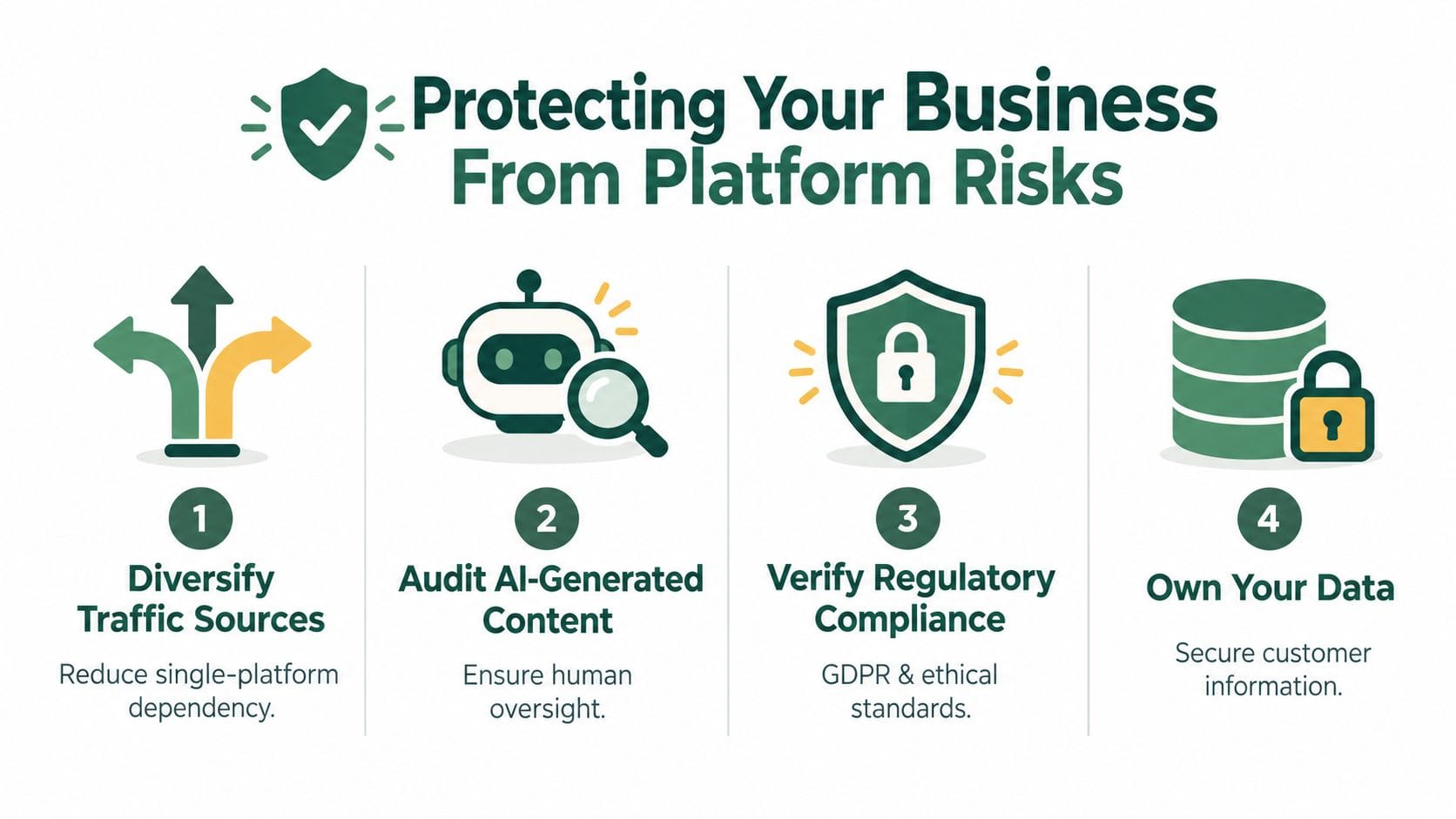
Protecting Your Business From Platform Risks
A Brisbane business can publish every day, buy advertising, and still lose customer access overnight. A platform may suspend an account, change its rules, remove a profile, or provide incomplete performance data. That is a poor foundation for local lead generation.
The ACCC identifies risks for Australian small businesses, including fake reviews, account deactivation, and losing access to customers through major platforms, in its Digital Platform Services Inquiry report.
Use AI with a proper approval process
AI is useful for drafting social posts, grouping search queries, summarising customer questions, and preparing first versions of ad copy. A person should check every claim before publication, especially statements about prices, guarantees, response times, qualifications, service areas, or customer outcomes.
The ABS reported that about 11% of Australian small and micro-businesses used AI in 2024–25, with adoption at 19% among innovation-active small businesses and 4% among small businesses that are not innovation-active, according to its business AI adoption release. The advantage comes from selective AI use backed by human review and genuine local knowledge, not from producing more AI output.
Use this short approval checklist:
- Check factual claims: Match every measurable statement against current business records.
- Protect personal information: Do not paste customer details into tools without a lawful, appropriate process.
- Review local accuracy: Confirm suburbs, service boundaries, opening hours, and seasonal information.
- Preserve a human voice: Replace generic wording with real customer questions and practical examples.
Keep a recovery plan ready
Record account owners, administrator access, recovery contacts, two-factor authentication details, creative assets, website access, and reporting history. Store customer records lawfully in a system the business can access without relying on a social platform or advertising account.
Build several routes to enquiries. A conversion-focused website, search visibility, direct customer communication, referrals, review processes, and suitable offline partnerships give the business options if a Google Business Profile or social account becomes unavailable.
Advertising claims still fall under Australian Consumer Law. The ACCC guidance on social media promotions requires claims to be accurate, provable, and not misleading. Apply the same standard to reviews. The ACCC online review guidance explains that reviews should be independent and genuine. Do not create fake reviews, arrange misleading reviews, or offer incentives only for positive feedback.
A platform can provide reach, but it should not own the entire customer relationship.
Understanding Pricing and Key Performance Indicators
Internet marketing costs depend on the work involved. A website rebuild is usually a project with a defined start and finish. SEO, content, social media, and advertising management are normally ongoing because the business needs continued improvement, testing, reporting, and maintenance.
The cheapest proposal isn't necessarily the most affordable. A low monthly fee that produces no qualified enquiries wastes more money than a focused programme that fixes a clear conversion problem. A sensible proposal should state what will change, who will do it, how success will be measured, and what information the business needs to provide.
Use paid search benchmarks as comparison points
An Australian SME benchmark reports an average cost per click of A$2.10 and cost per conversion of A$46, while top-quartile accounts achieve a cost per conversion between A$18 and A$28, according to the Australian SME marketing benchmark. These are comparison points, not promises for every Brisbane campaign. Competition, service category, location, landing page quality, and lead quality all affect the result.
A campaign should optimise towards qualified enquiries or booked jobs rather than form volume. A CRM can record whether a lead answered the phone, matched the service area, requested a profitable service, and became paying work. Where appropriate, conversion values can reflect service margin rather than treating every enquiry as equal.
Put useful numbers in the monthly report
A practical report can include:
- Qualified enquiries: Count calls, forms, messages, and bookings that meet the business's criteria.
- Cost per qualified enquiry: Compare advertising and management costs with useful opportunities, not raw clicks.
- Booked-job rate: Track how many suitable leads become appointments, quotes, or completed work.
- Lead source: Identify whether the enquiry came from organic search, paid search, social media, referrals, or another channel.
- Revenue contribution: Connect completed work to the marketing source where the business has reliable records.
Businesses wanting a plain-language reference for choosing measures can use this practical KPI guide from Otter A/B. A business reviewing advertising costs can also read about Google Ads pricing in Australia before assessing a proposal.
Likes and impressions may help explain awareness, but they shouldn't be the final score. The report needs to show what the marketing generated and what the business learned.
Your Next Steps for Sustainable Growth
A small business doesn't need to rebuild every channel at once. The first priority is finding the biggest leak between discovery and a booked customer, then fixing that leak before adding more activity.
A practical first-week review can look like this:
- Check the Google Business Profile: Confirm the category, phone number, hours, service area, photos, and review responses are accurate.
- Test the website on a mobile: Ask whether a customer can understand the offer and call or enquire without hunting.
- Review the main service pages: Make sure each page names the service, location, customer problem, proof, and next action.
- Record enquiries consistently: Add source, service, suburb, outcome, and booking status to a simple spreadsheet or CRM.
- Audit account ownership: Confirm the business controls website, advertising, social, analytics, and profile access.
- Choose one focused improvement: Fix one high-value page, campaign, or conversion step instead of starting a dozen unfinished tasks.
The local business digital marketing guide can help organise those priorities around the business's actual capacity. A tradesperson may start with local service pages and call tracking. A retailer may prioritise product pages, email permission, and shopping journeys. A professional service firm may need clearer expertise content and a consultation pathway.
Sustainable growth is usually less about doing everything and more about fixing the right customer journey in the right order.
Brisbane business owners who want a practical starting point can contact Boocoo on 1300 093 797 or hello@boocoo.au. The first conversation can focus on current goals, available budget, time constraints, existing marketing assets, and a sensible first step, whether that means improving local SEO, tightening paid search, rebuilding a key page, or creating a more resilient lead system.