
A lot of Brisbane business owners are in the same spot right now. They've spoken to one agency that talks only about Google Ads, another that promises SEO “authority”, and a third that sends a proposal full of charts but not much clarity on what brings in calls, bookings, or sales.
That confusion is expensive. A small business doesn't need more jargon. It needs a partner that can explain what to do first, what to ignore, and what's worth paying for in Brisbane Digital Marketing.
Search engine marketing works best when it's treated like a two-lane road. One lane is paid search, which can bring enquiries faster. The other is organic SEO, which builds visibility that doesn't disappear the moment ad spend pauses. Many agency pitches still split those lanes apart. That's a problem, because Australian commentary often reduces SEM to PPC alone, even though 68% of Australian small businesses waste ad spend because they lack SEO alignment according to Sharp Instincts on search engine marketing.
Small businesses that want a steadier footing usually benefit from getting the basics right first. A practical primer like SEO tips for small business can help clarify what should already be in place before any campaign ramps up. For a local view on how that applies to search visibility in this market, Brisbane search engine optimisation is also useful background.
Why Hiring the Right SEM Agency Matters in Brisbane
Brisbane businesses don't hire search engine marketing agencies because they want reports. They hire them because they want the phone to ring with better-fit leads, online bookings to come through more consistently, or quote requests to stop relying on word of mouth alone.
That's why the right agency matters more than the cheapest proposal. A poor-fit agency can spend money quickly and still leave the owner asking the same question each month. “What did that do for the business?”
SEM is bigger than ads alone
A good SEM partner doesn't treat Google Ads and SEO like unrelated services. It treats them like parts of the same system.
If paid search is switched on before the website, service pages, and local search basics are ready, the business can end up paying to send people into a weak sales process. That's a bit like paying for more water to run through a hose with a kink in it. The flow looks active, but the result at the end is disappointing.
Practical rule: If an agency only talks about clicks and never talks about the website, search intent, local landing pages, or conversion paths, it's usually selling media spend, not business growth.
Local context changes the outcome
A Brisbane plumber targeting northside suburbs doesn't need the same campaign structure as a national ecommerce brand. A local accountant working around Chermside, Paddington, or Logan needs a strategy shaped around service areas, local intent, and the kind of customer who wants to call before filling in a form.
That local understanding shows up in practical ways:
- Suburb targeting: Campaigns can be built around where work is profitable, not where impressions are cheapest.
- Offer positioning: Messaging can reflect how Brisbane buyers search, compare, and choose.
- Lead quality control: Local teams are usually better at spotting when a campaign is attracting the wrong suburbs, wrong service type, or low-value jobs.
The agency should reduce overwhelm
A strong agency relationship should feel like taking something off the owner's plate. The business should know what's being done, why it matters, and what the next decision is.
Search engine marketing agencies earn trust when they simplify decisions, not when they make simple work sound complicated. If a business owner leaves the first meeting more confused than when they walked in, that's already a warning sign.
The best Brisbane Digital Marketing relationships usually start with a clear diagnosis, not a flashy pitch.
Defining Your Goals and a Realistic Marketing Budget
Most hiring mistakes happen before any agency is contacted. The business owner asks for “more traffic” or “better SEO”, the agency replies with a bundle of services, and both sides end up talking past each other.
Clear goals fix that. They also save time, because a good agency can tell much faster whether it's the right fit.
Start with business outcomes, not marketing tasks
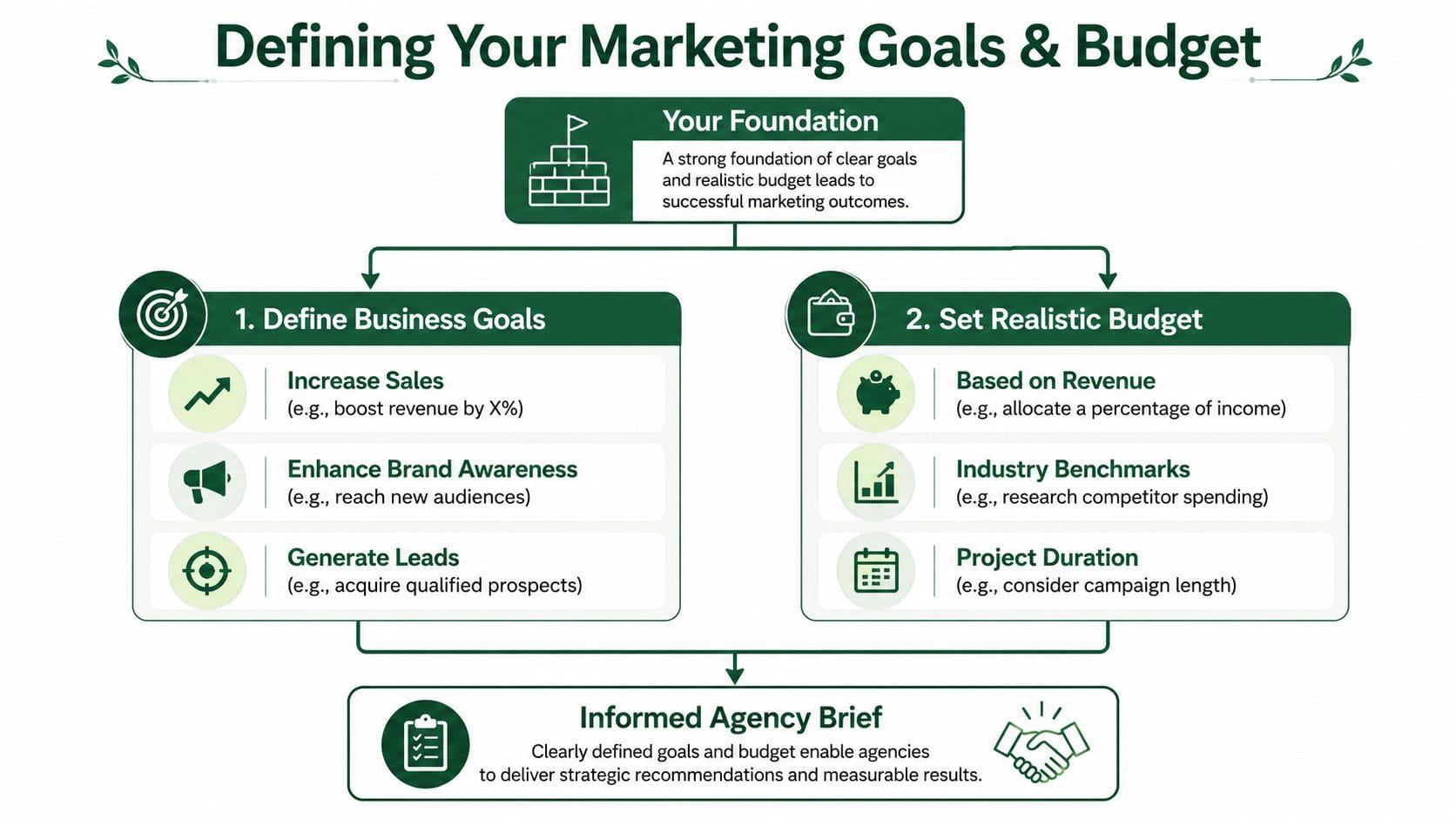
A small business usually doesn't need “SEO”. It needs one of these:
- More qualified leads: For example, a service business might want more calls from people ready to book, not more general website visits.
- More booked jobs: A trades business may need enquiry volume that fills next month's calendar without attracting tiny, low-margin jobs.
- Better lead quality: Some businesses already get enquiries, but too many are outside the service area or after the wrong service.
- Stronger visibility in one city: Many Brisbane operators don't need a national strategy. They need to win locally first.
That distinction matters. If the goal is better-fit leads in one city, the agency brief should say that plainly. It shouldn't lead with blog volume, keyword counts, or vague “awareness”.
A simple way to frame it is this:
- Choose the outcome. Calls, form fills, bookings, quote requests, or sales.
- Choose the audience. Which suburb, service area, or customer type matters most.
- Choose the priority service. The one that brings the best margin, repeat work, or easiest close rate.
Set a budget that matches the job
Marketing spend works more like maintaining a vehicle than buying a raffle ticket. If the budget only covers fuel but not servicing, the business can still get moving, but performance won't hold up for long.
For Australian small businesses targeting a single city with one or two channels such as local SEO and Google Ads, meaningful agency campaigns realistically start between $800 and $2,000 per month, while growth-focused SMBs needing multi-channel work typically pay $3,000 to $10,000 monthly according to WME Group's agency cost guide.
That range helps sort wishful thinking from workable planning.
- At the lower end: The campaign usually needs a narrower scope. One city. Fewer services. Tighter targeting.
- In the middle: There's room for more landing page work, ongoing optimisation, and stronger reporting.
- At the higher end: The agency can coordinate multiple channels without cutting corners.
A business comparing proposals can also benefit from understanding how retainers, project fees, and performance-based arrangements are commonly structured. RedactAI's marketing agency pricing gives a useful breakdown of those models in plain English. For owners specifically weighing paid search support, Google Ads Brisbane adds local context to what should be included.
Don't ask, “What's your cheapest package?” Ask, “What can be done properly within this budget?”
A practical example
A Brisbane electrician with one service area and two core services may be better off funding a focused local SEO and Google Ads setup than spreading the same money across SEO, Meta ads, email, TikTok, and content.
That narrower approach often saves money because it removes management overhead, simplifies reporting, and gives the agency one clear job. Get the right local leads coming in, then expand.
Finding and Shortlisting Local Brisbane Agencies
Many owners start the search the obvious way. They type “search engine marketing agencies” into Google, click a few websites, and end up with a list that looks polished but feels hard to compare.
The problem isn't the search itself. It's that many directories and listings lean toward national agencies or firms built around Sydney and Melbourne visibility. In one Australian listing set, 61 SEM agencies are listed for small businesses, but only 3 explicitly serve Brisbane according to Clutch's Australian SEM agency listings. That gap makes local shortlisting harder than it should be.
What a real local agency looks like
A genuine Brisbane agency usually leaves local fingerprints online. Not just a Brisbane page stuffed with suburb names, but signs that the team works with local operators.
Useful signals include:
- Brisbane-relevant website content: Articles, service pages, or examples that mention local service realities in a natural way.
- Real local presence: A visible office location, local staff profiles, or community involvement.
- Practical service focus: Case examples that sound like actual small business work, not enterprise campaigns with no local relevance.
A national agency with a virtual office can still do good work. But small businesses often pay more for the overhead that comes with bigger-city teams, broader account structures, and slower response times.
A simple shortlist filter
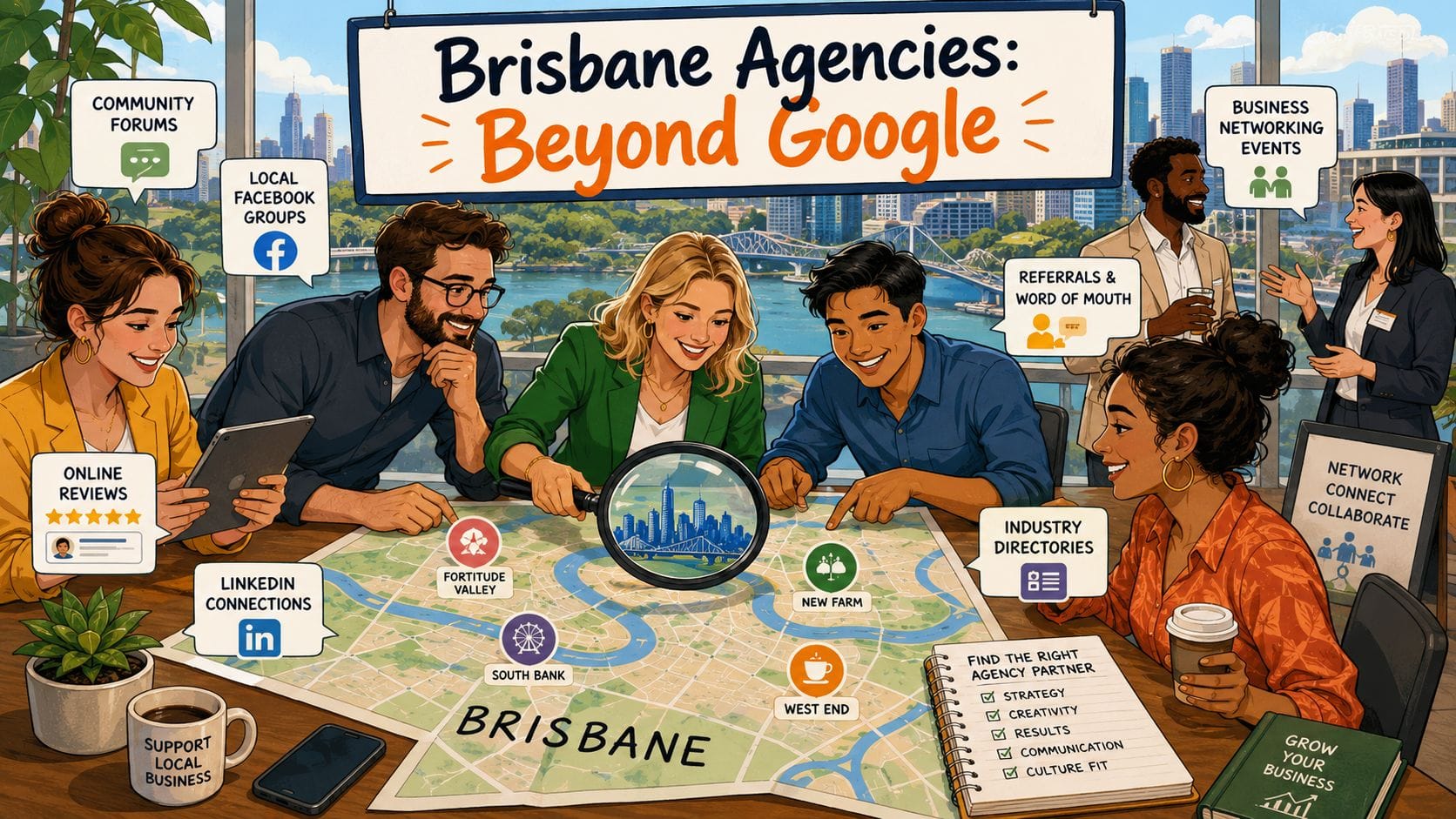
A better shortlist usually comes from combining search with old-fashioned local validation.
One approach that works well is this:
- Ask non-competing business owners: A bookkeeper, web developer, photographer, or signage company often knows who communicates well and who doesn't.
- Check LinkedIn properly: Look at who on the team is Brisbane-based and whether their content shows day-to-day understanding of local campaigns.
- Review the proposal style on the website: If every service page sounds interchangeable, the delivery might be too.
- Look for local channel depth: If paid search matters, a specialised resource like pay per click advertising company can help clarify what a credible provider should cover.
A shortlist should be small on purpose. Three strong options are easier to compare than ten vague ones.
What to remove from the list quickly
Some agencies can be ruled out within minutes.
- No clear owner fit: If the site speaks only to enterprise brands, a small business may get less attention than it expects.
- No mention of reporting or communication: Silence here usually becomes frustration later.
- No sense of place: If the agency claims Brisbane but nothing on the site feels local, there may be little difference between it and a remote national provider.
The best shortlists are built on relevance, not volume. A business owner doesn't need every option. It needs a few that look capable, transparent, and realistically priced for Brisbane work.
The Vetting Process Key Questions to Ask Any Agency
Once the shortlist is built, the next job is to stop listening like a prospect and start interviewing like a buyer.
Good agencies won't mind that. In fact, the stronger ones usually welcome direct questions because clear expectations make delivery easier.
Questions that expose the real process
The aim isn't to catch anyone out. It's to find out how the agency thinks.
These questions tend to reveal that quickly:
How do you decide what to work on first?
A capable agency should talk about audits, account history, website issues, search intent, and where wasted spend or missed opportunity sits.How do you measure whether the campaign is working?
A clear answer should include lead quality, conversion tracking, and commercial outcomes, not just traffic graphs.How often will reporting happen, and what will be shown?
Owners should know whether they'll see spend, lead trends, search terms, conversions, and recommendations.Who actually does the work?
This matters. Sometimes the senior person sells the project and a junior team member runs it with limited oversight.How do you calculate ROI?
This question matters more than most owners realise. According to Bench Media's guide to search engine marketing, a common mistake is failing to separate new customer revenue from repeat business, and they recommend using a rolling 3-month average and including all costs such as agency fees, ad spend, and software. The same source notes that a Marketing ROI ratio of at least 3:1 is a key benchmark.
If an agency can't explain measurement in plain language, the reporting probably won't help when tough decisions need to be made.
For businesses comparing specialist support, Google Ads consulting is a helpful reference point for the kind of strategic questions a consultant should be able to answer.
Agency Vetting Red Flags vs Green Flags
| Question Topic | Red Flag Answer (Warning!) | Green Flag Answer (Good Sign) |
|---|---|---|
| Strategy | “We use the same process for every client.” | “The first phase depends on the account, website quality, service priorities, and where lead leakage is happening.” |
| Reporting | “We'll send monthly stats.” | “You'll see spend, conversions, lead quality notes, search terms, and what we're changing next.” |
| ROI | “You'll know it's working from more traffic.” | “We track new customer value where possible, include core costs, and review results over time rather than one isolated month.” |
| Team | “Our experts handle everything.” | “These are the people on the account, what each person does, and who you'll speak with regularly.” |
| Local fit | “We work with businesses everywhere.” | “We understand your service area, suburb targeting, and which jobs are worth pursuing in Brisbane.” |
| Scope | “We'll do SEO, PPC, social, web, email, and content straight away.” | “We'd start with the channels most likely to produce the right leads, then expand when the numbers support it.” |
Copy and send this enquiry email
A short, direct email often gets better proposals than a vague contact form message.
Hello,
This business is looking for support with search marketing in Brisbane. The priority is [insert goal], focused on [insert service or audience].
Current challenges include [insert a few issues such as low-quality leads, inconsistent enquiries, or poor visibility].
The likely budget range is [insert budget], and the business is looking for an agency that can explain scope, reporting, and expected first steps clearly.
Please outline how your team would approach this, who would manage the account, and what success would be measured against.
Regards,
[Business name]
That format keeps the conversation grounded. It also makes it easier to compare agencies on substance instead of polish.
Making the Hire and Ensuring a Smooth Onboarding
Choosing an agency is only the halfway point. The first few weeks after signing often determine whether the relationship feels organised or chaotic.
A smooth onboarding process saves billable time, avoids access delays, and gives the agency a better chance of producing useful early data.
What to check before signing
The service agreement should be plain enough that a business owner can explain it back to someone else.
Key points worth checking include:
- Scope of work: What is included each month, and what isn't.
- Deliverables: Reports, meetings, campaign setup, landing page work, ad management, SEO tasks.
- Access ownership: Who owns ad accounts, analytics, and creative assets.
- Notice period: What happens if the business wants to pause or stop.
- Approval process: Who signs off on campaigns, copy, or website edits.
If those points are fuzzy at the beginning, they usually become painful later.
What the business owner should prepare
The strongest onboarding happens when the owner brings more than passwords.
Useful materials often include:
- Customer insights: The services that make the best margin, the jobs to avoid, and the suburbs that matter most.
- Sales context: What counts as a good lead, what usually closes, and what wastes staff time.
- Brand assets: Logo files, approved messaging, photos, and any existing offer language.
- Platform access: Website CMS, Google Analytics, Google Ads, Google Business Profile, Meta accounts, and call tracking tools if used.
A good agency can still help organise a messy setup. It just moves faster when the business is prepared.
The faster both sides agree on what a qualified lead looks like, the faster campaign decisions become useful.
There should also be realistic expectations around early performance. For Australian service businesses, Cost Per Qualified Lead often ranges from $50 to $200, and B2B service conversion rates sit at 10% to 20% according to Spacewolf's KPI guide for Australian businesses. That doesn't mean every business will hit those figures immediately, but it gives owners a sensible benchmark for the first stage of campaign review.
The first phase should feel like this
The first month often involves setup, tracking fixes, account cleanup, targeting decisions, and baseline reporting. That's normal.
By the next phase, the agency should usually be refining search terms, tightening location targeting, improving copy, and filtering out weak leads. After that, the relationship should feel less like launch mode and more like regular optimisation.
If the owner still doesn't know what's being tested, what's improving, or what the next focus is, the onboarding hasn't done its job.
Measuring Success Beyond Traffic and Rankings
Traffic has its place. Rankings do too. But neither pays wages on its own.
A small business should care more about whether enquiries are becoming customers at a sensible cost. That's the difference between marketing activity and marketing that supports the business.
The most useful numbers are usually:
- Cost per lead: What it costs to generate an enquiry.
- Customer acquisition cost: The full cost of winning a new customer.
- Lead-to-sale rate: Whether the leads are closeable.
- Qualified lead volume: How many enquiries are worth staff follow-up.
Customer acquisition cost is broader than ad spend alone. ScaleSuite's CAC calculator for Australia explains it as marketing spend plus sales team costs, marketing tools, and allocated overheads divided by new customers. For owners wanting a quick way to pressure-test campaign performance, an Ad ROI calculator can help frame the conversation before the next agency meeting. It also helps to understand how website improvements shape those numbers over time, which is where conversion rate optimisation in Australia becomes relevant.
A campaign can look busy and still underperform. The useful question is whether the business is buying profitable growth.
Strong search engine marketing agencies don't hide behind vanity metrics. They connect spend to lead quality, lead quality to sales potential, and sales potential to commercial return.
That's what Brisbane small businesses should expect from Brisbane Digital Marketing. Clear goals. Realistic budgets. Straight answers. And a partner that treats time and money like they matter.