
Australian households spent $82.6 billion online, up 13.9% year on year, across 9.8 million households that shopped online. The average online basket was $96, which is $10 lower than five years earlier. Queensland alone accounted for $17.8 billion of national online spending.
Those figures change how a busy store owner should think about search. There is no shortage of online buying activity, but people are comparing harder before they pay. A keyword plan built only around big, broad product terms misses the value-seeking questions sitting beside the order button.
Ecommerce keyword research works like a map of a fragmented Australian buying journey. One shopper starts with a product name. Another starts with a price limit. Another wants delivery to Brisbane this week. Another wants proof the item is worth the money before risking $96 on it. Each search is a different step toward, or away from, checkout.
The shop-sign analogy helps here. The best sign uses the customer's own words and points to the till, not the busiest road in town. “Things” on a shop window gets glances from every passer-by, but nobody knows whether to walk in. “Linen throws under $100, Brisbane delivery in 2 days” stops fewer people and steers the right ones inside. Volume is the busy road. Intent is the till.
Keyword research turns those buying questions into a simple worksheet. Pick one best seller, then write one phrase for each of five customer concerns. The aim is to name the reason someone buys before touching a keyword tool.
Five keyword clusters for a small ecommerce store
| Cluster | What the shopper wants | Example phrase | Page job |
|---|---|---|---|
| Product | A specific item they can picture | buy handmade soy candle online | One product page with price and stock |
| Price and value | A cheaper or fair-priced option | soy candle starter bundle under $100 | Collection, bundle or sale filter |
| Delivery and place | How and where it arrives | same-day candle delivery Brisbane | Category or landing note with suburbs and timing |
| Trust and risk | Proof it is worth the money | are soy candles worth it | FAQ, review block or short guide |
| Comparison | A choice between options | soy candle vs beeswax | Comparison section or guide, not a duplicate product URL |
A Fortitude Valley homewares store can use the same structure with a linen throw. “Linen throw” is only a seed. “Linen throw under $100” is price. “Queensland delivery linen throw” is fulfilment. “Is a linen throw worth it” is trust. “Linen versus cotton throw” is comparison. Five minutes on one product gives the owner five phrases that each point to a different buying concern.
Price and postage sit inside the purchase decision, not beside it. The $96 basket figure shows why value terms deserve the same attention as product names. Shoppers check whether an item is worth it before they commit. They compare materials because a wrong choice costs money. A phrase like “is a linen throw worth it” may look like a low-value blog question, but for this buyer it can be the last objection before checkout. A product page that never answers that question is like having a shop assistant who walks away whenever a customer asks about durability.
A clear buyer picture helps turn the five clusters into useful phrases. A quick user persona exercise names the shopper, the budget, the delivery postcode, and the single worry that delays the order. That gives each phrase a job. “Under $100” speaks to budget. “Brisbane delivery” speaks to timing. “Worth it” speaks to doubt.
Raw search volume tells you how many people type a word. It does not tell you whether they have $96 to spend, whether they need it this week, or whether they will switch to a cheaper linen blend before they pay. The five-cluster list captures those signals in plain language. Fill it in for one product today and the rest of the process becomes sorting and matching, not guessing.
What Australian Shoppers Actually Search For
Australian shoppers are buying online in large numbers, and they are doing it with a tighter eye on value. According to the Australia Post 2025 ecommerce report, Australian households spent $82.6 billion online, up 13.9% year on year, across 9.8 million households that shopped online. The same report puts the average online basket at $96, which is $10 lower than five years earlier, and shows Queensland accounted for $17.8 billion of national online spending.
That matters because Australian ecommerce keyword research is really a map of a fragmented buying journey. A shopper might start with a broad product word, then move through price checks, delivery questions, reviews, returns, and comparisons before paying. The same person can type “natural skincare Brisbane” on one day and “starter skincare bundle under $100” on the next. Both searches belong to the same purchase journey, and both tell you something different.
High-volume product terms are only one part of that map. “Skincare” shows interest. “Skincare starter bundle Brisbane” shows a shopper looking for an easy first purchase. “Natural skincare with free delivery Queensland” shows value and place inside the search itself. Those details help a store answer the practical question behind the click: will this suit me, arrive in time, and feel worth the money?
A Brisbane skincare store can use that view to shape keywords around value-seeking questions as well as product names. Phrases such as “natural skincare Brisbane,” “skincare starter bundle,” “under $100 skincare set,” “free delivery skincare Queensland,” “skincare returns,” and “sensitive skin skincare bundle” each point to a different concern. One points to local supply. One points to a lower-risk first buy. Another points to postage, while another points to confidence before checkout.
The useful move is to sort phrases by the job they do. Product terms name what the shopper wants. Price terms show what they are willing to spend. Delivery and place terms show where they expect the store to serve them. Trust terms expose the worry that might stop the order. Comparison terms show what the shopper is weighing against your product.
A quick user persona exercise can make those groups more specific. Name the buyer, the budget, the delivery postcode, and the single worry that delays the order. A shopper buying skincare for themselves in Brisbane may care about sensitive skin and postage. A shopper buying a gift may care more about a bundle, a price ceiling, and whether delivery arrives on time.
This approach keeps keyword research tied to real buying behaviour instead of raw search volume. It also gives a small store a manageable starting point. Choose one product, write one phrase for each concern, and use those phrases to shape product copy, category content, FAQs, and short campaigns. The result is a keyword list that reflects how Australian shoppers decide, step by step.
How to Run Ecommerce Keyword Research
Two hours can produce a useful ecommerce keyword list. The goal is a short, practical set of phrases that matches what the shop sells and what a Brisbane buyer is prepared to pay for. Treat the list like a street map of a fragmented buying journey. One person searches the product, another checks the price, another wants local delivery, and another needs reassurance before paying. Keyword research should cover those stops, not just the busiest search term.
1. Set one goal and cap the session at two hours. Write down the single outcome: online sales or quote requests. For sales, judge every phrase by whether it points to a product someone can buy. For enquiries, phrases about availability, timing and local delivery carry more weight. The time cap keeps the session useful. Two hours is enough to build a working list, not a perfect one.
2. Collect ten seed phrases from invoices, product names, and customer messages. Customer emails and site messages show the exact words buyers use, including phrases no tool may suggest. Invoices show what people already pay for. Competitor homepages can help with language, but they often reflect another shop's stock and margins. Keep the first list to ten phrases so the next step stays focused.
3. Expand each seed with price, sale, free shipping, size, material, warranty, reviews, Brisbane, Queensland, and near me. Use Google's suggestions or a free keyword tool for this step. Australian shoppers often adjust what they buy to find better value. IAB Australia reported that 62% of Australian online shoppers switched products or brands to find cheaper alternatives, and 38% used price-comparison sites or services, according to the IAB Australia online shopping research. That means “linen throw” needs companions such as “linen throw under $100,” “linen throw free shipping Brisbane,” and “linen throw alternatives.” Price, comparison, value, bundles and total delivered cost are part of the buying journey, not decorative add-ons.
4. Open the live results on a phone for each survivor and note what Google shows. Mobile testing matters because 50.3% of Australians search for ecommerce brands and products on phones, according to the IAB Australia online shopping research. A phrase can look tidy in a desktop tool and still bring up shopping ads, product grids or advice articles on a handset. That tells you what kind of page the search results favour. If product pages dominate, improve a product URL. If guides dominate, the query may need comparison content. A short primer on what a SERP is explains the difference between organic results, shopping ads and map packs. That difference decides which page deserves the work.
5. Score what remains by estimated qualified clicks times an honest conversion rate times gross profit, then divide by the hours to build or fix the page. This is a practical prioritisation method for a small store. A phrase that brings 30 clicks a month, converts 3% of them, earns $40 gross profit per sale, and needs four hours of work is worth $9 per hour of implementation. A phrase that needs 20 hours for a similar return is not. The calculation keeps emotion out of the shortlist and ties effort to margin. It also helps an owner choose between polishing a page that already converts and building a new page from scratch.
6. Keep one URL per intent, merge true synonyms, and split a term only when the results look different. If three near-identical phrases all show the same product pages and compare the same items, they belong on one page. Several near-identical terms spread across separate URLs dilute internal links and make the site harder to manage. Consolidate synonyms on one authoritative category or product page. Create separate pages only when the search results and buyer intent differ, such as when “linen throw” shows category grids but “linen throw under $100” shows deal filters and bundle pages.
For marketplace sellers, the same logic extends to Amazon. A practical walkthrough of Amazon keyword research methods shows how to mine autocomplete, competitor listings, and backend search terms, which is useful when the same products appear on a shop and a marketplace. The process is the same: collect seeds, expand with modifiers, read the results, and keep the pages aligned.
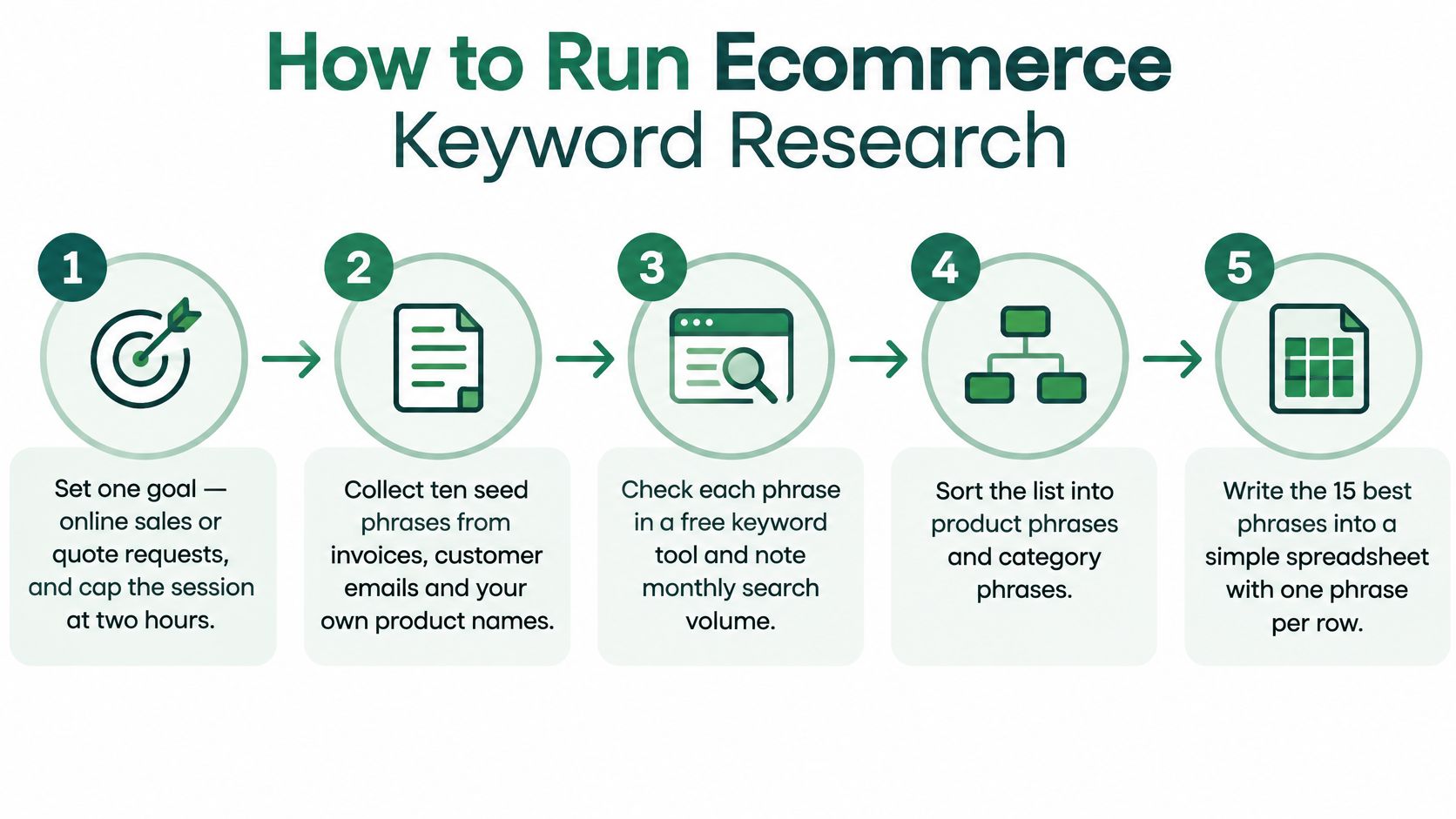
After the six steps, cap the working list at 15 phrases. That is enough to cover five products, three categories, a few comparisons, and two local delivery phrases. A longer list means the next month becomes spreadsheet admin instead of page fixes. The afternoon ends with 15 phrases, each attached to one page job, each scored for profit, and each checked on a phone. That is a working keyword plan for a store that needs enquiries and sales, not a research project that sits untouched.
Map Keywords to Pages That Convert
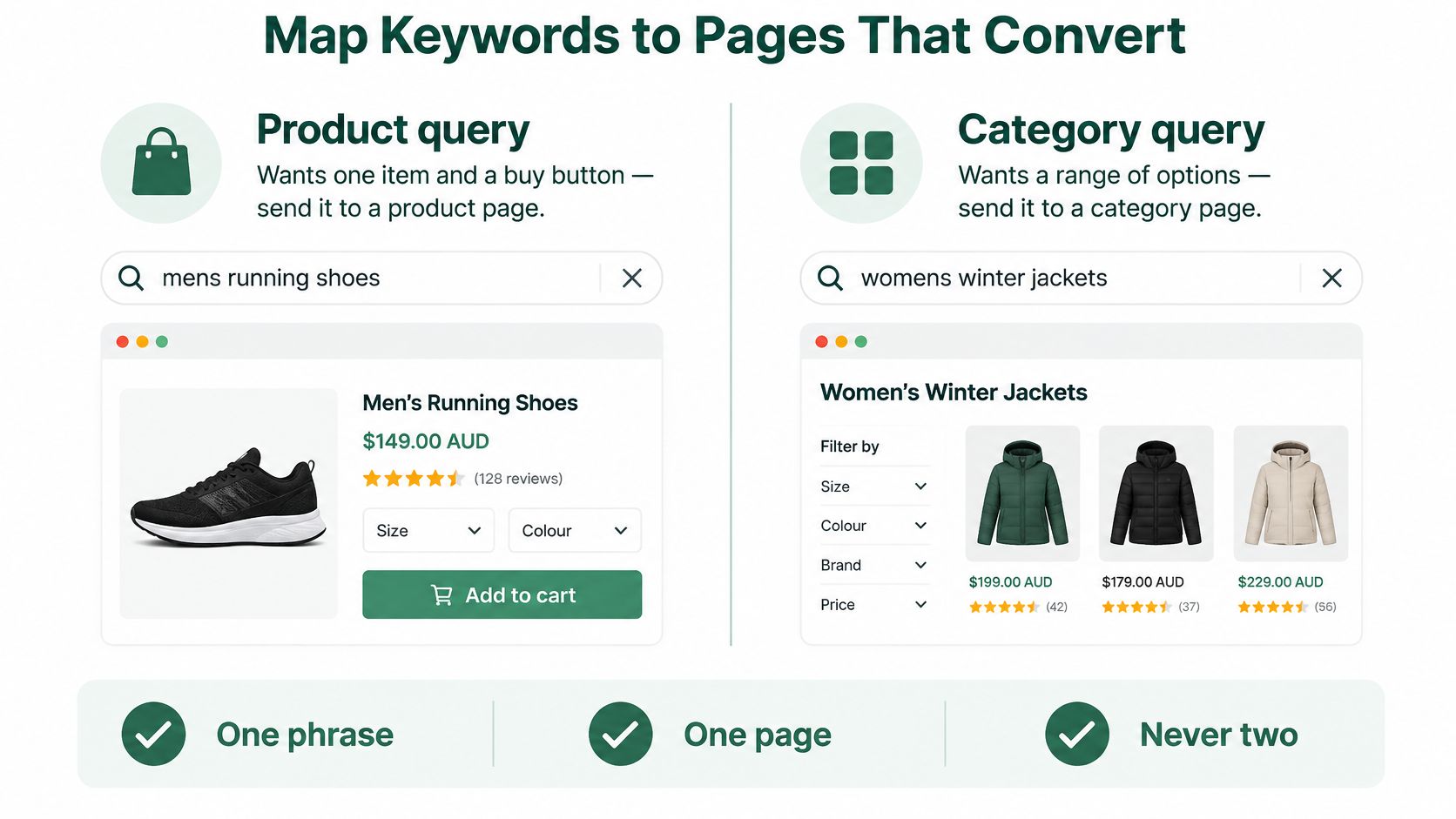
The 15-phrase list is only useful once every phrase has one home. Assigning a term to two pages splits the signals and lets neither page rank as well as one focused URL would. The rule is one phrase per page, never two.
The mapping decision comes down to what the query wants. A product query wants one item and a buy button. A category query wants a filtered range. A comparison query wants a judgement between two options. A local query wants delivery or pickup proof. Copying a national retailer's category for a tiny catalogue creates thin pages that rank for nothing and support no sale.
Australia Post's finding on touchpoints explains why this mapping matters commercially. Shoppers now use an average of 4.8 touchpoints before purchasing, including search, retailer websites, personal recommendations, reviews, social media, and influencers, according to the Australia Post 2026 ecommerce report. Search is a particularly important discovery tool for 64% of Australians aged over 50, while 59% of 18–39-year-olds regard social media as important for finding products. A generic high-volume product name may catch a small slice of one touchpoint, while a lower-volume phrase about Brisbane delivery, returns, or humid-climate durability can be the decisive confirmation before checkout. A local concern phrase can out-earn a broad term that a national retailer already owns.
Reading a results page takes two minutes and tells an owner which page Google expects. Shopping ads and product grids mean a product or category URL. Long articles and review roundups mean a guide or comparison block. A map pack with local business listings means a local landing note with real suburbs and opening hours.
Which page each ecommerce query deserves
| Query type | Example | Page to build | What usually ranks | Brisbane check |
|---|---|---|---|---|
| Product buy | buy linen shirt online Australia | Single product URL | Product pages and shopping results | Show price, stock and delivery days above the fold |
| Category browse | women's linen shirts | Category with filters | Category grids and large retailers | Offer size and price bands you actually stock |
| Comparison | linen vs cotton shirt durability | Guide or on-page comparison | Articles and review roundups | Mention Australian wash, sun and humidity |
| Price risk | skincare starter kit under $100 | Bundle or filtered collection | Deal and collection pages | Keep the offer near a $96 basket, not a fantasy price |
| Local fulfilment | same-day gift delivery Brisbane | Category or landing note | Local packs and retailer pages | Name real suburbs and cutoff times |
Take the Fortitude Valley homewares shop. “Linen throw” is a category query and belongs on a category page with filters for size, colour and price band. “Linen throw under $100” is a price-risk query and belongs on a filtered collection or bundle offer. “Linen versus cotton throw” is a comparison and belongs in a guide or on-page comparison block, not a duplicate product URL. “Same-day linen throw delivery Brisbane” is local fulfilment and belongs on a landing note that names suburbs and cutoff times.
For social and reviews, the mapping works differently. Phrases like “does linen pill” or “how long does postage take” are objection language that surfaces in customer messages and reviews. They do not need new URLs. Add them to an FAQ, a review block or the delivery section of the product page. The phrase serves the shopper without creating a thin page that competes with the main product URL.
For a store wanting to judge whether any of this improves orders, a dashboard focused on conversion rate optimisation measures add-to-cart and checkout starts, not page views. That is the metric that tells an owner whether the mapped page sells. Industry benchmarks on the conversion rate for ecommerce give a useful reference for what a reasonable result looks like, which helps separate a page problem from a market problem.
The final step of the afternoon is to label each of the 15 phrases with one destination: product, category, comparison block or local note. Once every phrase has a home, the research is finished and the writing can begin.
Write Product and Category Pages That Match
Turning the labelled list into page copy does not require a copywriter. It requires a small team or a sole trader to paste a few patterns and adapt them to real products. The goal is a page that answers the shopper's question in the first screen, because mobile is where most Australian purchases happen.
Mobile devices were used for 61% of Australians' most recent online retail transactions in the 2025 Global Digital Shopping Index: Australia Edition, and for 43% of Australians' latest retail purchases when both online and in-store purchases were included, according to the Visa acceptance guide. That makes mobile search intent a practical keyword-research consideration, not a web-design preference. A small business should test how target terms appear on a phone, especially searches such as “shop women's shoes Brisbane,” “same-day gift delivery Brisbane,” or “buy [product] online Australia.”
A useful analogy is a shop window viewed through a narrow doorway. On a phone, the customer must immediately see what is sold, how much it costs, and how to buy it without scrolling through a brand story first. If the price sits three screens down, the shopper assumes it is expensive or unavailable and leaves.
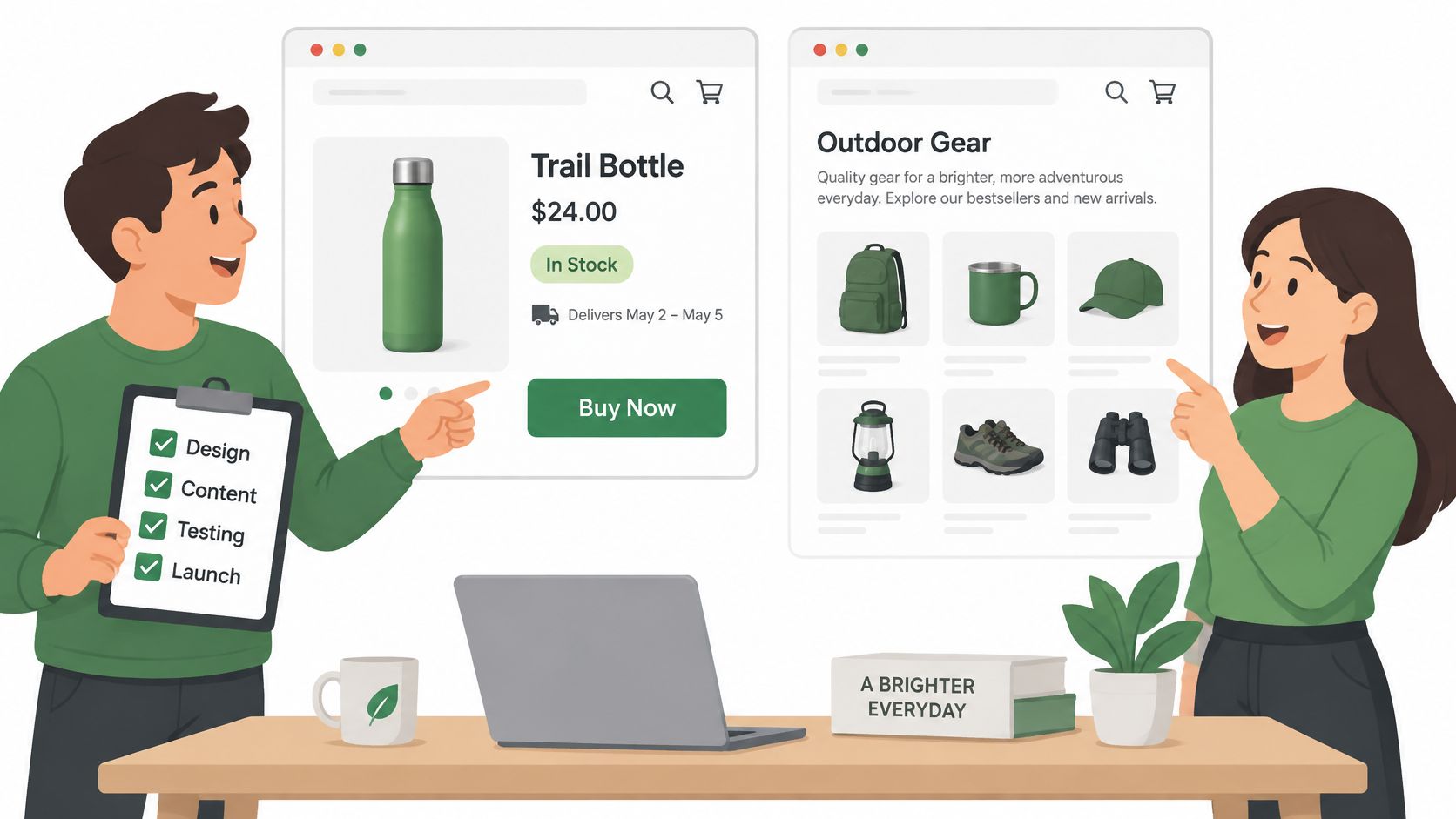
For a product page, put the item name, price, availability, delivery window and buy button in the first screen. A title pattern that works is Handmade Soy Candle, 200g, Brisbane Delivery. The opening 40 to 60 words should answer price and postage, for example: “Hand-poured soy candle in a 200g amber jar, $28 with free Brisbane delivery on orders over $60. In stock and shipped from Fortitude Valley within one business day.” That is the entire first screen, and it answers the three questions every phone shopper asks.
For a category page, write 80 to 120 words that use the main phrase once, then lead with filters for size, price band and material. A women's linen shirts category can open with one line: “Women's linen shirts in sizes 8 to 18, priced from $59 to $129, in breathable flax and washed linen.” Then the filters do the rest. The copy does not need to rank for every synonym on the page, it needs to show the shopper they are in the right place.
Add three FAQs drawn from real returns and messages, such as the postage threshold, the returns window, and care in Queensland weather. A linen shirt FAQ can answer “Does linen shrink in a Queensland summer?” with a one-sentence care note. These questions come from customer service, not from a keyword tool, which means they reflect the worry that delays an order.
Internal links should point sideways to the comparison block and down to two or three products, not to every synonym on the site. A product page for a linen shirt links to the linen versus cotton guide and to two other shirts in the same size range. That keeps the shopper moving toward a choice instead of wandering through a flat list of related searches.
For the underlying page architecture, a guide to scalable product detail page architecture covers how to structure product URLs, specs, and related items without creating near-duplicate pages. It helps when a store has 50 variants and wants one clean pattern rather than 50 slightly different layouts. A separate resource on copy for websites gives practical sentence patterns for the first screen, the FAQ and the category intro.
Businesses with little time can begin with their highest-value five pages, review mobile usability, shorten titles and descriptions where they are truncated, and ensure buttons and forms are easy to tap. Keyword data should also be segmented by device where possible, because mobile visitors may use shorter, faster, and more locally specific searches than desktop users. Fix the highest-margin five pages first, test checkout on an ordinary handset, and only then write any new article.
Quick Wins for Time-Poor Brisbane Stores
A trading week leaves little room for a monthly research project. The good news is that ecommerce keyword research can produce quick wins in a single afternoon, provided the owner measures commercial actions, not page views. Block one afternoon, not a monthly research project. The first pass through a store's own data often surfaces phrases the owner already ranks for but never promoted.
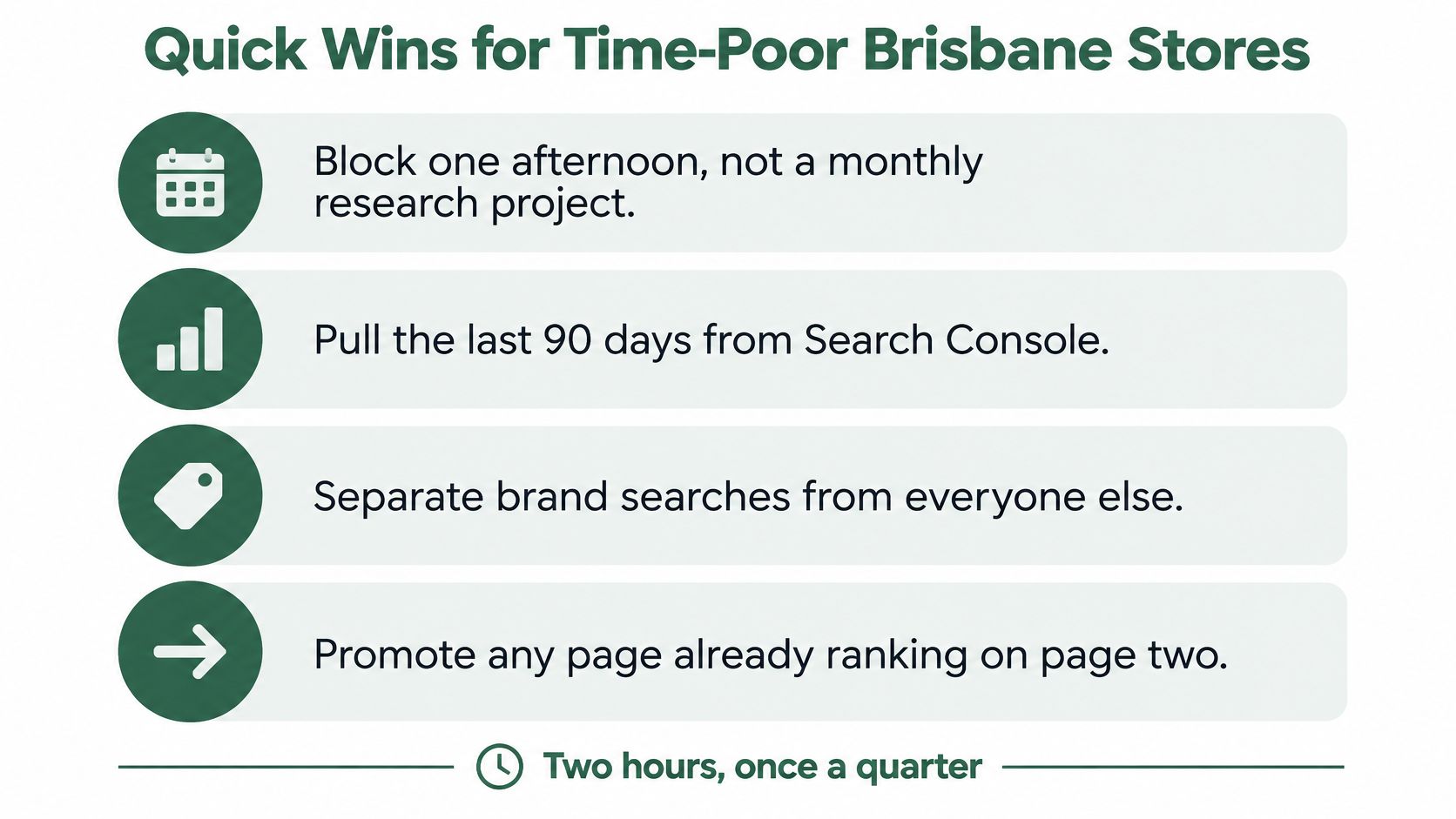
Start with the last 90 days from Google Search Console. Separate brand searches from everyone else. Brand searches show people who already know the shop and are not a new keyword opportunity. Non-brand queries that already bring clicks but sit off page one are the gold. Promote any such query by strengthening the page it already points to, with a clearer title, a price and delivery note, or an internal link from a related category.
Mine on-site search, reviews and returns reasons for wording such as “free delivery,” “under $100” and “easy returns.” Those phrases came from real buyers and belong on existing pages, not new ones. Add a line to the product page: “Free Brisbane delivery on orders over $60, easy 30-day returns.” That single sentence answers the two objections behind most abandoned carts and costs nothing to add.
Seasonal phrases deserve a second, smaller list. The timing is not random. In 2023, Black Friday generated 88% more online purchases than in 2019, while Cyber Monday rose 70%; Boxing Day and end-of-financial-year sales increased by 67% and 75%, respectively, over the same period, according to the DP World ecommerce industry report. A Brisbane store can prepend those events to three proven products, for example “EOFY linen shirt sale” or “Black Friday candle bundle Brisbane,” rather than inventing a new catalogue. Evergreen terms describe products, uses, materials, sizes and comparisons throughout the year, while seasonal terms capture shoppers preparing for specific events. Both belong in the keyword plan, but the seasonal ones can be prepped once per quarter in about 30 minutes.
Local edges to test include Southside delivery, northside pickup and Queensland postage, but only where the store delivers. A phrase that promises Southside delivery when the courier does not cover Acacia Ridge creates a customer service problem, not a ranking win. Name the suburbs and cutoff times, and the local phrase becomes a sales asset.
Measure add-to-cart, checkout starts and revenue, not page views. A page that ranks for a phrase and gets 500 visits but no one adds to cart is a signal the query and the page are mismatched. After 30 days, keep phrases that assist sales and drop duplicates that split links. The one-afternoon pass through Search Console, plus a seasonal list, plus three local phrases, is a complete quick-win plan for a time-poor store.
For a Brisbane store on Shopify, a dedicated SEO service for Shopify handles the technical side such as collection structure, page speed and structured data, which is often where the afternoon pass gets stuck. A shorter local phrase with a clear next step beats a famous generic term the shop cannot rank for. The goal is not a bigger keyword list. It is three or four phrases that make the phone ring or the checkout button get clicked this week.
Start With Five Keywords This Week
The entire playbook reduces to one decision: choose five phrases with the best profit score that also match stock the owner can ship around Brisbane. Improve or publish one page for each, using the product or category pattern already set. Diary a Google Search Console check for 30 days. If those five pages are live, stop researching and start watching add-to-cart and sales.
That is the whole strategy. Five commercial phrases on five useful pages, then judge them by orders, not by how long the keyword list became. A phrase like “linen throw under $100 Brisbane delivery” on a proper product page will teach an owner more in a month than a 300-row spreadsheet ever will. The data arrives in add-to-cart events, checkout starts and revenue, which are the numbers that pay rent.
The trap is mistaking research for progress. An owner can spend four afternoons gathering phrases, exporting CSV files and colour-coding a spreadsheet, and still have not changed a single page a shopper sees. The five-page plan breaks that loop. If the catalogue, tech fixes and copy feel like a second job, a local partner can take the ongoing work.
Boocoo has been helping small and medium Brisbane businesses grow online for over 15 years, across retail as well as hospitality, trades and professional services. The first step is a free discovery call where the team learns about the business, the goal and what marketing already exists. Monthly reports are written in plain English and cover what was done, what it cost and what it delivered, which suits an owner who does not want vanity charts.
The action either way is the same: five commercial phrases on five useful pages, then judge them by orders, not by how long the keyword list became. Start with the best seller, write one phrase for each of the five customer concerns, build or improve the page, and check back in 30 days. The phone number is 1300 093 797 and the email is hello@boocoo.au for a free discovery call about the business, the goal and what marketing already exists. Book the call, then spend the afternoon on the five phrases while the momentum is still fresh.