
An impression is a single instance of an ad or piece of content being displayed on a user's screen, whether or not they click it. Under the Australian viewability standard, a display ad needs at least 50% of its pixels visible for 1 continuous second, while video needs 2 seconds, before it counts as viewable.
A Brisbane café owner can open an advertising dashboard, see a large impression total, and reasonably wonder why the phone hasn't started ringing. The confusion usually comes from treating delivery as attention. An ad can be served below the fold, loaded in an inactive tab, or shown repeatedly to the same person without creating a meaningful visit, enquiry or sale.
That distinction sits at the heart of a useful impressions definition marketing strategy. Impressions help answer, “Was the message delivered?” They don't answer, “Did the right customer notice it and take action?” The sections below apply that difference to Brisbane small businesses, Australian channels and tightly controlled budgets.
Why Impressions Confuse Brisbane Small Business Owners
A Brisbane tradie might run display ads across local suburbs, check the report after a week and find 50,000 impressions. The number looks impressive. It can feel like 50,000 potential customers have noticed the business, yet the enquiry form remains quiet and the phone hasn't produced a matching stream of work.
The problem isn't necessarily the campaign. It's the assumption behind the number. In Australian digital advertising, an impression generally means one instance of an ad being displayed on a screen, regardless of whether the user clicks it. If one person sees the ad twice, that creates two impressions, while reach counts the unique people exposed, as outlined in the IAB Australia viewability guidance.
A served opportunity is not a customer
An impression is best understood as a served opportunity to see an ad. The platform has registered delivery, but the person might have scrolled past, looked away, changed tabs or never noticed the placement. A café owner can use the shop-window analogy: a sign may face a busy street, but passing foot traffic isn't the same as people entering for coffee.
This is why impression totals work well as an early awareness signal. They show whether a campaign is getting distribution, whether a selected audience is available and whether a message is appearing often enough to have a chance of being remembered. They don't replace clicks, calls, bookings, quote requests or purchases.
A practical campaign review should separate three questions:
- Delivery: Did the platform serve the ad?
- Quality exposure: Was the ad viewable and placed in front of a relevant audience?
- Commercial response: Did the exposure contribute to an action that matters to the business?
Practical rule: Treat impressions as the start of the conversation, not evidence that the conversation happened.
Small operators often need a simple framework before they add another platform or campaign type. An essential guide for local business owners can help organise broader marketing decisions, but the same discipline applies inside an ad report: define the business outcome first, then use impressions to diagnose visibility.
Why the metric still matters
Ignoring impressions would also be a mistake. A new Brisbane landscaper entering a suburb, a clinic promoting a new service or a retailer preparing for a seasonal offer needs to know whether the audience is seeing the brand at all. If impressions are very low, a conversion problem may be a reach, targeting or budget problem.
The useful interpretation is narrower and more honest: impressions measure exposure opportunities. The business owner then checks reach, frequency, viewability and response to understand whether those opportunities were worthwhile.
Impressions vs Reach vs Views vs Clicks
A shop window on Queen Street Mall makes the difference easy to remember. An impression is one display of the sign. If the same person walks past twice and sees it twice, the business records two impressions. Reach is the number of unique people who were exposed, while a view usually applies a platform-specific attention threshold, particularly for video. A click requires an active decision to engage.
The terms aren't interchangeable, and dashboards can make them look closer than they are. A business that optimises for the wrong one may increase a report number while moving further from enquiries.
| Metric | What It Counts | What It Tells You | When It Matters Most |
|---|---|---|---|
| Impressions | Each time an ad is displayed | How often delivery occurred | Awareness and delivery checks |
| Reach | Unique people exposed | How broadly the audience was covered | Local market coverage and audience size |
| Views | A platform-defined viewing event | Whether content received a qualifying level of attention | Video and content engagement |
| Clicks | Active selections on the ad or link | Whether someone took a direct digital action | Traffic, lead generation and response campaigns |
The same audience can create very different totals
A Brisbane plumber might serve an ad repeatedly to a narrow group of local searchers. Impressions can accumulate quickly, while reach stays comparatively limited. That repeated exposure may help recall, but it can also create fatigue if the same people keep seeing an irrelevant or unchanged message.
A social post can be delivered into a feed and count as an impression without receiving a reaction. A video can receive an impression without satisfying the platform's definition of a view. A click goes further, but it still doesn't guarantee that the visitor read the page, called the business or completed a form.
That's why a report should show the path from exposure to action rather than celebrating one large total. The explanation of CTR meaning in marketing is useful when a business needs to connect clicks with the number of impressions that generated them.
A practical reading habit
For every campaign, the owner should ask:
- How many unique people were reached? This prevents repeated delivery from looking like a larger audience.
- How often did each person see the message? Frequency helps identify useful repetition or possible fatigue.
- Did the platform record meaningful views? This matters especially when video is part of the campaign.
- Did clicks lead to commercial actions? Website visits have value, but calls, bookings and quote requests are closer to revenue.
A wider content strategy also needs more than raw delivery. Businesses exploring how a brand can develop a from zero to meme channel still need to distinguish passive exposure from active audience response. The more channels a brand uses, the more important that separation becomes.
How Impressions Are Measured Across Australian Channels
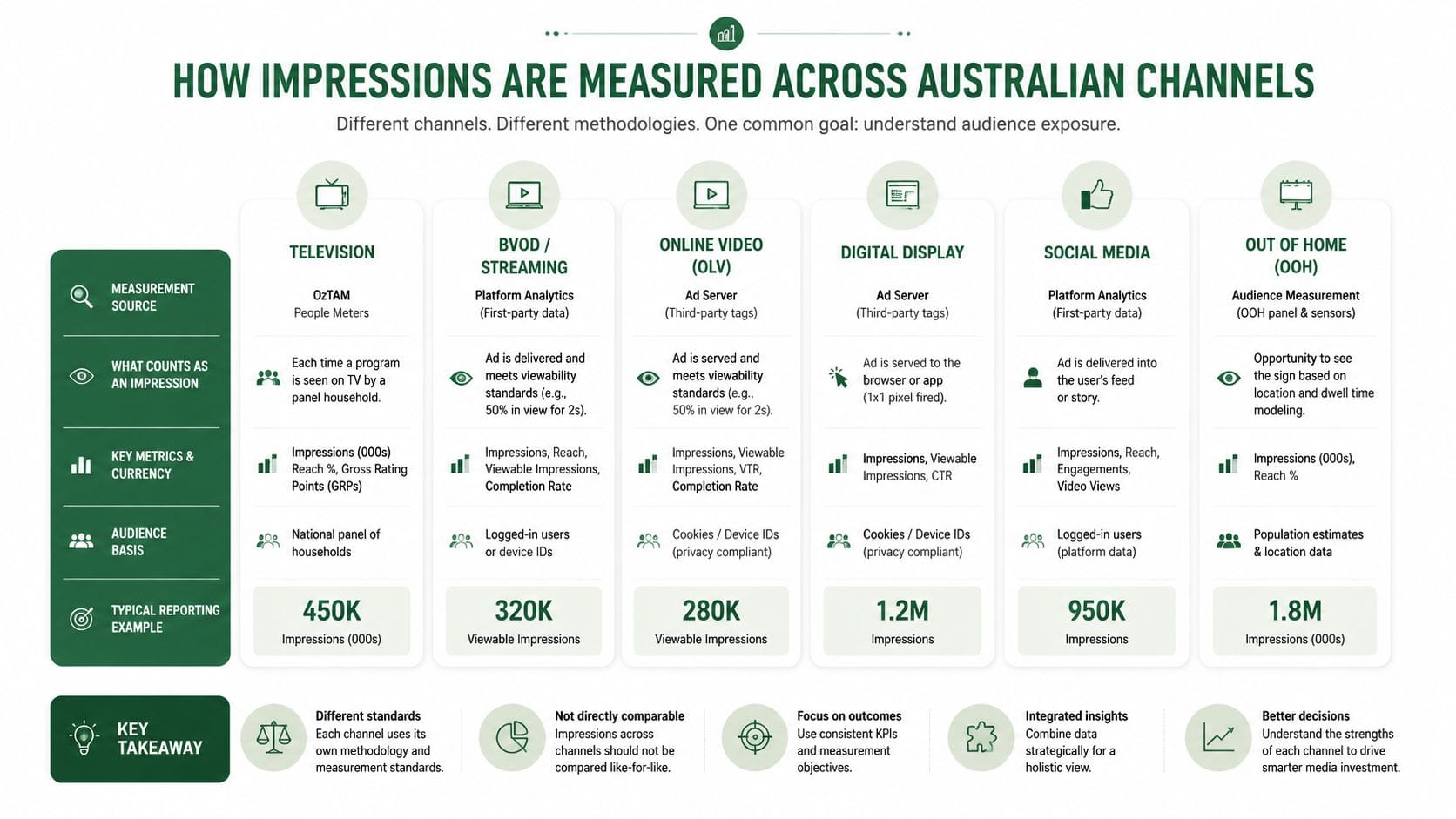
An impression doesn't carry exactly the same meaning across every Australian channel. Search, social, display, video and digital out-of-home each have their own delivery environment, audience behaviour and measurement conditions. A Brisbane business comparing reports should resist placing all impression totals into one spreadsheet column and treating them as equivalent.
Search and social delivery
In Google Search, an impression generally means the ad appeared on a results page. It reflects visibility for a search query, but it doesn't confirm that the person read the ad or considered the business. Search impressions can be particularly useful for local services because they connect visibility with an expressed need, although the business still needs to assess clicks and enquiries.
On social platforms, an impression generally records delivery into a feed or placement. The user may have been scrolling quickly, using a mobile device in a distracting environment or viewing another part of the screen. Social impressions can therefore help assess distribution and audience exposure, but creative quality and downstream interaction determine whether that exposure has practical value.
Display placements introduce further variables. An ad might load at the bottom of a page, in a position the user never reaches, or while the browser tab isn't active. Raw delivery remains useful for auditing distribution, but viewability should be checked before a business treats the total as genuine exposure.
Video and digital out-of-home
Video reporting separates delivery from deeper viewing behaviour. A served video impression doesn't automatically mean the viewer watched the message through a meaningful point, so completed plays, watch behaviour and actions deserve separate attention. A paid media plan can benefit from a practical RemotionAI paid promotion guide when video distribution is part of the mix.
Digital out-of-home, or DOOH, works differently again. Australian programmatic out-of-home campaigns are traded on impressions and use an impression multiplier to estimate how many people likely viewed each ad play based on visibility and traffic conditions, as reported by B&T's coverage of the Australian internet advertising market.
Australia's internet advertising market reached $17.2 billion in FY25, with Search at 44% and Video at 29% of spend, according to the same source. Those figures show why impressions remain commercially important, but they don't make an impression from Search, Video and DOOH directly comparable.
For a small business reviewing Facebook advertising costs, the practical question is not which channel produces the largest impression total. It's which channel provides the most useful exposure for the available budget and business objective.
The Viewability Problem That Inflates Your Reports
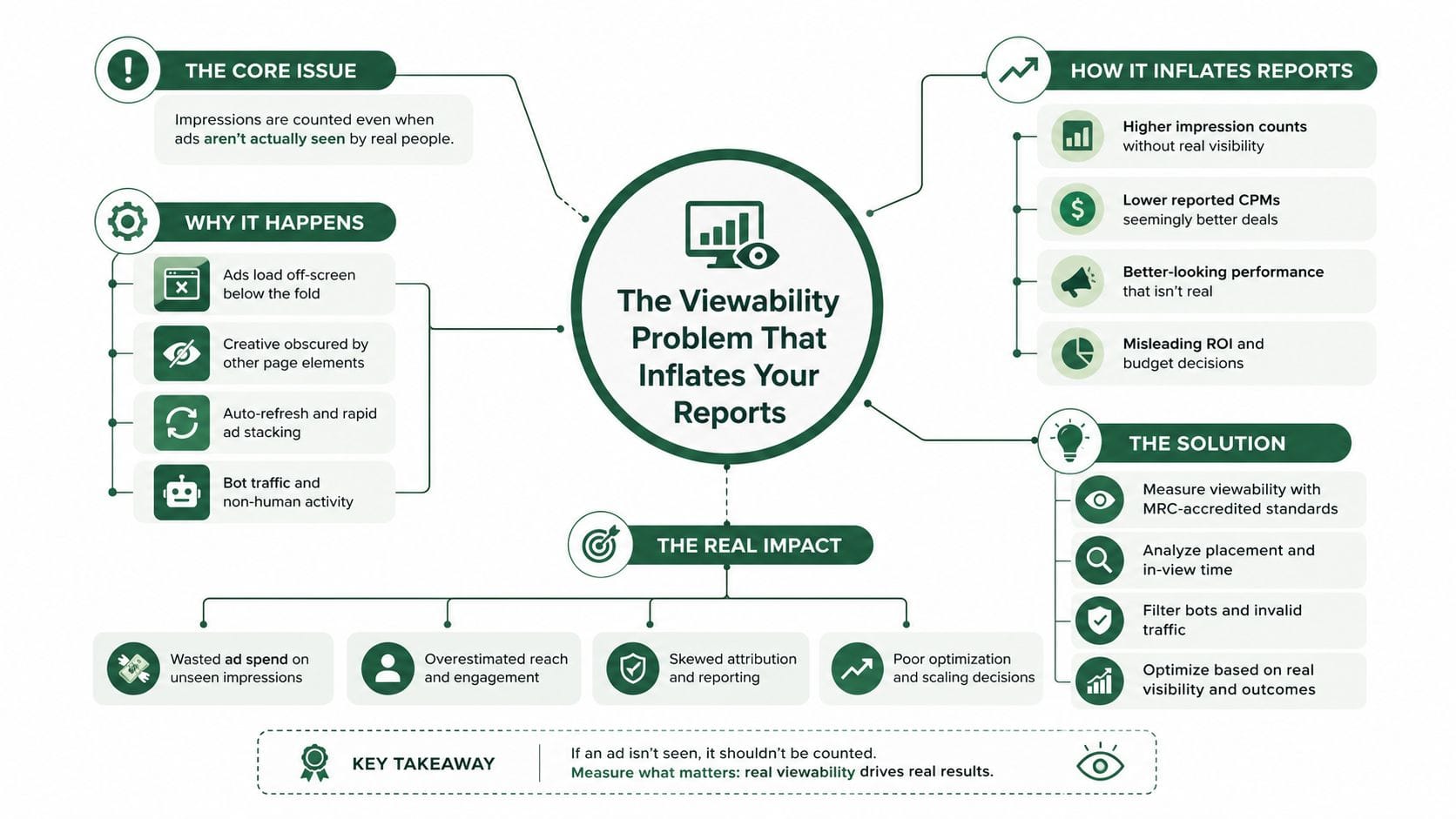
A served impression can exist without a realistic opportunity for the user to see the ad. That's the uncomfortable gap between raw impressions and viewable impressions, and it's where a large-looking report can become misleading.
The IAB Australia standard treats a display impression as viewable only when at least 50% of the pixels are on screen for 1 continuous second. For video, the requirement is 2 seconds. News Corp Australia applies the same standard, which makes viewable impressions a more useful basis for comparing frequency and CPM than delivery alone, as described in its Australian viewability terms.
Where non-viewable delivery happens
A display ad can load below the fold before the user scrolls. It can appear in an unfocused browser tab, render after the visitor has already moved on, or compete with a page layout that pushes the creative away from attention. These situations don't necessarily mean the platform has made an error. They show why served delivery and visible opportunity need separate reporting.
Invalid and fraudulent impressions create another quality concern. The Australian industry framework distinguishes invalid or fraudulent activity from legitimate impressions, so a responsible report should identify what has been filtered and what measurement standard applies.
A Brisbane business owner can ask an agency or platform for:
- Viewable impression rate: How much of the served delivery met the viewability standard?
- Device breakdown: Does mobile, desktop or tablet show materially different visibility?
- Placement detail: Are ads appearing above the fold and in active page areas?
- Invalid traffic treatment: What controls remove suspicious or non-human delivery?
- Frequency by audience: Is the campaign reaching new people or repeating exposure to the same users?
Spend should follow quality, not volume
A cheap CPM can look attractive if the business only reviews served impressions. The comparison becomes more useful when the business examines the cost of viewable exposure and then checks whether the audience was relevant.
The explanation of what CPM means helps owners interpret the buying unit, but CPM alone won't prove that an ad was noticed. Better campaign decisions come from combining cost, viewability, reach, frequency and response.
A report that counts delivery without checking visibility can make an unseen ad look like a successful ad.
Page geometry, in-focus tab controls and load-speed improvements can reduce non-viewable delivery. Placement quality also matters. Above-the-fold inventory may cost more, but paying for a smaller volume of viewable opportunities can be more efficient than buying a larger quantity of low-quality delivery.
When Impressions Matter More Than Other KPIs
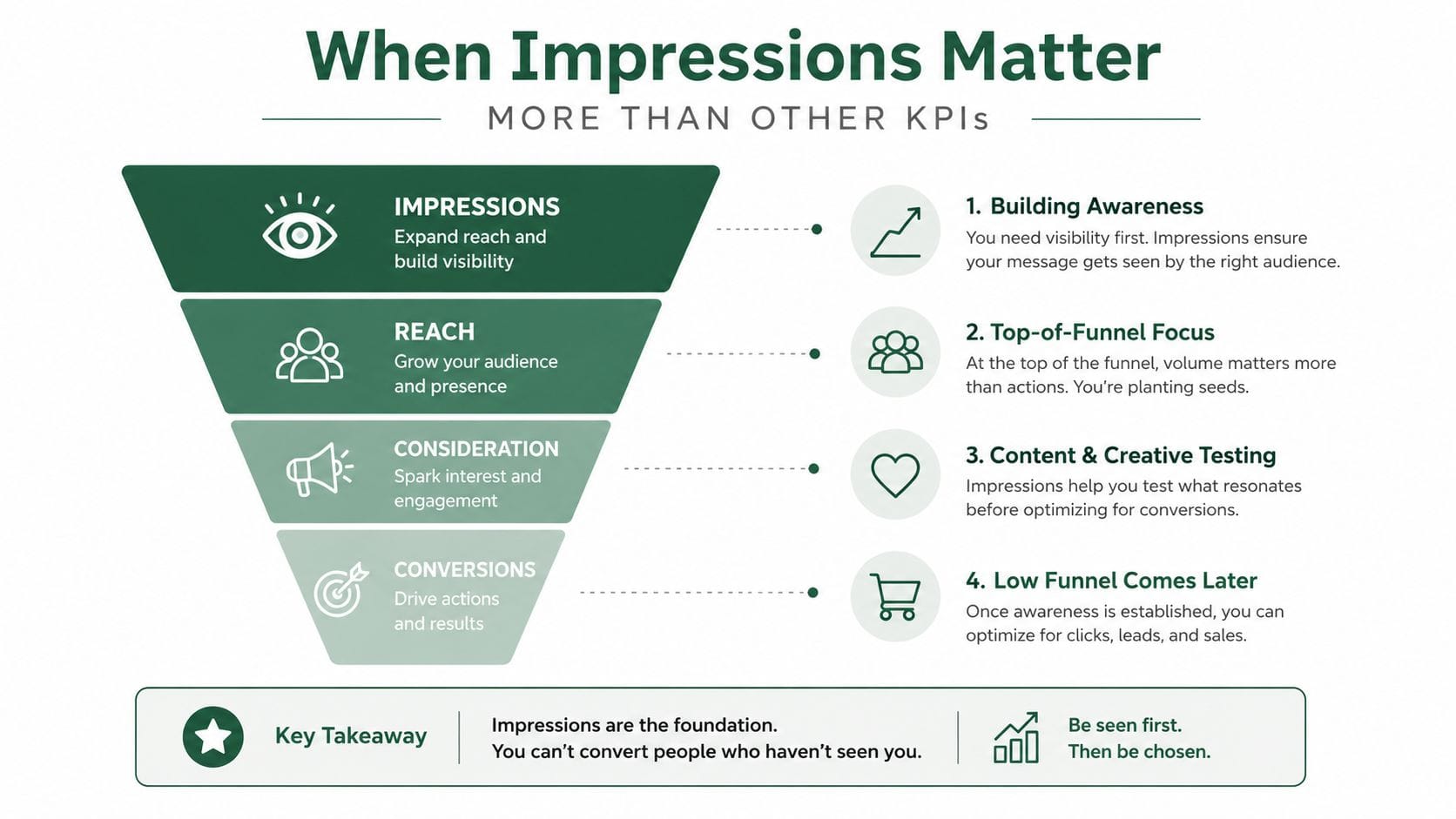
Impressions deserve priority when the business needs awareness before action. That includes launching a new service, entering a Brisbane suburb, building familiarity ahead of a seasonal period or making a previously unknown brand recognisable to a local audience.
They shouldn't be the main success measure when the campaign exists to generate immediate leads or sales. A clinic running ads for appointments should watch calls, bookings and completed enquiries. A tradie should assess qualified quote requests. An online shop should connect exposure with visits and transactions.
A simple decision framework
Use impressions as the lead metric when the immediate question is whether the market is seeing the brand. A new bookkeeping firm, for example, may need visibility among local business owners before enough people recognise the name to search for it directly.
Use clicks as the next checkpoint when the campaign needs website traffic, service-page visits or content consumption. A rising impression count with weak click activity can point to a mismatch between the audience, message, placement or offer.
Use leads and conversions as the primary measures when the business has a clear response path. A local clinic can track booking forms and calls, while a home renovation company can track completed quote requests rather than treating exposure as the final result.
Small businesses allocate an average of $1,200 per month to SEO, while Australian businesses are projected to spend $1.5 billion on SEO services in 2025, up 12% from 2024, according to Andava's Australian digital marketing statistics. That context makes measurement discipline important. Owners need to know whether visibility is supporting the commercial outcome, not merely increasing a dashboard total.
The useful sequence is:
- Confirm visibility: Are the ads or organic listings appearing for the intended audience?
- Check quality: Are those impressions viewable and relevant?
- Measure movement: Are people clicking, calling, booking or requesting a quote?
- Change one variable: Adjust targeting, creative, landing page or offer rather than increasing spend automatically.
For businesses that need to interpret conversion rate alongside exposure, the key principle is simple. Impression growth is an upstream signal. It can justify further investigation, but it can't independently justify a larger budget.
Reading Impression Data Like a Brisbane Local
Brisbane owners often operate with limited time, small teams and little tolerance for waste. Australian business conditions reinforce that reality: there were around 2.73 million actively trading businesses at June 2025, and roughly 97% were small businesses, according to Australian small-business SEO statistics. A useful report must therefore support a decision, not just provide a larger number to admire.
For local search, Google deserves close attention. Google accounts for 93% of search engine usage in Australia, according to Local Digital's Australian search and content statistics. A Brisbane electrician, accountant or landscaper can use search impressions as an early visibility signal because the platform captures a substantial share of local search activity.
A local example
A bookkeeping firm bidding on “Brisbane BAS agent” may see impressions rise as its targeting, budget or ranking improves. That doesn't prove the firm is winning clients, but it can show that the business is entering more relevant results pages and becoming available during an active comparison process.
The owner should then compare that visibility with:
- Reach: Is the campaign finding new local searchers or repeatedly appearing to a narrow audience?
- Frequency: Is repeated exposure helping recall or creating fatigue?
- Click-through behaviour: Are the ad and search phrase encouraging visits?
- Lead quality: Are calls and forms coming from suitable Brisbane businesses?
- Cost and capacity: Can the firm handle the enquiries generated?
A report that shows high impressions but few relevant calls may need sharper keyword intent, a clearer service page or a stronger local offer. Increasing the budget before fixing those issues usually buys more of the same weak outcome.
Make the report decision-ready
A time-poor owner can ask for one line per channel: served impressions, viewable impressions where available, reach, frequency, clicks and commercial actions. The figures should cover the same period and audience, otherwise comparisons become unreliable.
A specialist page on Google Ads Brisbane can help local operators think through search visibility, but the reporting principle applies to every channel. Impressions tell the owner whether the message is entering the market. Calls, bookings, sales and qualified enquiries decide whether that exposure earned its place in the budget.
Boocoo is one Brisbane-based option for businesses wanting outsourced support across SEO, web design, social media management and paid advertising. Its team can be contacted on 1300 093 797 or at hello@boocoo.au to discuss goals and next steps.
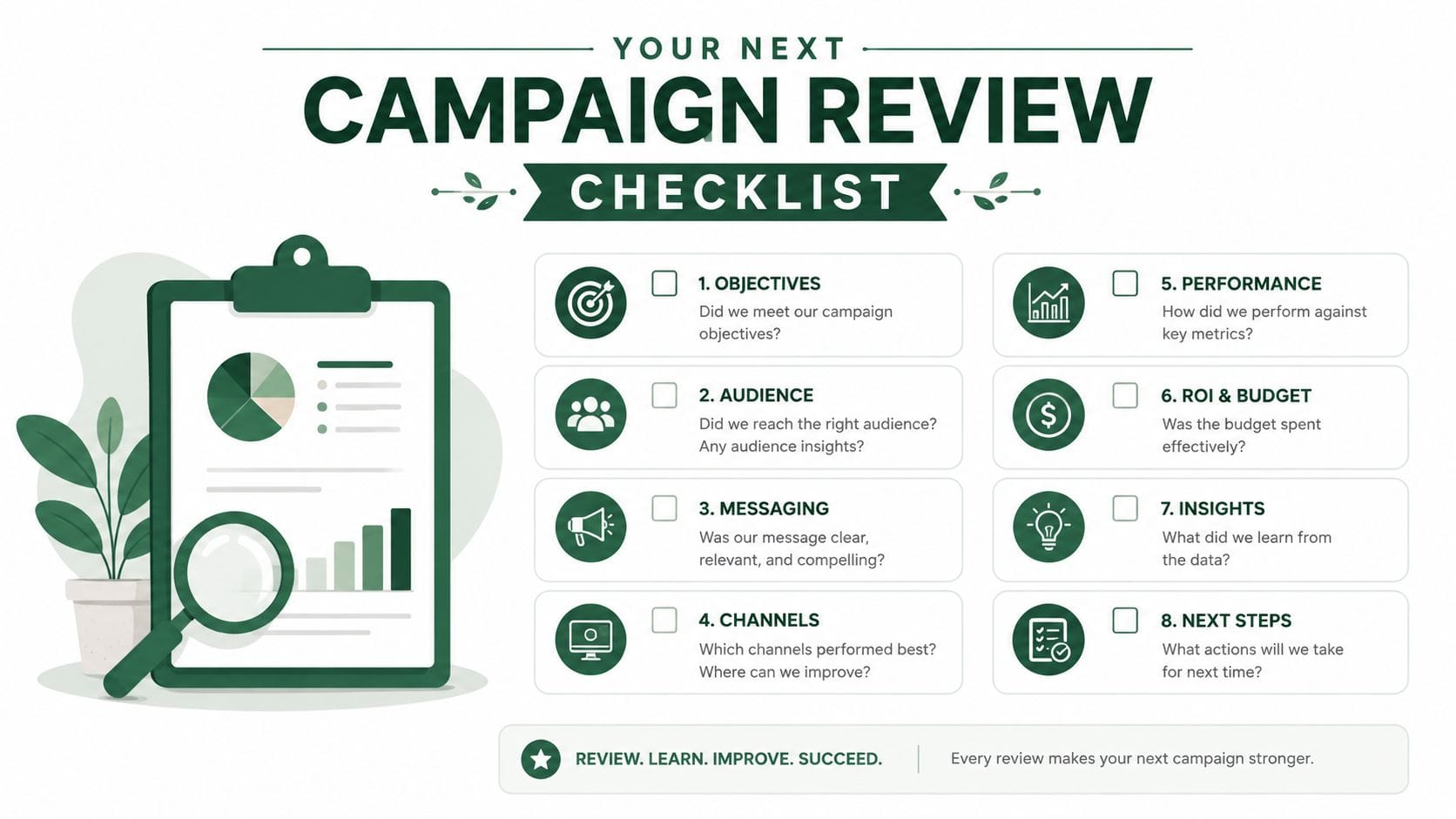
Your Next Campaign Review Checklist
Before approving another month of advertising, a Brisbane business owner should ask these questions:
- What does the platform count as an impression? Confirm the delivery definition for each channel.
- How many impressions were viewable? Request the viewable rate where the platform reports it.
- How many unique people were reached? Separate broad coverage from repeated delivery.
- What was the frequency? Check whether the same users saw the message too often.
- Does the metric match the objective? Awareness needs exposure, while lead campaigns need enquiries and conversions.
- Which placements delivered quality visibility? Shift attention away from locations that load unseen.
- Did clicks produce useful actions? Review calls, bookings, quote requests or sales, not traffic alone.
- What single change comes next? Adjust targeting, creative, landing page or placement with a clear reason.
Use impressions as an early warning system. If visibility is weak, fix distribution. If viewability is weak, fix placements. If exposure is strong but enquiries remain flat, investigate the message, offer, landing page and follow-up process.