
A lot of Brisbane business owners land in the same spot.
They've boosted a few Instagram posts, picked a suburb radius, added a small budget, and watched the likes roll in. The problem is the likes don't turn into booked jobs, quote requests, product sales, or repeat customers. The café in New Farm gets hearts. The electrician in Chermside gets views. The clinic in West End gets comments. But the actual business result feels fuzzy.
That's usually the point where hiring an Instagram advertising agency starts to sound less like a luxury and more like a practical question. Not “can someone run ads?” but “can someone make this channel accountable?”
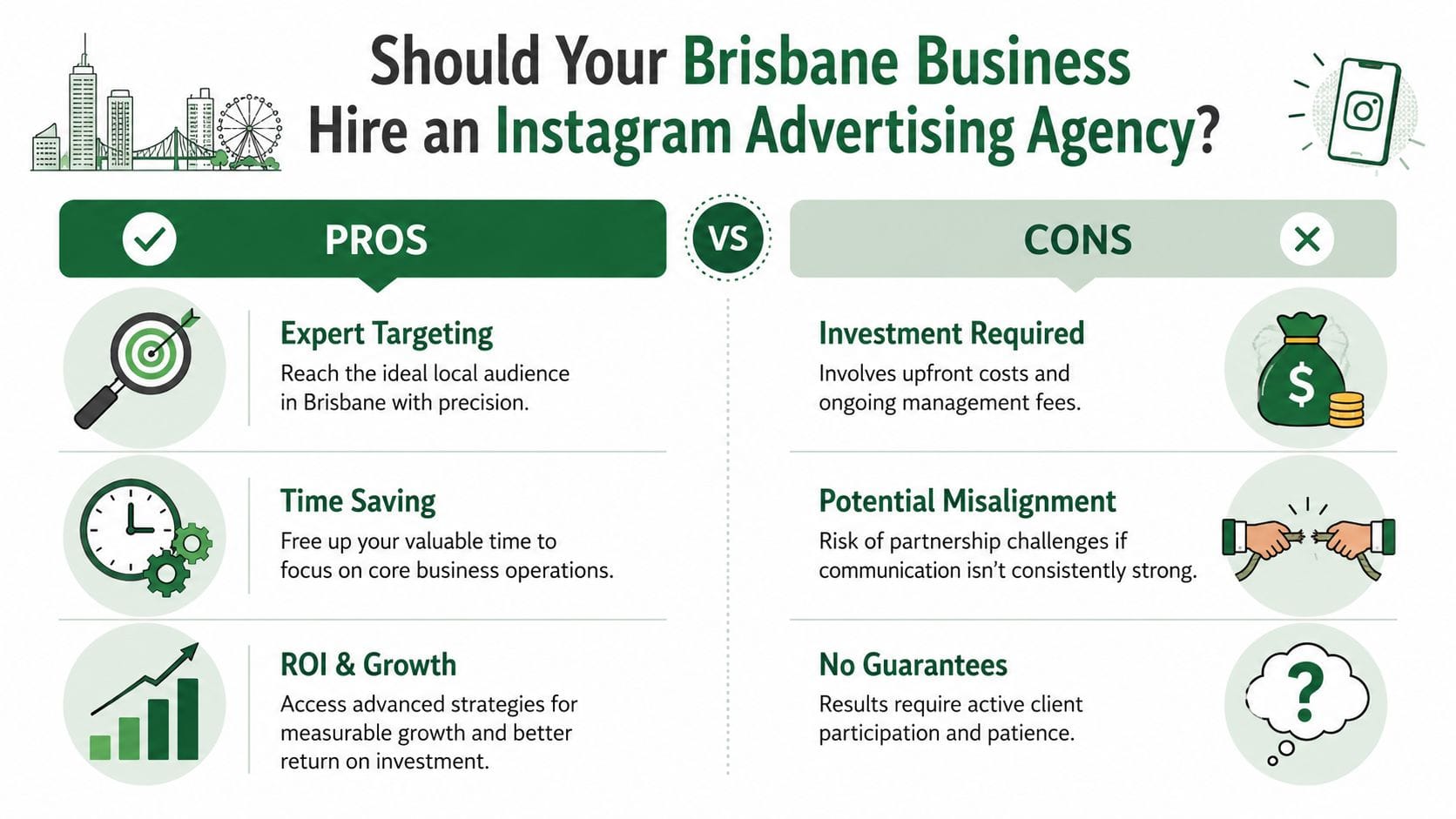
Should Your Brisbane Business Hire an Agency?
A Brisbane small business doesn't need an agency just because Instagram is big. It needs one when the platform becomes too important to run casually.
Instagram's ad reach hit 1.74 billion users in January 2025 according to Sked Social's Instagram statistics. For a local business, that doesn't mean advertising to the whole world. It means Meta's system has enough scale to help a specialist narrow in on a very specific audience, which is much harder to do well with basic boosted posts.
When DIY still makes sense
If the business is very early stage, has a tiny budget, and only needs basic local visibility, DIY can still be sensible.
That often applies to businesses like:
- A new solo tradie: someone who mainly wants to stay visible in a few nearby suburbs
- A market stall or maker brand: where simple product posts and occasional promotions are enough for now
- A business testing demand: before committing time and money to a more structured funnel
In that phase, the main win is learning what customers respond to. Short videos, before-and-after shots, customer questions, and plain-language offers can reveal a lot. Resources on video marketing strategies for SMBs can help shape simple creative without turning content creation into a second job.
When an agency becomes the cheaper option
A proper agency costs money. But for many owners, the comparison isn't “agency fee versus free.” It's “agency fee versus owner time, avoidable mistakes, and poor tracking.”
A café owner shouldn't be inside Meta Ads Manager at 10.30 pm trying to work out why a campaign spent money but didn't drive bookings. A physiotherapist shouldn't be guessing whether people who clicked an ad filled in a form. A plumbing company shouldn't be relying on likes as proof that advertising is working.
Practical rule: Hire an Instagram advertising agency when the business can no longer afford unclear results.
These are the signals that usually justify outsourcing:
- You've hit a plateau: boosted posts aren't producing steady enquiries
- You need targeting depth: not just broad local awareness, but specific audiences and retargeting
- You need reporting that means something: leads, calls, sales, booked consults
- You're losing hours every week: time that should be spent on staff, customers, and operations
A good local partner should also think beyond the ad itself. The click has to land somewhere useful, the offer has to be clear, and follow-up has to happen. For businesses comparing service options, digital advertising support in Brisbane is one example of the kind of broader paid media help that can sit around Instagram rather than treating it as a standalone channel.
The hard truth is simple. If the campaign setup, creative, tracking, and follow-up aren't organised, Instagram becomes an expensive attention machine instead of a lead channel.
Finding and Shortlisting Local Brisbane Agencies
Most small businesses start in the wrong place. They search “Instagram ads Brisbane,” skim a few homepages, and then compare agencies on confidence instead of process.
That's risky, because Instagram is no longer a side platform. It's projected to account for 11.1% of all U.S. digital ad spending in 2026, according to SQ Magazine's Instagram ads statistics roundup. That's a U.S. projection, but it still shows how commercially mature the platform has become. A real agency should have a clear playbook for strategy, creative, and conversion tracking. Not just posting and boosting.
Where to find realistic options
A short list is usually better than a long one. Three to five agencies is enough.
Start with businesses around Brisbane that already market well. Look at restaurants, clinics, ecommerce brands, and trades that show up consistently with clean offers and decent creative. Then check whether the ads and organic content feel organised or random.
Other sensible sources include:
- Local business networks: chambers, referral groups, and trade communities often surface agencies that understand Brisbane suburbs and service areas
- Industry peers: ask suppliers, neighbouring businesses, or non-competing operators who they use
- Agency content: blogs, reports, and social posts can reveal whether the team explains strategy clearly or hides behind jargon
For a broader view of how businesses compare paid social partners across Meta channels, this guide from AdStellar AI on Facebook agencies is useful because the hiring logic is similar even when the campaign focus includes Instagram.
Agency Vetting Checklist
| Category | Question to Ask | What a Good Answer Looks Like |
|---|---|---|
| Strategy | How do you decide whether to use Reels, carousels, Stories, or feed ads? | They explain format choice based on the offer, audience behaviour, and business goal |
| Tracking | How will you connect ad clicks to leads or sales? | They mention UTM parameters, conversion tracking, attribution, and downstream reporting |
| Reporting | What will the monthly report actually show? | It includes business metrics, not just reach and engagement |
| Creative | How often do you test new ads? | They talk about structured testing rather than “set and forget” |
| Communication | Who will the business talk to each month? | A clear contact person with a review rhythm and decision process |
| Fit | Have you worked with local service businesses or small ecommerce brands? | They can describe relevant experience in plain English without dodging specifics |
| Ownership | Who owns the ad account and creative assets? | The client keeps proper access and visibility |
| Process | What happens if the first creative angle doesn't work? | They describe how they diagnose, test, and adjust |
If an agency can't explain its process simply, it usually can't explain poor performance simply either.
Red flags that should slow the conversation
Some warning signs show up fast.
- Guaranteed outcomes: no serious agency can promise a fixed result before seeing the offer, website, sales process, and tracking setup
- Vague reporting: if the sample report is all impressions and engagement, expect future frustration
- One-size-fits-all packages: a suburban dentist and a mobile detailer shouldn't get the same campaign logic
- No mention of creative testing: Instagram performance depends heavily on creative quality and iteration
- Poor discovery questions: if they don't ask about margins, lead handling, booking process, or sales cycle, they're probably not thinking past the click
The strongest Brisbane partnerships usually start with honest friction. The agency asks uncomfortable questions. The business asks practical ones back. That's a good sign.
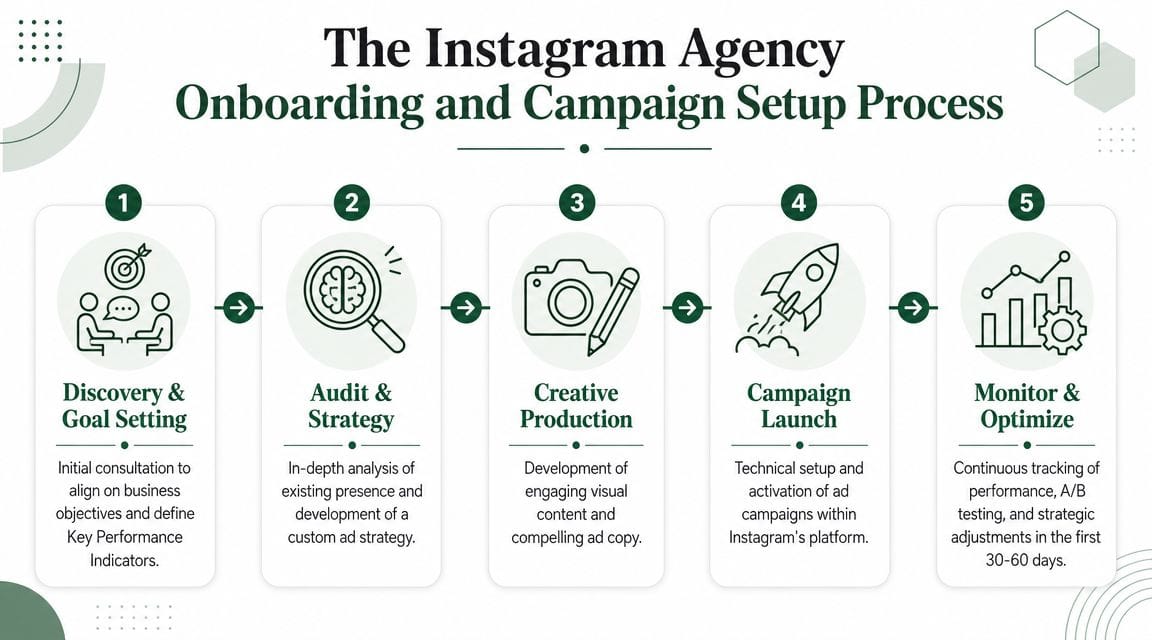
The Onboarding and Campaign Setup Process
A solid onboarding process feels organised early. There's a kickoff call, a list of required access, a discussion about goals, and a clear explanation of what gets built first.
If onboarding feels vague, the campaigns usually feel vague too.
What a clean kickoff looks like
The first conversation should cover commercial basics before creative ideas. That includes what the business sells, who buys it, how leads are handled, what counts as a conversion, and what the offer is.
For a Brisbane service business, that might mean:
- Service area definition. Northside, Southside, inner-city, or a tighter suburb cluster.
- Offer clarity. Free quote, consultation request, online purchase, phone call, or booking.
- Customer quality filter. Not every lead is equal, so the agency needs to know what a good enquiry looks like.
- Sales path review. Website form, direct message, phone, landing page, or ecommerce checkout.
A useful agency won't rush past this. It will slow down long enough to stop poor-fit traffic from eating budget.
What the agency needs from you
The practical side matters more than most owners expect. Delays usually come from missing access, scattered assets, or unclear approvals.
The business should be ready to provide:
- Meta access: ad account, Facebook page, Instagram account, and any connected assets
- Brand basics: logo files, colours, offers, service list, testimonials, and approved claims
- Creative raw material: photos, short videos, job-site footage, product shots, FAQs, or staff intros
- Website destinations: the pages where traffic should land and convert
The fastest campaigns aren't built by the flashiest agency. They're built by businesses that can supply clean assets and make decisions quickly.
Early setup should also include conversion tracking and campaign structure. If the destination page is weak, the agency should say so. Sending paid traffic to a slow, cluttered, or confusing page wastes budget.
For businesses that want a clearer sense of timing and audience behaviour across Meta platforms, guidance on the best time to post to Facebook can help frame content planning, even though paid campaigns should still be driven mainly by conversion data rather than posting habits alone.
The first month should end with something concrete. Campaigns launched, data coming in, and an agreed list of what gets tested next.
Measuring What Matters for Your Business
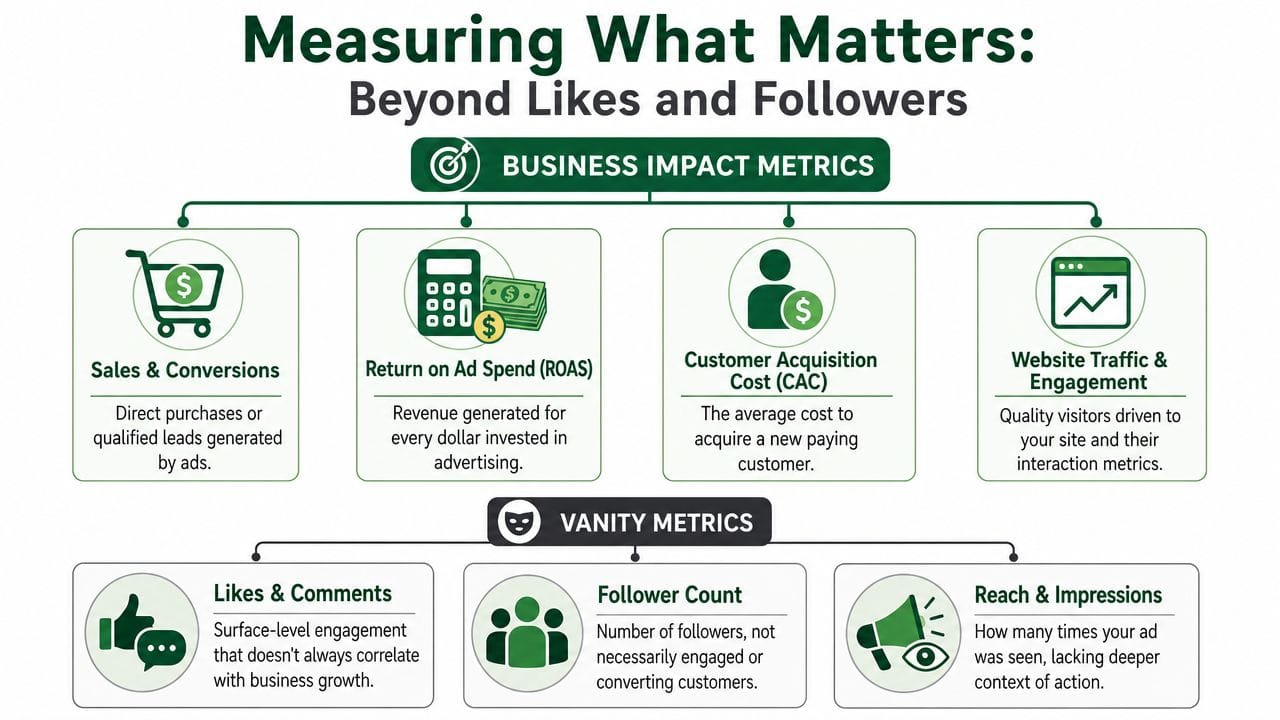
Many small businesses get trapped by visible numbers. Reach looks exciting. Likes feel reassuring. Comments create the sense that something is happening.
But a busy comment section doesn't pay wages.
For an Australia-focused Instagram advertising agency, the more useful measurement stack is clear: set goals in Meta Ads Manager, track reach, impressions, engagement rate, link clicks, CTR, CPC, and conversion rate, then connect traffic to downstream revenue using UTM parameters and attribution modelling, as outlined in Improvado's Instagram analytics dashboard guide. The same guidance recommends reviewing reach and engagement weekly, while focusing on conversion efficiency monthly.
The metrics worth checking every week and every month
The weekly check is for signals. The monthly check is for decisions.
A sensible rhythm looks like this:
Weekly checks
- Reach and impressions: enough delivery to know the ads are being seen
- Engagement rate: useful as an early sign of relevance, not a final business outcome
- Link clicks and CTR: whether people are interested enough to act
Monthly checks
- CPC: whether traffic is becoming more or less expensive
- Conversion rate: whether the landing page and offer are doing their job
- Cost per conversion: whether the campaign is commercially viable
Platform metrics can flatter weak campaigns. A local skincare clinic might get strong engagement on a polished Reel. If nobody books a consult, the ad isn't helping enough. A suburban legal practice might get fewer interactions overall but more qualified contact form submissions. That second result is usually worth more.
How to tie Instagram activity back to revenue
Many agencies fall short. They report what Instagram did, not what the business got.
A better setup links ad traffic to business outcomes:
- UTM parameters show where the traffic came from inside reporting tools
- Attribution modelling helps map which campaigns influenced enquiries or sales
- CRM notes or lead tagging show whether leads were qualified, quoted, and closed
- Call tracking or booking source fields help when the conversion happens offline
A report should answer a business question. Not just a platform question.
For Brisbane service businesses, this often matters more than ecommerce-style reporting. A plumber may care about booked jobs. A mortgage broker may care about qualified appointments. A cosmetic clinic may care about consults that attend.
That's also where work on the website becomes relevant. If Instagram ads send decent traffic but the page doesn't convert, the campaign can look worse than it really is. Businesses trying to improve that handoff often need conversion rate optimisation support in Australia alongside paid social, because better traffic and better pages usually work together.
The agency report should leave the owner with a clear view of three things: what happened, why it happened, and what gets changed next.
Getting the Most from Your Agency Partnership
Hiring an agency doesn't remove the owner from the process. It changes the owner's role.
The best results usually come from businesses that stay involved in the right places. Not by micromanaging bids or rewriting every caption, but by supplying context, fast feedback, and commercial reality.

What good clients do differently
A good client doesn't just ask, “How are the ads going?” They share what's happening in the business.
That includes:
- Lead quality feedback: whether enquiries are good, poor, urgent, price-shopping, or outside the service area
- Operational updates: booked-out periods, new offers, staffing changes, or margin issues
- Sales objections: what prospects keep asking before they buy
- Asset flow: new job photos, fresh testimonials, short videos, product updates
An agency can optimise faster when that feedback comes regularly. If a Brisbane garden design business keeps attracting small residential jobs but wants larger design projects, the campaign needs that signal quickly. If an ecommerce store sees repeat questions about shipping or sizing, the creative and landing page can answer them earlier.
Better feedback usually beats louder feedback.
Why testing matters more than posting volume
A large 2026 Instagram study covering 15 million posts from 350,000 accounts found that average post reach fell 31% year over year, and Reels reach fell 35%, according to Metricool's Instagram statistics analysis. The practical takeaway is straightforward. More content alone isn't a growth strategy.
That's why strong agency partnerships focus on high-signal testing:
- Creative angle tests: educational, offer-led, testimonial, behind-the-scenes
- Format tests: Reels, carousels, static images, Stories
- Audience tests: suburb clusters, warm audiences, broader prospecting
- Offer tests: quote request, limited promotion, free consult, product bundle
A useful monthly conversation sounds like this:
- Which ads produced efficient traffic?
- Which creative drove the strongest conversion behaviour?
- Which audience segment looked interested but didn't convert?
- What gets cut, improved, or expanded next month?
One local option businesses may consider for that kind of practical support is Boocoo, which offers digital marketing and social media services in Brisbane as part of a broader small business marketing setup. The key point isn't the provider name. It's whether the partner can test cleanly, report clearly, and adapt without drama.
Patience matters, but blind patience doesn't. A good agency should be calm, methodical, and willing to explain what it's learning as it goes.
FAQs for Brisbane Small Businesses
| Question | Answer |
|---|---|
| Do Instagram ads work for service businesses, not just ecommerce? | Yes, if the offer is clear and the campaign is built around an actual action such as a quote request, booking, or phone call. Service businesses usually need stronger local targeting and better lead tracking than product brands. |
| Is boosting posts enough? | Usually not for long. Boosting can create visibility, but it gives limited control compared with structured campaigns inside Meta Ads Manager. |
| What should a Brisbane business ask before signing with an Instagram advertising agency? | Ask how they track conversions, what reports look like, who owns the ad account, how creative testing works, and what they need from the business each month. |
| How involved does the business owner need to be? | Involved enough to approve creative, share business updates, and report on lead quality. Not involved in every technical setting. |
| What if the business doesn't have many photos or videos? | That's common. Start with simple raw assets such as phone-shot footage, customer questions, team introductions, before-and-afters, or product demos. Clear and authentic often works better than overproduced. |
| How long should an agency get before performance is judged? | Long enough to complete setup, launch campaigns, gather real data, and run at least a few meaningful tests. Judging too early usually leads to bad decisions. |
| What makes a report useful? | It should connect spend to outcomes the business actually cares about, such as leads, bookings, sales quality, or revenue signals. If it only shows platform activity, it's incomplete. |
| Should Instagram ads run by themselves? | Sometimes, but many small businesses get better results when Instagram is part of a broader system that includes landing pages, follow-up, and other channels. |
An Instagram advertising agency is worth considering when the business needs clarity more than noise. For Brisbane small businesses with tight budgets, that usually means choosing a partner who respects time, tracks real outcomes, and treats every campaign like a commercial decision instead of a content exercise.