
A Brisbane business owner often reaches the same point. The website looks dated, enquiries are patchy, and every agency proposal sounds like it was written for a tech company instead of a local service business trying to stay busy and save time.
That confusion is normal. The web industry is large, noisy, and full of jargon. It's also a real part of how Australian businesses compete now. In 2026, the Australian Web Design Services industry comprises 3,581 businesses and generated $1.5 billion in annual revenue, with 3.6% CAGR between 2021 and 2026, according to IBISWorld's Australian web design services industry snapshot. That matters because it shows one thing clearly. Businesses are still investing in websites because websites still do real work.
Your Guide to Brisbane Web Development
Most Brisbane small business owners don't need a lecture on code. They need a straight answer to three questions. What services for web development matter, what will the project cost, and how does the business avoid wasting months on the wrong setup?
That's where many projects go off track. A local electrician, accountant, clinic, or retailer doesn't need every possible platform, integration, and workshop. They need the right mix of design, build, content, support, and marketing so the site can launch without chewing up the owner's week.
A strong website is no longer a nice extra for businesses that want steady enquiries. It's part sales tool, part trust signal, and part admin support. If a customer can't quickly work out what the business does, where it operates, and how to book or enquire, that customer usually leaves.
Practical rule: A small business website should reduce workload, not create another job for the owner.
Brisbane businesses also need practical local thinking. A suburban plumbing company has different needs from an online store. A legal practice needs credibility and clean structure. A home services brand often needs suburb pages, quote forms, and fast mobile performance. The phrase services for web development sounds broad, but the useful part is choosing only the services that support the business goal.
The smartest approach is usually simple. Start with what the business needs the site to do this year, not every feature it might want later.
That means deciding things like:
- Lead generation first: For trades and professional services, the site should make it easy to call, submit a form, or request a quote.
- Easy updates: If staff need to change team profiles, service pages, or specials, a proper content management setup matters.
- Support after launch: A site that no one maintains becomes a liability fast.
- Local visibility: The build should support search visibility from day one, not treat SEO as an afterthought.
A good website doesn't need to be flashy. It needs to be clear, fast, and built around how real customers choose a business.
Decoding the Jargon What Services Are Actually on Offer
The fastest way to waste money on a website is to agree to services no one in the business understands. Most web terms aren't complicated once they're translated into plain English.
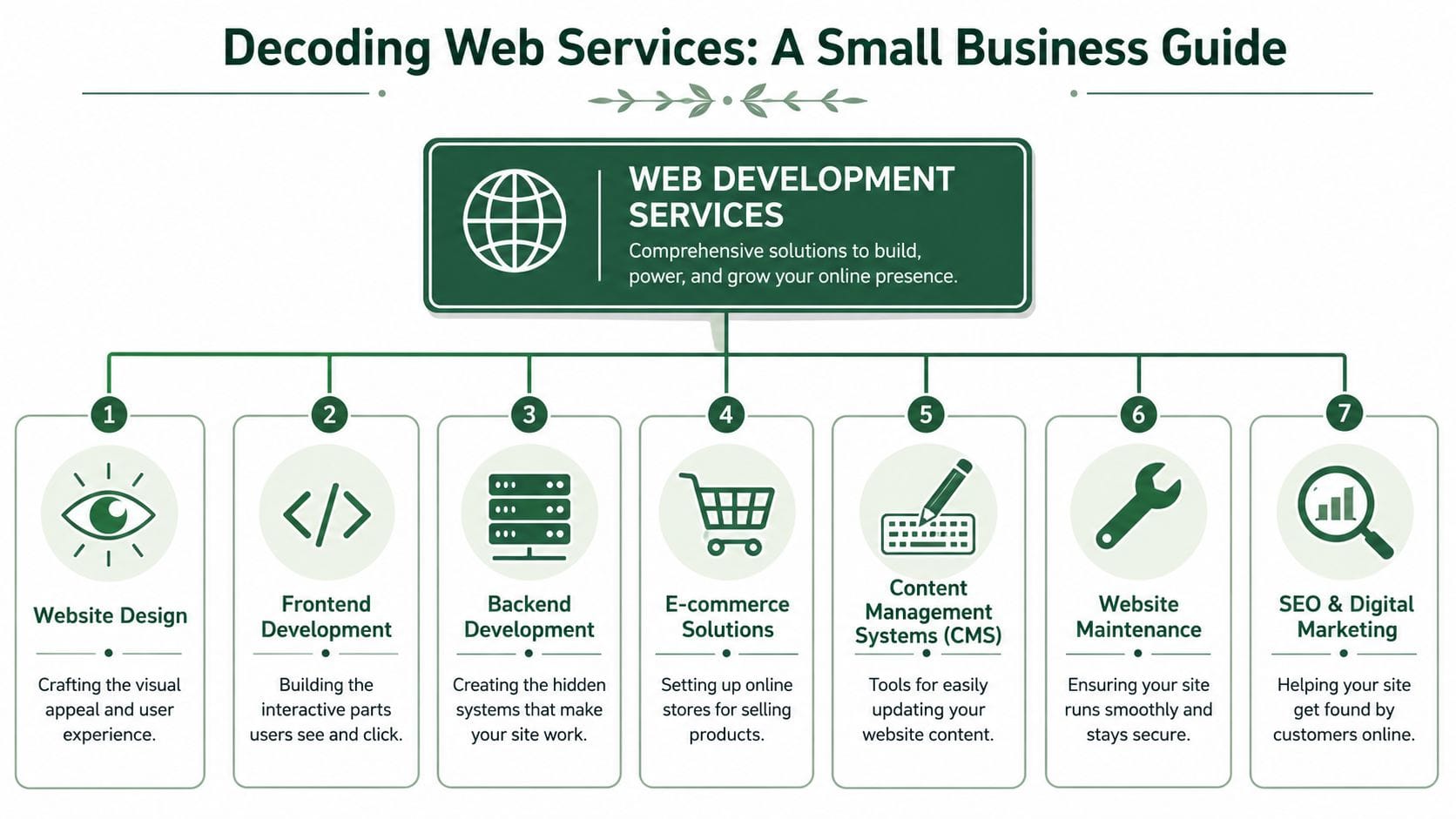
The core services most small businesses actually need
Website design is the look and feel. Think of it as the shopfront, signage, layout, and first impression. It covers colours, page layouts, buttons, typography, and how easy the site feels to use.
Front-end development is what visitors interact with on screen. It turns designs into working pages. If design is the shop fit-out plan, front-end is the actual counter, doors, lighting, and displays customers use.
Back-end development is everything behind the scenes. It handles forms, databases, logins, user permissions, bookings, dashboards, and anything else that makes the website function. This is the stockroom, wiring, and plumbing.
CMS, or content management system, is the control panel. It lets staff update text, swap photos, publish blog posts, and change service pages without asking a developer every time. For a small business, this can save a lot of admin friction.
E-commerce development covers online selling. That includes product pages, cart functions, payments, shipping settings, customer emails, and order management. According to Vrinsoft's Australia web design cost guide, basic eCommerce websites in Australia range from AUD $22,000 to $28,000, while advanced versions go up to $70,000+, while basic sites sit in the $3,000 to $8,000 range. That gap is exactly why many small businesses should avoid overbuilding too early.
A business that only needs leads should not pay for store-level complexity.
What this looks like in real life
A Brisbane physiotherapy clinic might need website design, front-end development, a CMS, and a booking integration. It probably doesn't need a custom portal.
A local clothing label selling products nationwide needs a different stack. It may need product filtering, checkout setup, delivery rules, inventory connections, and maintenance support. That's proper e-commerce work, not just “adding a shop page”.
Other common services for web development include:
- Hosting: The server space and environment where the site runs.
- Maintenance: Ongoing updates, backups, plugin checks, bug fixes, and security monitoring.
- Integrations: Connecting the website to tools like Stripe, Xero, Mailchimp, Calendly, or a CRM.
- SEO support: Structuring pages, metadata, headings, and content so the site can be found in search.
Small businesses also benefit from basic auditing before rebuilding. If a current site already exists, MetricsWatch explains website auditing in a practical way that helps owners spot issues with content, performance, and structure before they pay for a redesign.
The key is not to buy every service. The key is to buy the right ones in the right order.
Choosing Your Project Model Fixed Price Hourly or Retainer
Once the business knows what it needs, the next decision is how the work gets priced. This choice affects risk, flexibility, and how stressful the project feels.
A bad pricing model can sink an otherwise good project. A fixed fee can become rigid. Hourly billing can drift. A retainer can be brilliant for ongoing work or a waste if no one uses it properly.
Comparing Web Development Pricing Models
| Model | Best For | Pros | Cons |
|---|---|---|---|
| Fixed Price | Clear projects with defined scope, such as a brochure website | Budget certainty, easier approval, simpler comparison between proposals | Changes can trigger extra fees, less flexible if requirements shift |
| Hourly | Projects with moving requirements or staged discovery | Flexible, useful when the business is still deciding details, good for ad hoc work | Harder to predict total spend, requires tighter oversight |
| Retainer | Ongoing support, monthly improvements, maintenance, content updates | Predictable ongoing support, faster turnaround for recurring work, easier planning | Monthly commitment, value depends on consistent use |
Which model suits a Brisbane small business
A fixed-price project usually suits a straightforward service business website. If the business already knows the pages it wants, the functionality it needs, and the look it's aiming for, fixed pricing keeps things cleaner. It also makes comparing agencies easier because each quote should reflect the same scope.
An hourly model works better when the owner is still figuring things out. A startup testing a new service, for example, may need discovery, quick changes, and staged decisions. That flexibility is useful, but only if someone is watching scope and approvals closely.
A retainer makes sense after launch or when digital work doesn't stop. A business that regularly needs landing pages, content edits, plugin updates, design tweaks, and campaign support often does better on a monthly arrangement than raising one-off jobs every week. Businesses comparing this route can also review Boocoo's perspective on web maintenance in Brisbane to understand what ongoing support should realistically cover.
Decision shortcut: If the site is simple and the brief is clear, fixed price is usually the least stressful option.
A useful test is this. If the owner can describe the website in a few clear paragraphs, fixed price is usually possible. If every second sentence starts with “maybe”, hourly is safer.
The wrong model often creates tension, not the wrong developer. That's why this decision deserves more attention than most business owners give it.
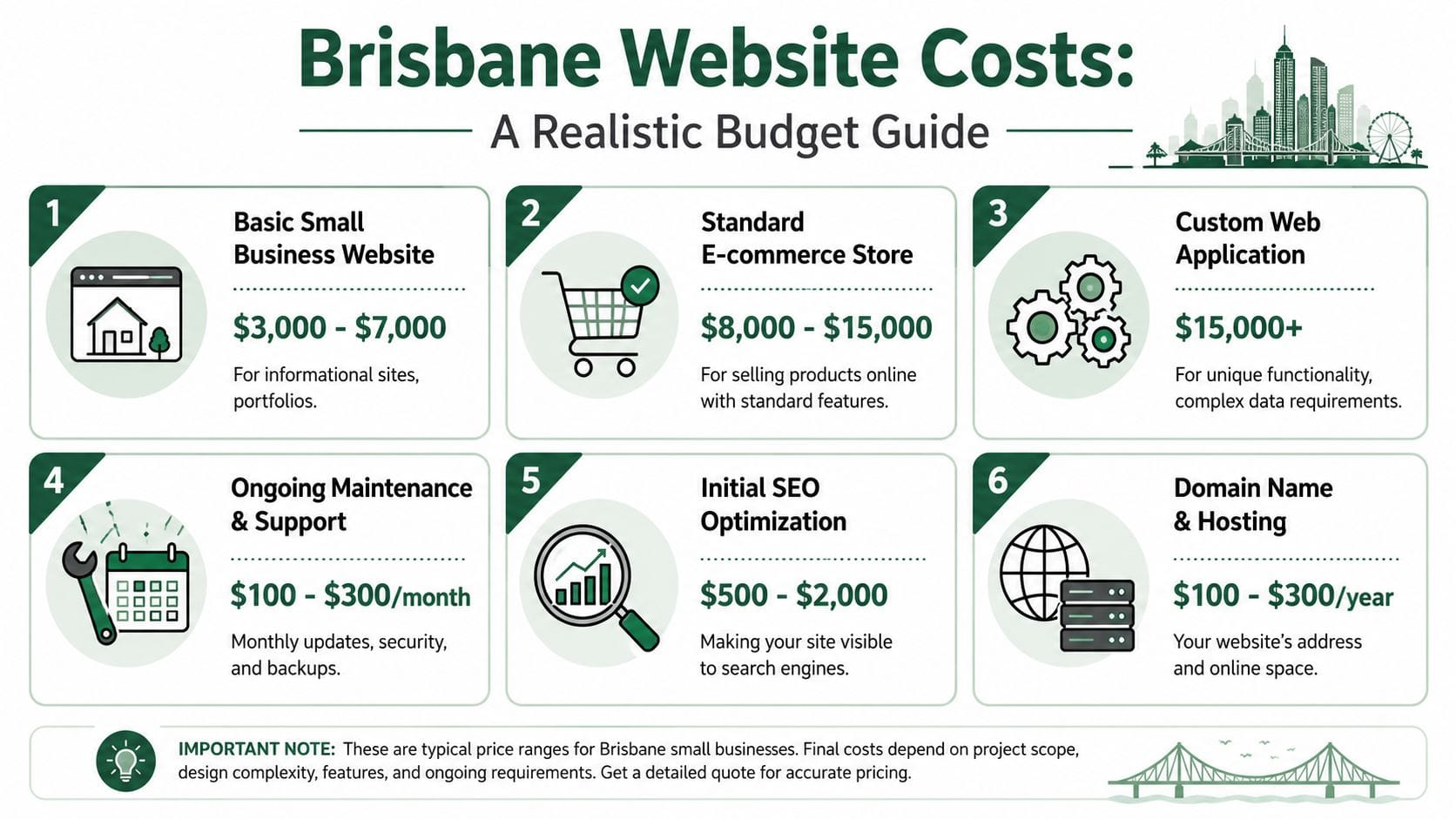
What a Website Really Costs in Brisbane A Realistic Budget Guide
Plenty of small businesses get stuck at this point. Quotes arrive with big gaps between them, and it's hard to tell whether one agency is overpriced or another has left out half the work.
The first thing to understand is that Brisbane businesses can build very cheaply. According to B2B Websites' Brisbane website cost guide, a basic DIY website can cost $150 to $400 per year, but that usually means 1 to 3 static pages and limited flexibility. The same source notes that professional support at $50 to $150 per month can be more cost-effective for updates and growth.
The cheap option and its limits
DIY platforms can work for a micro-business that needs a quick online presence. A sole trader with one service, one suburb, and minimal content might get by for a while.
The problem starts when the business grows. New service pages are needed. Better enquiry forms are needed. Search visibility starts to matter. Reviews, galleries, FAQs, and landing pages become important. The cheap site that saved money at the start can turn into a slow, awkward patchwork.
That's why small businesses should separate launch cost from ownership cost. A cheaper build can cost more later if every update is painful, the structure is weak, or the platform doesn't scale.
Where to spend and where to stay lean
The infographic above gives a simple budget view, but owners still need to know what drives the quote.
Costs usually rise when the project includes:
- Custom functionality: Booking workflows, portals, calculators, member areas, or advanced forms.
- Large content scope: More service pages, suburb pages, team profiles, case studies, and FAQs mean more design and build work.
- Complex integrations: Payment systems, CRMs, job management software, stock systems, and email platforms add setup time.
- Bespoke design: A custom visual system takes more work than adapting a proven template.
- Ongoing support needs: If the business doesn't have time internally, support becomes part of the budget decision.
Costs usually stay leaner when the business keeps the first version focused. A local accountant might launch with Home, About, Services, FAQs, Contact, and a blog. That's often enough to get moving.
A retail startup should also think beyond the build. Product photography, copy, email flows, reviews, and customer trust elements can matter just as much as the platform itself. For businesses planning review collection or location-based customer feedback, Plans for client reviews can help clarify one part of that ongoing stack without overcomplicating the website build.
For many owners, the best move is to launch a focused site now and improve in stages. Businesses wanting a leaner starting point can also compare ideas in Boocoo's guide to affordable web design for small business.
One opinion stands out here. If a Brisbane small business needs more than a digital brochure but doesn't yet have a proven need for heavy custom features, it should resist the big-platform pitch. Overbuilt websites waste money. Underplanned websites waste time. A practical middle ground usually wins.
How to Choose the Right Web Development Partner
Plenty of agencies can build pages. Fewer can guide a small business clearly, stick to scope, communicate properly, and build something that still makes sense six months later.
That's why the cheapest quote often isn't the best deal. If the wrong partner creates delays, confusion, or a poor handover, the business pays for it twice.
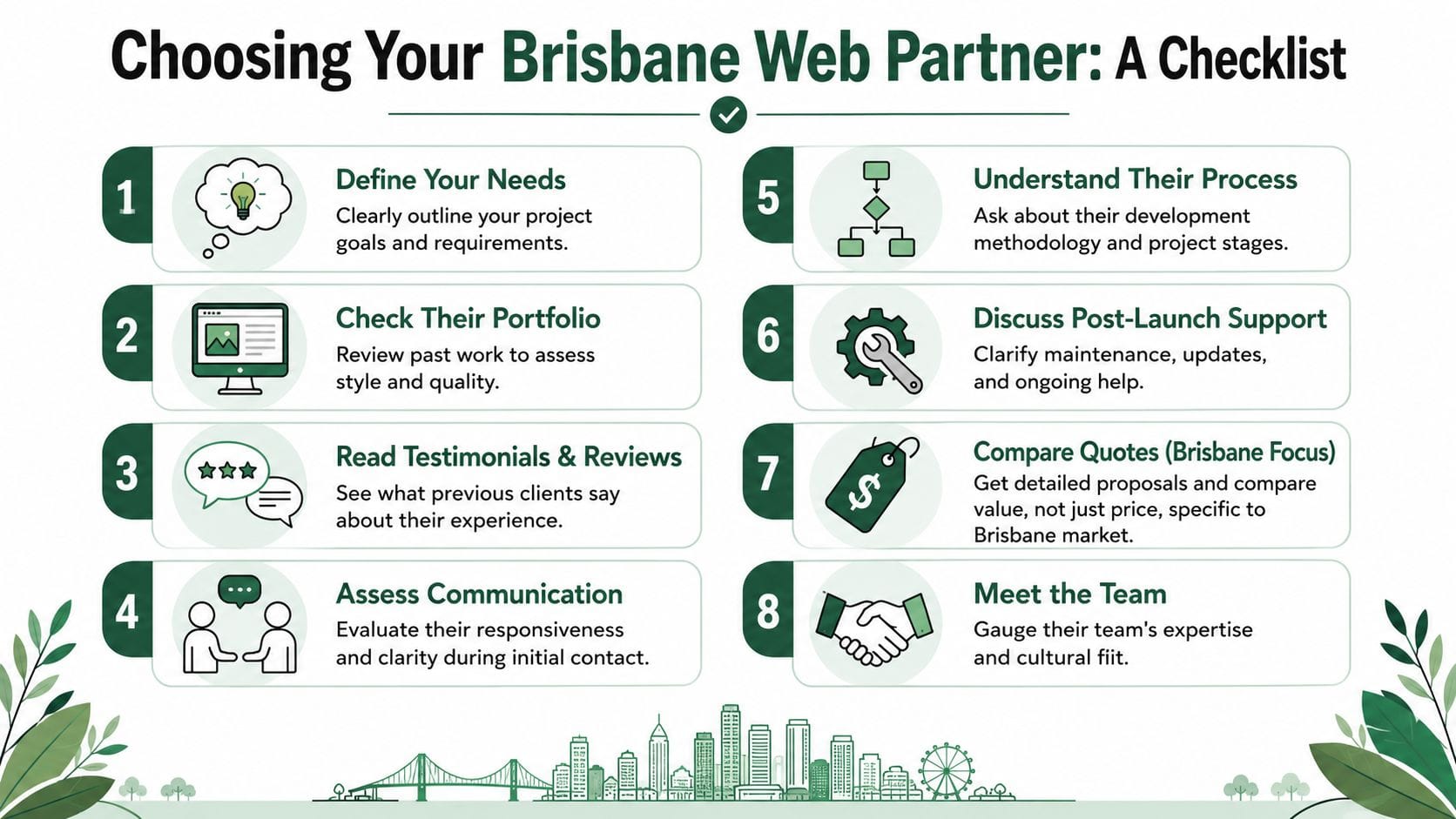
The questions that save money
Use the checklist in the infographic, then ask direct questions.
- Who will do the work? Some agencies sell locally and outsource most of the build elsewhere.
- What happens after launch? If support is vague, problems later become expensive.
- How are changes handled? Scope changes aren't bad, but the process should be clear.
- What does the quote exclude? Content entry, copywriting, revisions, hosting, and training often get left out.
- Can the business update the site easily? A good CMS setup should reduce dependency, not increase it.
The pricing benchmark matters here too. According to Classic Informatics' overview of Australian web development costs, custom web development projects range from $15,000 for a small web application to over $200,000 for enterprise-grade platforms, and local Australian studios charge between $120 and $200 per hour. That doesn't mean every small business should pay those rates. It does mean a serious custom project won't be delivered properly for pocket money.
What a good partner looks like
A strong partner usually shows a few habits early.
They ask sharp questions about the business before talking about features.
They also explain technical choices in plain language. If an agency hides behind jargon, that's usually a warning sign. A small business owner doesn't need to become a developer, but the owner should understand what's being bought and why.
Look for these signs:
- Clear process: Discovery, design, build, testing, launch, and support are all explained.
- Commercial thinking: The conversation stays tied to leads, sales, bookings, or admin efficiency.
- Brisbane understanding: Local service areas, suburbs, competition, and customer behaviour are considered.
- Clean proposals: The quote is structured, readable, and specific.
Portfolio matters, but fit matters more. A technically strong team that communicates poorly can still make the project painful. The right web partner should feel organised, honest, and practical.
Preparing Your Brief to Get an Accurate Quote
A messy brief creates messy pricing. That's one of the main reasons website quotes vary so much.
A small business doesn't need a long formal document. It needs a clear one. If the owner can explain the business, the goal, the audience, and the required features in a page or two, agencies can price with far less guesswork.
What to include in a simple brief
The brief should cover the essentials:
Business overview
What the business does, who it serves, and where it operates.Main goal
More quote requests, more calls, more bookings, more product sales, or less admin time.Target audience
Homeowners, commercial clients, local families, professionals, wholesale buyers, or another clear group.Required pages
For example, Home, About, Services, Service Area, FAQs, Contact, Blog, Shop, or Booking page.Needed functionality
Forms, online payments, booking tools, customer login, quote calculators, file uploads, or integrations.Content status
Whether the business already has copy and images, or needs help. Businesses sorting out website words before requesting quotes often benefit from reviewing Boocoo's guide on content writing on website projects.Examples of websites liked
Include what stands out. Fast layout, clean design, easy navigation, strong trust signals, or clear calls to action.Budget range and timing
A realistic range helps agencies suggest the right approach instead of pricing imaginary scope.
A practical one-page format
There's another reason the brief matters. In Australia, the minimum cost to develop a high-quality, secure web application with back-end management and professional design exceeds A$30,000, according to a discussion cited in the Brisbane web designers and developers thread on Reddit. When the work is substantial, vague instructions become expensive very quickly.
Useful advice: If the brief is unclear, the quote is only a guess dressed up as a proposal.
A practical brief can be written as simple notes under these headings:
- About the business
- What the new website must achieve
- Must-have features
- Nice-to-have features
- Pages required
- Websites liked
- Preferred budget
- Ideal launch timing
That format saves time on both sides. It also makes quotes easier to compare because every agency is responding to the same request.
Your Next Steps to a Better Website in Brisbane
A better website usually starts with fewer assumptions. The business needs to know which services for web development it needs, how it wants to pay for the work, what budget makes sense in Brisbane, and which partner communicates clearly enough to be trusted.
That sounds like a lot, but it becomes manageable once the decisions are broken down. A focused site, a realistic brief, and a sensible scope will save more money than chasing the cheapest quote.
This is the point where many Brisbane business owners need a straightforward second opinion, not another pushy sales pitch.
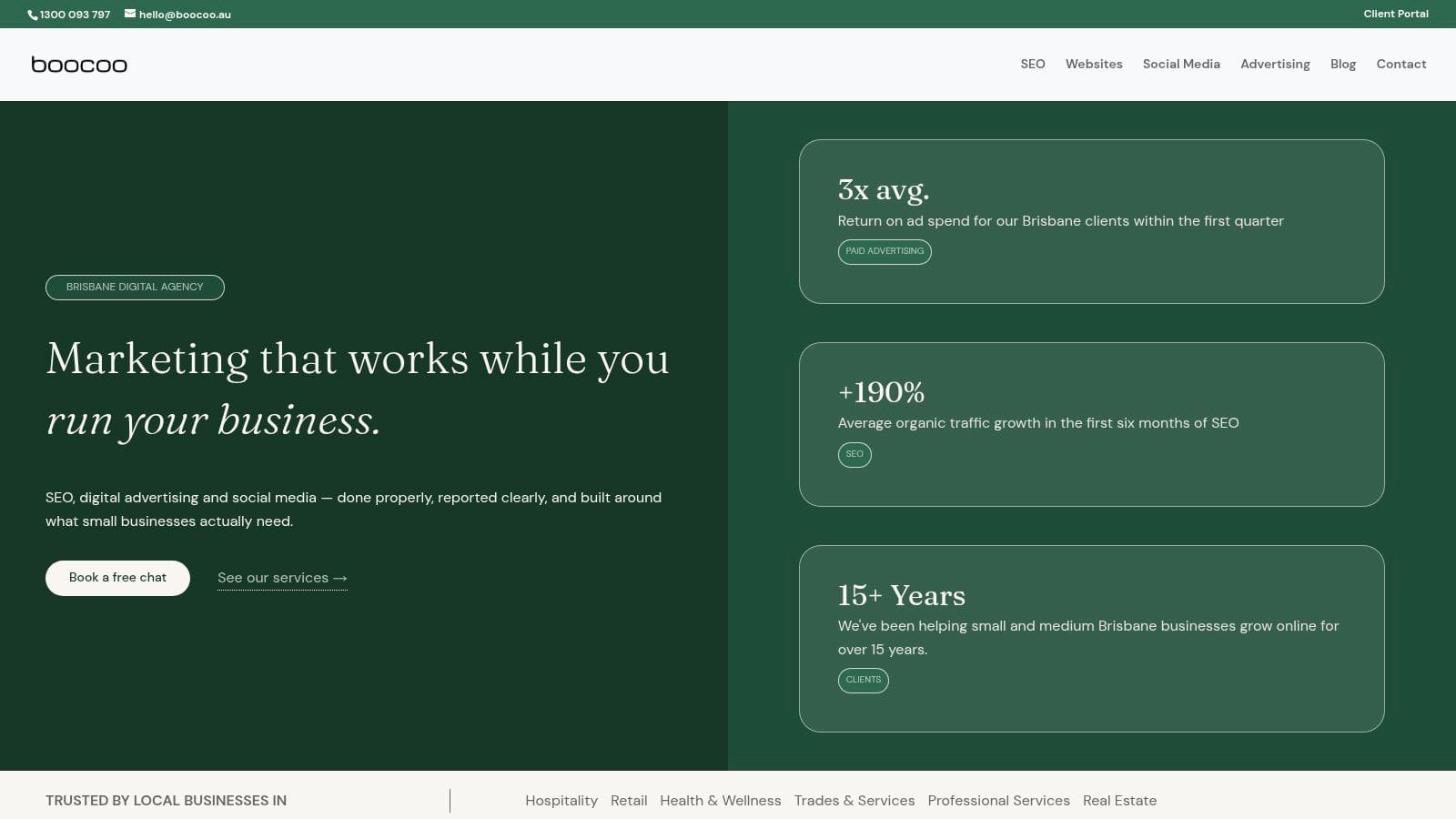
If a local business wants practical help with a new website, a rebuild, or ongoing digital support, Boocoo is a Brisbane-based option worth speaking with. The team keeps things low-pressure and clear. Business owners can call 1300 093 797 or email hello@boocoo.au for a no-obligation chat about goals, budget, and next steps.