

A Brisbane owner usually notices the problem in a small, annoying moment. The phone stays quiet after a busy week, a quote form gets one enquiry, and the website that looked polished in the design handover hasn't earned back the money spent on it. That's the issue with small business web design Brisbane, most sites are built to exist, not to convert.
The smarter way to judge a website is simple, does it turn local search demand into calls and quote requests, or does it just sit there looking tidy? Brisbane businesses are competing in a market where very small Australian businesses still lag on website adoption, while the web design industry itself is already a mature national service sector, not some niche side hustle. A site has to do a job, and if it doesn't, the budget is leaking.
Why Most Brisbane Small Business Websites Miss the Point
The exact moment many owners realise the website is costing them work is brutally ordinary. A tradesperson checks the inbox on a Monday, sees no new quote requests, then hears from a customer who found someone else after a quick search on their phone. The site was live, the logo looked fine, but it wasn't built around the one thing that matters, getting a qualified lead.
A website is not a brochure
Brisbane operators often get sold on visuals first. The homepage gets a hero image, the menu gets six pages, and the build gets called “done” even though the site doesn't make the next step obvious. That's backwards.
A useful small business web design Brisbane project starts with a one-page brief, not colours and fonts. The brief should name the target customer, the action the visitor should take, the suburbs served, and what counts as a qualified enquiry. For a plumber, that might mean phone calls during business hours and form submissions after hours. For a cafe, it might mean bookings, directions, and opening hours that are impossible to miss.
Practical rule: if a page can't tell a visitor what to do in the first few seconds, it's decoration, not marketing.
The local demand is there. Brisbane-focused material reports monthly searches for trades terms such as 22,000 for “electrician,” 19,000 for “plumber,” 23,000 for “carpenter,” and 24,000 for “concreter” in Brisbane, and even a small conversion rate would create meaningful enquiry volume. That's why the site has to act like a filter, not a poster. It should route the right person to the right service page and make contact effortless.
Score the site before design starts
A simple scoring system keeps the project honest. Give the site one point each for clear customer focus, suburb specificity, one primary call to action, easy mobile contact, and a form that asks only for the essentials. If the brief scores poorly, the design won't save it.
That's the benchmark a Brisbane tradie can use before approving a build. A site that scores high is set up to answer a simple question, “Can this page get the job booked?” A site that scores low is just a digital flyer with a contact page attached.
The industry backdrop matters too. The Australian Web Design Services market is estimated at $1.5 billion in 2026, with 3,581 businesses in the sector and a 1.4% CAGR from 2021 to 2026, according to the source linked in the verified data. That means Brisbane owners aren't short of suppliers. They're short of suppliers who think about lead conversion first.
Picking the Right CMS, Builder and Hosting Stack
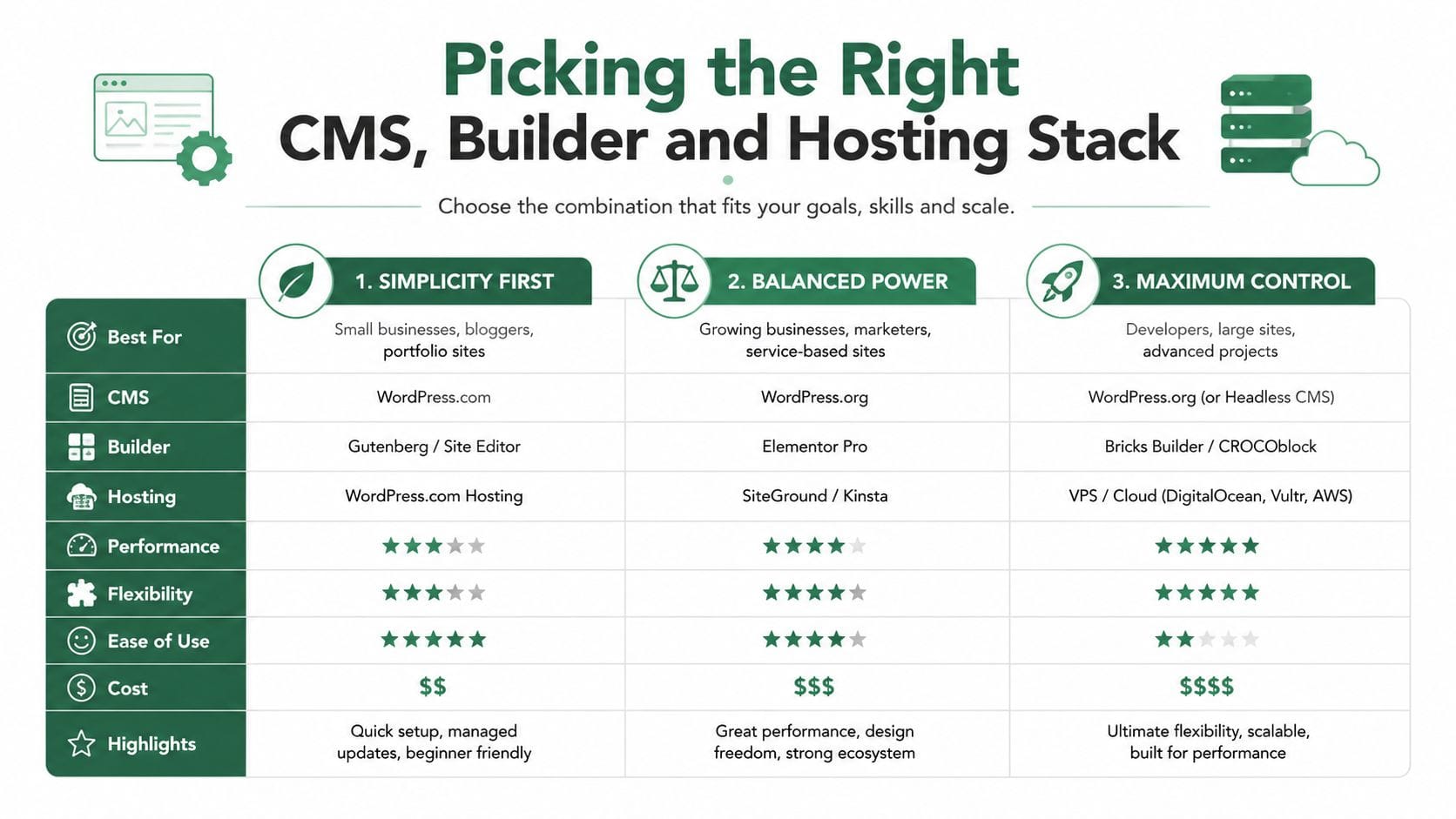
The right stack depends on what the business needs, not what sounds modern in a sales call. A plumber, a local consultant, and a product seller do not need the same setup, and forcing them into one template is how budgets get blown.
If the owner wants control, portability, and room to grow, WordPress with managed Australian hosting is the safest default. If the owner wants to edit a simple site without touching plugins, Squarespace or Wix can work for a lighter brochure build. If the business sells products, Shopify makes sense. Custom builds only belong in rare cases where the workflow is unusual enough to justify the cost and the handover risk.
| Option | Best for | Typical annual cost (AUD) | Handover risk |
|---|---|---|---|
| WordPress with managed hosting | Service businesses that want ownership and flexibility | Ongoing costs vary by host and maintenance scope | Low if the build is clean |
| Squarespace or Wix | Owners who want simple editing and minimal setup | Subscription-based and predictable | Medium if design and content get locked into the platform |
| Shopify | Product sellers and small eCommerce stores | Platform fees plus app and support costs | Medium, especially if apps stack up |
The best way to choose is to ask three questions. Can the owner update pages without calling a developer? Can another marketer take over later without rebuilding the whole thing? And can the business afford the ongoing support it will need after launch? If any answer is “no”, the stack is wrong.
For WordPress hosting specifics, the WP Triage hosting guide is a useful plain-English reference for understanding what hosting changes. It helps separate marketing jargon from practical hosting needs.
Cheap overseas hosting is a false economy. It often saves money upfront and costs more later through slow pages, bad support, and emergency rebuilds.
The internal planning side matters too. A solid build should be matched with the right service scope, and Boocoo's website development services page is a straightforward example of how a Brisbane provider can package that work without overcomplicating it.
Designing for Mobile, Speed and Local Trust
A Brisbane service website should work like a good front counter, not a pretty brochure nobody can use. If someone opens it on a phone, they should see the phone number, the suburb, and the next action straight away. Anything else gets in the way of enquiries.
Build the page around contact, not aesthetics
The homepage layout should start with a tap-to-call button, a short service summary, and a suburb or service-area mention in the heading. After that, it should move into trust signals, such as licence details where relevant, reviews, and a short explanation of how the work gets handled. Forms should stay short. If a business only needs name, phone, suburb, and job type to quote, that is all the form should ask for.
A tradie homepage that once sprawled across five sections can be tightened into a much better lead page. The top of the page handles the call now, the middle proves trust, and the bottom supports action with FAQs or service details. That structure makes the site easier to use and easier to maintain.
Speed is not a nice-to-have. Australian web guidance says 53% of mobile users abandon a site that takes longer than 3 seconds to load, 60% don't return if a site isn't responsive, 47% expect a website to load in 2 seconds or less, and around 40% leave a site that isn't optimised for mobile from the verified data. Those numbers point to the same outcome, slow and awkward sites lose enquiries.
The best design choices hold up over time. Keep the layout clean, limit animation, use clear headings, and avoid trendy elements that look clever for six months and clumsy after that. A site should still make sense when the owner revisits it next year.
For owners using Elementor, find performance tips for your Elementor site before adding more visual effects. Performance usually slips because someone keeps adding blocks, not because the business needs a fancier layout.
Good local sites act like a receptionist who never misses a call. They greet, direct, and filter. That is why design is a conversion system, not a colour palette. If the page is not producing enough calls and quote requests, conversion rate optimisation for Australian websites is the right place to tighten the offer and the flow.
Local SEO Essentials for Brisbane Small Business Sites
Brisbane local search works best when the website and the Google Business Profile point in the same direction. The site needs to show exactly what the business does, where it does it, and how a customer can act fast. If those signals are vague, the search traffic goes elsewhere.
Service pages that match search intent
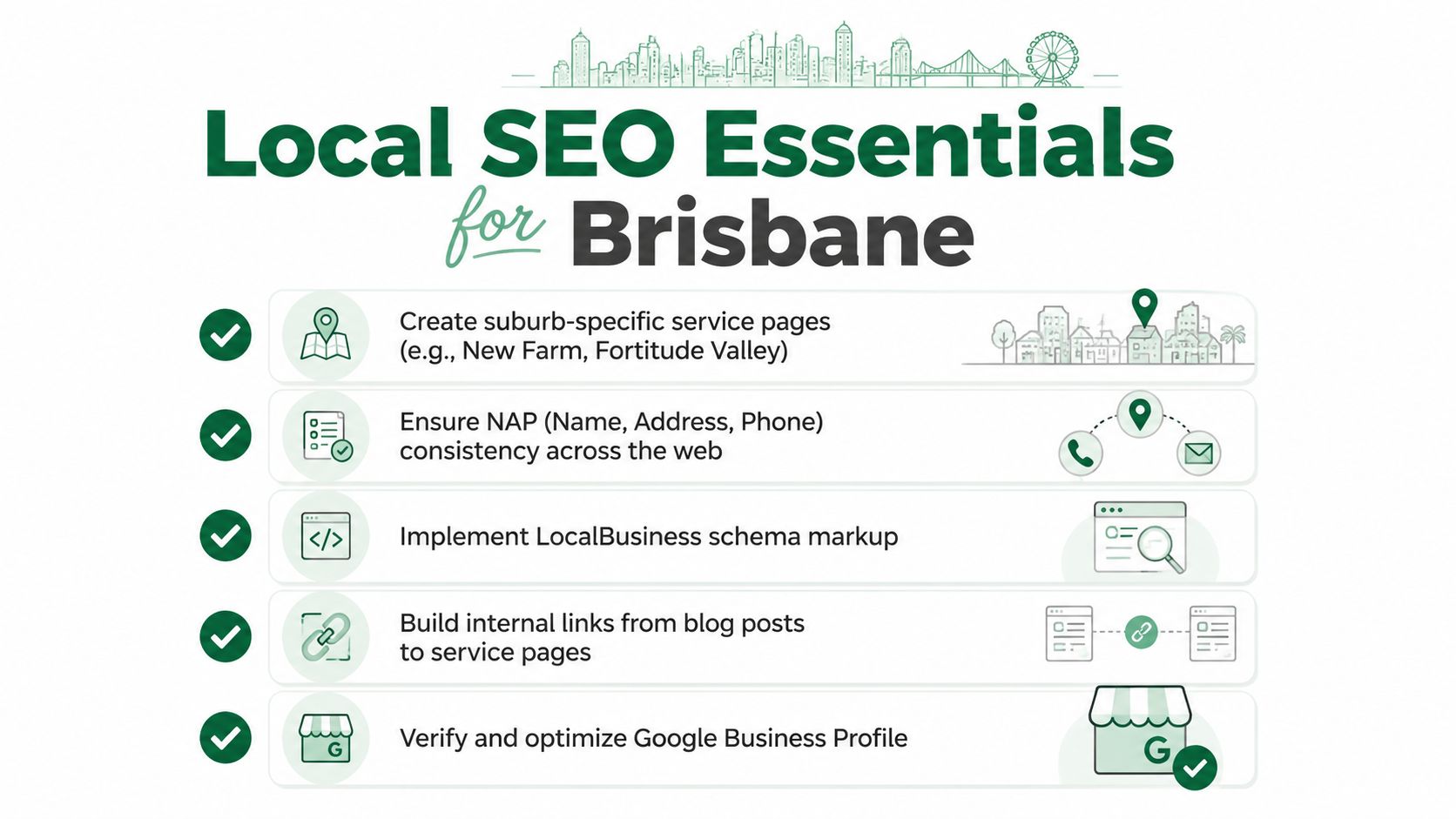
A plumber or concreter serving Brisbane shouldn't rely on one generic services page. Each core service deserves its own page, and suburb-specific pages should only exist where the business can serve that area. The page should mention the service, the locality, the process, and the next step, without stuffing every suburb into one paragraph.
NAP consistency matters here too, name, address, and phone need to stay the same across the website and the web. Internal links should connect blog posts and service pages so Google can understand which pages matter most. Schema markup helps reinforce that clarity, and Google Business Profile should match the site line for line.
The content cadence for a one-person team should stay realistic. One good service page beats four rushed blog posts. A useful post can answer a common customer question, then link back to the main service page.
The mistake most local businesses make is chasing broad visibility before they've clarified the service area. That wastes time and muddies the lead quality.
A practical structure for a Brisbane concreter might look like this, a main concreting page, then separate pages for driveways, slabs, and decorative finishes, plus specific suburb pages only where there's real demand and genuine service coverage. A plumber can do the same with blocked drains, hot water, and emergency repairs. That keeps the site understandable for customers and search engines alike.
For Google Business Profile setup, how to add your business to Google gives a clear local reference point. For owners who want the broader local search picture, the point is simple, the website and the listing should work as one system, not as separate marketing tasks.
Realistic Brisbane Web Design Costs and Timelines
A cheap site that does not convert is expensive. A larger build that fixes real lead problems can be good value. Brisbane owners should judge scope first, then compare the price.
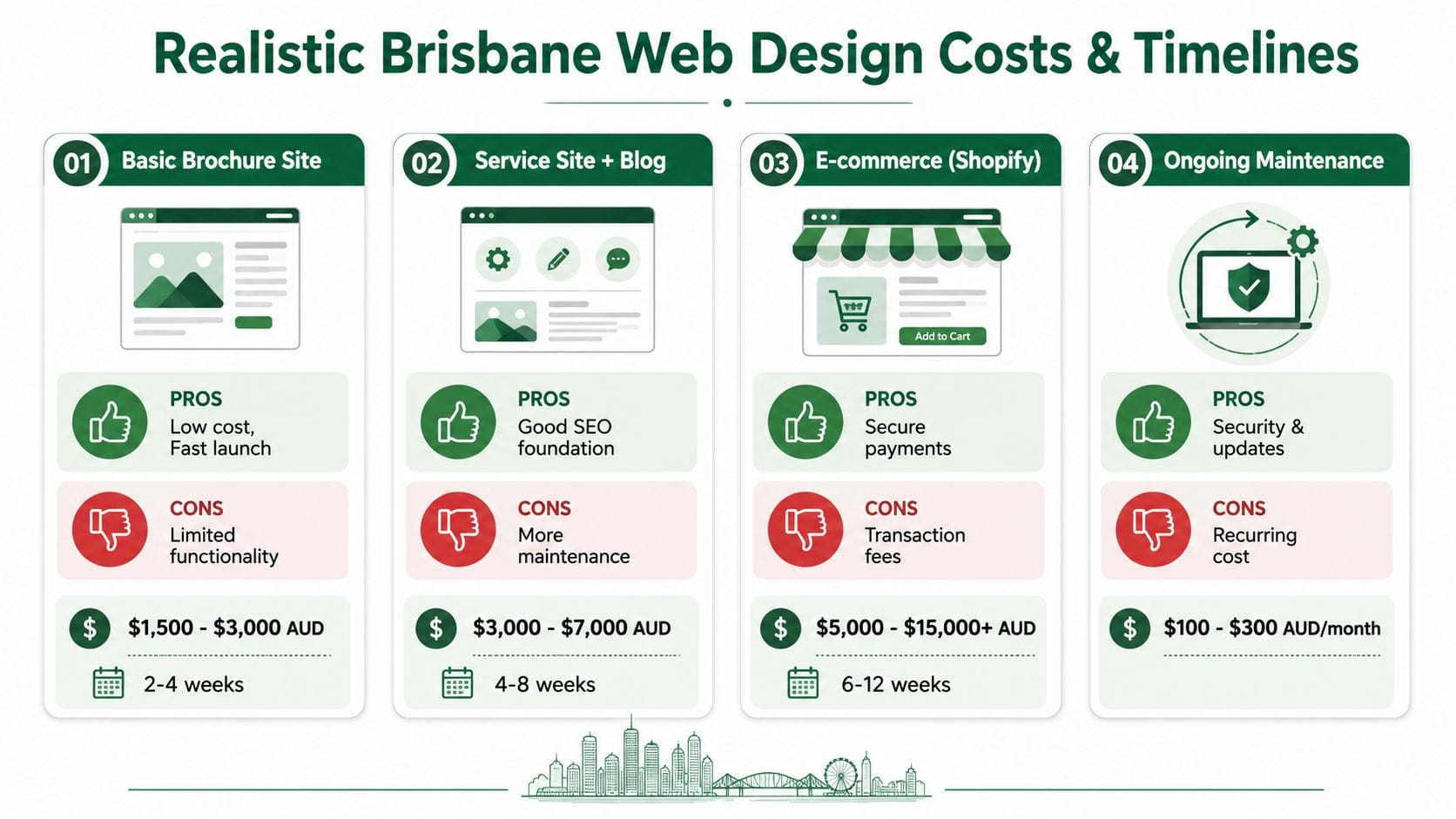
According to the 2026 Brisbane Web Pricing Survey, basic static sites at $0–$300 for 1–3 pages, core brochure sites at $800–$2,000 for 3–7 pages, service sites with blogs at $2,500–$5,000 for 5–12 pages, and larger eCommerce builds at $5,000–$10,000+ sit in the usual Brisbane range. That spread makes sense because page count, copy, design, and features all push the price up. A lean trades site can start small, then add blog content or booking functionality once the business has proof that the core pages are bringing enquiries.
What the budget should cover
A proper quote should split out strategy, copy, design, build, and launch support. If those parts are blurred together, owners end up paying for extras they do not need. If a provider cannot explain what changes the price, the quote is padded.
The timeline should match the scope. A small brochure site can move quickly. A service site with custom copy and SEO takes longer. An eCommerce build needs more testing before launch, because broken checkout flows cost enquiries and sales the moment the site goes live.
A trades business should not buy every feature on day one. Start with the pages that bring enquiries, then add richer content once the core site has been proven. That keeps cash in the business and avoids paying for features nobody uses. If you are comparing providers, a web design agency Brisbane page should spell out how they handle the build, the handover, and the work after launch.
Agency, Freelancer or DIY and What to Ask Each
The hiring decision should be about ownership and support, not ego. A DIY build can work if the owner has time and enough comfort with tools. A freelancer suits a clear, contained project. An agency fits better when the business wants strategy, execution, and ongoing measurement in one place.
Boocoo's web design agency Brisbane page is one example of how an agency can package that mix for local operators, but the provider matters less than the questions asked before signing anything.
Ask about the work after launch
The right questions are blunt. Who owns the domain and hosting? What happens if the project overruns? Who writes or supplies the copy? How are leads tracked? What gets handed over at the end? If the answers are vague, the relationship will be vague too.
A provider should be able to explain the build, the handover, and the maintenance path without hiding behind jargon.
DIY suits owners who have time and can tolerate a slower path. Freelancers suit businesses with a defined scope and a clear brief. Agencies suit owners who want someone to think about the whole funnel, not just the homepage. For most Brisbane service businesses, that last option is usually the most sensible when enquiries matter more than visual novelty.
The cleaner the brief, the better the fit. A business that already knows its services, suburbs, and lead priorities can work with a freelancer or agency efficiently. A business still figuring that out needs more strategy before design starts.
Launch, Measure and Maintain Without Burning Out
A site launch is where the guesswork stops. If the phone does not ring, forms do not fire, or booking requests vanish into a broken path, the problem is the build, not the owner. A clean launch process keeps that from turning into a slow leak of enquiries.
Keep the maintenance rhythm simple
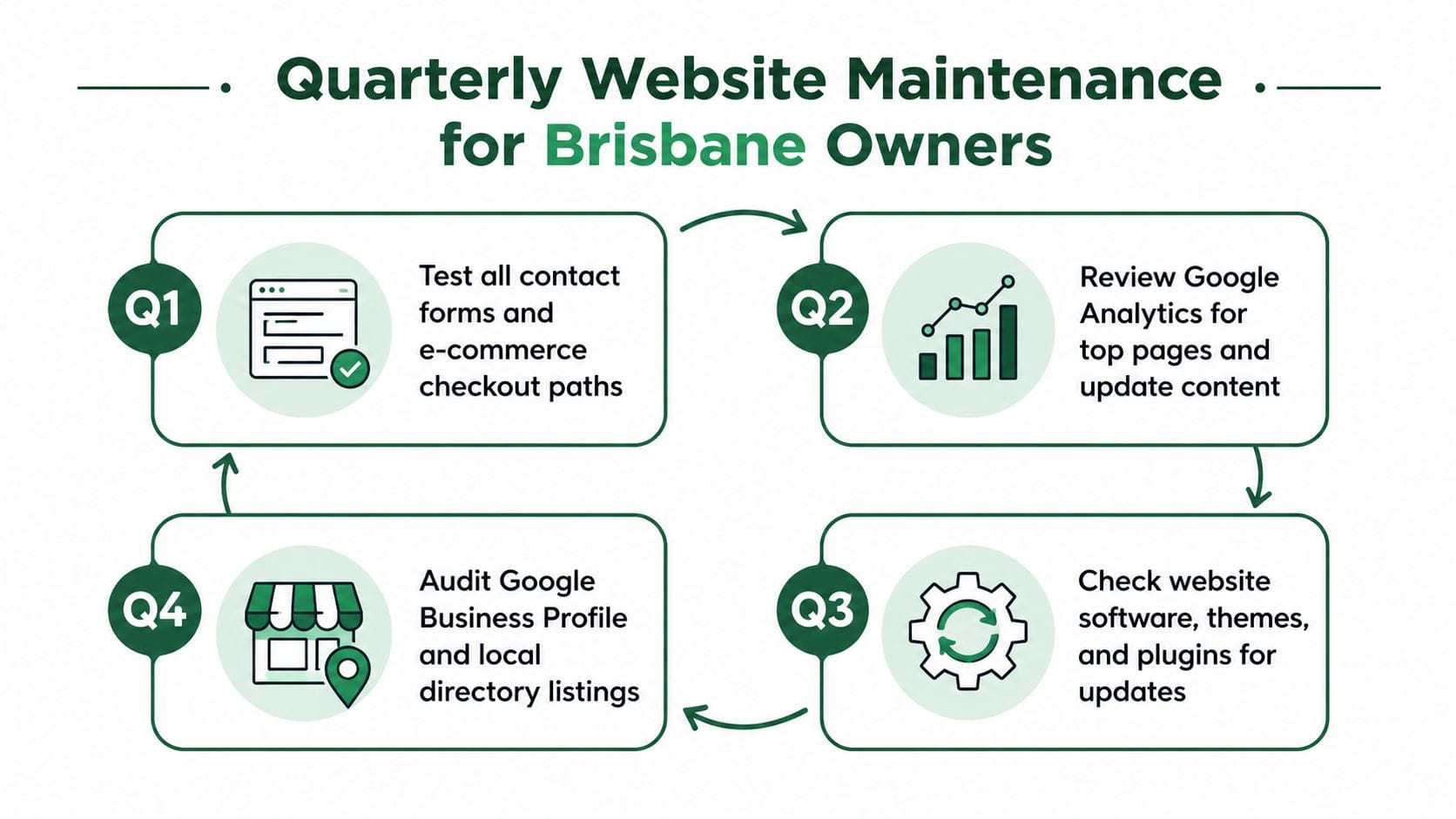
Before launch, test every contact form, phone tap, and booking path. Check that analytics are firing, the Google Business Profile points back correctly, and backups are set. After launch, keep the monthly review narrow, calls, form submissions, top pages, and speed.
Owners do not need a bloated maintenance routine. A working site just needs steady care, clear ownership, and quick fixes when something breaks. If the business changes its services, update the core service page. If there is a real customer question worth answering, publish one useful blog post. If reviews or credentials change, refresh the trust signals so the site still matches the business.
A busy owner who wants a basic read on traffic can use Expressify AI traffic analysis to spot obvious visibility and traffic issues without getting buried in dashboards. It is a starting point, not a replacement for proper tracking, but it gives a quick read on what the site is doing.
Websites also need a maintenance plan after launch, not a rescue job six months later. If you want a clear breakdown of what that looks like in Brisbane, website maintenance in Brisbane should be part of the brief before the site goes live. That keeps the owner from treating updates as an afterthought and helps stop small problems from turning into lost leads.
SEO takes time because the site needs the right structure, content, and trust signals before it can compete well. Rebuilding is not always the answer. Tighten the current site first, fix the lead path, and only rebuild when the structure is the core problem. Bring in a marketer when the business needs ongoing content, local SEO, or ad management beyond what the team can handle in-house.
The right website earns its keep. Brisbane owners do not need a prettier homepage. They need a site that turns local demand into conversations and quotes.