
A lot of Brisbane business owners are sitting in the same spot right now. The website looks dated, enquiries are patchy, and every agency quote seems to promise more leads, better SEO, faster speed, and a smooth process, all at wildly different prices.
That's where the confusion starts. One agency talks about custom builds. Another pushes templates. A third says the site only needs a refresh, while someone else says everything should be rebuilt from scratch. For a small business owner trying to keep staff busy, answer phones, and manage cash flow, sorting through that noise is a job in itself.
Brisbane Digital Marketing needs to feel practical, not overwhelming. A website isn't a trophy. It's more like a shopfront with a receptionist built in. If the sign is unclear, the door sticks, and the receptionist forgets to take names, the business loses opportunities before a conversation even starts.
Why Choosing a Web Agency in Brisbane Feels Overwhelming
A common scenario looks like this. A local trade business has a website that technically works, but it doesn't bring in many calls. A professional services firm has a polished logo and solid word of mouth, but the website feels thin and out of date. Both owners know something needs to change, but every conversation with agencies seems to create more questions than answers.
Part of the reason is simple. The Australian web design services industry is projected to reach a $1.5 billion market size in 2026, with Brisbane hosting over 45 top-rated web design companies, according to IBISWorld's overview of the Australian web design services industry. Plenty of choice sounds good, but for a small business owner it often means a crowded field of similar claims.
That's why a search for a Web Design Agency Brisbane can feel less like shopping and more like comparing mechanics when the car won't start. Everyone says they can fix it. Not everyone explains what's wrong, what work is necessary, and what can wait.
A good agency reduces confusion early. If the first conversation leaves a business owner more puzzled than before, that's already useful information.
Another problem is that quotes often focus on outputs instead of outcomes. Five pages. Ten pages. WordPress. Shopify. SEO setup. Contact forms. These things matter, but they're not the reason a small business invests in a website. The core question is whether the site helps generate enquiries, support sales, and save admin time.
Some owners also assume web design sits in a separate box from the rest of their marketing. It doesn't. A website is usually one piece of a broader system that includes search, content, paid ads, and follow-up. That's why it helps to understand how web development services fit into business growth before comparing agencies on price alone.
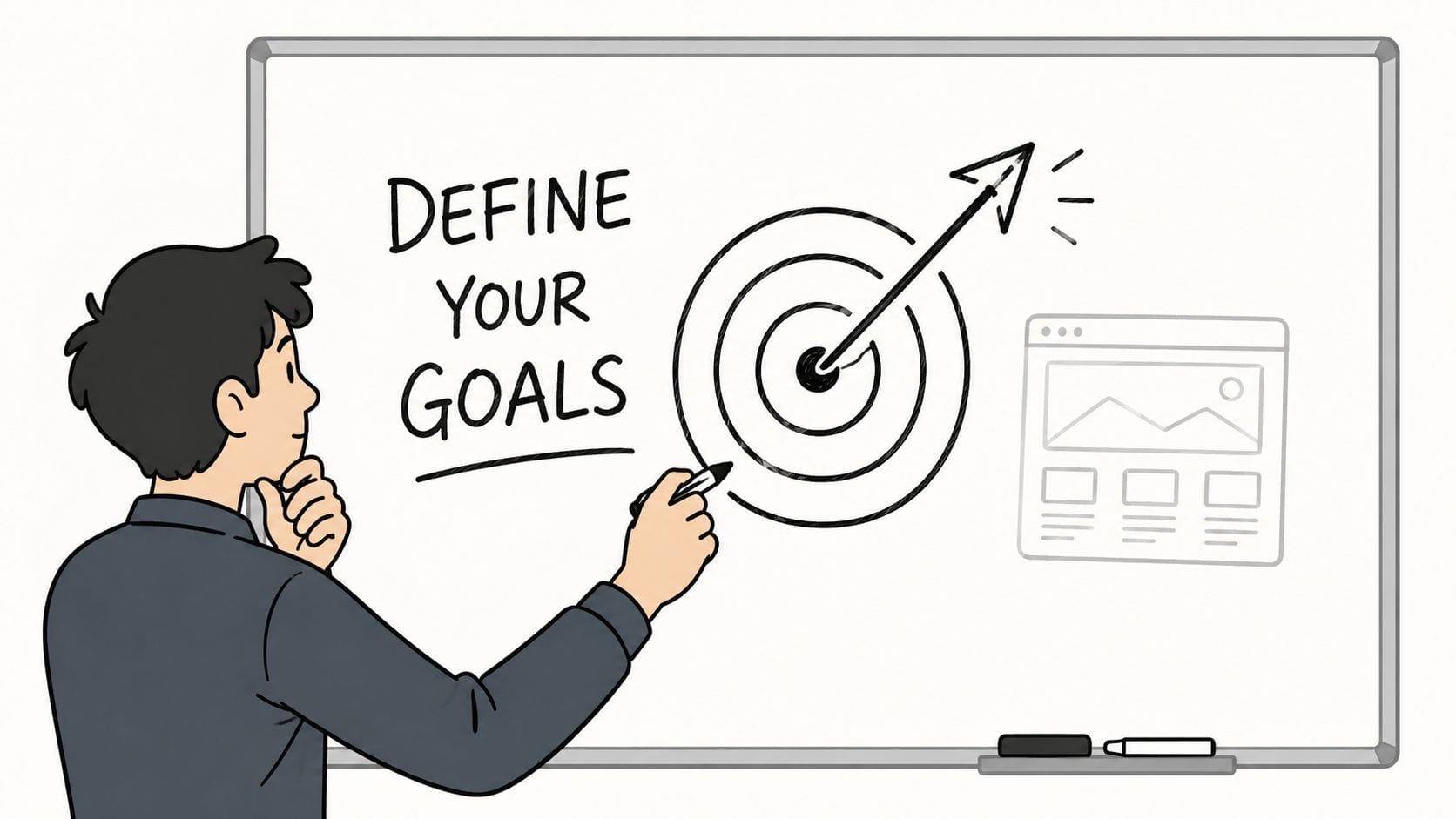
First Define Your Goals Not Just the Website Features
Before contacting agencies, the smartest move is to get clear on the business problem. That sounds basic, but it's where many projects drift off course. A business owner asks for a new homepage, a booking form, or a service page rewrite when the underlying issue is weak lead quality, too many unqualified enquiries, or low trust from first-time visitors.
Start with the business problem
A website project should begin with a sentence like one of these:
- Lead quality is poor: The business gets contact form submissions, but many aren't the right fit.
- Too much manual admin: Staff answer the same questions over and over because the site doesn't filter or guide people properly.
- Low trust: Visitors don't quickly understand what the business does, who it helps, or why they should enquire.
- Poor local visibility: The website exists, but it doesn't support search visibility for the areas the business services.
That shift matters because features are only useful when they solve a business problem. A quote request form isn't valuable by itself. It's valuable if it helps the owner receive better job details before picking up the phone.
A simple way to think about it is this. Features are the ingredients. Goals are the meal. No one buys a pantry. They buy dinner.
Build a one page brief
One page is enough. It doesn't need marketing jargon. It just needs enough clarity so agencies can recommend the right scope instead of guessing.
Include these points:
What the business does
Keep it plain. “Electrical contractor servicing inner Brisbane” is stronger than a fluffy brand statement.Who the ideal customer is
A clear audience picture is beneficial. A business that understands user personas and customer intent will usually make sharper website decisions than one trying to appeal to everyone.What the website needs to achieve
Focus on actions, not design wish lists. Common examples include more phone calls, more quote requests, more appointment bookings, or better-qualified enquiries.What the current site isn't doing well
Be honest. Slow updates, confusing navigation, poor mobile experience, weak service page content, or no clear conversion path are all fair observations.What content or systems already exist
Existing photography, service descriptions, customer reviews, booking software, and CRM tools all affect scope and cost.
Practical rule: If a goal can't be linked to an action a customer takes, it's probably too vague.
This exercise also saves money. It stops businesses from buying pages they don't need, apps they won't use, and “nice to have” features that don't support revenue. For small businesses with limited time, that's often the difference between a useful project and an expensive distraction.
How to Vet a Brisbane Agency for Real Results
A polished portfolio can be helpful, but it can also distract from the thing that matters most. Does the agency build websites that support business outcomes?
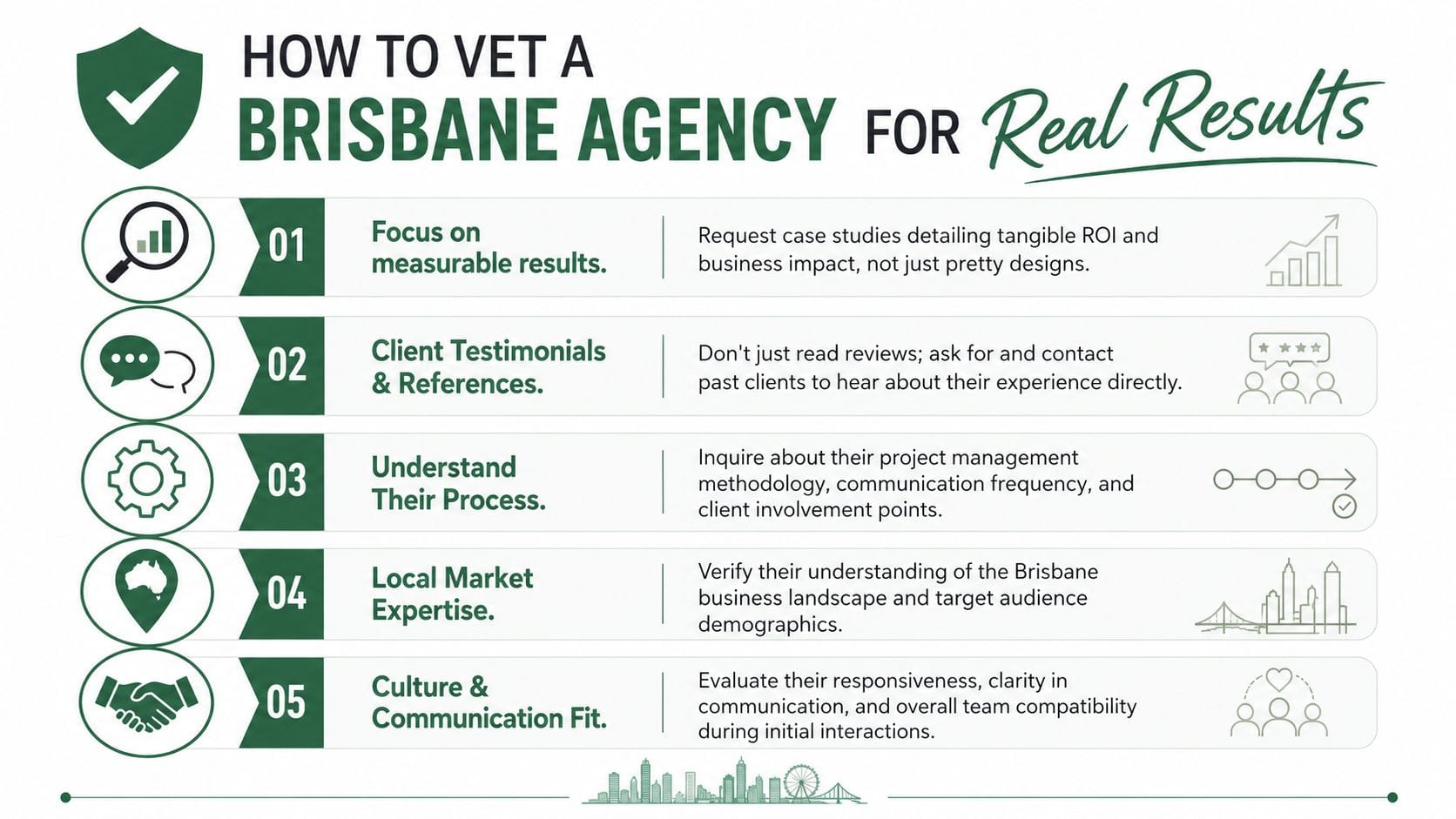
A useful local benchmark comes from a 2025 analysis noting that review counts are a trust signal, but most Brisbane agency pages still lack transparent, region-specific case studies with real performance stats that small business owners can compare objectively, according to MyWork's Brisbane agency analysis. That means a business owner often needs to ask harder questions instead of relying on the website alone.
What matters more than a pretty portfolio
A portfolio shows taste. It doesn't automatically show commercial value.
When reviewing agencies, these signals are stronger than flashy screenshots:
| What to check | Why it matters |
|---|---|
| Case studies with business context | A site for a local accountant should solve different problems from a site for a fencing contractor. |
| Evidence of conversion thinking | Good agencies talk about enquiry paths, calls to action, trust signals, and user flow. |
| Clear process | Strong delivery usually comes from a defined workflow, not improvised project management. |
| Post-launch support | A website isn't finished on launch day. It still needs updates, fixes, and iteration. |
Businesses should also pay attention to how an agency talks about conversion. Design choices aren't just aesthetic. Page structure, copy hierarchy, forms, proof elements, and calls to action all influence whether a visitor takes the next step. For a practical outside read on this topic, Quikly's guide to psychological triggers for conversion is worth reviewing before agency meetings. It helps separate decoration from decision-making.
A simple shortlist test
A practical shortlist usually becomes clear after three conversations. Not because every answer is perfect, but because patterns start to show.
Look for agencies that can do these things:
Explain results in business language
If the agency keeps talking about animations, frameworks, and layouts but never mentions leads, sales conversations, or customer actions, that's a warning sign.Show relevance to the local market
Brisbane buyers don't behave like a generic national audience. Local service areas, suburb intent, and trust cues matter.Discuss traffic and conversion together
A website without traffic is a brochure. Traffic without conversion is wasted effort.Be honest about trade-offs
Good agencies say things like “that integration will add complexity” or “that feature may not be necessary in phase one.”
The best agency conversations usually feel calm, specific, and slightly unglamorous. That's often a good sign because real delivery work is built on clarity, not theatre.
If a business owner needs options beyond pure web design, it can also help to compare firms that work across search and paid traffic, such as agencies listed in this overview of search engine marketing support in Brisbane. That broader lens often reveals whether an agency understands the website as part of a lead system rather than a stand-alone design job.
Key Questions to Ask Before You Sign Anything
A proposal can look tidy and still leave major gaps. That's why the conversation before signing matters just as much as the quote itself.
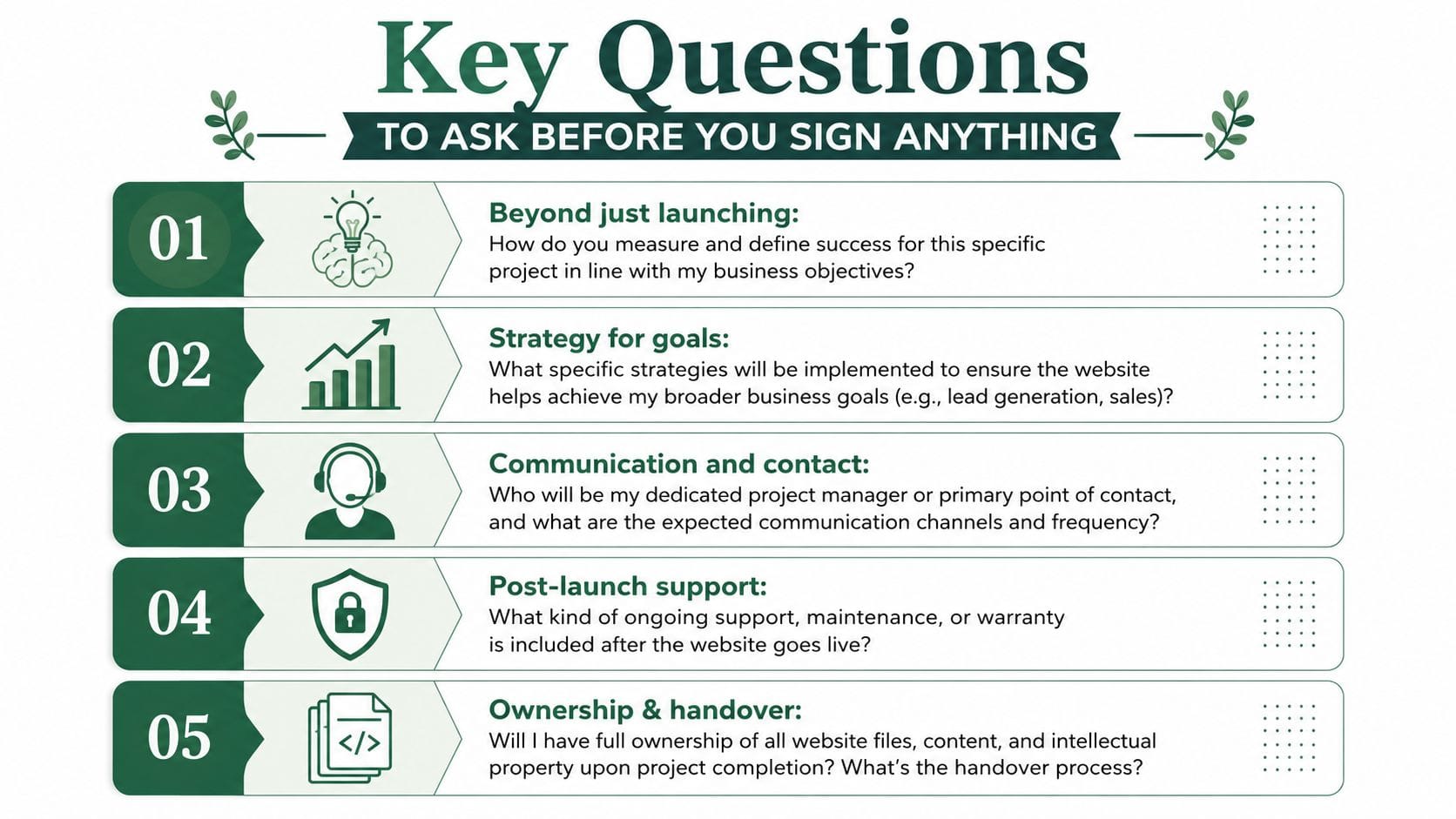
For local businesses, the best success measures are usually direct actions such as phone calls, form submissions, direction requests, booked appointments or quoted jobs, and lead quality by channel, as outlined in Boocoo's Brisbane local business digital marketing guidance. That's a much healthier starting point than vague talk about “engagement”.
Questions that reveal how they work
These questions tend to expose whether an agency thinks like a business partner or just a supplier.
How do you define success for a project like this?
A strong answer connects the website to a measurable action. A weak answer stays at the level of impressions, aesthetics, or “brand presence”.Who will be the day-to-day contact?
Small businesses need a clear line of communication. If the sales person disappears after the contract is signed, that should be known upfront.What happens after launch?
This should cover support, bug fixes, edits, training, and who handles plugin or platform updates if relevant.What does the handover include?
Ownership matters. So does access to content, logins, assets, and documentation.How do you manage revisions and approvals?
Without a clear process, projects drag. Then deadlines slip and everyone gets frustrated.
What a solid answer sounds like
The wording doesn't need to be polished. It just needs to be concrete.
A strong agency might say success will be measured through calls, bookings, forms, and lead quality. They should also be able to explain how the website structure supports those actions. For a Brisbane service business, that often means clear service pages, suburb relevance, trust elements, and obvious next steps.
A weaker answer usually sounds broad. “We build high-performing websites” or “we focus on user engagement” may sound professional, but they don't tell a business owner what will be tracked or improved.
This is also a good moment to ask who should be involved on the business side. Often, website projects stall because the owner expects the agency to read minds while the agency waits for content, photos, approvals, or access. Clear roles save time.
“If an agency can't explain how a website supports enquiries in plain English, the project may become expensive homework for the client.”
For owners who want strategic support before getting quotes, a session with a local Brisbane marketing consultant can help clarify goals, scope, and channel priorities before any build begins.
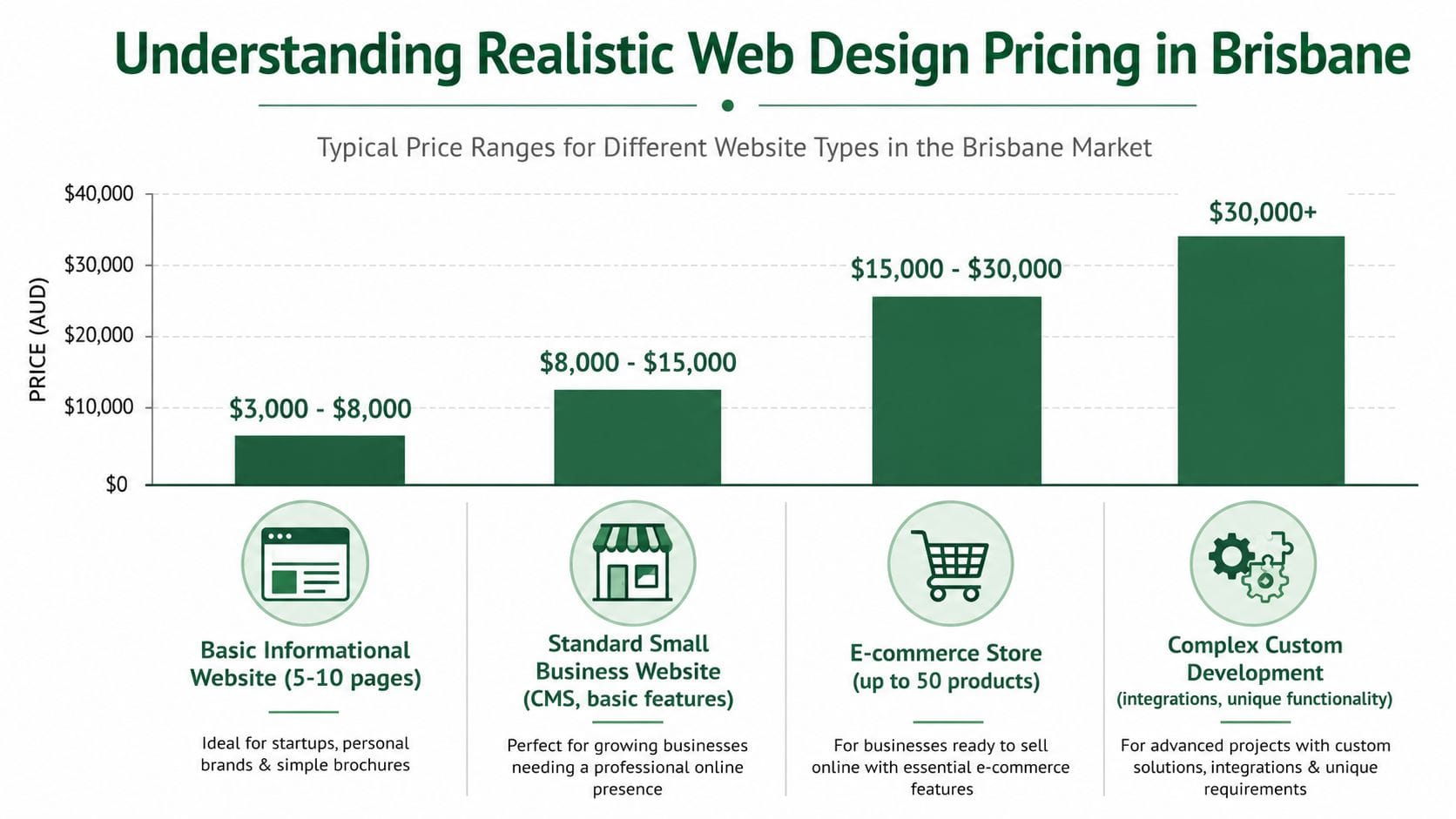
Understanding Realistic Web Design Pricing in Brisbane
Price conversations often go wrong because people compare quotes that aren't comparable. One proposal may include strategy, copy guidance, SEO basics, redirects, and post-launch support. Another may cover design and development only. On paper, both are “website quotes”. In reality, they're different products.
There's another complication. Much of the content around budget web design in Brisbane skips the ongoing costs. As noted by Havealook's discussion of Brisbane website design affordability, many “affordable” offers fail to explain the hidden costs of maintenance, security updates, and local SEO integration that make up the total cost of ownership over 3–5 years.
Why the upfront quote is only part of the cost
For small businesses, the initial build cost matters. But it's only the entry point.
A realistic budget should also account for:
Ongoing maintenance
Websites need software updates, plugin checks, and occasional fixes.Security work
This isn't glamorous, but it protects the site and reduces operational headaches.Content updates
Service changes, staff updates, project examples, and new offers all need a process.SEO integration
A website that launches without local search foundations can become harder to improve later.
That's why the cheapest quote can become the most expensive option over time. If a business saves money upfront but ends up paying for repairs, migrations, or missing setup later, the total spend rises anyway.
What usually pushes pricing up or down
Several factors influence cost, even when two websites look similar on the surface.
A leaner project often has a smaller page count, simpler functionality, fewer rounds of revisions, and clear existing content. A more expensive project may include custom design systems, booking flows, e-commerce setup, CRM integration, customized copy support, or location-based landing pages.
It also depends on who is doing what. If the agency is sourcing stock imagery, writing copy, setting up analytics, managing redirects, and training staff, the quote will reflect that broader workload.
Here's the practical takeaway. Don't ask only, “How much is the website?” Ask, “What will this cost to own and improve over the next few years?” Businesses comparing affordable web design options in Brisbane usually make better decisions when they compare scope, support, and upkeep together instead of treating the launch fee as the whole story.
Common Red Flags and How to Choose with Confidence
Some agency warning signs are obvious. Others only become clear after the contract is signed. It's far easier to spot them early.
One reason this matters so much is agency stability. A reported industry figure claims 89% of Australian web design agencies fail within 3 years, which highlights the risk of choosing a very new or unstable provider, according to Rocking Web's analysis of Australian agency failure rates. Whether a business owner is hiring for a fresh build or a rebuild, continuity matters because websites need support after launch.
Red flags worth taking seriously
Watch for patterns like these:
Guarantees that sound too neat
“Guaranteed rankings” or blanket promises of results without context should raise questions.Vague scope
If the proposal doesn't clearly outline what is included, disputes tend to appear later.Poor communication before the sale
Slow replies, missed calls, and unclear answers rarely improve once the project starts.Pressure tactics
A solid agency should be able to answer questions without forcing urgency.No discussion of maintenance or next steps
Websites need care after launch. If that part is brushed off, the business may inherit avoidable problems.
A useful cross-check is whether the agency understands content beyond the initial build. For businesses planning ongoing articles, social snippets, or campaign assets, a resource on how to find a content repurposing agency can help frame what sustainable content support looks like after the site is live.
What confident selection looks like
A confident choice usually isn't the flashiest one. It's the agency that answers directly, scopes work properly, explains trade-offs, and aligns the website with how the business wins customers.
That might be a specialist web studio. It might be a broader local agency. For example, Boocoo is a Brisbane-based option that provides web design alongside SEO, social media, and paid advertising, which can suit small businesses that want the website connected to wider lead generation rather than managed in isolation.
The main point is simple. A website should help the business make decisions, generate enquiries, and support growth without creating extra confusion. When an agency can explain how that happens, in clear language, with a sensible process and realistic support, the decision becomes much easier.