
A meta description is a short HTML summary of a web page, usually up to 160 characters, that search engines often display beneath the page title in search results to help users decide whether to click. It works like a small piece of free ad copy for a Brisbane business, turning a search listing into a clearer invitation to visit the website.
A Brisbane owner might search for “Brisbane digital marketing”, “plumber near me”, or “accountant in Brisbane” and notice that one result explains its value immediately while another displays a vague sentence or a randomly selected line from the page. That small difference can influence which result earns attention, even when both pages appear in similar positions.
What a Meta Description Is
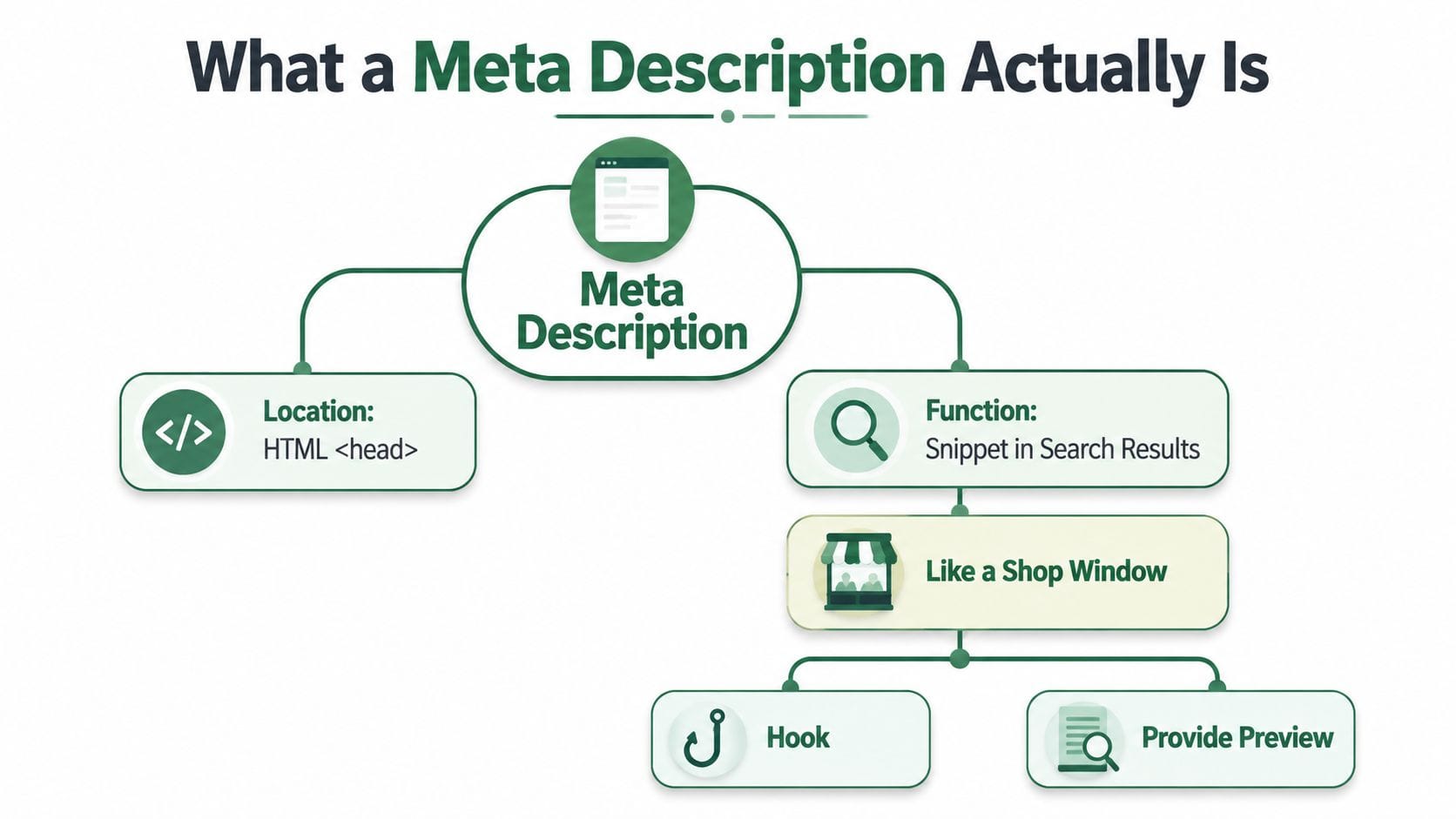
A meta description is a brief piece of text added to a web page's HTML, usually inside the <head> section. Visitors do not see it within the page itself. Google may display it beneath the page title and URL, giving searchers a quick preview of the page's offer.
It works like an elevator pitch for the page. The page title names the topic, the URL shows where the page sits on the website, and the meta description gives a short reason to continue. For a Brisbane business, that space can explain the service, location and next step before a potential customer visits.
The three parts of a search listing
A Brisbane landscaping business might see these elements in Google:
- Page title: Brisbane Garden Design and Landscaping Services
- URL: example.com.au/brisbane-landscaping
- Meta description: Create a practical Brisbane garden with local landscaping support, design advice and reliable project planning. Request a consultation.
The title identifies the page. The URL gives searchers a sense of its location on the site. The description adds useful context and helps the right person decide whether to click.
Small screens can cut off the ending of a description, so place the main benefit and location near the beginning. Google can also rewrite the snippet with text from the page when that wording better matches the search. Treat the field as guidance for Google, not a guaranteed script.
Australian guidance recommends plain, user-centred language for page summaries. The Australian Style Manual guidance on page optimisation recommends a practical target of no more than 150 characters including spaces, while other Australian guidance uses a maximum of 160 characters.
A well-planned title and description should support each other. Businesses improving both can use this resource to craft compelling page titles. The Boocoo website content writing guide provides related guidance for clear website copy.
How Meta Descriptions Influence Clicks and Local Search
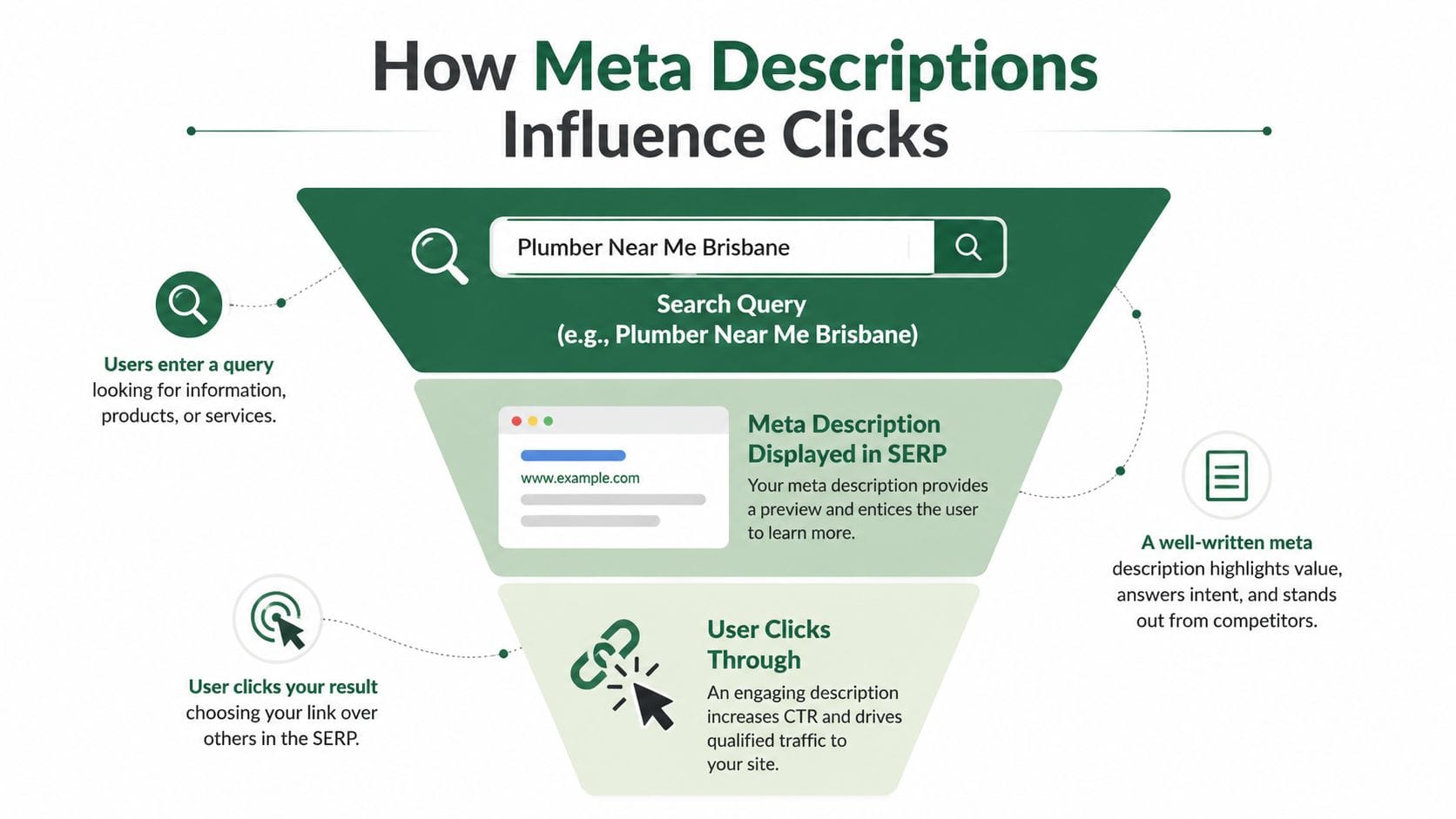
A Brisbane customer searches for “digital marketing” between appointments. Two listings appear. One says, “Welcome to our website. Learn more about our services.” The other says, “Brisbane digital marketing for small businesses, with practical SEO, websites and campaigns built around your budget. Enquire today.” Which one makes the next click feel safer?
That second description works like a small business's free advertising inside the search results. It identifies the local audience, explains the offer and gives the searcher a reason to continue. The page still needs to deliver what the listing promises, but clear wording can bring more relevant visitors through the door.
Google may rewrite the snippet for a particular search. Its official documentation on snippets explains that a meta description is a short summary that may be displayed, rather than a guaranteed script. Google can select text from the page when that wording appears more relevant to the query.
Why local intent changes the wording
A local searcher usually wants a quick answer: does this business serve my area, handle my problem and offer a practical next step? They may be looking for a nearby service, an appointment, a quote, opening information or reassurance that the business works in their suburb.
Useful local details can include:
- Service area: Brisbane, inner north, bayside or a named suburb, where accurate
- Customer need: emergency repairs, tax advice, garden design or website support
- Practical benefit: transparent advice, fast booking or a clear consultation process
- Next step: call, book, request a quote or view available services
The guide to local SEO marketing places this page-level work within a broader local search strategy. A description cannot replace a useful website or accurate business information, yet it gives each page a clear invitation to the right searcher without the cost of a new advertising campaign.
Australian government-style writing also favours plain, user-centred summaries. On mobile screens, the ending can disappear, so put the location, benefit and strongest reason to click early. Write for the person choosing a result, not for a search engine decoding repeated keywords.
Best Practices for Writing Meta Descriptions That Convert
A good meta description gives a page a specific promise. It doesn't need clever wording. It needs accurate wording that matches the searcher's intent and the page's actual content.
Start with the space available
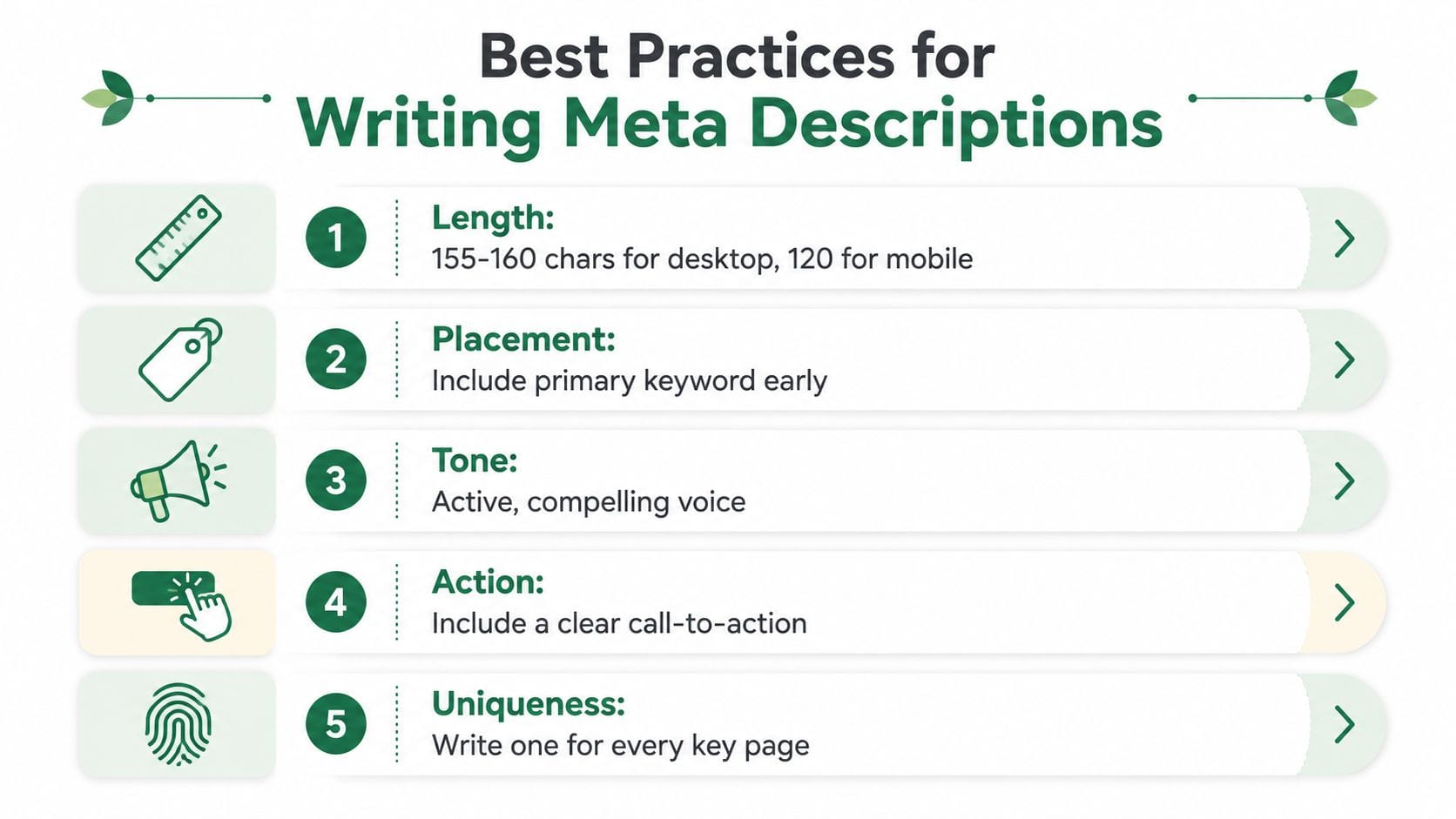
Australian SEO guidance commonly places the practical desktop range around 150 to 160 characters, while mobile-focused advice can be closer to 120 characters. Safari Digital discusses this meta description length guidance and explains why longer copy can be cut off in search results.
The exact display can vary because search engines measure rendered width rather than counting characters. The safest approach is to keep the key message near the beginning.
- Name the service or page topic.
- State the most useful benefit.
- Add the location when it supports local intent.
- Finish with a direct action if space allows.
A business can draft freely, then shorten the sentence until the essential meaning survives a possible truncation.
Use the primary phrase naturally
A page about Brisbane bookkeeping should make that subject clear. It shouldn't repeat “Brisbane bookkeeping” several times in an awkward sequence. One natural mention is usually enough when the rest of the sentence explains the customer benefit.
For example, “Brisbane bookkeeping for growing businesses, with organised reporting, payroll support and practical advice. Book a consultation.” reads like useful marketing copy. “Brisbane bookkeeping Brisbane accountant Brisbane books Brisbane” reads like a label pile.
Choose active, specific language
Words such as “explore”, “compare”, “book”, “request”, “call” and “learn” give the searcher a clear next step. Claims should remain accurate. A local business shouldn't promise instant service, the lowest price or guaranteed results unless the page can support that promise.
The Australian government's content guidance also recommends user-focused language, terms the audience would use, active voice and a call to action where appropriate. The same principles support a broader guide to SEO content creation, particularly when a business is preparing many service pages.
Give every important page its own description
A homepage, service page, location page and product category should each answer a different search need. Reusing one description across the whole site makes it harder for searchers to distinguish the pages.
A simple review checklist can keep the task manageable:
- Accuracy: Does the description match the page?
- Relevance: Does it answer the likely search intent?
- Clarity: Can a busy reader understand it quickly?
- Local fit: Is Brisbane or the relevant service area useful?
- Action: Does the next step feel natural?
- Uniqueness: Does the wording differ from other key pages?
For owners who want to connect snippet wording with the page's broader enquiry path, conversion rate optimisation services provide a useful related perspective. A description may earn the click, but the page still needs to make the next action easy.
Real Meta Description Examples for Brisbane Small Businesses
The difference between a weak and useful description becomes clearer when the page has a real customer and a real local need. The following examples are editorial examples for Brisbane businesses, not performance claims about particular companies.
| Page type | Before, generic | After, more useful |
|---|---|---|
| Plumber homepage | Plumbing services for all your needs. Contact us today. | Brisbane plumbing for leaks, blocked drains and repairs. Get practical advice and request a quote from a local team. |
| Accountant service page | We offer accounting services to businesses and individuals. | Brisbane small business accounting for BAS, bookkeeping and tax planning. Arrange a clear, practical consultation. |
| Landscaping landing page | Quality landscaping services at affordable prices. | Plan a low-maintenance Brisbane garden with local landscaping design and project support. Discuss the next step today. |
The plumbing version names the problems a customer may recognise. “All your needs” is broad and forgettable, while leaks and blocked drains help the right searcher decide that the page is relevant.
The accounting example narrows the audience and identifies services. A visitor looking for BAS or bookkeeping support gets a stronger reason to click than a visitor reading a general promise about accounting.
Three reusable patterns
A service business can adapt these structures without starting from a blank page:
- Problem and service: Solve [problem] with [service] in [location]. Request [action].
- Audience and outcome: [Service] for [audience], supporting [benefit]. Book [action].
- Product and use case: Find [product category] for [need], with [helpful feature]. Shop or enquire today.
The wording should reflect what the page provides. A description that attracts the wrong visitor can create wasted enquiries, while a precise description helps a smaller business spend time on people who are more likely to need its service.
Adding Meta Descriptions in Your CMS and When to Let Google Decide
The field's location depends on the content management system, but the underlying task is similar. The owner or editor finds the page-level SEO settings, pastes a concise summary, checks the preview and saves the page.
In WordPress, plugins such as Yoast SEO and Rank Math usually add an SEO panel beneath the editor or in the page sidebar. The editor can enter the description, review the length indicator and inspect the search preview before publishing.
Squarespace places search appearance settings within the page's SEO options. Wix provides an SEO settings area for each page, while Shopify includes search engine listing controls for products, collections and pages. Menu labels can change as platforms update, so the useful signs are “SEO title”, “meta description”, “search appearance” or “search engine listing”.
A practical publishing check
Before saving, the editor should ask:
- Does the description describe the specific page?
- Does the opening phrase communicate the main topic?
- Is the wording useful on a small mobile screen?
- Does the call to action match the page?
- Does the preview show a complete, readable message?
A character counter is helpful, but it isn't a guarantee that Google will use the text exactly as written. Google can select different content when another part of the page better matches the search query.
Long-form articles, product catalogues with many variants and pages aimed at a broad range of queries may sometimes benefit from allowing Google to generate a snippet from relevant page content. That choice shouldn't be automatic. A carefully written description is usually worthwhile for a high-value homepage, service page or location page where the business wants to control the first impression.
Businesses managing many pages can explore an SEO at scale resource from WebinOne for broader CMS workflow ideas. Owners who are still building their site can also review how to build a small business website before creating a page structure that becomes difficult to maintain.
Testing, Measuring and Future-Proofing Your Snippets
A meta description shouldn't be treated as permanent copy. Search results change, competitors update their listings and Google may rewrite snippets when it believes another passage better answers the query.
Google Search Console gives owners a practical place to review pages and search queries. The useful signals include impressions, clicks and click-through rate. A page that receives visibility but attracts fewer clicks than expected may deserve a clearer description, provided the page itself matches the promise.
A lightweight review routine
A small business can keep the process simple:
- Identify important pages that already receive search visibility.
- Review the queries associated with those pages.
- Compare the wording with the searcher's apparent need.
- Rewrite one element, such as the opening benefit or call to action.
- Record the change and review the page again later.
This isn't a controlled scientific experiment because rankings, query mix and snippet rewriting can change at the same time. It's still a sensible editorial process for finding unclear copy and improving alignment between a listing and its landing page.
AI-generated search experiences add another reason to use precise language. Emerging Australian SEO guidance discusses clearer entity wording, schema pairing and query-focused copy for modern search and answer engines, as outlined in this resource on meta descriptions for AI search. A business should clearly identify what it does, who it serves and where it operates. That context helps automated systems interpret the page, even when the supplied description isn't displayed verbatim.
For broader search visibility work, owners can also review how to improve Google search ranking. Meta descriptions work best as part of a coherent page, not as a substitute for useful content, accurate business information or a straightforward enquiry path.
Your Simple Meta Description Action Plan
A time-poor Brisbane owner doesn't need to rewrite every page at once. Start with the pages closest to revenue, such as the homepage, primary service pages, location pages and important product categories.
For each page, write a description that names the topic, reflects the customer's need, includes a useful local detail where appropriate and ends with a clear action. Keep the most important message early, then check the preview in the business's CMS before publishing.
A practical sequence is:
- Choose priority pages: Begin with pages that matter most to enquiries or sales.
- Review existing snippets: Look for vague, duplicated or incomplete wording.
- Rewrite for intent: Use the language a Brisbane customer would use.
- Check the destination: Make sure the page fulfils the description's promise.
- Measure and refine: Review Search Console data and update unclear copy.
A business owner can handle a small site internally, but technical problems, a large catalogue or inconsistent results can quickly consume valuable working time. Boocoo offers Brisbane businesses support across SEO and related digital marketing activities, including on-page page optimisation that can involve improving meta descriptions. To discuss goals, timelines and budget with a local team, call 1300 093 797 or email hello@boocoo.au today.