
A Brisbane café owner sits in a sales meeting while an agency representative compares two screenshots. Her competitor's Domain Authority appears stronger, her own site looks weaker, and the proposed solution is a long campaign designed to “fix the gap”. The number feels decisive, even though the business question is simpler: which café appears when someone searches for coffee near Latrobe Terrace, and which listing earns the order?
That moment captures why a clear domain authority definition matters. Domain Authority can help a business compare websites and understand link strength, but it doesn't tell an owner who receives the next enquiry. For a time-poor Brisbane operator, rankings, relevant visitors, map visibility and qualified leads deserve more attention than a score viewed in isolation.
The Pitch That Sounds Too Good to Be True
The owner asks whether the competitor's higher score explains the difference. It might reveal a stronger backlink profile, but it doesn't prove that the competitor wins every local search. A site can have links from respected websites and still have weak service pages, incomplete local information or a confusing path to purchase.
The screenshot also hides an important distinction. Domain Authority is an SEO tool metric, not a government measure, Google score or official Australian business rating. Moz created it as a predictive comparison of a domain's ability to rank, while Google doesn't use Moz's number as a direct ranking input. Moz's explanation of Domain Authority makes that distinction central to interpreting the metric responsibly.
Practical rule: A DA gap should prompt better questions, not an automatic purchase decision.
For the café, the useful evidence sits closer to the customer. Does the business rank for searches connected to its suburb and service? Does its Google Business Profile display accurate hours, categories, photos and reviews? Can a visitor quickly find the menu, location and booking option? Does the website generate phone calls, direction requests or online orders?
The national setting adds another layer of context. The Australian Government endorsed the .au Domain Administration, or auDA, in 2000, and describes auDA as the independent not-for-profit body responsible for policy and technical administration of Australia's country-code top-level domain on behalf of Australian internet users. Australian Government domain-name governance information identifies auDA as the organisation overseeing operation and management of the .au domain under updated 2025 terms.
That framework helps explain why a .au identity can support a recognisably Australian web presence, but it doesn't replace sound content, links or local relevance. The working definition below turns the intimidating screenshot into a useful, limited benchmark.
What Domain Authority Actually Means
A Brisbane business owner receives an SEO report showing a DA of 24, while a competitor shows 48. The immediate question is often, “Are we losing?” DA can help start that conversation, but it cannot answer whether the website attracts the right customers or generates enquiries.
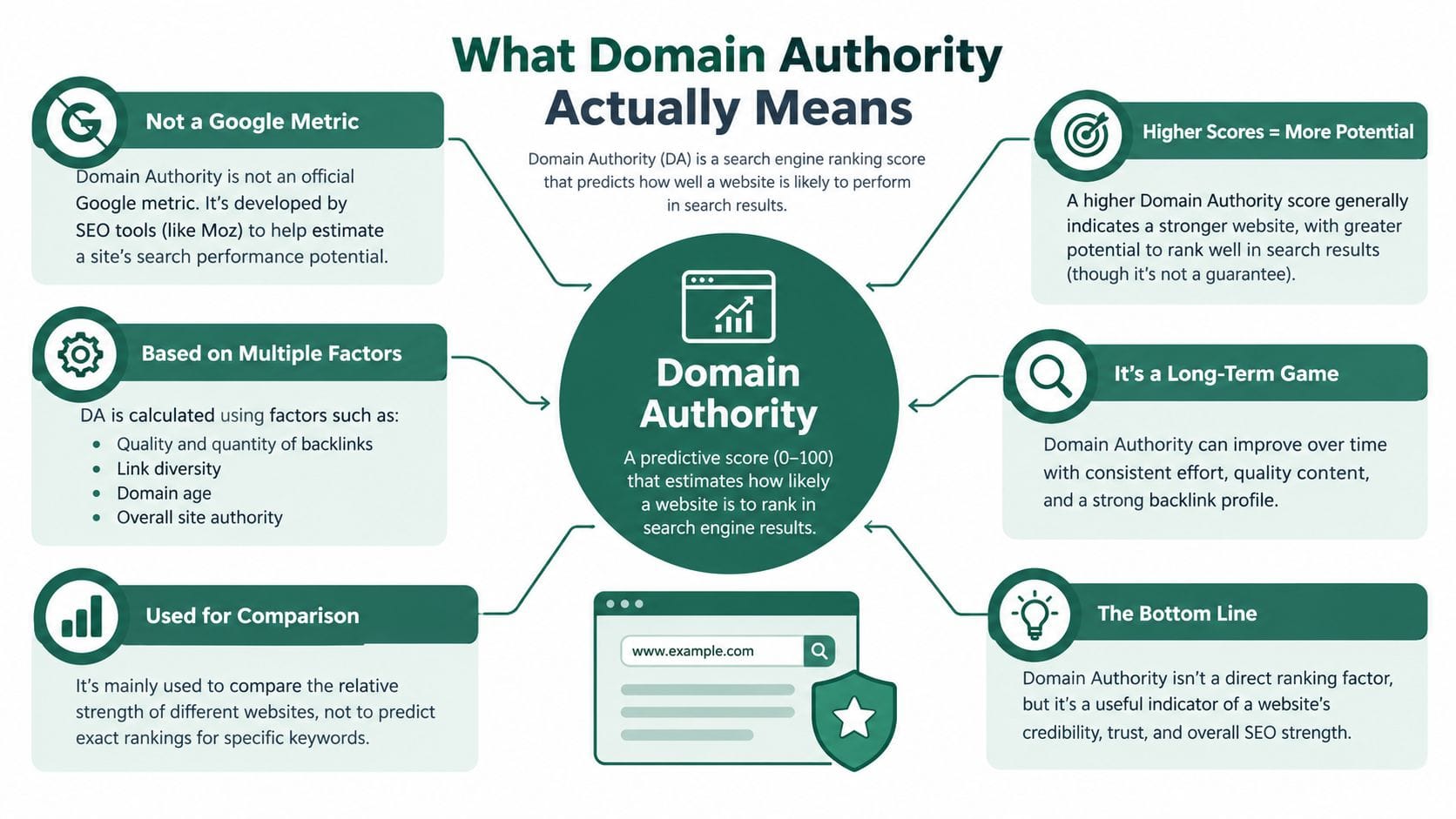
Domain Authority, or DA, is Moz's predictive SEO score for a whole domain. It uses a scale from 1 to 100 to estimate how likely that domain may be to rank in search results. Higher scores generally suggest stronger ranking potential, yet DA remains a comparison benchmark, not a promise of visibility.
A credit-score analogy helps. A lender can use a credit score to compare financial risk, but the score does not describe someone's entire financial position. DA similarly compresses parts of a website's link profile into one number. It does not explain every ranking, every page, or every customer outcome.
The scale behaves like a hill, not a ladder
DA uses a logarithmic scale, so gains become harder near the upper end. Moving from 20 to 30 is generally easier than moving from 70 to 80, because the higher range requires a disproportionately stronger link profile. GoDaddy's Australian explanation of Domain Authority explains this comparative structure and why score movement differs across the scale.
Moz calculates DA from signals associated with a domain's backlink profile. Common inputs include:
- Linking root domains: The number of unique websites linking to a domain. Several links from one website still count as one root domain.
- Link quality: A relevant, trusted publication may provide more useful context than an unrelated or low-quality website.
- Spam signals: Moz's model considers patterns that may suggest an unnatural or risky link profile.
- Machine weighting: Moz combines these signals through its proprietary model to produce a predictive score.
The score may change as Moz updates its crawl and index, as websites gain or lose links, or as competing domains change their link profiles. A movement in DA does not automatically mean Google has changed its view of the business.
For a plain-English reference, domain authority explained for businesses provides another accessible explanation. Owners who need the wider context can also read what SEO means for a business website, particularly when judging whether search activity is reaching qualified local demand.
The practical definition is simple: DA is Moz's 1-to-100 estimate of how competitive a domain's link profile may be in search, used for comparison rather than as a Google ranking score. For a Brisbane small business, treat it as a diagnostic clue. Then check the evidence that matters closer to the customer, including relevant local visibility, useful pages, calls, bookings and enquiries.
DA Compared to Page Authority and Domain Rating
SEO platforms use different names for related ideas. That's where many business owners get caught comparing a Moz DA number with an Ahrefs DR number as though both were measured on the same ruler.
Domain Authority evaluates the perceived ranking strength of an entire domain. Page Authority evaluates an individual page, such as a service page, article or location landing page. Domain Rating is Ahrefs' measure of a website's backlink profile strength. All three rely heavily on link-graph information, but each provider uses its own database and calculation method.
| Metric | Provider | Scores | Granularity | Best Used For |
|---|---|---|---|---|
| Domain Authority | Moz | 1 to 100 | Whole domain | Comparing domain-level link strength |
| Page Authority | Moz | 1 to 100 | Individual page | Assessing a target page's link competitiveness |
| Domain Rating | Ahrefs | 0 to 100 | Whole domain | Comparing backlink profile strength in Ahrefs |
The domain-versus-page distinction matters for a Brisbane small business. A website might have modest overall authority while one well-researched guide earns strong links and becomes the site's most competitive page. Conversely, a domain can show a respectable overall score while a newly published suburb page has little external support.
Use like-for-like comparisons
DA and DR may correlate with ranking performance because stronger link profiles often accompany competitive websites, but correlation is imperfect. Relevance, content quality, location and search intent can change the result, particularly for local service searches.
A practical benchmarking process keeps the provider consistent. If an agency reports Moz DA, track Moz DA for the business and its direct competitors. If an internal team uses Ahrefs DR, keep the comparison inside Ahrefs. Switching tools from one report to the next creates fluctuations that reflect different data sets rather than genuine progress.
PA deserves separate attention when a business is assessing a specific page. A local electrician may care less about the domain's overall score than whether the page targeting a particular service and Brisbane suburb has clear content, useful internal links and suitable external references.
Mixing DA, PA and DR in one league table creates an apples-to-oranges comparison.
The number should answer a defined question. Domain-level benchmarking supports competitor research, page-level assessment supports content decisions, and backlink tools support link opportunity review. None should become a substitute for checking actual search results and enquiries.
Why DA Is Not a Google Ranking Factor
Google doesn't use Moz's Domain Authority score to rank a Brisbane business. Moz creates DA by synthesising link-related signals into a predictive benchmark, while Google uses its own ranking systems and evaluates many signals connected to relevance, quality, location, usefulness and search intent. The two systems can point in a similar direction without being the same system.
Consider a Fortitude Valley plumber targeting “blocked drain Brisbane CBD”. A smaller local website with a well-maintained Google Business Profile, clear suburb-specific service pages, accurate business details and strong customer reviews may be more useful for that search than a national franchise with a much higher DA. The larger domain may have broader link strength, but local alignment can make the smaller result a better answer.
| DA Score vs. Real Google Ranking Factors for Brisbane Local Search | |
|---|---|
| What DA Measures in Moz | A predictive, comparative estimate based mainly on the domain's link profile, including linking domains, link quality and spam-related signals. |
| What Google Actually Weighs | The usefulness and relevance of the page, local alignment, business information, content quality, user experience and signals connected to the searcher's need. |
The confusion often starts in sales pitches. An agency presents a DA increase as though it were a direct ranking mechanism, then leaves the owner to assume that a larger number must produce more calls. That shortcut can divert budget from practical work, such as improving service pages, correcting inconsistent name, address and phone details, adding structured data, strengthening internal links and earning genuine local reviews.
A deeper explanation of DA and backlink evaluation can help owners recognise where the metric fits. It belongs in competitor diagnosis and link-profile monitoring, not in Google's list of business-controlled ranking levers.
Measure the outcome closer to revenue
A local SEO report should connect activity to the customer journey. Useful measures include ranking visibility for commercially relevant searches, map-pack presence, calls, direction requests, form submissions and the quality of enquiries. DA can provide background on link competitiveness, but it cannot identify whether a caller needs the service, lives in the service area or is ready to book.
That's why the Fortitude Valley example matters. A high DA may support competitiveness across a broad range of searches, but local relevance can create an opening for a smaller, better-focused business.
Practical Ways Brisbane Small Businesses Can Lift DA
If a Brisbane owner is promised a DA increase and more enquiries in the same breath, pause before approving the work. Domain Authority is better used as a diagnostic benchmark. It can help compare link strength with competitors, while the actual goal remains qualified local demand, useful website visits and enquiries from people who can become customers.
Start with the website before chasing links
Begin with the pages that support revenue. A solo operator can review each important service page and check for a focused title tag, a clear heading, a useful explanation and one obvious next step. Internal links should connect related services with relevant suburb pages, so visitors and search engines can follow the site's structure.
Structured data can describe the business, services and location. Compressing images can reduce page weight and make mobile use easier. These changes may not move DA directly, but they improve the foundation for crawling, understanding and conversion.
A practical review can ask:
- Titles: Does each important page identify one service and location clearly?
- Internal links: Can a visitor reach a relevant suburb page from a service page without returning to the main menu?
- Images: Are photos compressed and given meaningful alternative text where appropriate?
- Page purpose: Does each page answer a real customer question instead of repeating generic marketing copy?
Clean local listings
Consistent business information supports local discovery. Australian guidance on tracking and improving Domain Authority discusses citation sources such as Yellow Pages, True Local and Yelp.com.au.
A Brisbane business can check its details across Hotfrog, TrueLocal, Yellow Pages, LinkedIn, the Brisbane Chamber of Commerce and relevant industry directories. A trade business might also review an appropriate listing associated with the Master Plumbers Association. Choose directories for relevance and accuracy rather than creating every available profile.
Earn links through useful local relationships
A relevant backlink usually comes from a relationship that makes sense to the reader. A business could contribute a practical column to a local publication, provide expert commentary for a Brisbane story, sponsor a suburb event, request a supplier mention or join a local podcast conversation.
A small outreach test can use a part-time virtual assistant or a modest budget of $300 to $1,500. Treat those figures as planning options, not promises of DA growth or new enquiries. Businesses wanting a framework for a focused backlink campaign for startups can adapt the process to local partnerships and industry relevance. Avoid paid link schemes and private blog networks because manufactured links can create quality and policy risks.
Publish material people can reference
Useful material gives other websites a reason to mention the business. Location pages, clear FAQs, original explanations and customer case studies can support both authority signals and customer decisions. A roofing company might publish a Brisbane storm-preparation guide, while an accountant could answer common questions about operating a small business in Queensland. Blogging and SEO guidance for small businesses provides a starting point for connecting helpful content with search visibility.
Expect gradual movement. A brand-new site may progress from DA 1 to 15 to 25 over six to twelve months of consistent work, rather than within weeks. Higher scores generally require stronger, more relevant links, so the number becomes harder to grow as authority increases. Use that pattern to assess competitiveness, not to replace service-page improvements, local relevance or enquiry tracking.
DA in an AI Search and Zero Click World
Search behaviour is spreading across more surfaces. Brisbane customers may use Google Maps, conversational searches, AI assistants or search-result summaries before they visit a business website. The ACCC reports that 66% of Australians used digital platforms to compare products or services during the latest Digital Platform Services Inquiry reporting period. The ACCC's inquiry information supports the importance of discoverability, but it doesn't show that a higher DA alone creates enquiries.
AI-generated answers can reduce the need for a user to click through. A customer might ask ChatGPT or Perplexity for a shortlist, see a Google summary, or scan a map result for a nearby provider. A business still needs clear pages, but visibility may include being mentioned, cited or surfaced without a direct website session.
Authority now has several visible forms
A strong link profile can help establish broader credibility, but AI retrieval also depends on clarity. Brand mentions in trusted Australian publications, consistent business details, structured data, clear service descriptions and locally relevant references can help systems understand what a business does and where it operates.
A tightly written Brisbane page can therefore compete for inclusion even when its domain has less authority than a national competitor. The page needs a distinct entity, a clear service, a clear location and evidence that supports the answer. It should also make the next action obvious for users who do click.
Businesses reviewing SERP meaning and search-result terminology can extend the dashboard beyond traditional blue-link rankings. Useful indicators include branded search activity, map-pack positions, referral visits from AI assistants, qualified form submissions and direct enquiry growth.
Better question: Is the business becoming easier for the right local customer, search engine and AI assistant to identify?
DA remains useful as a diagnostic signal inside that wider view. It can indicate whether a competitor appears to have a stronger link foundation, but it can't reveal whether a business is being chosen, contacted or recommended in the moments that matter.
When DA Should and Should Not Guide Your Decisions
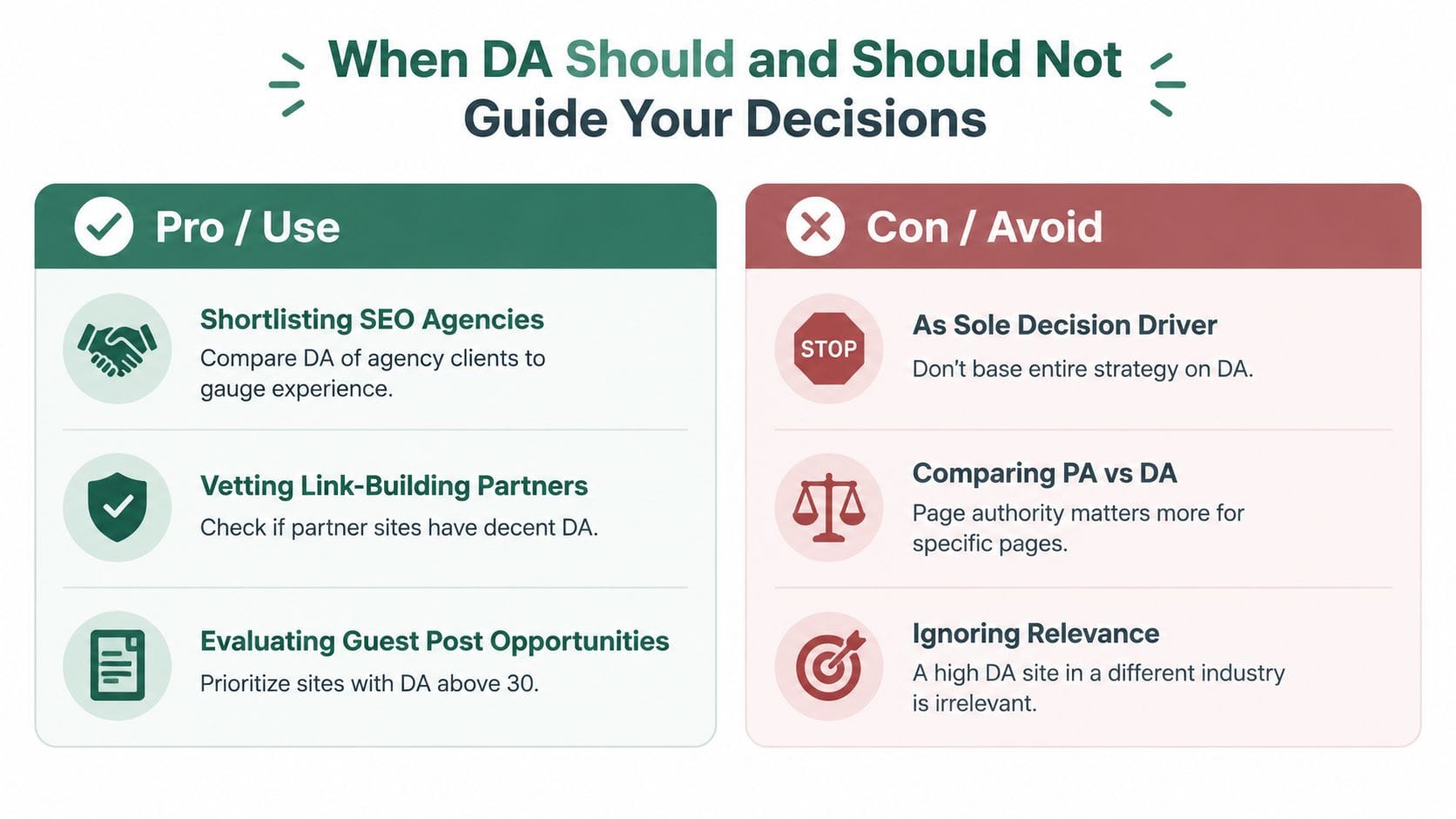
DA works best as a decision filter, not a decision driver. It can help an owner organise research, but it shouldn't decide where every dollar or hour goes.
When shortlisting two SEO agencies, a DA screenshot may help prompt questions about the agency's client work and reporting. It says little about the agency's process, technical ability or understanding of Brisbane search intent. If Agency A promises a DA jump but can't name three practical changes it would make to the website, the owner has a sound reason to keep looking.
A link-building partner deserves the same scrutiny. A high-DA website may still have little topical relevance, weak readership or an audience unrelated to the business. A relevant local or industry publication with a smaller score may create a more credible connection.
Situations where DA can assist
- Competitor benchmarking: Compare direct Brisbane competitors in the same service category, using the same provider and a consistent reporting period.
- Link opportunity review: Use DA as an initial filter, then inspect relevance, editorial quality, traffic signals and audience fit.
- Agency conversations: Ask what work sits behind the proposed metric and how the agency will connect it to rankings, enquiries and conversions.
- Domain decisions: Treat DA as one background input when considering a redesign or domain change, never as proof that a new domain will perform better.
Situations where DA should stay in the background
A single score can't show whether a backlink is genuine, whether a page serves the right suburb or whether a website is ready for a redesign. It also shouldn't discourage a business from publishing useful content or targeting a commercially important search phrase.
Before acting on any DA data point, ask one question: Does this information change a specific action this week? If it doesn't change the next page update, citation correction, outreach conversation or measurement decision, the number can wait.
Your 30 Day Authority Building Checklist
A Brisbane owner can make meaningful progress without handing over the entire marketing function. The checklist below keeps the first month focused on evidence, consistency and useful relationships.
Week one, establish the baseline
- Audit the domain: Check the site in Moz, Ahrefs and Semrush, but record the provider beside every score.
- Export existing links: Review referring websites and flag obvious irrelevance, lost relationships or useful opportunities.
- List enquiry searches: Write down the five search terms customers mention or use when contacting the business.
- Time allowance: Set aside a focused review session rather than checking scores repeatedly.
Week two, clean local information
- Check NAP details: Compare the business name, address and phone number across Brisbane, Queensland, Australian and industry directories.
- Update priority listings: Correct the profiles most likely to be seen by customers and partners.
- Record changes: Keep a simple spreadsheet with the listing, correction date and login owner.
Week three, strengthen important pages
- Connect related pages: Link service pages to relevant suburb pages and remove orphaned content.
- Tighten page signals: Improve titles, headings, service explanations and suitable schema markup.
- Time allowance: Work through the pages most closely connected to enquiries first.
- Further reading: SEO tips for small business provides a practical reference for prioritising limited resources.
Week four, begin genuine outreach
- Pitch local value: Send two useful digital PR ideas to relevant Brisbane outlets.
- Request one guest contribution: Choose an industry site where the topic and audience fit.
- Reclaim one mention: Find a business reference that lacks a link and request a natural attribution.
- Track responses: Measure conversations and relevant mentions, not just the DA score.
This process gives the owner a clearer authority baseline and a set of actions tied to local demand. A Brisbane digital marketing strategy becomes more useful when the score supports those actions rather than replacing them.