

99.7% of Australian adults used at least one device to go online in the first half of 2025, up from 90% in 2019, according to the Australian Communications and Media Authority. The same research puts mobile internet use at 97% of adults, with 91% going online through a phone several times a day.
That matters for a trade built on urgent work. A homeowner with a burning smell at the switchboard, a property manager who needs smoke alarms checked before a lease renewal, or a renovator comparing quotes for a new circuit all start in the same place, a search on a phone. Whoever appears with clear services, a tap-to-call number and evidence of local work gets the first conversation.
This is a practical guide to local SEO for electricians, written for a small Australian electrical business rather than a multi-state contractor. It treats suburb pages and review requests as lead-quality decisions, not a race to rank for the most postcodes, and it measures success the only way that counts, booked jobs.
The Local Signals That Decide Who Gets Called
93% of Australians searched online for local brands or hyperlocal businesses in 2024, according to the Yellow Digital Report 2024. That is the starting point for electrical search. A customer comparing a switchboard upgrade or a fault check starts on a search screen, then decides which business looks safe enough to call.
The signals that decide who gets the call are a short list, and most cost time rather than money. The mistake is treating them as a ranking contest. A suburb page only helps if it brings the right job. A review request only helps if it produces a useful, recent account of completed work. Booked jobs are the measure.
| Signal | What It Tells Google and Customers | Low-Cost Action | Typical Time Needed |
|---|---|---|---|
| Google Business Profile | Confirms who you are, where you work and what you do | Claim it and complete every field with accurate details | About 2 hours once, then 30 minutes a month |
| Consistent name, address and phone | Shows your details match everywhere they appear | Check your website, directories and social profiles against one master list | About 1 hour |
| Google reviews | Shows real customers were satisfied and recently | Ask each customer after a completed job using the same short message | About 5 minutes per job |
| Service pages for each core job | Matches a specific search, such as a switchboard upgrade in a named suburb, to a relevant page | Write one clear page for your most common job first | About 4 to 6 hours per page |
| Mobile page speed | Keeps a customer searching on a phone from leaving before calling | Test your homepage on your own phone and compress large images | About 1 hour |
Two rows often decide whether the phone rings. A complete profile tells Google which searches you belong in and tells a nervous caller whether you handle their exact problem. A half-filled listing loses to a competitor with fewer reviews but clearer details. Matching name, address and phone details stop both Google and the customer from wondering which version of your business is real.
Reviews work on recency as much as volume. A batch of old reviews reads as a business that stopped caring. Three specific reviews from the past two months read as a business that is busy now. Ask for detail that helps the next customer, such as the job type, the suburb and whether the electrician arrived when promised. That is more useful than a stream of one-word praise.
Slow mobile pages create the opposite effect. A customer with a dead power point will not wait while a phone loads oversized photos before it shows a call button. Test the homepage on your own phone, compress large images and keep the number visible. The aim is a fast path from problem to enquiry.
Getting your details consistent across the web is dull work made faster with a single master record, the approach set out in this business listing management guide. For a sense of how a well-structured trade site presents service areas and contact details on one page, local electrical contractor is a reasonable reference point.
The baseline test: search your business name and suburb on a phone and write down what appears, including the map listing and your website. That list is the starting point for everything that follows.
How to Set Up Your Google Business Profile
A national survey of 1,300 Australians found that 82% were extremely likely to trust a search engine when finding a local service, compared with 23% who were extremely likely to rely on friends and family, as reported in this analysis of electrician search behaviour. The profile is where that trust is either earned or lost before anyone reaches your website.
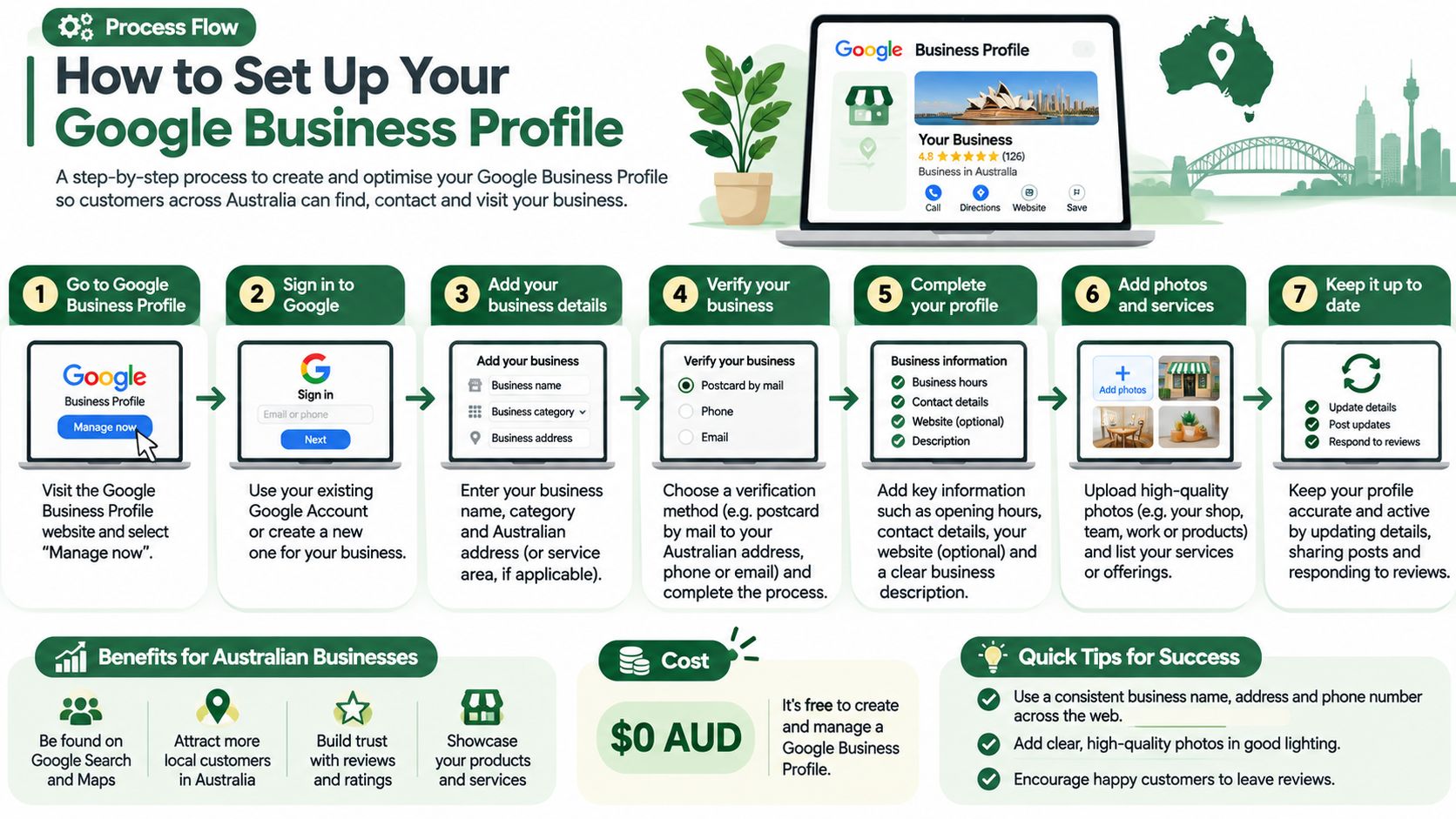
Here's the sequence that works, field by field.
Work Through the Fields in This Order
Claim and verify the profile on a shared business login. Verification usually runs through a postcard or phone call, so allow several days before you plan any promotion around it. The common slip is using a personal Gmail that disappears when a staff member leaves.
Set your primary category to Electrician. Add a secondary category only for work you'd take every week, such as Solar installer. Wrong categories send you calls you can't serve, and those callers leave one-star reviews.
List the suburbs or travel distance you cover. A list you can reach quickly builds trust and reduces wasted travel. An inflated list produces call-outs you have to decline, which costs goodwill and office time.
Enter opening hours and state plainly whether you take after-hours or emergency call-outs. Customers searching at 9pm need to know if anyone answers. The slip here is a 24/7 claim that goes to voicemail, which is worse than no claim at all.
Copy the exact business name, address and phone number from your website. No added keywords in the name field. Keyword-stuffed names breach Google's guidelines and risk suspension, and a suspended listing vanishes from the map entirely.
Upload recent photos of completed work and add a few each month. A tidy new switchboard photographed straight on convinces people in a way stock imagery never will. A profile that never changes looks dormant.
Add each service with a short plain description, and put your licence number in the description. Customers check for credentials before letting a stranger near their board. Your licence number, insurance and any manufacturer certifications answer that question without a phone call.
Link the profile to the service page for your main job. When the search, the listing and the website all point to the same offer, the customer stops second-guessing. Pointing every listing link at the homepage wastes the click.
Step-by-step instructions for getting the listing live in the first place are covered in this guide to adding your business to Google. Budget about two hours for the first pass and 30 minutes a month after that for photos, service edits and review replies.
Finish with a check. Search electrician plus your suburb on a phone and confirm the listing and the website appear together, with the same hours and the same phone number.
Service-Area Pages Without Misleading Suburb Spam
A useful area page answers a local question. A template with the suburb name swapped in does not, and customers spot it within two lines.
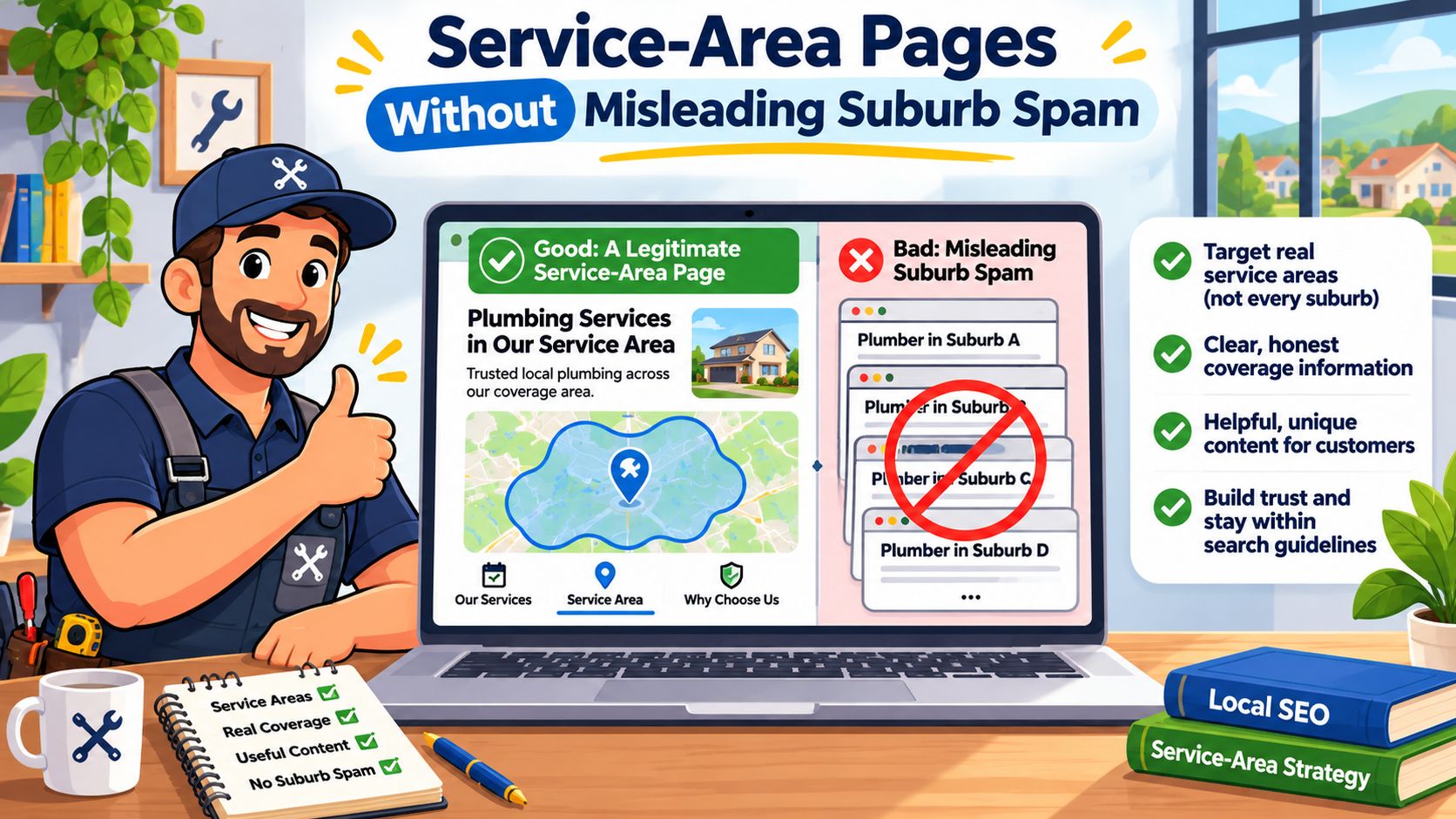
The most common version of this mistake is one page per suburb, generated from a single template with the place name changed. It looks thin to Google and, worse, it implies you work everywhere. Customers then call from suburbs you can't reach in under an hour, and the conversation ends badly for both sides.
The market pressure is real. 97.3% of Australia's 2.73 million actively trading businesses were classified as small businesses in June 2025, according to analysis of Google Business Profile practice. A Brisbane electrician competes in a crowded field, and thin pages are how that field gets crowded with noise.
What a Genuinely Useful Area Page Contains
- Real travel limits and response times. Say which suburbs you reach and roughly how fast, including whether an emergency call at 7am on a Sunday is realistic.
- Call-out and quote policy in plain words. Whether there's a minimum charge, what a quote costs, and what the customer gets for it.
- Emergency availability stated clearly. Days, hours and what happens after them.
- Licence and insurance details. The facts a careful homeowner checks before opening the door.
- Completed work in named suburbs. Real photos where you have permission, with the job type described.
- Answers to the phone questions. Whether you come to a particular suburb, how quickly, and whether parking or access is a problem in that area.
The test is simple. Take the suburb names out of the page and read it again. If it still helps someone decide whether to call, it's doing its job.
If a page falls apart once the place names are removed, it was never about the place. Rewrite it or delete it.
Aim for a small set of pages rather than a large one. One page for each core job, such as emergency call-outs, switchboard upgrades, smoke alarm installation and electrical safety inspections, plus a handful of area pages for suburbs where you've worked.
Maintain them on a six-month cycle. Review each page, update any changed policy or travel limit, and add a recent job example. That keeps the content honest and saves the rewriting job that builds up when a page goes stale for three years. A useful comparison for how service and suburb information should read is this guide to hiring trusted Brisbane electricians, which answers the questions customers ask before they pick up the phone.
Reviews That Build Trust Within the Rules
Four shortcuts will cost you more than they win. Never offer a discount, gift or free service in exchange for a review. Never write or buy reviews. Never ask only the customers you expect to be happy. Never delete or hide criticism.
Genuine, non-misleading reviews are what Google's policies and Australian Consumer Law expect, and they're also what customers trust. The Australian Government's guidance on online reviews notes that online profiles appear on platforms including Google Maps, Bing and Yelp, and that reviews can boost local search rankings, making it easier for new customers to find a business. The same guidance recommends asking customers through follow-up messages.
That gives a straightforward process.
Send one short message after the job is signed off. Thank the customer and include your Google review link. Not three days later, while the work is still fresh.
Invite specifics without writing the review for them. A line like "feel free to mention the switchboard upgrade if you have a moment" is fine. Drafted wording is not, and it reads as scripted.
Ask every customer, not the ones who seemed pleased. Selective asking is review gating, and it distorts the picture customers rely on.
Reply to every review, including the rough ones. Acknowledge the problem, state the facts once, and offer to sort it out by phone. Prospects reading the reply are judging how you behave when something goes wrong.
Log each request and each review in a simple spreadsheet. Date requested, date received, and any enquiry that followed. It takes a minute and tells you whether the process is working.
The mechanics of collecting and replying are covered in this guide to Google Business Profile reviews, including how to find your review link quickly.
Ask everyone, pay no one. The two rules that keep a review profile credible are also the two rules that keep it compliant.
At roughly five minutes per job, this is the cheapest trust asset an electrical business has. A steady trickle of recent, specific reviews beats a burst of twenty collected after a marketing push, because recency is what a customer scanning the listing notices first.
How to Track Which Leads Come From Local Search
Profile views and website visits show what people looked at. Booked jobs show what's worth your attention. Those are different numbers and only one of them pays the crew.
The Australian Government's digital strategy guidance supports using free analytics to connect marketing activity to real results. It notes that Google Analytics can monitor website traffic and show how effective content and digital advertising are at driving sales, and recommends using that data to decide what's working and what needs to change. The measures it lists include visitor numbers, visitor location, how people found the site and which pages they viewed, while email platforms report open rate, click-through rate, bounce rate and unsubscribe rate.
None of that needs paid software. What it needs is a way to connect a source to an outcome.
| Measure | Where to Find It | Decision It Supports |
|---|---|---|
| Calls from your Google Business Profile | Profile insights or a separate call tracking number | Keep profile updates that bring calls and stop those that do not |
| Direction requests by suburb | Profile insights | Check which suburbs are visiting you and whether your area page covers them |
| Enquiry form submissions by source | Website analytics or your form tool | Improve the service page that gets visits but few enquiries |
| Booked jobs by source | Your job sheet or spreadsheet | Decide where to spend your next hour of marketing time |
| Review requests sent and reviews received | Your review spreadsheet | Adjust the wording or timing of the follow-up message |
The glue is one question asked on every call and one field on every form. "How did you hear about us?" takes ten seconds to ask and gives you a source for every enquiry. Record it next to the job type and whether it converted.
Then spend about 20 minutes a week on three questions. Which source produced booked jobs? Which page produced enquiries but no bookings? Which activity produced attention and nothing else?
Change one thing at a time, such as the emergency page or the review message, and check the result the following month. A step-by-step method for connecting spend to outcomes sits in this guide to measuring marketing ROI.
What Local SEO Looks Like for Three Electrical Businesses
The three scenarios below are illustrative, built to show how the same steps change with the work you sell. They aren't reported client results, and the numbers are typical ranges rather than measured outcomes.
The market they sit in is substantial. Jobs and Skills Australia's occupation profile for electricians reports 136,100 employed electricians, with 85.9% working full time and construction as the main employing industry. That mix of domestic and construction demand is why two electrical businesses in the same city can need completely different pages.
A Sole Trader Covering a Handful of Suburbs
A residential electrician working across a defined patch of southern Brisbane suburbs has one job above all others, being findable and callable. The priority list is a profile with accurate suburbs and hours, one emergency call-out page that loads a phone number first, and a review message sent after every job.
Weekly time is about 30 minutes, mostly review requests and a couple of job photos. The measure to watch is calls from the profile. If that stays flat for a month, the fix is usually the primary category or the service list, not more suburb pages.
A Small Commercial Contractor Doing Fit-Outs
A contractor fitting out shops and offices sells to a different buyer, one who checks documentation before price. The priority is a service page for commercial fit-outs that describes typical project sizes, the licence and insurance evidence clients ask for, and the kind of premises you've worked in.
Reviews should come from business clients and name the project type, because "refit of a retail tenancy" reassures a property manager in a way that "great job" never will. The measure to watch is enquiries from that commercial page. If it stays flat, the page usually lacks specifics about scope and process.
An Electrician Who Also Installs Solar and EV Chargers
Two services in one business need two pages. Someone searching for an EV charger installation wants a page about chargers, not a paragraph buried between ceiling fans and safety switches. The priority is separate pages per service and a profile that lists both with accurate categories.
The measure to watch is enquiries by service page. If charger enquiries stall while general work holds up, the fix is usually the page itself, missing details on switchboard capacity checks or which hardware you install.
How AI Search Tools Find Local Electricians
Tools such as ChatGPT, Google AI Overviews and Perplexity answer questions by drawing on publicly available business information, not just a list of ranked links. When a customer asks one of them for a good electrician in their suburb, the answer is assembled from your profile, your website, directories and reviews.
This is no longer a niche channel. The Australian Government's AI Adoption Tracker reported in June 2025 that 41% of Australian small and medium-sized enterprises were adopting AI, up 5 percentage points from the previous quarter. Your customers are among them.
The mechanism is indirect. When your business name, suburb coverage, phone number, licence details and reviews agree across your profile, website and directories, these tools have consistent facts to work from. When they disagree, the tools either describe you wrongly or leave you out.
A Brisbane example makes it concrete. If the profile lists after-hours call-outs but the website never mentions them, the tools have two versions of the same business and no way to pick one.
Ask two AI tools a real question. "Who is a good electrician in [your suburb] for a switchboard upgrade?" Note which businesses appear and which sources they cite.
Compare what they show with your listing. Fix any mismatch in hours, services, phone number or suburb coverage on the page the tool cited.
State licence, insurance and service area plainly on your home page. Plain text, not an image of a certificate.
Budget 30 minutes a month. No tool guarantees a mention, so the goal is accurate information rather than a ranking promise. A wider comparison of how these assistants handle trade enquiries sits in this compare AI assistants for electrical services, and the broader groundwork is covered in this guide to AI-powered SEO.
Your Local SEO Checklist for This Week
A full week of local SEO for an electrical business is about two hours, split into blocks that fit between jobs. The point is not to rank for every suburb you can name. It is to make the next enquiry a booked job: correct details, a review from a real customer, and a way to see which calls came from search.
Search your business name and suburb on a phone. Note the map listing, your website, and how far you scroll before either appears. Ten minutes. If a neighbouring suburb outranks your own service area, that is a lead-quality problem, not a reason to publish thin suburb pages.
Open your Google Business Profile and check the basics. Match name, address, phone, hours, services and suburbs to the setup you already decided. Twenty-five minutes. Drop any suburb you will not travel to. A profile that overclaims coverage sends jobs you cannot take.
Compare those details with your website and two directories. Fix disagreements, starting with an old phone number. Twenty minutes. One wrong number wastes the call you already earned.
Send the short review message to your last five completed customers. Same wording each time, no incentives, no picking only the easy jobs. Twenty minutes. Ask people whose work you would want a new customer to judge. A stack of vague five-star lines does less for trust than a few reviews that name the job.
Add "How did you hear about us?" to your enquiry form or job sheet. Five minutes. From the next job onward you can separate map calls, website forms and word of mouth, and judge the week by booked work rather than impressions.
Pick one service page, usually your main emergency or upgrade job. Put the phone number, suburb coverage and licence details where they can be read on a phone without zooming. Forty-five minutes. That page should tell a caller whether you cover their street and can do the job, not list every postcode in the region.
These steps stand on their own. They need no ad budget and no subscription.
If you want a second set of eyes, Boocoo's local SEO covers Google Business Profile optimisation and local citations, and each client gets one dedicated strategist who knows the business, goals and competitors. Call 1300 093 797 or email hello@boocoo.au.