

Most Brisbane tradies don't have a lead problem first. They have a clarity problem. The phone goes quiet for a week, someone boosts a Facebook post, someone else pays for ads, the website sits untouched, and no one's fully sure which part is supposed to bring in actual jobs.
That's where most marketing for tradies goes wrong. Too many channels, no clear service area, and no simple system for turning attention into booked work. A plumber in Chermside, an electrician in Camp Hill, and a commercial painter chasing fit-out jobs in the CBD shouldn't be using the same plan.
The fix is simpler than most agencies make it sound. Start with local search, build a mobile-friendly path to enquiry, use the right social platform for the type of client being targeted, and keep lead handling tight enough that no good enquiry goes cold.
Laying the Groundwork Your Goals Budget and Niche
A Brisbane tradie can waste a month on marketing just by being too broad. “Need more work” sounds obvious, but it doesn't help decide whether the next dollar should go into Google, a website fix, or review collection.
Set the target before spending
Start with one clear business outcome. For a sole trader doing residential work, that could mean more quote requests in suburbs close to home. For a small crew chasing commercial work, it could mean landing better-fit enquiries from builders, property managers, or developers.
A simple way to frame it is:
- Pick the work type: residential maintenance, renovations, emergency jobs, or commercial projects.
- Pick the area: for example, Northside only, inner south, or CBD and fringe suburbs.
- Pick the lead action: calls, quote forms, or repeat customer bookings.
That immediately changes the marketing approach. A blocked drain service targeting Everton Park and Kedron needs speed and visibility. A cabinetmaker chasing larger fit-outs needs credibility, examples of completed work, and the right referral network.
Practical rule: if the goal can't be explained in one sentence, the marketing spend will drift.
Pick a budget that matches reality
Budget is where a lot of small operators get sold the wrong thing. Not every tradie needs a full website rebuild, ongoing SEO, content production, and ads from day one.
For Brisbane tradies, launching a Google Business Profile is the highest ROI initial step because it is free, while a basic website costs between $1,000 and $3,000, and SEO services range from $500 to $2,000 per month. Campaigns also need time. Most take 3 to 6 months to generate consistent, profitable leads. Those cost and timing benchmarks are noted in this guide to high-ROI lead channels for tradies.
That means a small budget should usually be split by stage, not spread across everything at once.
| Budget level | What to prioritise first | What to avoid |
|---|---|---|
| Very lean | Google Business Profile, reviews, job photos, basic follow-up system | Broad ad campaigns across all Brisbane |
| Moderate | Google Business Profile, simple website improvements, one ad channel | Paying for content that no one sees |
| Larger but still cautious | Local SEO, one paid channel, repeat customer email follow-up | Locking into too many services at once |
Choose a niche and service area people actually search for
The quickest way to waste time is marketing “all services in all suburbs”. Brisbane customers don't search that way. They search by problem and place. Think “roof leak repair New Farm” or “electrician Mount Gravatt”.
Use the same logic in every asset:
- Service pages: one page per main service, not one page trying to cover everything.
- Suburb mentions: include the places that are important to the business.
- Photos: use recent work from local jobs, not generic stock images.
- Offers: keep them tied to real services such as switchboard upgrades, bathroom waterproofing, or patio cleaning.
A focused niche also makes quoting easier. Better-fit enquiries usually mean less back-and-forth, fewer dead-end site visits, and less time spent explaining work that was never profitable in the first place.
Mastering Local Search Your Website and Google Profile
Google is still where most tradies win or lose local visibility. Historical industry data shows that over 75% of homeowners in Australia search for local tradies primarily through Google before contacting a business. If a business doesn't look established there, many customers won't make it to the next step.
Google Business Profile first
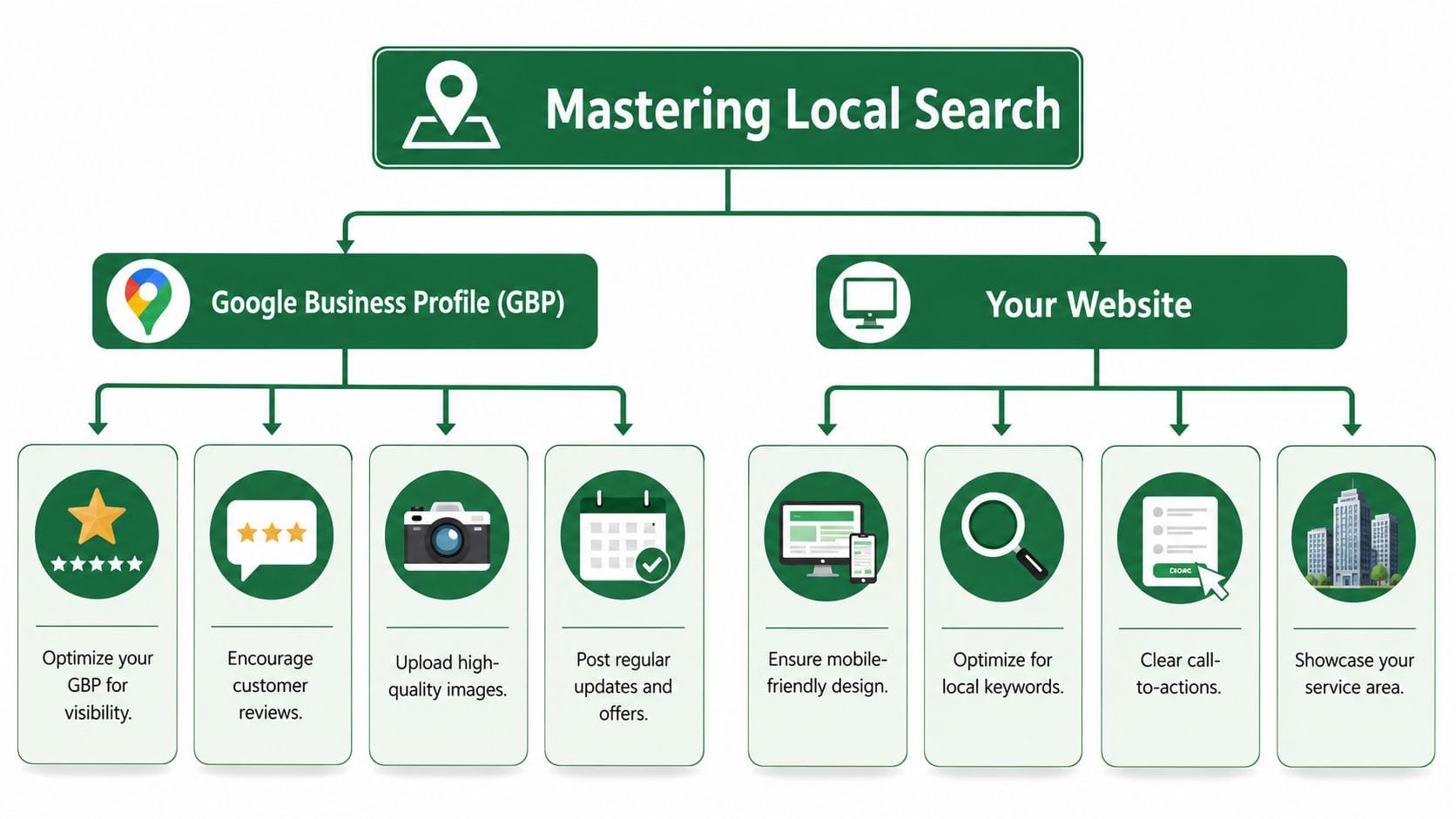
For a small business budget, Google Business Profile does the heavy lifting early. The setup has to be specific. Don't leave the service area vague. Brisbane tradies should list precise suburbs in the profile instead of only using “Brisbane”, because suburb-level detail helps local relevance in search. A practical walkthrough on suburb targeting sits in this article on Brisbane local SEO.
There are a few basics worth doing properly:
- Service categories: choose the closest real match to the trade and supporting services.
- Photos: upload recent job photos, team photos, van signage, and finished results.
- Posts: add short updates, seasonal offers, or recent jobs.
- Reviews: ask every happy customer while the job is still fresh.
Review collection matters because tradies who collect and display at least 10 positive Google reviews see a 30% increase in click-through rates on local search results. That's one of the clearest trust signals available in local search.
A website that helps the customer act fast
A tradie website shouldn't behave like a brochure. It should behave like a dispatcher. The visitor wants to know three things quickly: what the business does, where it works, and how to get in touch.
In the AU region, 82% of trade service searches occur on mobile devices. At the same time, 65% of Australian tradie websites fail Google's Mobile Usability test due to slow load times and poor button design. Sites built around a single-column mobile stack with a sticky Call Now button and a Book Now form in a modal achieve an average conversion rate of 4.8%, compared with the 1.2% national average for sites without that setup.
That's why the homepage and service pages should be stripped back. Keep the top section focused on one service promise, one area, and one action.
A website doesn't need more pages first. It needs fewer blockers between the visitor and the call.
For trade-specific page ideas, this electrician marketing playbook is useful even outside electrical because it shows how local service pages, calls to action, and suburb targeting can be structured clearly.
Clean up the local signals Google checks
One of the most common technical problems in marketing for tradies is inconsistent NAP data, meaning the business name, address, and phone number don't match across directories.
For Australian tradies, that inconsistency across places like TrueLocal and Hotfrog directly affects local visibility. Research shows tradies who complete a clean data protocol see a 35% increase in click-to-call actions within 90 days.
The work itself is unglamorous but worth doing:
- Audit every listing using the exact same business name, phone number, and address format.
- Fix key directories manually rather than assuming an old listing is close enough.
- Check the website footer so the business details match what appears elsewhere.
- Keep suburb references aligned with the actual service area.
If help is needed with the citation side, Boocoo offers tradie-focused local SEO work that includes Google Business Profile optimisation and citation cleanup. For many Brisbane operators, that's the kind of back-end fix that makes the front-end marketing work better.
Simple Social Media and Content That Gets Jobs
Social media only becomes a time sink when it's treated like entertainment instead of proof. Tradies don't need a content studio. They need a repeatable way to show recent work and prompt an enquiry.

A simple pattern works well. Take before and after photos at the end of a job, write one plain-English caption, and post it where the right buyer is already paying attention. Australian small trade businesses can save over 15 hours per week on content creation by using free social platforms like Facebook, Instagram, and LinkedIn to showcase work instead of paying the $2,000 to $5,000 monthly cost of professional video production. One practical example is posting three high-resolution before and after photos with a direct caption such as “Quote in 2 hours”.
A simple content routine for residential work
For Brisbane residential tradies, the platform choice is more straightforward than many people think. 68% of residential tradies in the region rely on Facebook for customer leads, according to Brisbane City Council data.
That makes Facebook the practical home for content like:
- Before and after albums: driveway cleaning, bathroom updates, fencing repairs, deck restoration.
- Short local captions: mention the suburb and service without overthinking the copy.
- Fast response prompts: “Need a quote this week?” or “Taking bookings in Paddington and Red Hill”.
A good caption doesn't need polish. It needs context. “Completed a hot water system replacement in Carindale today. Old unit out, new one running by lunchtime. Message for a quote.” That's enough.
For businesses wanting stronger website copy to support those posts, this guide on content writing on website helps tighten service pages so the traffic from social doesn't hit a weak landing page.
What to post when targeting commercial work
Commercial work is a different sale. The buyer is often checking reliability, scope, communication, and evidence that the business can handle site rules and timelines.
That's why LinkedIn matters more in that segment. 45% of commercial tradies in Brisbane report LinkedIn as their primary referral source.
Content for commercial targeting should look more like this:
| Post type | Why it works |
|---|---|
| Project progress updates | Shows organisation and consistency |
| Finished site photos | Gives visual proof without heavy sales language |
| Team and compliance snapshots | Builds trust with builders and facilities managers |
| Brief problem-solution posts | Demonstrates competence in practical terms |
There's also a format advantage in video. A 2025 report by the Australian Small Business Advisory Network found tradies using video content on Meta platforms saw a 40% higher engagement rate than static images, with 30 to 45 second short-form videos performing best.
The content that gets jobs usually looks ordinary. A clean photo, a real suburb, and a direct call to action beat clever branding most days of the week.
Paid Ad Recipes for Instant Leads on a Budget
Paid ads can fill gaps quickly, but they punish vague setups. If the targeting is loose, the service list is too broad, or the landing page is clunky, the budget disappears before the right customer even lands on the site.
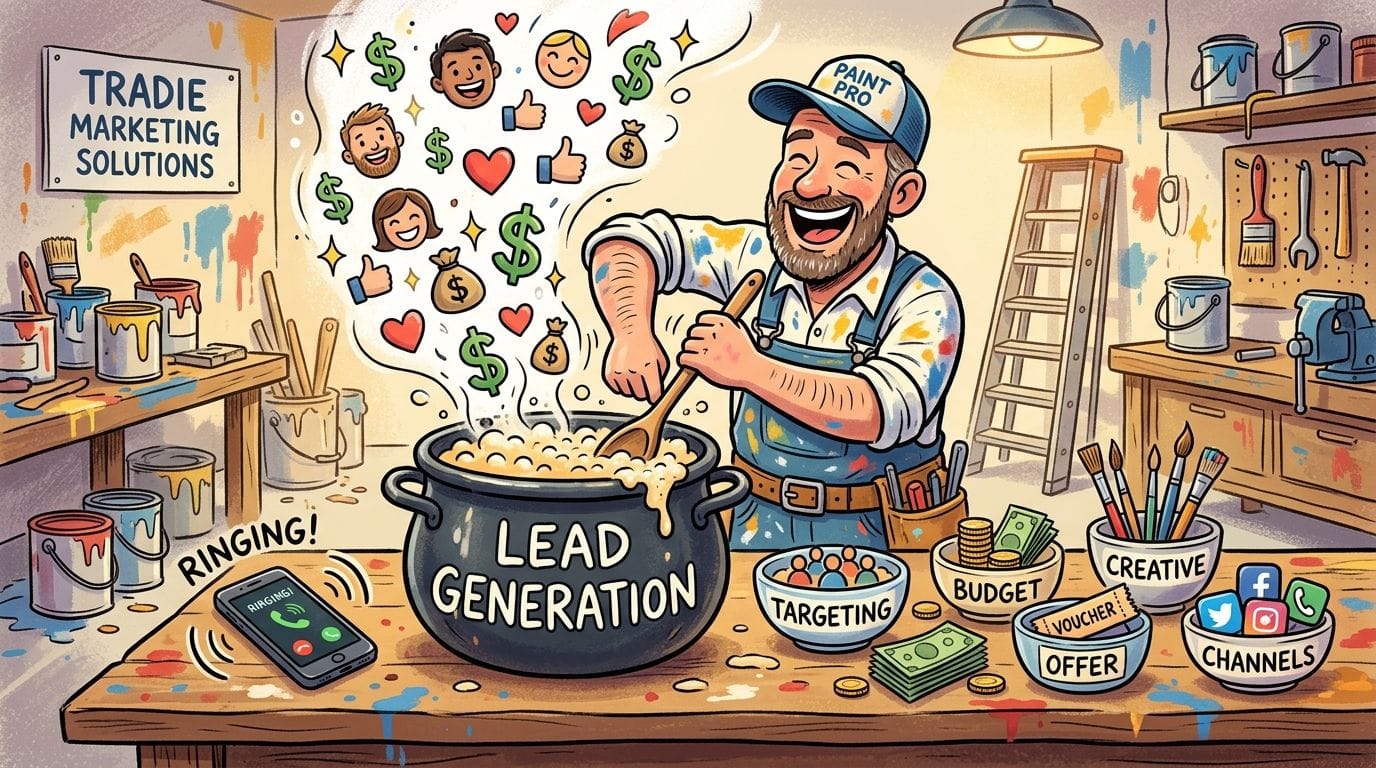
The useful way to approach ads is as recipes, not campaigns with endless moving parts. One service, one location group, one clear action.
Keep paid ads narrow and practical
In the Australian trades sector, paid digital campaigns can produce a cost per lead from $41 for high-intent keywords. That figure applies to targeted search terms with strong buyer intent, not broad vanity traffic. The same data also shows 60% of tradies using an integrated strategy with Google Ads and Meta Ads report a 25% increase in qualified leads within the first year.
That only works when the account stays disciplined. For a small operator, “all plumbing services across Brisbane” is usually too loose. “Emergency plumber northside” or “roof repair inner south” is far easier to control.
A good paid setup should answer these questions fast:
- What exact job is being promoted?
- Which suburbs matter most?
- Is the customer meant to call or fill out a form?
- Can the business respond quickly during ad hours?
For budgeting context on Meta campaigns, this breakdown of how much Facebook ads cost is useful when comparing enquiry costs against search ads.
Three ad setups that suit small tradie budgets
Google high-intent search ads work best for urgent, problem-based services. They catch customers already looking for help. Keep the keywords close to the actual service and service area. If the lead quality is poor, it usually means the terms are too broad or the ad copy is too generic.
Google automated local campaigns suit time-poor operators who need a simpler setup. They won't offer the same control as a tightly managed search campaign, but they can still support local lead flow if the business profile, service categories, and landing page are already tidy.
Facebook and Instagram ads make more sense for visual trades and non-urgent services. Think patios, painting, landscaping, bathroom upgrades, and pressure cleaning. Use local targeting, recent job photos, and a basic quote form. Don't send that traffic to a cluttered homepage.
Budget call: if every ad channel is switched on at once, none of them gets enough focus to improve.
From Enquiry to Invoice Lead Capture and Referrals
A lead isn't valuable because it arrived. It's valuable when someone follows it up, qualifies it, prices it properly, and gets the job booked.
A lot of tradies lose good enquiries after spending money to generate them. The problem usually isn't software. It's that no one has a clean handover from phone call, message, or form to actual quote and follow-up.
Lead capture that doesn't need fancy software
A spreadsheet is enough for many small teams. The system only needs a few fields:
- Customer name and suburb
- Job type
- Where the lead came from
- Date and time received
- Quoted or not quoted
- Won, lost, or pending
That one sheet makes the patterns obvious. It shows which service pages attract junk leads, which suburbs convert well, and whether ad spend is feeding the type of work the business wants.
Fast response matters too. If the phone can't be answered consistently, a backup system helps. For trades that deal with urgent calls, services like AI reception for HVAC and plumbing businesses are worth reviewing because they cover the gap between missed calls and proper follow-up.
Referrals that are trackable and worth running
Word-of-mouth is still one of the strongest lead sources in the trades. The issue is that many businesses leave it unstructured, so the referral happens but never gets tracked, rewarded, or repeated.
That's where a simple referral program helps. Offering a $50 gift card or 10% discount for a successful referral can generate 30% of new business for local service operators at a cost of only $0.50 per lead, compared with the $45 to $65 per lead cost of paid Google Ads.
A practical referral setup looks like this:
- Choose one reward and keep it simple. Don't run multiple offers.
- Create a referral code linked to the referring customer.
- Mention it on invoices and follow-up messages after a completed job.
- Log every referral source in the same lead sheet used for other enquiries.
- Pay the reward promptly once the referred job is complete.
There's another reason to handle this properly. Australian Privacy Principles and ACMA research indicate 74% of small tradies in Queensland avoid collecting referral data due to privacy concerns, resulting in a 30% loss in potential repeat business. The safe path is straightforward: ask for consent, explain what information is being collected, and only store what's needed to process the referral.
Email also deserves a place here, especially with past customers. In the AU region, email campaigns for tradies have shown a 35% higher conversion rate for repeat customers compared with cold leads, and businesses sending monthly newsletters with DIY tips and promotions see a 20% increase in customer retention.
Your 30-60-90 Day Brisbane Tradie Marketing Plan
Most tradies don't need a huge strategy deck. They need a short plan they can follow between jobs. The next ninety days should build from simple local visibility to a repeatable lead system, without piling on too many moving parts.
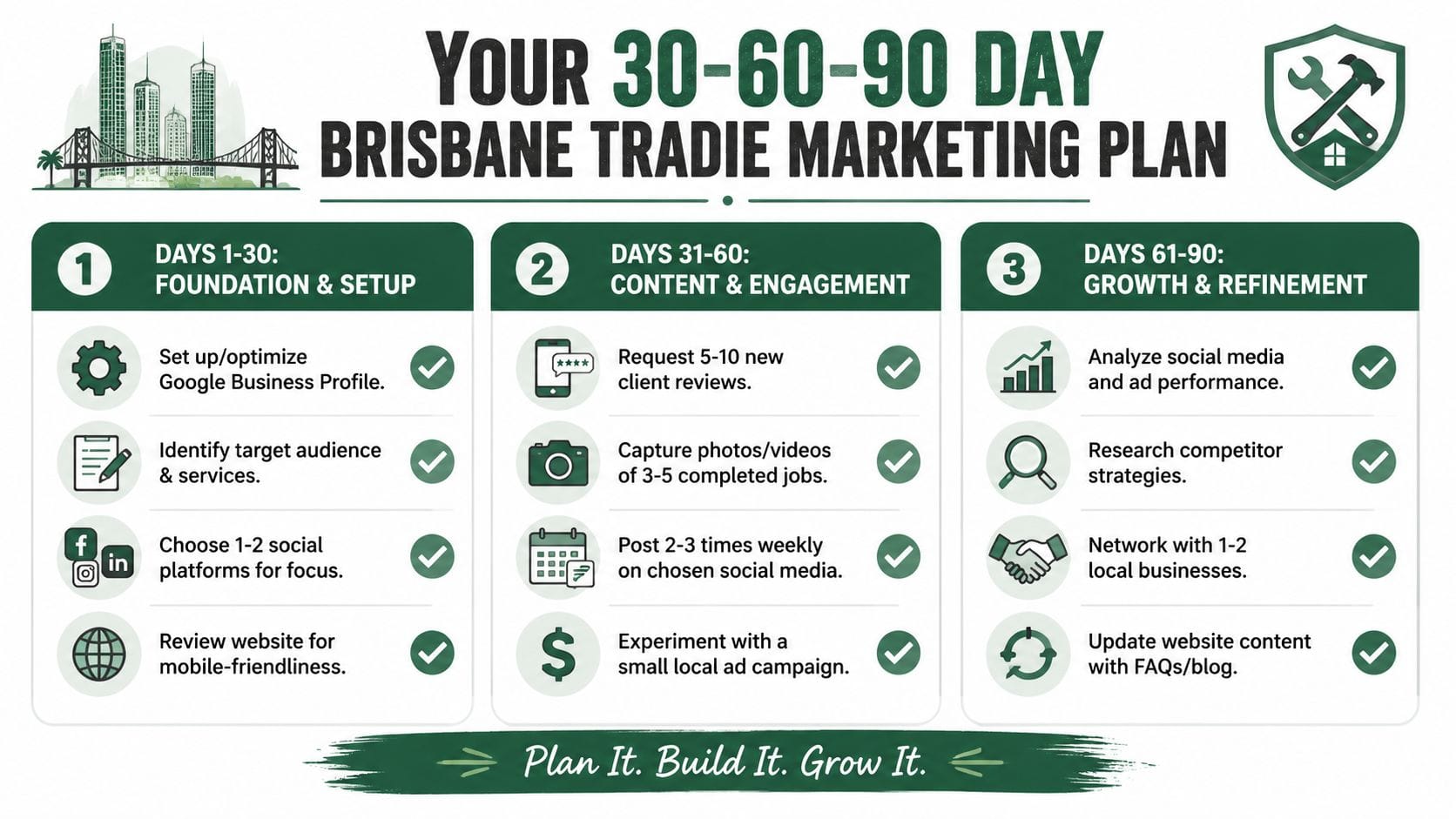
Days 1 to 30
Start with the assets that affect enquiries immediately.
- Finish the Google Business Profile properly: categories, service descriptions, real photos, opening hours, and suburb-level service areas.
- Tighten the website mobile experience: in the AU region, 82% of trade service searches happen on mobile, and a mobile-first website with a sticky Call Now button can reach an average conversion rate of 4.8%, compared with the 1.2% national average.
- Create one lead sheet: every call, form, text, and message goes into the same place.
- Pick one customer type: residential homeowner or commercial buyer. Don't try to speak to both with the same message.
The outcome to aim for in this phase is simple. A customer should be able to find the business, trust it quickly, and contact it without friction.
Days 31 to 60
This phase is about consistency, not volume.
Take photos at completed jobs. Save them in labelled folders by service and suburb. Turn them into short posts for the main platform that matches the target customer. Residential work suits Facebook. Commercial work usually needs a cleaner LinkedIn presence.
Add one paid test only if the basics are in place. Keep the targeting narrow and the action clear. If the business can't answer calls promptly, delay the ads and fix the response process first.
Good marketing for tradies often looks boring behind the scenes. Consistent photos, tidy listings, fast replies, and one offer repeated well.
Days 61 to 90
By this point, enough information should exist to make better decisions.
Review the lead sheet and check:
| What to review | What to look for |
|---|---|
| Best suburbs | Which areas send real jobs, not just tyre-kickers |
| Best service lines | Which services lead to profitable work |
| Best contact method | Calls versus forms versus social messages |
| Referral opportunities | Which customers are most likely to send repeat work |
Then add the referral program. Ask recent happy customers directly. Include the offer on the invoice email and in the follow-up message after job completion. Keep the wording plain and easy to share.
This is also the right time to trim what isn't working. If one channel brings poor-fit enquiries, pause it. If one page converts better, send more traffic there. If the website still feels slow on mobile, fix that before buying more traffic.
A Brisbane tradie doesn't need to win every marketing channel. The business only needs a small number of channels that consistently bring in the right jobs, in the right suburbs, at a cost that still leaves margin.