
Running a small business in Brisbane can feel like standing in the middle of a busy junction with too many signs and not enough time. One person says SEO, another says social, a third says ads, and meanwhile the phone still needs to ring, invoices still need sending, and the website still doesn't feel like it's pulling its weight. A good marketing strategy consultant cuts through that noise, not by adding more tactics, but by deciding what deserves attention first.
For Brisbane owners, that matters because local businesses are usually operating with lean teams and tight budgets. In Australia, small and medium businesses make up 97% of all businesses and account for roughly 70% of total employment, which means marketing support is mostly about helping owner-operators make sharper decisions, not building big in-house departments Consulting Success. That same data set shows there were about 2.59 million actively trading businesses in June 2024, so the market is crowded enough that vague marketing rarely wins Consulting Success.
A strategy consultant is a bit like an architect. They don't usually lay the bricks, paint the walls, or install the plumbing, they draw the plan, make sure the structure makes sense, and stop the owner from building the wrong thing in the wrong order. That's the difference between diagnosis and execution, and it's where a lot of Brisbane businesses get caught paying for the wrong kind of help.
What a Marketing Strategy Consultant Does
A Brisbane café owner, a tradie, or a local professional services firm usually doesn't need more opinions. They need someone to look at the whole marketing setup and say, “Leads are leaking here, this is worth fixing, and this can wait.” That is the core job of a marketing strategy consultant, and it is very different from hiring someone to post content or run ads.
Diagnosis before activity
Strong consultants start by identifying the bottlenecks. That might mean reviewing the website, the enquiry path, the current channels, the CRM, or the way follow-up is handled after a lead comes in. The technical value is often in the martech architecture and attribution design, where CRM, analytics, ad platforms, and automation tools are mapped so reporting reflects real demand rather than broken or duplicated conversions TrueSME.
That work starts with questions, not tactics. Which channels deserve budget, which messages need tightening, and how should website, search, and paid activity be sequenced so the owner is not guessing? Practical consulting guidance also centres on collecting and analysing website traffic, engagement, and conversion performance before iterating the plan Coursera. A consultant who skips that step and jumps straight to activity is usually selling motion, not direction.
Practical rule: if the consultant cannot explain how leads are tracked from first click to enquiry, they are not doing strategy, they are decorating.
Strategy is not execution
Many owners assume a consultant will handle the whole marketing job. That is where the mismatch starts. A strategy consultant may define the campaign path, but they do not always write the ad copy, manage the posting calendar, or build every landing page. Those are execution tasks, and they are often better handled by a freelancer or agency once the plan is clear.
For Brisbane businesses, that distinction matters because owner time is scarce. If a consultant spends their hours producing social posts or tinkering with ad creative, the business is paying strategy rates for production work. A better fit is usually a consultant who helps the owner make the right marketing decisions, then hands off a clear plan that can be executed efficiently. If the brief is about delivery rather than direction, a business may be better placed to sell consulting services around the strategic side and keep implementation separate.
For a useful primer on the broader concept, the Boocoo guide to what a digital marketing strategy is is a solid companion read, especially if the business is still deciding what kind of support it needs.

A good way to think about it is this. The consultant sets the course, the crew sails the ship, and the owner decides whether the route makes commercial sense. For small Brisbane firms, that kind of clarity can save a lot of wasted spend.
Typical Services and Deliverables You Can Expect
What should a Brisbane business receive when it hires a strategy consultant? A clear answer matters, because if the scope is fuzzy at the start, the work often drifts into busywork or generic advice.
What lands in your inbox
A proper engagement often starts with a marketing audit. That audit should show what is happening across search, website, email, social, and paid media, and where leads are dropping away. It might also point out obvious friction, such as a homepage that explains the business but does not invite enquiry, or a contact form that creates more hassle than it should.
Another common deliverable is a channel prioritisation framework. That is the part where the consultant says whether SEO, paid search, social, referrals, or email deserves attention first. For a Brisbane plumber, that answer may look very different from a boutique law firm or a local retailer, because the buying journey is different for each. If the consultant gives the same answer to every client, they are not really diagnosing anything.
Good strategy work should reduce choice, not multiply it.
Measurement and the plumbing behind the scenes
The most overlooked deliverable is the measurement setup. Australian small businesses already operate in a highly digital market, with 96.2% of households having internet access in 2021–22, 72% of people aged 15+ buying goods or services online in 2020–21, and the ACMA reporting more than 20 million Australians online in 2023 Shno Marketing Statistics. That makes conversion tracking and website-led lead capture core infrastructure, not optional extras.
A consultant should therefore be able to define what counts as a qualified enquiry, how it is tracked, and which reports matter. If the stack is broken, the business ends up trusting platform-reported conversions that may not reflect real demand. That is why martech architecture sits near the centre of serious strategy work.
The deliverable list often includes a roadmap too. That roadmap should say what happens first, what can wait, and what success looks like at each stage. For a small Brisbane business, that usually means fewer channels, tighter sequencing, and clearer measurement.
Strategy should also cover the handoff point. If the business needs help with execution after the plan is set, the consultant should spell out what stays in-house, what gets outsourced, and what the next operator needs to know. A useful strategist does not pretend to be a production team, and they do not leave the owner guessing about who owns what.
That separation matters for budgets as well as outcomes. A consultant can diagnose the problem, set priorities, and give the business a plan worth acting on. If the brief is really about implementation, a different setup may make more sense, and it is worth being clear about that before money gets spent on the wrong kind of help. For businesses that want a broader view of how content fits into that mix, Boocoo's content marketing services page is a practical reference point.
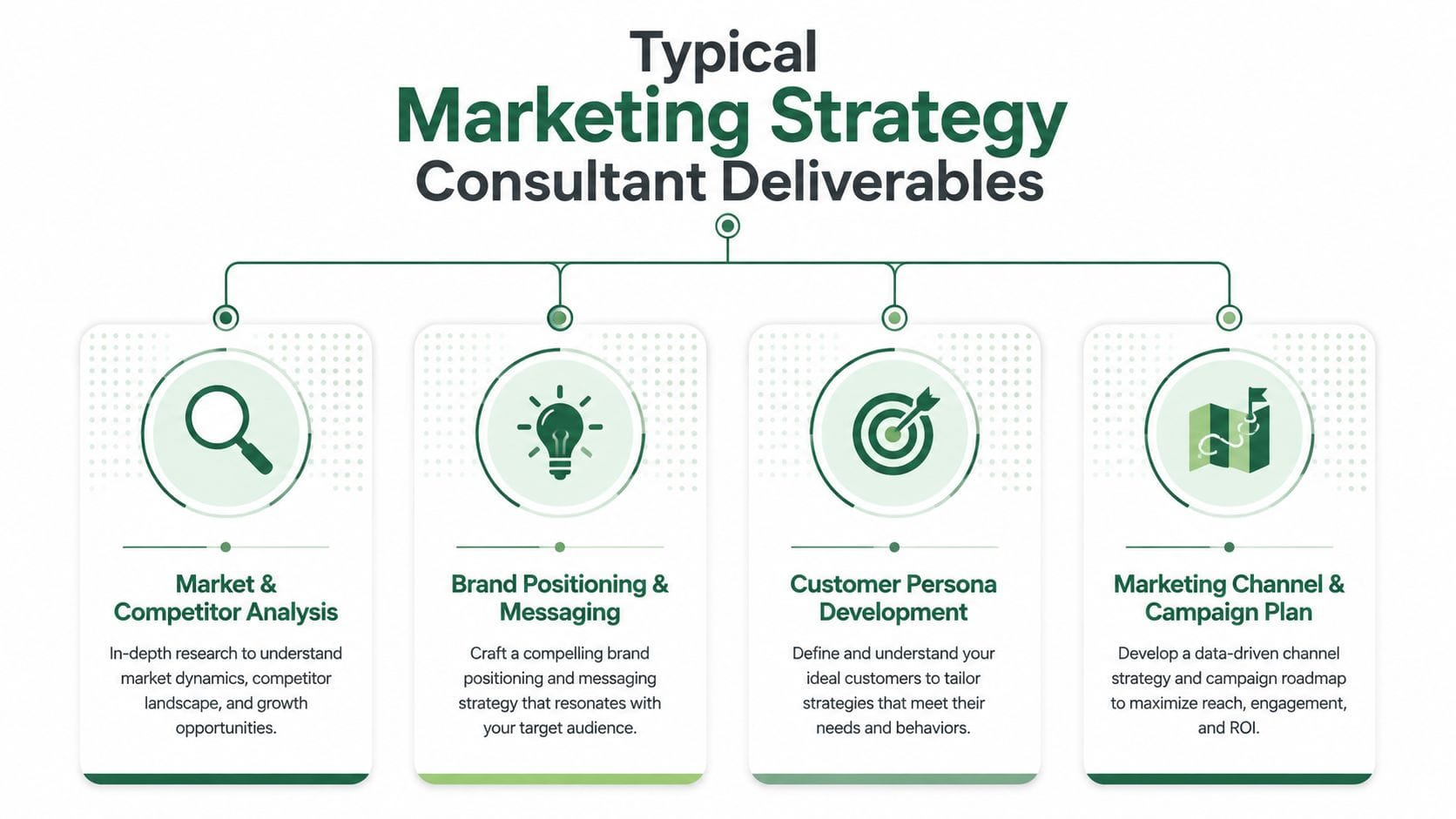
The best deliverables are not beautiful PDFs for the sake of it. They are decision tools that help a business stop wasting money on activity that feels busy but does not produce enquiries. When the work is framed properly, the owner can see whether they need strategic diagnosis and a plan, or whether they need hands-on delivery from someone who can execute.
Consultant vs Freelancer vs Agency vs DIY
A Brisbane owner staring at a stretched budget usually does not need more marketing options. They need a clearer call on whether the business needs diagnosis and direction, or whether it needs someone to do the work. Paying consultant rates for production is a waste. Paying agency rates for a one-off strategy deck is the same problem in a different wrapper.
Match the model to the job
A marketing strategy consultant fits when the business needs analysis, priority-setting, and a plan that can hold up under pressure. A freelancer fits when the strategy is already set and the work is about landing pages, ad setup, SEO implementation, or content production. An agency suits owners who want ongoing management across several channels and are prepared to pay for the extra coordination that comes with that arrangement. DIY works when the owner has the time, discipline, and systems to keep marketing moving without outside help.
The difference is practical, not academic. You would not use a power washer to detail a watch, and you would not pay a mechanic to polish the paint while the engine still misfires. The question is not which model sounds better on paper, it is which one matches the job in front of the business.
For a broader view of how agency support tends to fit, Boocoo's digital marketing agency for small businesses page is a useful reference. For a clearer sense of where advice ends and delivery begins, these agency freelancer SEO resources are helpful because they draw that boundary without the usual fluff.
| Model | Typical Cost Range | Strategic Depth | Time Required From You | Best For |
|---|---|---|---|---|
| Consultant | Defined by project or advisory engagement | High | Moderate | Businesses that need a plan, channel focus, and measurement clarity |
| Freelancer | Task-based or hourly | Low to moderate | Moderate to high | Businesses that already know what needs doing |
| Agency | Retainer-based | Moderate to high | Low to moderate | Businesses wanting ongoing multi-channel management |
| DIY | Cash-light, time-heavy | Depends on the owner | High | Very small teams with strong internal discipline |
Where each option breaks down
Consultants lose value when they are pulled into day-to-day execution. Agencies become expensive when the business only needs a sharp strategic answer, not a full-service team. Freelancers can do excellent work, but the output is only as strong as the brief and direction they receive. DIY can work, though only if the owner can protect time and keep measurement honest.
A simple rule helps. Use strategy when the business needs direction, use execution when the work already exists, and use an agency when the need is ongoing coordination across channels. That keeps the spend aligned with the problem and stops Brisbane owners from paying for the wrong layer.
How to Find and Evaluate the Right Consultant
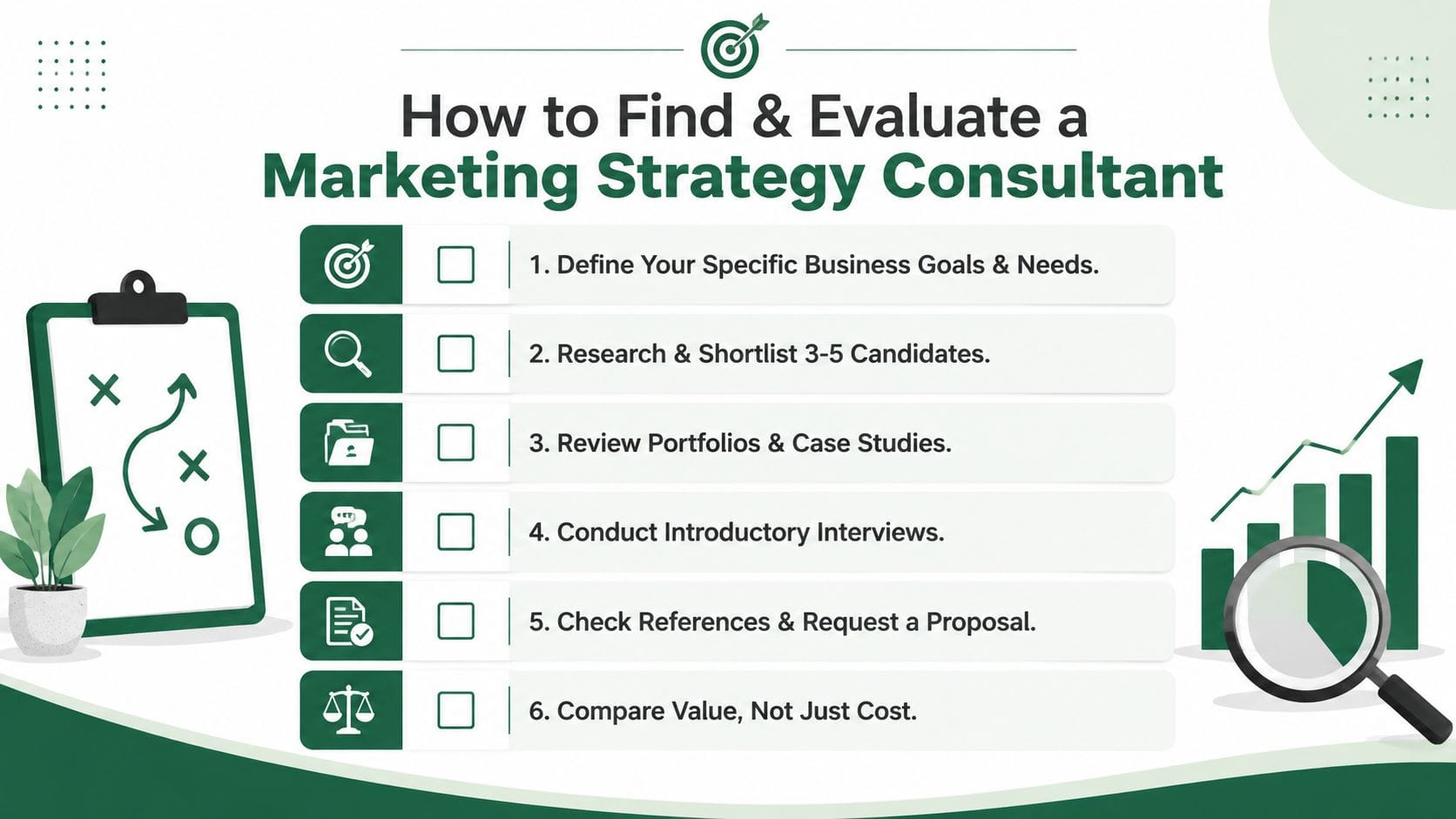
Most Brisbane businesses hire the wrong consultant because they confuse references with results. The safe-looking choice is often someone who talks well, shares polished slides, and lists familiar brands, while the better choice is the person who can diagnose what is holding the business back and say what should happen next.
Start with relevant proof
A strong shortlist usually comes from local referrals, professional networks, or consultants who publish useful thinking for owner-managed businesses. The portfolio should show work with businesses at a similar stage, like a 3-person trade company with a tight monthly marketing budget, not just polished enterprise case studies. A consultant who has helped a large national brand doesn't automatically understand a service business with limited staff and no spare budget.
The same applies to the type of work they show. If the business needs strategic diagnosis, look for evidence of planning, channel prioritisation, measurement decisions, and commercial outcomes. If the consultant only shows execution screenshots, content calendars, or ad creative, they may be better suited to delivery work than to shaping the plan.
Ask directly for examples of measurable outcomes they've influenced, how they think about attribution, and what they do when tracking is incomplete. The point isn't to demand a perfect number, it is to see whether they know how to connect marketing activity to commercial outcomes. Consultants who can't explain that loop are usually leaning on vague confidence instead of method.
If you want a practical comparison point, the same discipline that separates strategy from delivery here also shows up in areas like SEO packages for small business. The useful question is always whether you need a roadmap, implementation, or both.
Ask for the thinking, not just the deck.
Questions that expose fluff
Good questions tend to surface fast. “How do you decide which channel gets priority first?” is more useful than “What services do you offer?” “How do you separate a vanity metric from a useful metric?” is better than “Can you help with social media?” A useful consultant should be comfortable explaining why one channel matters more than another for that specific business.
Pricing questions tell you a lot as well. Ask how they scope work, what happens if the brief changes, and whether the fee covers strategy only or also ongoing execution. A consultant who stays clear about boundaries is usually more useful than one who tries to sell everything at once.
Watch for red flags. Promises of exact rankings or follower counts are a problem. So is a one-size-fits-all recommendation that always points to the same channel, no matter the business type. Another warning sign is fuzzy language around reporting. If the answer is never specific, the strategy probably won't be either.
The best evaluation process is blunt but fair. Review the proposal, check the fit, and ask whether the consultant's approach matches the business's current stage and budget. A smart consultant will make the owner feel clearer, not more confused.
Pricing Models and Contract Structures Explained
Pricing is where a lot of small businesses hesitate, then either overpay or stall. The best way to avoid that is to understand how consultants usually package their work and what should be written down before the work starts.
Common pricing structures
The cleanest model for a strategy engagement is often a project fee. That suits a defined deliverable such as a marketing audit, channel plan, or measurement framework. A monthly retainer works better when the consultant is advising over time, reviewing performance, and guiding decisions as campaigns evolve. A day rate can suit workshops or intensive planning sessions where the owner needs fast, concentrated input.
Consulting pricing discussions often point to a marketing budget of 5% to 10% of target revenue during the system-building phase, and a consultant aiming for $200,000 in annual revenue might budget $20,000 to $40,000 for marketing in the first year Logotio. Those figures are useful as a planning benchmark, but they still need to be matched to business size, cash flow, and the expected pace of growth.
For a simple explanation of ongoing fee structures, the guide on pricing retainer agreements is helpful because it shows why retainers only make sense when scope and rhythm are clear.
What a decent contract should say
The contract should spell out scope boundaries, revision limits, who owns the strategy documents, and how either side can exit if the engagement isn't working. It should also define what success is being measured against. For a small business, that means focusing on cost per qualified enquiry and time-to-payback, not impressions or follower counts.
The biggest mistake is buying a strategy deck without a measurement plan. The second biggest is buying ongoing support with no scope boundaries. Both turn into budget leaks quickly.
A straightforward contract protects both sides. The consultant knows what they're responsible for. The owner knows what outcome the work is meant to support. That's the level of clarity worth paying for.
Onboarding Your Consultant for a Strong Start
The first month can make the whole engagement work or waste it. If the consultant spends weeks waiting for access, chasing files, or decoding vague goals, the business has already burned through valuable time.
What to hand over before day one
The consultant should get access to analytics, CRM data, past campaign results, and any existing briefs or reports. If the business uses a CRM and it's messy, that needs to be stated upfront. A good CRM setup should help the consultant see what happens after the enquiry, not just what happens on the website. For a plain-English overview of that system layer, the Boocoo guide on CRM system, what is it is worth keeping nearby.
The business should also prepare a short, direct summary of goals, constraints, and current priorities. That includes things like seasonality, limited capacity, or a product/service that sells better than the rest. The consultant can't make sharp decisions if the brief is full of wishful thinking.
Make the kickoff a working session
The kickoff shouldn't feel like a formal introduction with polite nods and no decisions. It should be a working session where the consultant asks hard questions, spots gaps, and confirms what success will look like. That's where the business should also decide who the internal point person is, so the consultant isn't being pulled in six directions.
Simple rule: one strategic contact beats five half-informed stakeholders.
Communication rhythm matters too. Weekly or fortnightly check-ins are usually enough for a small business, provided the consultant has access to the data and the owner doesn't keep changing the brief. Too many meetings slow momentum. Too few meetings create drift.
There's another trap here. Some owners treat the consultant like an on-demand marketing helpdesk. That's expensive and inefficient. Tactical jobs should be filtered to the right person, while the consultant stays focused on the higher-value decisions that shape the whole marketing system.
Making Your Decision and Taking the Next Step
The next step depends on one question. What gap is keeping the business stuck right now? If the problem is unclear direction, strategy comes first. If the plan is already settled and the issue is capacity, execution support is the better spend.
A marketing strategy consultant fits when the owner needs diagnosis, clearer priorities, or a plan that can stand up to real-world constraints. If the business already knows what to do and just needs someone to do it, a freelancer or agency may be the better fit. DIY only works when the owner has time, discipline, and enough marketing knowledge to keep the work on track.
For Brisbane small businesses, the practical decision is usually simple. Need a plan? Start with a consultant. Need hands? Hire for execution. That keeps the business from paying consultant rates for production work, or agency rates for a one-off strategy deck.
Before signing anything, ask for relevant examples, a clear scope, and a straightforward view of how results will be measured. Compare what is included, not just the headline price. A cheap brief that leaves out decision-making can cost more later than a more considered engagement with firm boundaries.
The best fit should make marketing feel more manageable, not more complicated. It should connect to real enquiries, respect the business's budget, and match the owner's current capacity. If the brief is clear and the role is clear, the decision gets easier fast.