

A Brisbane broker can have a strong reputation, good listings and years of local knowledge, yet still lose an instruction because a vendor enquiry sat unanswered while the team handled inspections, appraisals and paperwork. The same pattern appears on the marketing side. A broker receives another generic message promising “more leads”, skims it between calls and moves on.
Effective marketing to real estate brokers works differently. It treats the broker's business as a response system, not a content showcase. The offer needs to connect a specific suburb, a credible proof point and a practical next step, then help the broker respond to vendor demand before another agent does.
That matters in a market as broad and fragmented as Australia. The sector includes about 45,440 real estate businesses in 2025, with the industry largely made up of small firms and independent operators, according to Australian real estate industry data summarising the ABS category. A Brisbane marketer therefore needs a repeatable way to choose targets, demonstrate value and protect a client's limited time.
Why Broker Marketing Feels So Hard Right Now
At 10.15 on a Brisbane weekday morning, a vendor appraisal request arrives through a website form. The principal is at an inspection, the administrator is answering a buyer's question and the salesperson assumes somebody else will call. By the afternoon, the enquiry is still sitting in the inbox. The broker's marketing may be generating attention, but the operating loop is leaking before attention becomes a conversation.
This is why many broker campaigns underperform even when the creative looks polished. A suburb report, listing video or paid campaign can attract interest, but the broker still needs a clear owner, a response standard and a follow-up path. Without those pieces, more enquiries can create more missed opportunities rather than better economics.
Australia's online discovery environment makes the gap more visible. A Real Estate Academy Australia summary citing Domain research says 95% of Australian property searches begin online, while referrals and word-of-mouth remain important lead sources, as outlined in the Australian property seeker study. Brokers therefore need both digital visibility and trust signals that make a vendor comfortable choosing them.
The response loop is the product
A marketer selling to brokers shouldn't lead with a list of services. The stronger message is operational:
- Enquiry routing: Every appraisal request reaches a named person instead of a shared inbox.
- Same-day contact: The team knows what happens immediately after a form submission.
- Proof follow-up: A suburb insight, review or relevant result gives the second contact a reason to exist.
- Attribution: The principal can see which source produced a qualified appraisal conversation.
The urgency is measurable. Agents contacting a property appraisal request within 24 hours achieve an 80% lead conversion rate, while waiting one day reduces conversion to 20%, according to Stepps' real estate lead response analysis. Those figures make response time a commercial issue, not an administrative preference.
Practical rule: A broker doesn't need another content calendar until the team can explain who calls, when they call and what happens if the vendor doesn't answer.
Broker marketing becomes easier once the campaign stops trying to win every agency in Brisbane. A focused segment, a local proof point and a response workflow will usually earn more attention than a broad promise about brand awareness.
Mapping the Four Brisbane Broker Segments
Brisbane's broker market contains different buying situations, even when agencies use similar language on their websites. A sole trader in Paddington doesn't have the same problem as a multi-office group targeting the CBD, and a small office in North Lakes may need operational support rather than a new visual identity.
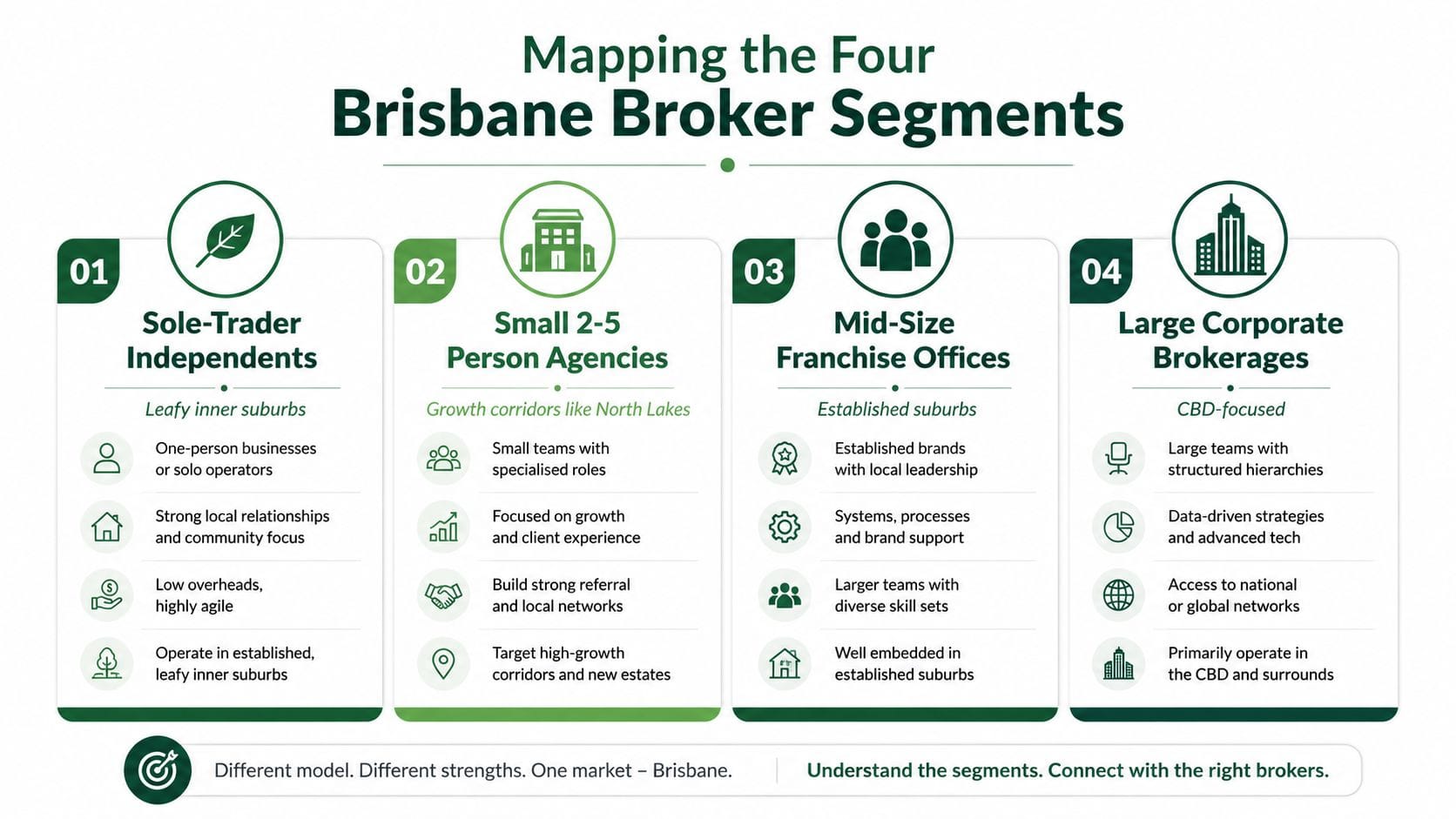
Four practical clusters
| Broker segment | Typical Brisbane focus | Main pressure | Offer angle |
|---|---|---|---|
| Sole-trader independent | Leafy inner suburbs | Consistent lead flow and limited time | A tightly managed local search and appraisal follow-up system |
| Small two-to-five-person agency | Growth corridors such as North Lakes and Springfield | Converting activity into vendor trust | Suburb campaigns, review proof and simple CRM routing |
| Mid-size boutique firm | Prestige postcodes and established premium areas | Differentiation against familiar competitors | High-quality market evidence, authority content and vendor presentation assets |
| Franchise office | Brand-led, multi-agent funnels | Consistent execution across people and locations | Campaign governance, reporting and process alignment |
The first cluster often responds to a practical audit. The marketer can show whether the Google Business Profile is complete, whether suburb pages answer seller questions and whether reviews support the claimed local expertise. The independent broker usually doesn't need a sprawling campaign. They need a system that keeps working while they're at appointments.
Small agencies in growth corridors need clearer segmentation. A campaign for Springfield sellers should not look like a general Brisbane property advertisement. The landing page, email language and proof should reflect the local questions vendors ask, such as competition, preparation and the reason a seller should choose this office rather than another nearby team.
Mid-size boutique firms may already have good visibility. Their problem is often shortlisting, not recognition. A marketer should package recent outcomes, suburb knowledge, testimonial evidence and vendor education into a presentation that helps the principal defend the fee.
Franchise offices need consistency. A single agent may post regularly while another has no discoverable social profile. Properti's Digital Visibility Index found only 20.8% of 38,240 active Australian agents visible on the main buyer and seller search platforms, while 38.6% had no discoverable social presence. The Properti Digital Visibility Index evaluates Instagram, Facebook, LinkedIn, Google and realestate.com.au using activity, engagement, reputation, video, creative and reach signals.
For campaign planning, a useful user persona framework can help, but the decision should remain commercial. Start with the segment where the marketer can produce relevant proof, reach the decision-maker and support delivery without creating a service burden.
Crafting Messages That Earn a Reply
Brokers don't reply because a marketer offers SEO, social media or paid advertising. They reply when the message identifies a local commercial problem and makes the next step feel easy.
A subject line such as “A quick idea for your Brisbane marketing” says nothing about the broker's business. A stronger version names the operating context: “A seller follow-up gap for Paddington appraisals” or “A suburb proof idea for Springfield vendors”. The message should then show one observation, one consequence and one low-friction action.
Replace services with outcomes
For a sole trader, the proof point might be an incomplete local profile, weak review visibility or a missed suburb-specific search opportunity. For a growth-corridor agency, it might be the absence of a vendor landing page that connects recent sales, testimonials and a clear appraisal action.
A reusable email structure looks like this:
Subject: A local appraisal idea for [suburb]
Hi [name],
Sellers searching in [suburb] are likely comparing local proof before they request an appraisal. [Specific observation about the agency's profile, suburb page or review presentation] appears to leave one part of that decision unanswered.
A practical fix would be a [suburb report, review-led landing page or follow-up workflow] connected to the appraisal form, with every enquiry assigned for same-day contact.
Would a short comparison of the current path and the proposed version be useful?
Regards,
[name]
The bracketed fields are not permission to send generic templates. They force the marketer to complete the research before contacting the broker.
Adjust the proof by segment
- Sole-trader independent: Lead with time saved and a single suburb opportunity. Subject line: “One simpler appraisal follow-up for [suburb]”. Proof should be a short audit, not a long proposal.
- Small agency: Lead with consistency between marketing and the team's response process. Subject line: “Turning [suburb] enquiries into booked conversations”. Proof should show the page, form and routing sequence.
- Boutique firm: Lead with vendor trust and differentiation. Subject line: “A stronger vendor proof pack for [postcode]”. Proof should include a structured comparison of reviews, outcomes and local expertise.
- Franchise office: Lead with repeatable implementation. Subject line: “A consistent local campaign across your offices”. Proof should show reporting, approvals and how each office preserves its local voice.
LinkedIn should be shorter: “Your team has a strong [suburb] presence. A quick review suggests the appraisal follow-up path could make that visibility work harder. A concise local comparison may be useful.” The goal is to earn permission for a relevant conversation, not reproduce the email.
A practical follow-up sequence can include the initial observation, a useful suburb proof point and a final permission-based close. Broker databases also need deliberate nurture, especially after a first conversation. A guide on how to nurture leads with ProHouseApp is useful context for separating immediate appraisal follow-up from longer-term relationship messages.
Choosing the Right Channel Mix
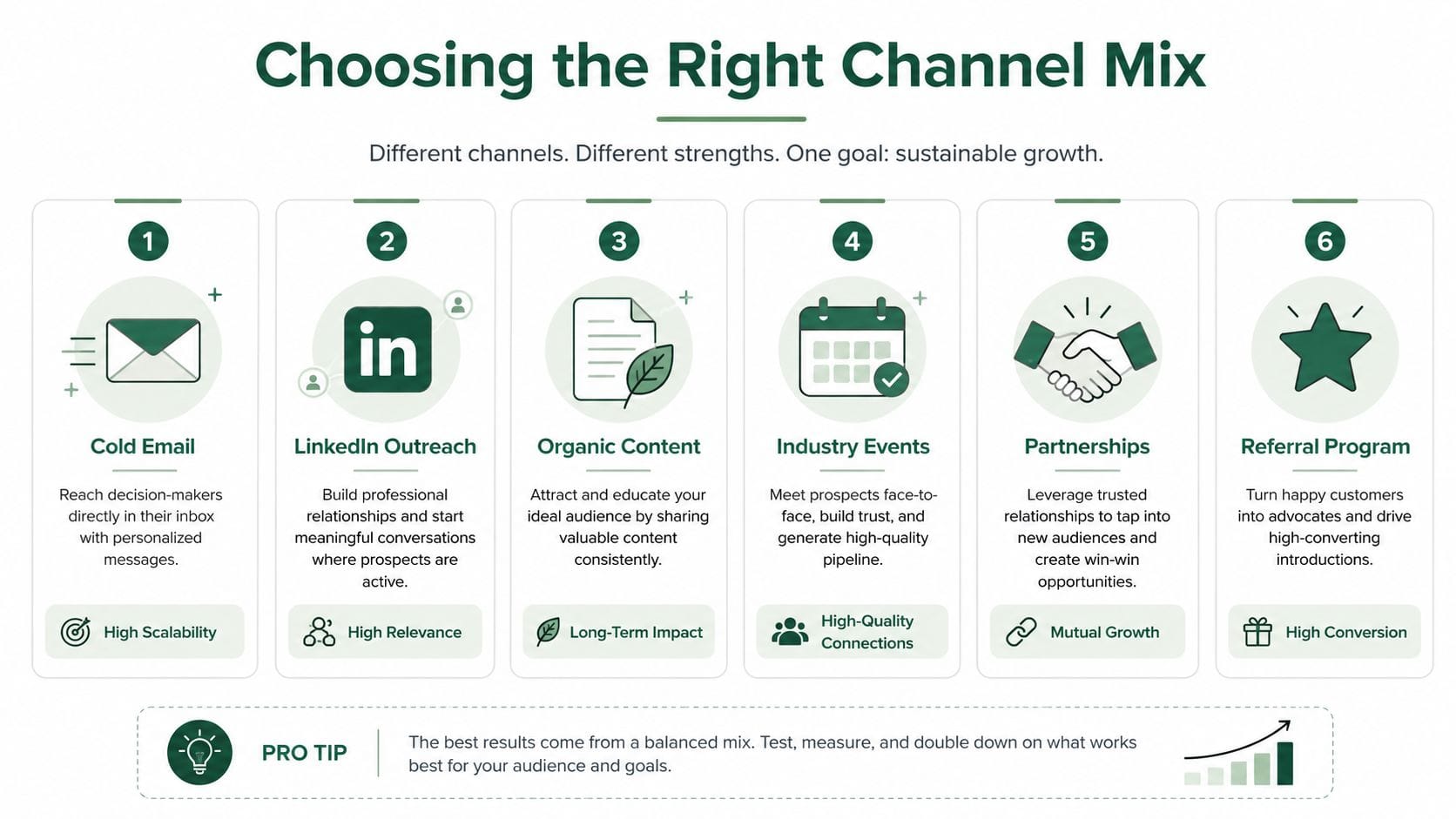
Channel selection should follow the cost and quality of qualified meetings, not the size of the audience. A large reach can still produce no principal conversations, while a small partnership with a conveyancer can create a warm introduction to exactly the right office.
Cold email is usually the most controllable starting point for a solo marketer. It requires careful list building, relevant observations and disciplined follow-up, but it can reach principals without buying broad awareness. The trade-off is deliverability risk and low response quality when the research is shallow.
LinkedIn works well for boutique principals, franchise leaders and marketing managers who already share professional updates. It supports context before the direct message, although it takes longer to build familiarity. A Brisbane marketer wanting to structure this channel can review guidance on a LinkedIn ad agency approach, then keep the campaign narrow enough to maintain personal relevance.
A realistic channel ranking
| Priority | Channel | Best use | Main drawback |
|---|---|---|---|
| 1 | Partnerships | Warm introductions through mortgage brokers, conveyancers and photographers | Requires relationship maintenance |
| 2 | Cold email | Direct access to a selected principal list | Weak targeting produces quick dismissal |
| 3 | LinkedIn outreach | Professional credibility and targeted conversations | Slower compounding effect |
| 4 | Industry events | Trust building and local relationship development | Time cost can exceed the meeting value |
| 5 | Organic content | Proof that supports outbound and referrals | Rarely creates immediate broker meetings alone |
| 6 | Meta and Google ads | Broker co-marketing or vendor instruction campaigns | Broad cold recruitment can waste budget |
Paid ads deserve careful handling. They can support a broker's vendor acquisition campaign by promoting a local appraisal asset, but they're usually a poor first choice for recruiting brokers cold. The audience is narrow, the message needs credibility and the marketer still needs a strong follow-up process.
For the first 90 days, a small Brisbane agency can concentrate on partnership introductions and researched email, use LinkedIn to support named-account outreach, publish only the suburb proof assets required by those conversations and reserve paid media for a broker-approved vendor campaign. Content scheduling can reduce upkeep, and resources such as a social media autopilot for brokerages can help agencies assess automation without confusing posting frequency with commercial performance.
Building a 30-Day Campaign That Actually Runs
A campaign becomes manageable when each week produces a usable asset or a measurable action. The build doesn't need a large team. It needs a short list, a single segment and a workflow that survives a busy Brisbane sales week.
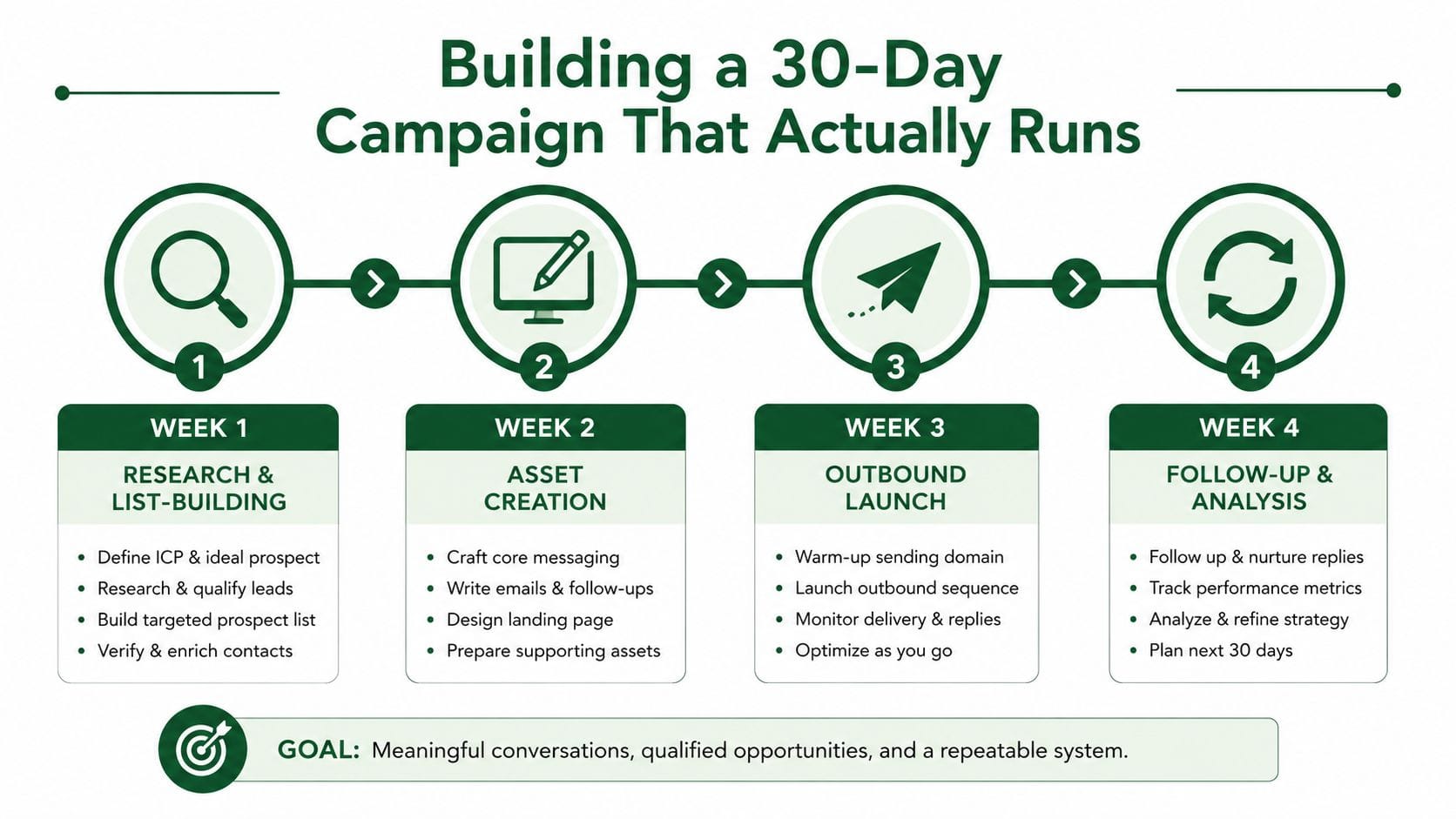
Week one builds the target
Select one broker segment and map the relevant suburbs. Record the principal's name, office location, service area, website, Google Business Profile, review presentation, social activity and the clearest visible gap. The list should be small enough for each account to receive a genuine observation.
Use a spreadsheet first if the process is simple. As conversations grow, a CRM system explained for small businesses can keep account status, next actions and replies in one place. The important field isn't “contacted”. It's “next useful action”.
Week two creates proof
Prepare a compact case study deck, one suburb report and two ad concepts. The case study should explain the starting problem, the change made and the evidence available. It shouldn't claim a result that cannot be documented.
A useful suburb-level creative brief includes:
- Audience: Vendors considering an appraisal in one Brisbane suburb.
- Problem: The seller can't tell which local agent offers relevant proof.
- Message: A clear explanation of the agency's local process and recent evidence.
- Asset: A mobile landing page connected to an appraisal request.
- Action: Request the local appraisal guide.
- Follow-up: Immediate assignment to a named broker, then a helpful second touch.
Weeks three and four create learning
Week three launches the outbound sequence and starts partnership outreach. Every reply should be tagged as interested, not now, referral, unsuitable or no response. Week four adds paid amplification only to the asset that already earns meaningful broker engagement, then reports on conversations rather than impressions.
A simple routing workflow looks like this:
- Broker replies.
- The marketer records the need and segment.
- A relevant proof asset is sent.
- A meeting is offered with a defined agenda.
- The outcome and next action are logged.
Keep weekly upkeep below the available capacity by batching list research, using approved templates and reviewing the pipeline at one fixed time. Automation should remove repetition, not replace judgement. A broker should still receive a message that reflects their suburb, audience and current business pressure.
Pricing, Packaging and Local Proof Points
Pricing conversations become easier when the service is attached to a defined operating problem. “Digital marketing support” sounds open-ended. “A suburb appraisal campaign with landing page, follow-up routing and monthly reporting” gives the broker something concrete to assess.
Three structures suit different Brisbane operators:
| Package | What it includes | Suitable buyer |
|---|---|---|
| Starter monthly retainer | Local SEO maintenance, profile improvements, content coordination and reporting | Sole traders needing steady support |
| Campaign-only project | Research, suburb asset, landing page, outbound sequence and launch review | Small agencies testing a defined opportunity |
| Performance-light hybrid | A modest base for delivery plus agreed review points tied to qualified conversations | Agencies with a working funnel and clear ownership |
The precise fee should reflect scope, production time, access to the broker's systems and the amount of follow-up required. Small agencies often convert better with a defined pilot than an open-ended retainer because the principal can judge the process before committing to ongoing work.
Make the price feel earned
A landing page for broker services should include a suburb audit sample, a clear delivery list, an example report and evidence of how enquiries move from form submission to broker contact. It should also explain what the marketer won't control, such as the broker's availability, appraisal quality or sales follow-through.
The appraisal-to-fee objection needs a calm answer. The marketer can ask what one additional qualified vendor conversation is worth to the agency, then show which parts of the campaign create that opportunity and which parts remain the broker's responsibility. The conversation should avoid promising instructions, listings or revenue that the campaign cannot guarantee.
For brand-led offices, the offer can include governance and consistency. For an independent, it may be better to remove unnecessary production and focus on one suburb, one proof asset and one follow-up workflow. A useful reference for connecting local identity with practical assets is Boocoo's real estate brand marketing guide.
Boocoo is one Brisbane-based option for small businesses seeking support across SEO, websites, social media and paid advertising. Other providers may suit a broker better if they offer stronger property-specific systems, creative capability or reporting. The buying decision should follow the workflow and evidence, not the size of the service menu.
Tracking KPIs and Iterating After Launch
Broker marketing needs a small dashboard that follows commercial progress. Raw list size, impressions and follower growth can indicate activity, but they don't prove that a principal sees enough value to continue.
Track the movement from contact to commitment:
- Qualified meetings booked: Did the contact involve a decision-maker and a relevant business need?
- Second meetings held: Did the first discussion create enough confidence for a deeper review?
- Pilot agreements signed: Did the broker accept a defined next step?
- Response rate by segment: Which cluster recognises the problem fastest?
- Cost per meeting: What did the campaign spend in time and media to create each qualified conversation?

Review on three clocks
A weekly review should identify replies requiring action, accounts without a next step and messages that attract the wrong type of interest. A monthly review should compare segments, offers, proof assets and meeting quality. At the 90-day checkpoint, the marketer can decide whether to deepen the strongest segment, change the offer or stop pursuing a weak cluster.
Reporting should show the broker what happened after an enquiry, not just what the platform recorded. For content measurement, the ClipCreator.ai content tracking guide provides useful context on connecting content activity with meaningful actions.
Paid campaigns need the same discipline. A marketer can explain cost per click in plain language, but the broker still needs to know whether those clicks produced an appraisal conversation and whether the team followed up quickly enough.
A campaign is working when the broker can identify the source, the response action and the commercial next step for each serious enquiry.
Brisbane broker acquisition rarely improves because a team publishes more generic content. It improves when a marketer chooses a segment, supplies suburb-level proof, makes response ownership visible and reviews the results often enough to change direction.