
The day often starts the same way for a Brisbane dental practice owner. The phone is ringing, a patient needs to reschedule, someone's asking about costs, and the chair schedule already looks tight. Then there's the website. It's live, technically. But it feels more like a placeholder than a staff member that helps.
That's the problem with a lot of websites for dentists. They sit there like a brochure pinned to a wall, when they should be doing front desk work around the clock. A good site answers common questions, reassures nervous patients, shows the practice is credible, and makes booking simple before anyone picks up the phone.
That matters because dental care is a routine spending category for households. Australians spend an average of $7.62 per week on dental services, and the average cost for a routine dental check-up and clean is approximately $125, according to Australian dental statistics compiled here. If a practice website doesn't help turn that demand into enquiries and bookings, it's leaking opportunities every week.
For small business owners thinking about Brisbane Digital Marketing, the website is usually the first place to fix. It's the home base for SEO, ads, Google Business Profile traffic, and referrals from local directories. If the site is confusing, slow, or thin on trust signals, the rest of the marketing works harder than it should.
Practices that need a practical starting point can get useful context from this guide on affordable web design for small business. The core idea is simple. The website shouldn't just exist. It should make busy practice owners feel like one part of the business is finally pulling its weight.
Your Hardest-Working Team Member a Digital Welcome Mat
A dental website earns its keep when it behaves like a capable receptionist. It welcomes people, gives clear answers, and points them to the next step without friction. That's a better way to think about websites for dentists than treating them as design projects.
A common scenario goes like this. A prospective patient searches late at night after putting off a check-up for months. They land on a clinic site, can't quickly find who the dentists are, what services are offered, whether the clinic is nearby, or how to book. They leave and try the next clinic. Nothing dramatic happened, but the first practice lost the enquiry.
Practical rule: If a new patient can't work out who the clinic helps, where it is, and how to book within a few seconds, the website isn't doing its job.
Often, many small businesses get stuck. They think the answer is “more marketing” when the first fix is often “a better website”. In Brisbane Digital Marketing, that distinction matters. A stronger site helps every other channel work better, from local SEO to Google Maps traffic to word-of-mouth referrals.
The most useful mindset shift is this. A dental website isn't there to impress other dentists. It's there to calm patients down and make action easy.
The Blueprint for a Patient-First Dental Website
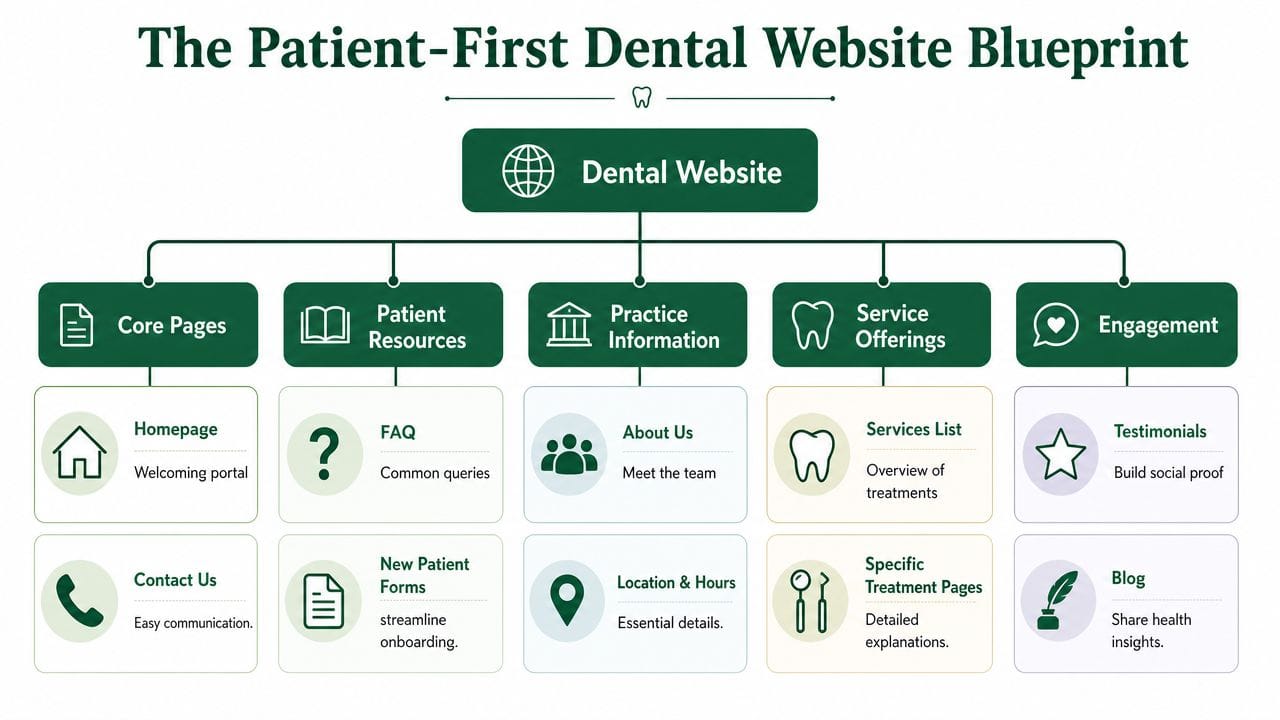
The easiest way to structure a dental website is to think about it like a well-organised clinic. The front desk gives direction. Treatment rooms handle specific needs. Signage removes confusion. The same logic works online.
Think about the site like a physical clinic
The homepage is the front entrance. It should quickly tell visitors what the clinic does, who it helps, where it's located, and what to do next. If the homepage tries to say everything at once, it often says nothing clearly.
Service pages are treatment rooms. Each one should focus on one treatment and one patient intent. A page for dental implants should not be buried inside a generic services paragraph. The same goes for Invisalign, emergency dental, children's dentistry, or cosmetic treatments.
The team page is the handshake. For healthcare, people don't just buy a service. They choose a person and a place. A clear team page with qualifications, experience, and professional memberships does more than fill space. It reduces hesitation.
Practices that want to sharpen the patient journey can also benefit from understanding what a user persona is, because a nervous first-time patient, a parent booking for a child, and someone seeking urgent treatment don't all need the same information first.
The pages that actually matter
A practical sitemap for websites for dentists usually includes these essentials:
Homepage
Keep the opening message plain. Say what the clinic offers, where it operates, and how to book. Include a strong call to action near the top.Individual service pages
Give each major treatment its own page. Explain what the treatment is, who it suits, what the process looks like, and how to take the next step.About and team page
Use real names, real roles, and factual credentials. Avoid vague claims that sound polished but say very little.New patient page
This page should answer practical questions. What to bring, how bookings work, whether forms can be completed online, and what happens at the first visit.Contact and location page
Include address, hours, phone number, map details, parking notes if relevant, and an obvious booking path.FAQ page
Good FAQs remove repetitive front desk questions and support search visibility for comparison-stage searches.
There's also a compliance angle here. According to this analysis of top-performing dental websites, the top 1% of dental practice websites generate 34x more patient enquiries by using specific structural elements, and one of the common failure points is relying on vague claims instead of factual credential sections that align with AHPRA advertising expectations.
A clean sitemap doesn't just help Google. It helps patients feel they're dealing with an organised practice.
A useful test is to open the site on a phone and ask three simple questions. Can a patient find the right treatment page fast? Can they verify the clinicians are qualified? Can they book without hunting around? If the answer to any of those is no, the structure needs work.
Building Digital Trust Before the First Appointment
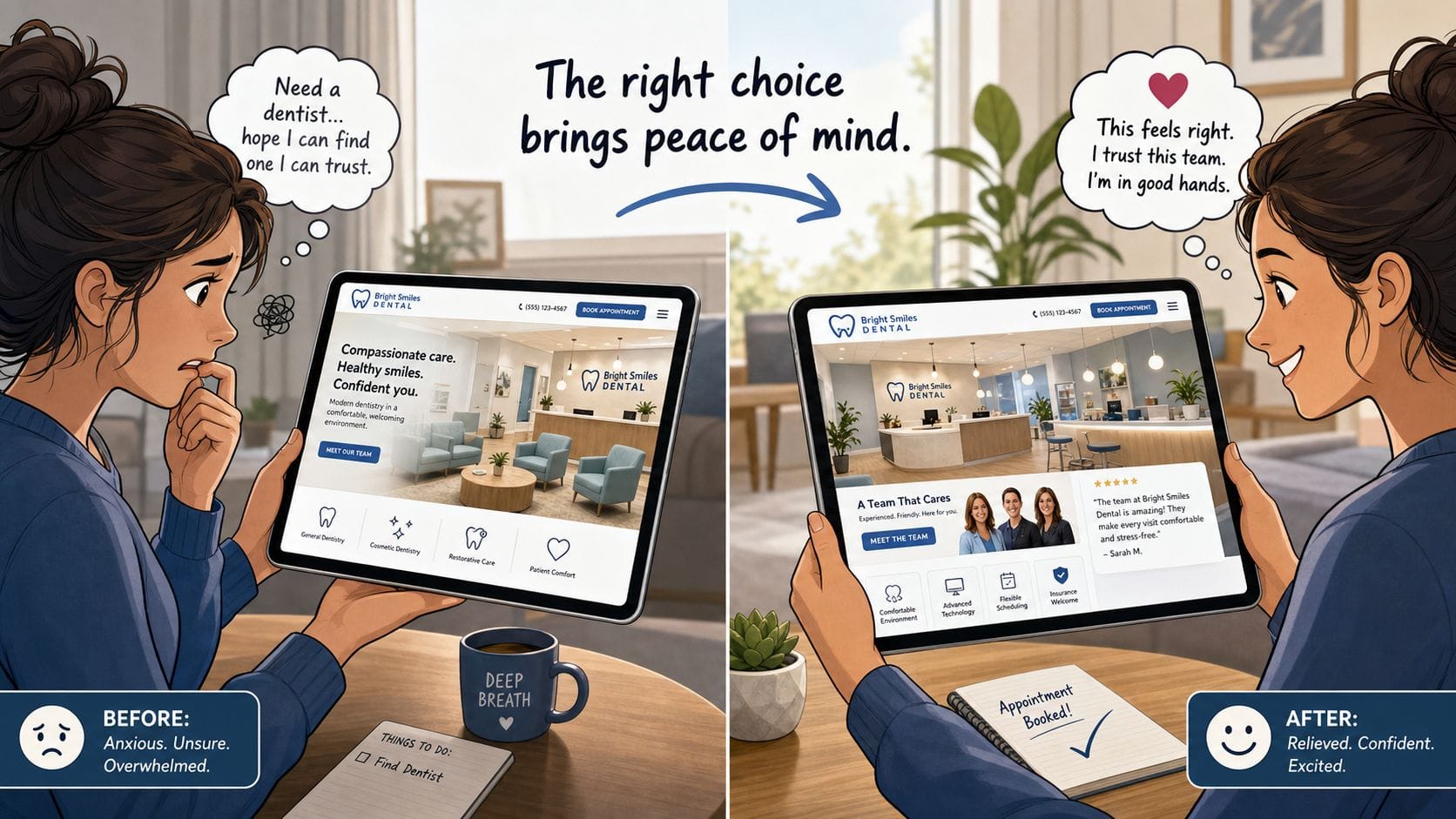
Trust is the conversion metric that matters most on a dental website. People don't arrive neutral. Many are cautious, embarrassed, cost-conscious, or anxious. The site either settles those concerns or adds to them.
Why trust beats clever design
A slick homepage won't rescue a clinic that feels vague online. Patients look for proof. They want to see who'll treat them, whether the practice looks professional, and whether booking feels straightforward.
That's why real visuals matter. According to this guide to high-converting dental layouts, real staff photos can increase trust by 124%, and clear calls to action such as “Book Your Check-Up Today” placed at the top and bottom of service pages help reduce anxiety and drive action. For a dental clinic, that's more useful than decorative graphics or generic stock photography.
A stock image of a model with perfect teeth often sends the wrong signal. It feels generic. Real photos of the reception area, treatment rooms, and practitioners tell a patient, “This is the place you'll visit in person.”
What lowers anxiety on a dental website
The strongest trust signals are usually simple:
Real practitioner bios
Include qualifications, areas of interest, memberships, and a warm but factual introduction.Photos of the actual clinic
Show the space clearly. Reception, treatment areas, and team images help first-time patients know what to expect.Visible contact details
Don't hide the phone number or booking button in a menu.Calm page flow
Short sections, readable headings, and clear next steps help visitors stay oriented.Consistent reviews and reputation signals
Reviews matter, but so does how the clinic manages its broader online presence. Practices that want a practical check on that can learn to audit your dental online presence.
For clinics investing in stronger trust-building content, short team and clinic videos can help too. A simple walkthrough or dentist introduction often does more for reassurance than another paragraph of website copy. This overview of business video production in Brisbane is useful for practices considering that option.
“Patients rarely say they want a trustworthy website. They show it by choosing the clinic that feels safest to contact.”
A quick trust audit works well here. Open the site as if seeing it for the first time on a mobile phone. If the clinic feels anonymous, hard to contact, or overly promotional, patients will hesitate. For healthcare, hesitation is expensive.
Attracting Local Patients with Brisbane Dental SEO
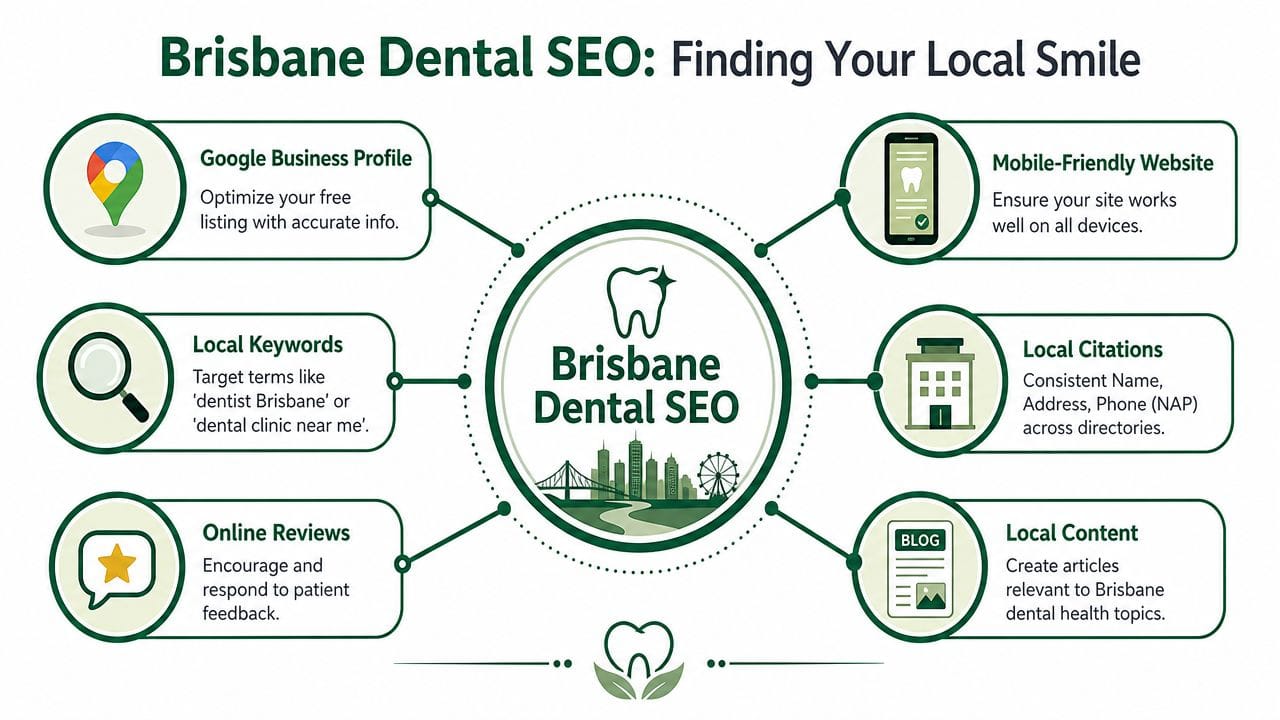
A strong website still needs directions. Local SEO is how a clinic gives Google the clearest route to the practice for searches with immediate intent, such as emergency care, family dentistry, or treatment-specific searches in a nearby suburb.
Give Google the clearest directions possible
The easiest analogy is Google Maps. If a clinic gives Google clear, matching, well-organised information, it's easier for the search engine to connect that clinic with nearby patients. If the information is patchy or inconsistent, visibility suffers.
For Brisbane businesses, this local search guide identifies three critical mechanics for dominating local search: a thorough Google Business Profile, systematic generation of positive reviews with professional responses, and hyperlocal content targeting specific suburbs.
That means a Brisbane dental clinic should care about more than just ranking for “dentist Brisbane”. It should also build pages and supporting content around the suburbs and services that match real patient searches.
Practices wanting a more niche reference point can also review AISEOGrow's local SEO for dentists, which gives extra context on how dental clinics approach local search visibility.
What a Brisbane clinic should prioritise first
A time-poor owner doesn't need a giant SEO checklist. Start with the moves that affect local discovery most:
Finish the Google Business Profile properly
Add the correct categories, services, hours, photos, and practice details. Keep them current.Build suburb relevance into the website
If the clinic serves areas like Chermside, New Farm, Indooroopilly, or Carindale, reflect that naturally in service content where it makes sense.Create one service page per major treatment
This helps patients and supports local intent. General pages rarely do enough heavy lifting.Make the site mobile-friendly and technically tidy
Fast-loading pages, HTTPS, compressed images, and clear navigation all support visibility and usability.Ask for reviews consistently and respond professionally
A strong review profile helps both trust and local search presence.
A clinic that wants support with the search side specifically can look at dentist SEO services to understand what specialist work usually involves.
Local SEO works best when the clinic's website, Google profile, and reviews all tell the same story.
For Brisbane Digital Marketing, this is often where dental practices get momentum. Not from chasing every keyword, but from tightening the local signals that help nearby patients find and trust the clinic quickly.
Streamlining Your Practice with Website Integrations
The best dental website doesn't stop at marketing. It should make the practice easier to run.
The website should reduce admin load
When a patient can book online, complete forms before arrival, and access payment information without calling the clinic, staff get time back. That matters on busy days when the front desk already has enough to manage.
Three integrations usually carry the most practical value:
Online booking tools
These help patients choose times without a call-and-wait process.Digital new patient forms
Patients can complete details at home, which reduces rushed paperwork in reception.Secure payment options
Useful for deposits, bill payments, or other transaction steps the clinic wants to handle online.
Websites for dentists become operational tools, not just lead generators. A site that reduces repetitive questions and admin handoffs often improves the patient experience at the same time.
Keep the patient journey connected
A disconnected setup creates friction. The website says “Book now”, but the booking system is clunky. Forms exist, but they're buried. Contact details are visible, but map listings use weak imagery. Patients notice those gaps.
One small but useful improvement is strengthening the clinic's visual presence on map platforms as part of the broader journey. This guide to a Google Maps photo strategy offers practical ideas for making location listings more helpful and more convincing.
A simple way to think about integrations is like the handoff between reception and the treatment room. If the transfer is smooth, everyone feels prepared. If it's messy, the whole appointment starts on the wrong foot.
Website Options and Your Brisbane Agency Checklist
Not every dental practice should build its site the same way. The right option depends on budget, available time, internal skills, and how much growth pressure sits on the website.
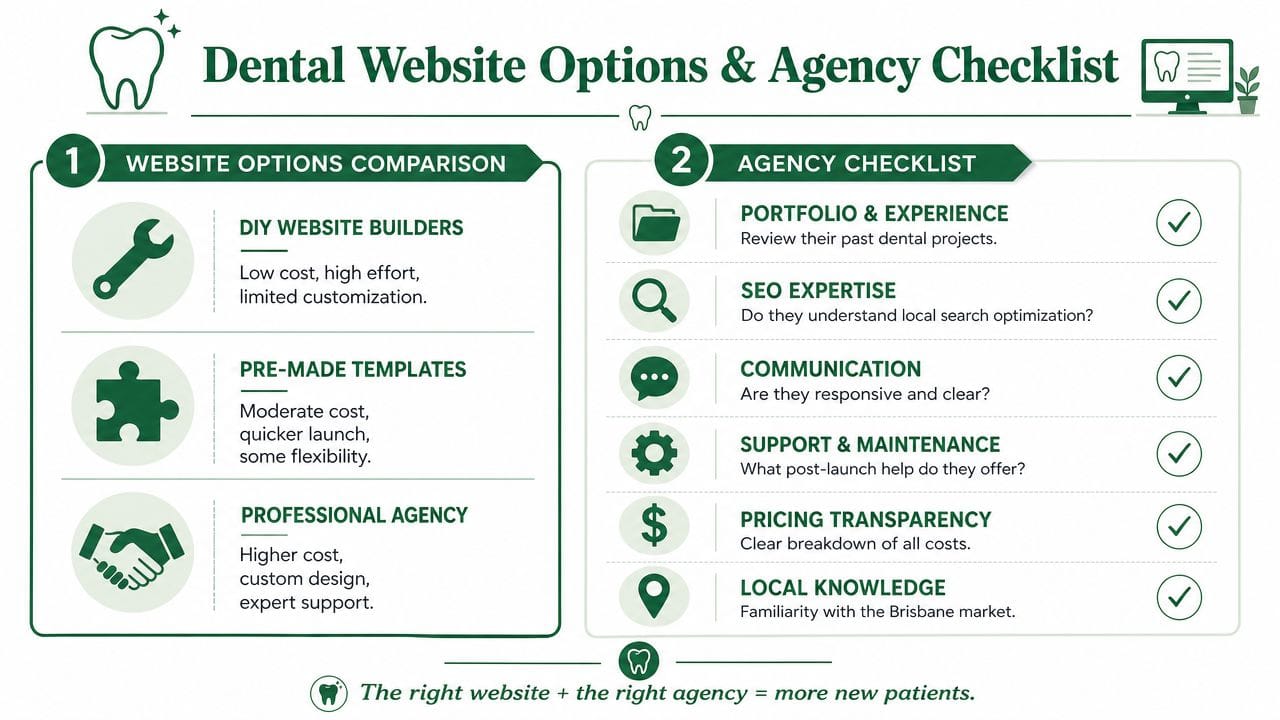
The real trade-offs between DIY templates and agencies
Here's the short version.
| Option | Best for | Upside | Trade-off |
|---|---|---|---|
| DIY website builder | Very small budgets and simple needs | Fast to start, lower upfront cost | High time demand, limited flexibility, easy to get structure wrong |
| Pre-made template | Practices that want a quicker launch | More polished than DIY, somewhat flexible | Often generic, can feel same-same, still needs content and SEO thought |
| Professional agency | Practices that want strategy, execution, and support | Custom build, stronger UX, clearer SEO planning | Higher investment, requires choosing the right partner |
DIY can work for a start-up clinic or a solo operator who needs a temporary web presence. But there's a hidden cost. The owner becomes the project manager, copywriter, reviewer, and quality controller on top of running the practice.
Templates sit in the middle. They can be useful if the chosen design is clean and the clinic has someone who can still customise the structure, service pages, imagery, and local content properly.
An agency usually makes more sense when the website needs to support lead generation, local SEO, and an organised patient journey without soaking up internal time.
A Brisbane agency checklist that saves wasted time
When comparing providers, ask questions that connect to outcomes, not fluff. For local small businesses, the most useful KPIs are direct action metrics such as phone calls, appointment form submissions, and direction requests from Google Maps rather than vanity metrics like page views. That should shape the conversation from the start.
Use this checklist when interviewing a Brisbane web or SEO partner:
Ask how they define success
If the answer leans heavily on impressions or traffic with no link to calls, bookings, or qualified enquiries, be careful.Check whether they understand local search
A dental clinic doesn't need generic national SEO talk. It needs someone who understands suburb-level visibility, Google Business Profile work, and service-page structure.Review their portfolio with a patient lens
Don't just ask if the sites look modern. Ask if they make booking easy, build trust fast, and explain services clearly.Ask who writes and structures the content
Strong dental websites need service pages, FAQs, team content, and location relevance. That doesn't happen by accident.Clarify post-launch support
Websites need updates, reviews, and occasional fixes. If support is vague before launch, it usually gets worse after launch.Look for pricing clarity
A good proposal should explain what's included, what sits outside scope, and what ongoing work is optional.Check communication style
Time-poor business owners need plain English, quick answers, and realistic timelines.
A good agency should feel like a practical operator, not a performer. That matters even more in Brisbane Digital Marketing, where local context shapes how clinics compete suburb by suburb.
For owners weighing up agency options more broadly, this guide to search engine marketing agencies can help frame the right questions.
The best agency choice usually isn't the one with the flashiest pitch. It's the one that understands how a dental practice actually wins trust and bookings.
A dental website should do three jobs well. It should reassure patients, help local people find the clinic, and save the team time. If it can't do those things, it isn't finished, no matter how polished it looks.
For Brisbane practice owners who want a local partner to take that work off their plate, Boocoo helps small businesses build practical websites and marketing systems that focus on real enquiries, not vanity metrics. The team can be reached on 1300 093 797 or by email at hello@boocoo.au.